Abstract
Objectives:
Soccer is one of the most popular youth sports in the United States and worldwide. Due to growing concerns regarding repeated head trauma, in 2015 the United States Soccer Federation (USSF) banned headers for athletes aged 10 and under and limited athletes aged 11 to 13 to practicing headers for 30 minutes per week. The purpose of this study was to assess whether the USSF header policy was associated with fewer soccer-related concussions that presented to emergency departments following the 2015 season.
Methods:
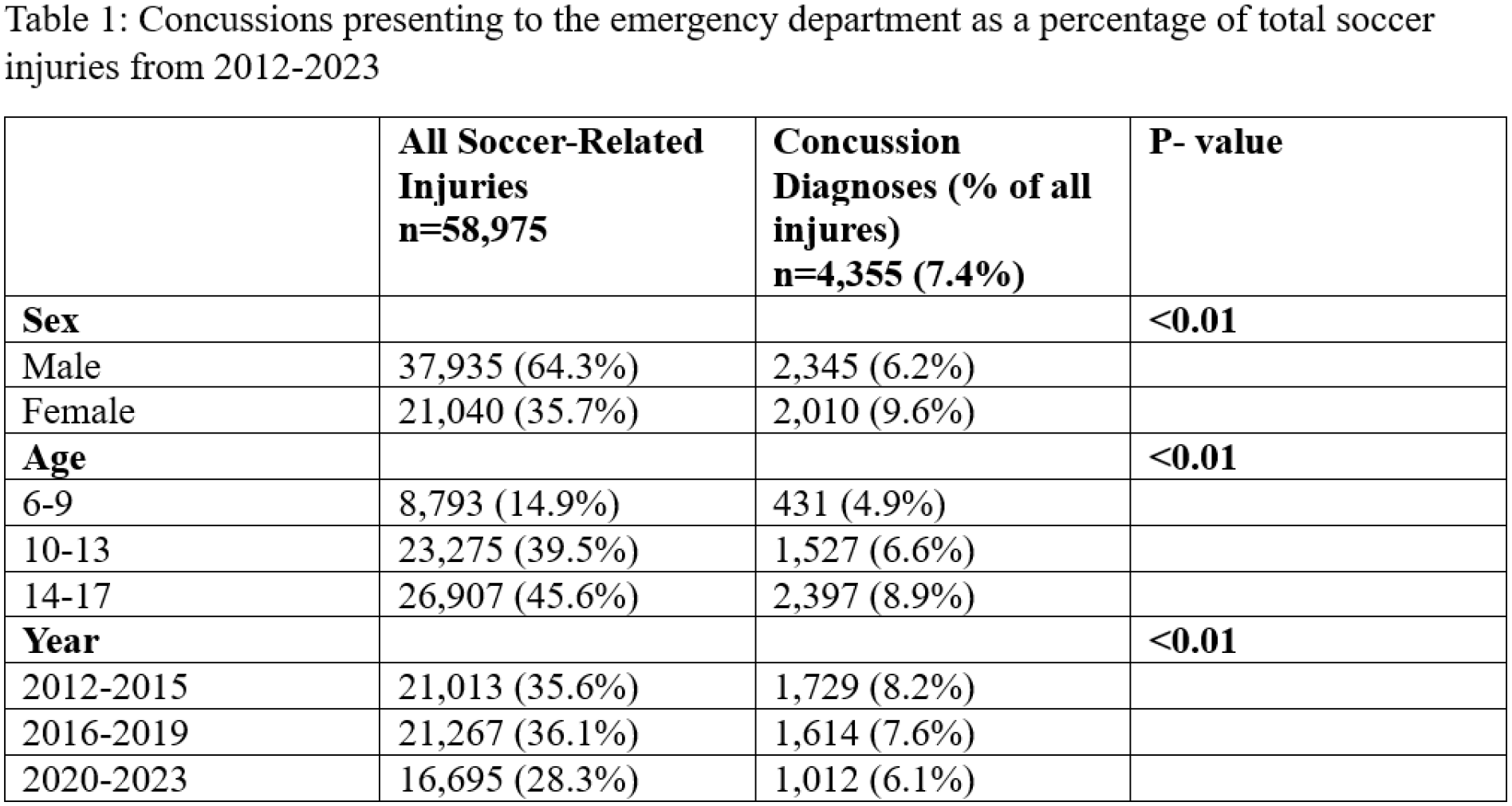
A retrospective cohort from the National Electronic Injury Surveillance System database was assessed. Age, sex, and injury type were extracted for all soccer-related emergency department visits between January 1st, 2012, and December 31st, 2023. Univariate and multivariable regression analyses were conducted to assess concussions as a percentage of all soccer-related injuries based on sex, age, and year.
Results:
The number of concussions as a percentage of all soccer-related injuries decreased from 8.2% in 2012-2015 to 6.1% in 2020-2023 (p<0.01). From 2012-2023, the concussion rate among 14-17-year-olds and 10-13-year-olds was higher than 6-9-year-olds (8.9% and 6.6% compared to 4.9%, p<0.01). Despite a lower soccer-related injury rate overall, females were diagnosed with a greater proportion of concussions than males (9.6% compared to 6.2%, p<0.01). In a multivariable regression analysis, injuries that occurred in the years 2020-2023 were associated with lower odds of concussion compared to 2012-2015 (OR: 0.75, 95% CI: 0.69- 0.81). The 10-13-year-old age group, 14-17-year-old age group, and female sex were associated with higher odds of concussion compared to the 6-9-year-old age group and male sex respectively (OR: 1.30, 95% CI: 1.16- 1.45; OR: 1.79, 95% CI: 1.61- 1.99; OR: 1.53, 95% CI: 1.43- 1.63).
Conclusions:
The USSF youth soccer header policy introduced in 2015 was associated with a 25.6% relative risk reduction to sustain a soccer-related concussion and present to the emergency department in 2020-2023 compared to 2012-2015. A header ban in players under 10 years old and limitation to 30 minutes of header practice a week in players under 13 years old may improve player safety by reducing head impacts in the youth population.