Abstract
Objectives:
During arthroscopy, irrigation solution is used to distend the joint and maintain visualization. The joint equilibrium is altered when hyperosmolar synovial fluid (404 mOsm/L; pH 7.7) is diluted by isotonic fluids like normal saline (308 mOsm/L; pH 5) or lactated Ringer’s (273 mOsm/L; pH 6.5). Chondrocytes are sensitive to fluctuations in osmolarity, pH, and temperature so this transition can result in cellular and extracellular matrix perturbations in articular tissues with detrimental effects. Further, periarticular extravasation of irrigation fluid can result in painful swelling and dysfunction. Previous work has elucidated the safety and efficacy of a hyperosmolar irrigation solution (400-600 mOsm/L) in vitro, using a preclinical animal model, and in two randomized clinical trials of patients undergoing arthroscopic surgeries in the shoulder or knee. To further enhance the benefits of a hyperosmolar solution, we sought to develop a novel hyperosmolar irrigation fluid supplemented with anti-inflammatory and anti-oxidant components (Hyperosmolar-plus). Therefore, the purpose of this study was to compare a novel Hyperosmolar-plus solution to standard Hyperosmolar and Isotonic saline solutions in knee and shoulder arthroscopic procedures based on clinical and whole-joint histologic outcome measures using a clinically relevant canine model.
Methods:
With IACUC approval (#42907), six adult female purpose-bred research hounds (23.75 ± 0.95 kg) underwent arthroscopy of the shoulders and knees. Arthroscopic irrigation solutions were formulated in standard 3L bags and delivered to each joint at a constant flow pressure of 40 mmHg. Each joint was irrigated for 2 hours with one of the following solutions:
In each shoulder, standardized humeral head and glenoid “arthroscrapes” were created using the arthroscopic trocar. In each knee, standardized 1-cm-diameter medial femoral condyle chondroplasty and white-white partial lateral meniscectomy were created using an arthroscopic curette and shaver and arthroscopic basket forceps and shaver, respectively. At the end of each 2-hour arthroscopic episode, subjective scores for intra-articular swelling/tissue edema were assigned by a board-certified veterinary surgeon. Calibrated ultrasonographic measurements of joint capsule thickness, fat pad thickness, and periarticular subcutaneous tissue distention (pre-op and immediately post-op) were determined for each joint. Shoulder and knee girth measurements (pre-op and immediately post-op) and total amount of irrigation fluids used for each joint were recorded. Dogs were recovered from surgery and provided analgesics, antibiotics, and soft padded bandages on both knees for 24 hours, restricted in activity for 1 month, and then provided leash walking, socialization, and enrichment activities for the remainder of the study. Comfortable joint range of motion [ROM] was measured using a goniometer at 1, 3 and 6-mo post-operatively, and OARSI semi-quantitative histologic analyses of shoulder and knee joints were performed following humane euthanasia at 6 months post-operatively. Intraoperative measurements were compared for statistically significant differences using either one-way ANOVA or Kruskal-Wallis Test. Histopathologic score and ROM data were compared for statistically significant differences using Friedman test.
Results:
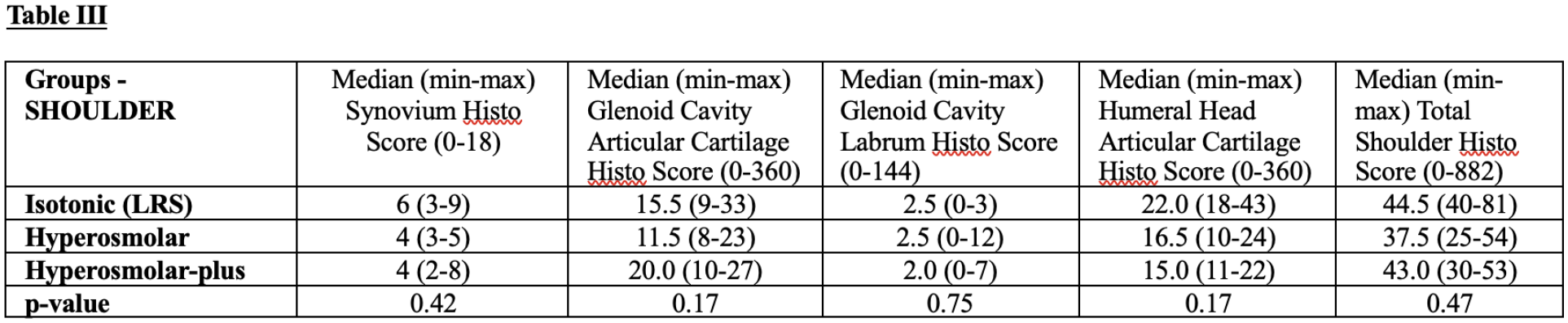
Both Hyperosmolar solutions were associated with better knee and shoulder ROM compared with the standard Isotonic arthroscopic irrigation solution at all time points with Hyperosmolar-plus associated with the highest ROMs at study endpoint (
Conclusions:
The enhanced hyperosmolar saline solution was formulated specifically for arthroscopic irrigation to address many of the concerns associated with isotonic fluids that are designed for intravenous delivery but used routinely for arthroscopic procedures. Based on the results from the present study, the Hyperosmolar-plus solution had clinically relevant benefits over the standard isotonic solution with respect to recovery of joint range of motion, mitigation of fluid extravasation, and preservation of joint health after knee and shoulder arthroscopy.