Abstract
Objectives:
The ulnar collateral ligament (UCL) is commonly injured in baseball pitchers due to the repetitive and high valgus torque imposed upon the UCL during pitching. Ultrasound has been used to evaluate chronic adaptations of the UCL via ulnohumeral joint gapping and UCL thickness, which has found the throwing elbow to demonstrate more joint gapping and a thicker UCL relative to the nonthrowing elbow. Collagen organization has also been used more recently to evaluate the rotator cuff, however organization of the UCL has yet to be evaluated. Therefore, the purpose of this study was to determine the chronic adaptations of UCL organization in professional baseball pitchers, with the secondary purpose of comparing UCL organization between pitchers with vs. without a history of UCL injury.
Methods:
Asymptomatic baseball pitchers within a single professional baseball organization were included during the 2024 preseason medical evaluation if they had not had elbow surgery within the past year and were currently cleared for full athletic participation. Included pitchers underwent bilateral elbow ultrasound evaluation by a fellowship-trained musculoskeletal radiologist. Both the throwing and nonthrowing elbows were evaluated in the resting and stressed positions, with 150 Newtons of valgus stress applied to the elbow using a Telos device. Images of the UCL were saved for later analysis of ligament organization using custom MATlab software. Mean collagen organization was compared between the dominant and non-dominant arms in the resting position, stressed position, and the change in collagen organization from stressed to resting (∆stress) using paired T tests. Comparisons were also made between the dominant elbows of pitchers with vs. without a history of UCL injury between the resting position, stressed position, and ∆stress. P values of <0.05 were considered statistically significant, and Cohen’s D effect size was calculated with effect sizes from 0.00-0.09 considered no effect, 0.10-0.29 a small effect, 0.30-0.49 a moderate effect, and effect sizes ≥0.50 considered a large effect.
Results:
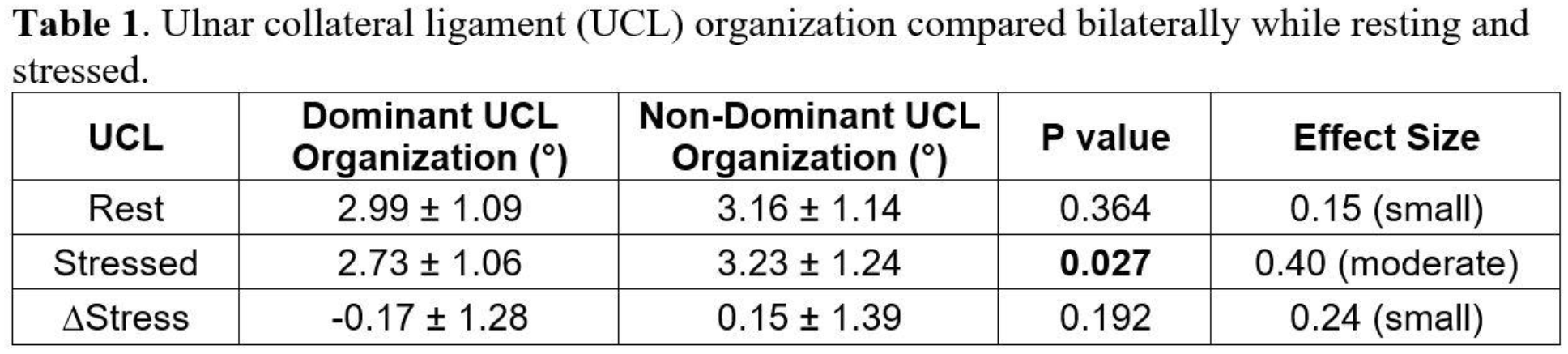
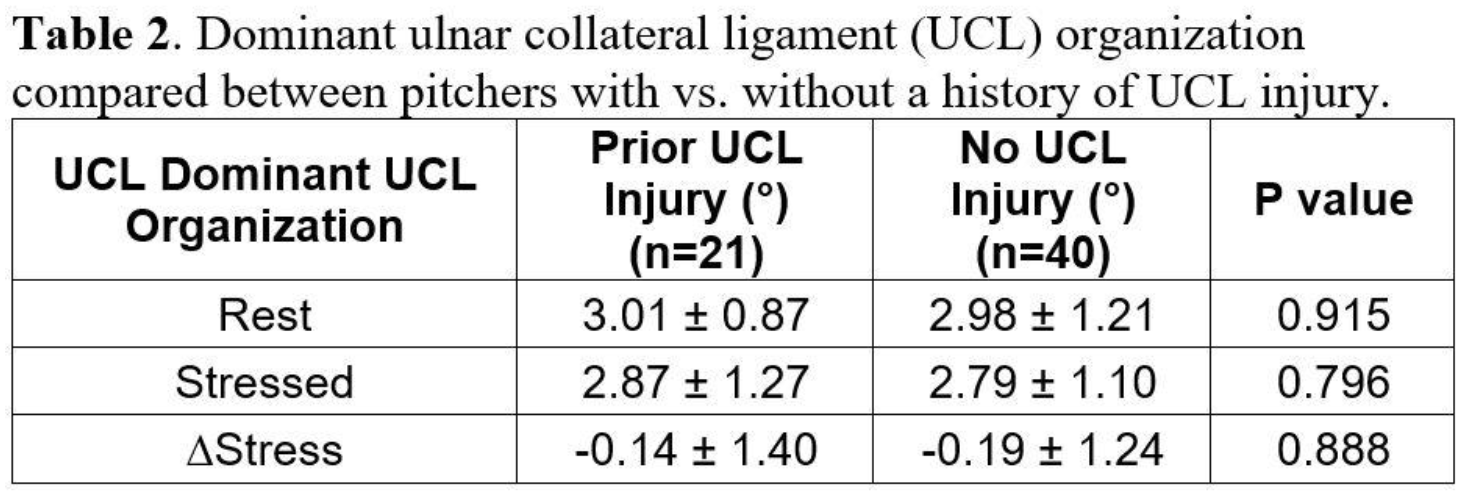
Overall, 61 professional baseball pitchers (age: 24±2, BMI: 27±3, years professional experience: 3±2 years, 80% right-hand dominant) were included. There were 21 (34%) pitchers with history of UCL injury and 18 (30%) had underwent a prior UCL reconstruction or UCL repair. Collagen organization in the resting position did not differ bilaterally (2.99° vs. 3.16°, p=0.364), however the dominant UCL was moderately more organized than the nondominant UCL in the stressed position (2.73° vs. 3.23°, p=0.027) (Table 1). The ∆stress also did not differ bilaterally (-0.17° vs. 0.15°, p=0.192). Pitchers with a history of UCL injury had similar dominant arm UCL organization at rest, stressed, and ∆stress compared to pitchers without a history of UCL injury (Table 2).
Conclusions:
The dominant arm in asymptomatic professional baseball pitchers experiences increased UCL organization with 150N of valgus stress compared to the nondominant arm. These findings suggest that the UCL undergoes collagen reorganization in response to the repetitive valgus stress imposed upon it from pitching. Future research comparing symptomatic vs. asymptomatic pitchers is needed to further understand the relationship with UCL pathology.