Abstract
Objectives:
While functional outcomes and failure rates have been extensively studied, there is a paucity of literature describing the clinically significant outcomes of patients who have successfully undergone arthroscopic stabilization and do not have a subsequent dislocation. The minimum clinically important difference (MCID) was developed to determine the smallest change in a patient’s condition that is clinically significant following an orthopedic surgery procedure. Similarly, the patient acceptable symptom state (PASS) denotes the postoperative level of symptoms and functional state that patients deems to be satisfacotry.The aim of this study is to establish the MCID and PASS thresholds for arthroscopic anterior shoulder stabilization at a minimum two-year follow-up. Factors that are predictive of MCID and PASS achievement, including preoperative, demographic, and intraoperative variables were evaluated in this study. The authors hypothesized that symptom duration and recurrent frank dislocations prior to stabilization would be predictive of MCID and PASS achievement.
Methods:
Patients who underwent primary arthroscopic stabilization for anterior-inferior labral tears from March 2018 to December 2021 with a minimum of 2 years follow-up were retrospectively identified through a prospectively-maintained institutional database. MCID thresholds were determined by a distribution-based method whereas PASS thresholds were established using an anchor-based method. The PROMs analyzed included Western Ontario Shoulder Instability Index (WOSI) score, Single Assessment Numeric Evaluation (SANE) score, Patient-Reported Outcomes Measurement Information System Upper Extremity (PROMIS UE) score and Veterans Rand (VR) 12 score. Multivariate logistic regressions were performed to determine factors associated with MCID and PASS achievement.
Results:
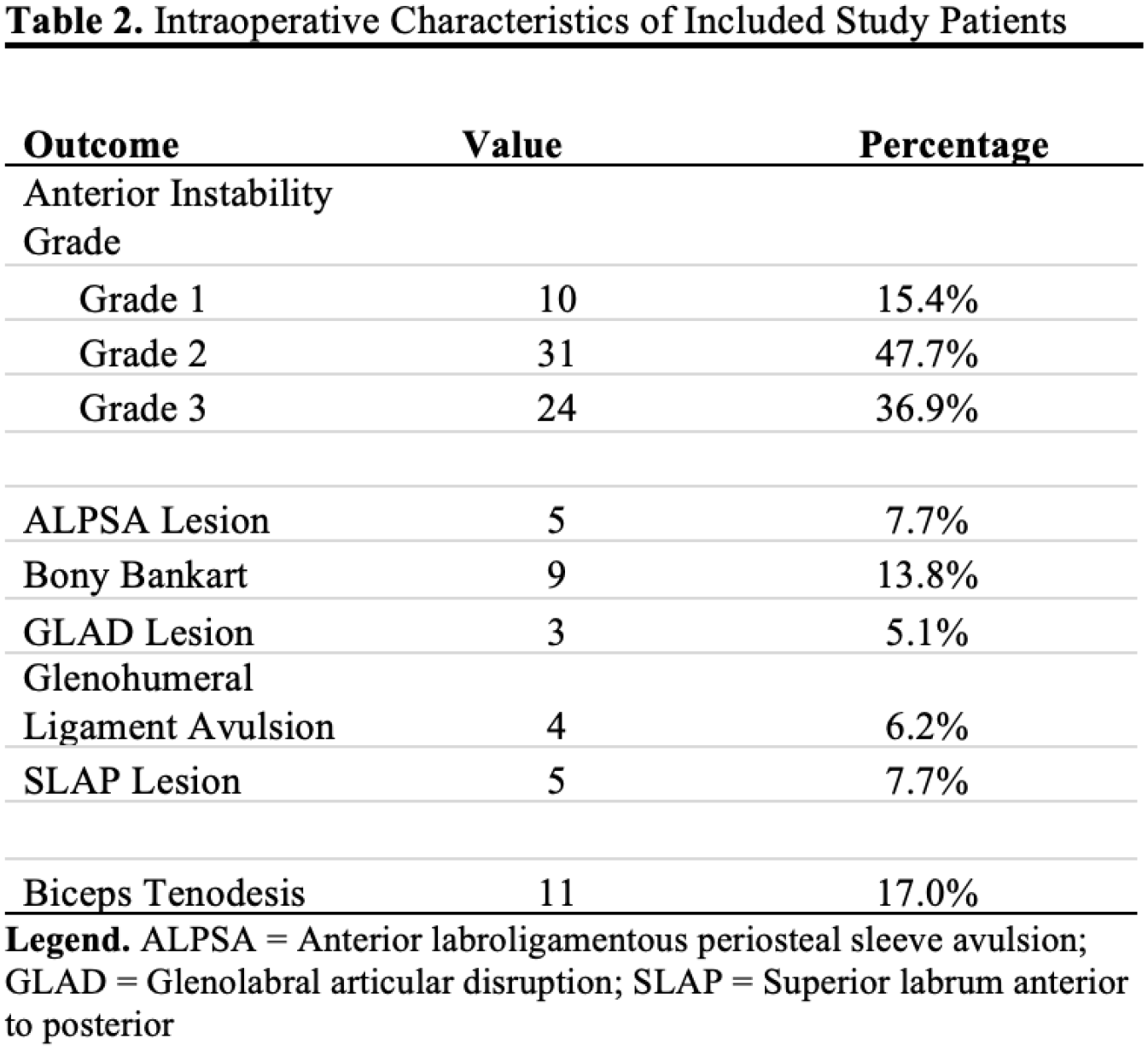
The demographic and intraoperative characteristics of the sixty-five included patients are described in
Conclusions:
This study defines the thresholds for MCID and PASS achievement at minimum 2 year follow-up in a cohort of patients undergoing arthroscopic anterior shoulder stabilization. Factors such as symptom duration, hyperlaxity, BMI and ALPSA lesions were found to be predictive of MCID and PASS achievement at short-term follow-up.