Abstract
Objectives:
To 1) characterize the morphology of rHSLs in the setting of recurrent posterior shoulder instability using advanced three-dimensional (3D) imaging analyses, and 2) compare these metrics to HSLs in patients with anterior instability.
Methods:
A retrospective review was performed of patients between 2004-2010 who presented with recurrent posterior shoulder instability. Patients with rHSLs were pair-matched in a 1:4 ratio for age, sex, and laterality to those with HSLs. 3D models of unilateral proximal humeri were reconstructed from two-dimensional (2D) CT scans, and width, depth, surface area (SA), and volume of identified rHSLs and HSLs were quantified, along with their location (medial, superior, and inferior extent) and orientation (rHSL/HSL rim (r) and center (c) angle). A Mann-Whitney U test was used to assess the relationship between measured group parameters.
Results:
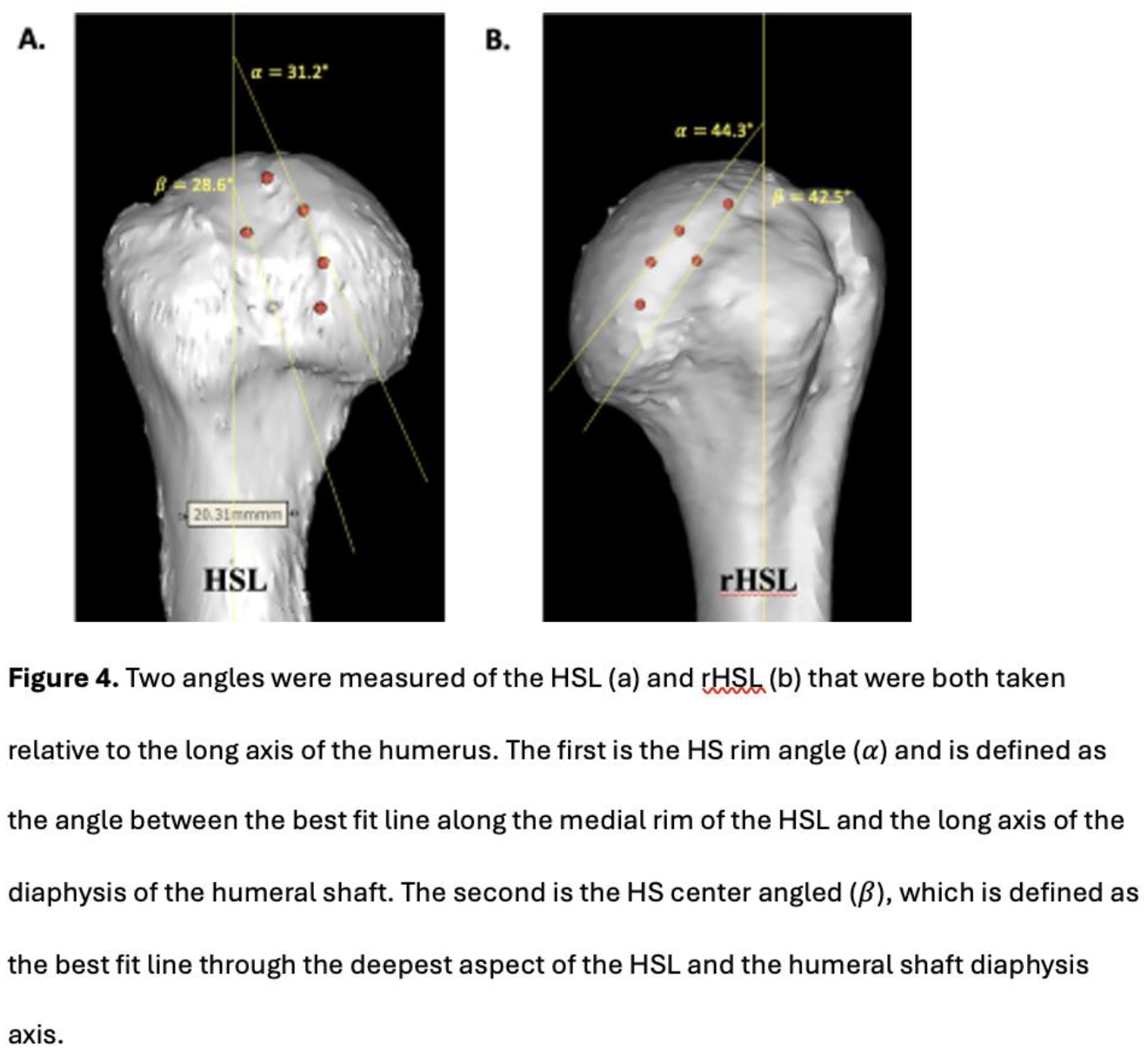
A total of 25 rHSLs, including 21 males and 4 females, met inclusion criteria (mean age: 27.9 years, range: 18 - 39 years), and were pair matched to 100 patients with HSLs. Mean rHSL depth, width, SA, and volume were 0.9 mm (range = 0.20-2.1 mm), 9.1 mm (range = 4.0-17.9 mm), 129.1 mm2 (range = 37.9-357.8 mm2), and 366.2 mm3 (range = 54.2-1488.7 mm3), respectively. On average, the medial border of rHSLs extended 18.1 mm (range = 11.5-28.6 mm) from the medial edge of the humeral head cartilage margin. When compared to HSLs, rHSLs were significantly narrower (p < 0.001), shallower (p < 0.001), had a smaller SA (p <0.01), and had a greater angulation relative to the humeral diaphysis (mean rHSL center (c) and rim (r) angle 16.0° and 13.7° greater than HSL, respectively) (p < 0.001) thus involving more of the humeral head cartilage.
Conclusions:
rHSLs are significantly narrower, shallower, and occupy less surface area than HSLs. Additionally, rHSLs had a greater angle of orientation relative to the humeral diaphysis involving more cartilage surface than HSLs. Appropriate morphological distinction between rHSLs and HSLs is imperative to correctly tailor treatment in the setting of posterior shoulder instability.