Abstract
Objectives:
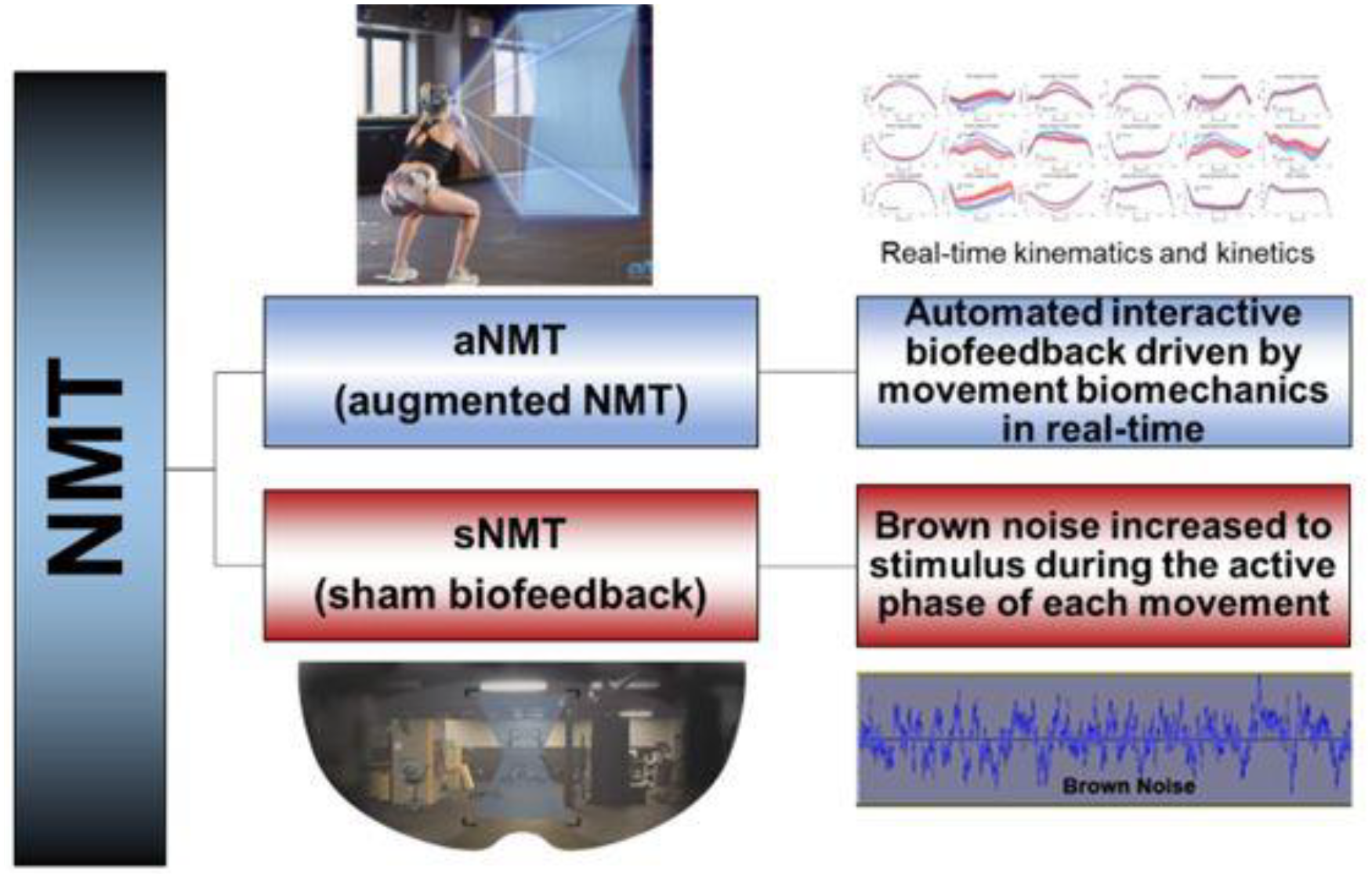
Neuromuscular training (NMT) can reduce preventable injuries, including anterior cruciate ligament (ACL) rupture, but is susceptible to non-compliance and has not effectively reduced worldwide injury rates. Perhaps the most critical barrier to successful NMT implementation is the challenge of delivering personalized, meaningful, and actionable feedback that helps athletes correct high-risk movement deficits as they perform training exercises. NMT could be improved by capitalizing on factors that enhance motor performance and learning, such as real-time visual biofeedback, that supports optimal attentional strategies when interacting with a stimulus. Accordingly, we aimed to evaluate the effectiveness of enhanced NMT with interactive, augmented-reality biofeedback (aNMT) to promote acquisition and transfer of injury-resistant biomechanics.
Methods:
This longitudinal, double-blind, placebo-controlled trial rigorously evaluated the potential of including small doses of aNMT biofeedback to enhance efficacy of NMT. We prospectively randomized 420 female high school soccer, basketball, and volleyball players (age: 15.47 ± 1.19 years; height: 165.71 ± 6.90 cm; weight: 62.47 ± 12.25 kg) to perform six weeks of preseason NMT including aNMT or sham biofeedback with NMT (sNMT) to a single exercise progression (
Results:
The final data analyses included 349 female athletes (soccer n = 137; volleyball n = 127; basketball n = 85). There was no significant difference in per-protocol compliance between aNMT and sNMT groups (p > .05). There were significant main effects for time, with NMT significantly improving local joint mechanics for all participants (all p < 0.05). Comparison of preventable injury between aNMT and sNMT groups resulted in a risk ratio of 0.68 (95% CI: 0.42, 1.10; p = 0.06) and incidence rate ratio of 0.72 (95% CI 0.42, 1.21; p = 0.11). ACL rupture showed a trend for reduced risk (0.7% vs 2.9%; risk ratio: 0.20; 95% CI: 0.024, 1.72; p = 0.06) and incidence (0.13 vs 0.57; risk ratio: 0.22; 95% CI: 0.01, 1.6; p = 0.08) for aNMT (n = 1) compared to sNMT (n = 5). The sNMT group accounted for 75% of participants who went on to experience preventable injuries (
Conclusions:
NMT was effective to improve isolated joint mechanics independent of additive biofeedback strategies in young female athletes. However, adding aNMT further reduced the incidence of preventable injuries over the course of the subsequent competitive sport season, indicating potential benefits of aNMT to support longer-term retention and transfer (to the field of play) of injury-resistant biomechanics from NMT. Our results indicate that even small doses visual biofeedback techniques may allow athletes to capitalize on motor learning principles, enabling aNMT to deliver personalized, intuitive, and accessible biofeedback to increase the efficiency and efficacy of NMT. aNMT biofeedback may have facilitated the adoption of mixed attentional focus strategies by directing attention to a more external focus on a visual pattern rather than internally on bodily movements. Through biofeedback strategies that allowed athletes to implicitly discover and acquire desirable movement strategies, enhanced motor learning was achieved. Athletes across all injury risk profiles can learn to enhance injury resilience by supplementing NMT with aNMT biofeedback. It is noteworthy that effects were detectable despite the low dosage of aNMT (≤12, 10-minute sessions), which may have helped address more subtle injury risk biomechanics that might not be perceived or cued by traditional instructors providing NMT. Future research should evaluate the potential for increased dosage of aNMT to further reduce injury risk. The current study results may help catalyze future strategies to optimize biofeedback technologies that can be scaled to reduce sports injury on a more widespread basis.