Abstract
Objectives:
There is disagreement regarding use of hip orthoses after arthroscopic surgery for femoroacetabular impingement syndrome (FAIS). We sought to test whether hip bracing affects patient outcomes. We hypothesized that at 3 and 6 weeks after arthroscopic surgery for FAIS, patients wearing a brace would have lower mean Numerical Pain Ranking Scales (NPRS) compared to patients who did not wear a brace. Secondary goals included comparison of additional patient reported outcome measures, physical exam findings, complications, use of narcotics, and outcome comparison 6 months postoperatively.
Methods:
An intent-to-treat randomized controlled trial for treatment superiority was performed. Inclusion criteria were patients aged 18-50 undergoing arthroscopic osteoplasty and labral repair for FAIS. We excluded patients who could not follow up in clinic, revision surgery, and diagnoses other than FAIS. Patients were randomized to Brace and No Brace groups at their preoperative appointment. Braces were worn full-time for 3 weeks postoperatively and then weaned. Surgeries were performed by a single, blinded surgeon. Patients completed NPRS and Hip disability Osteoarthritis Outcome Scores (HOOS) at regular intervals with a primary endpoint of 6 weeks after surgery. The study was designed to have 80% power to detect a clinically meaningful difference in NPRS of 1.2 points (32 patients per group).
Results:
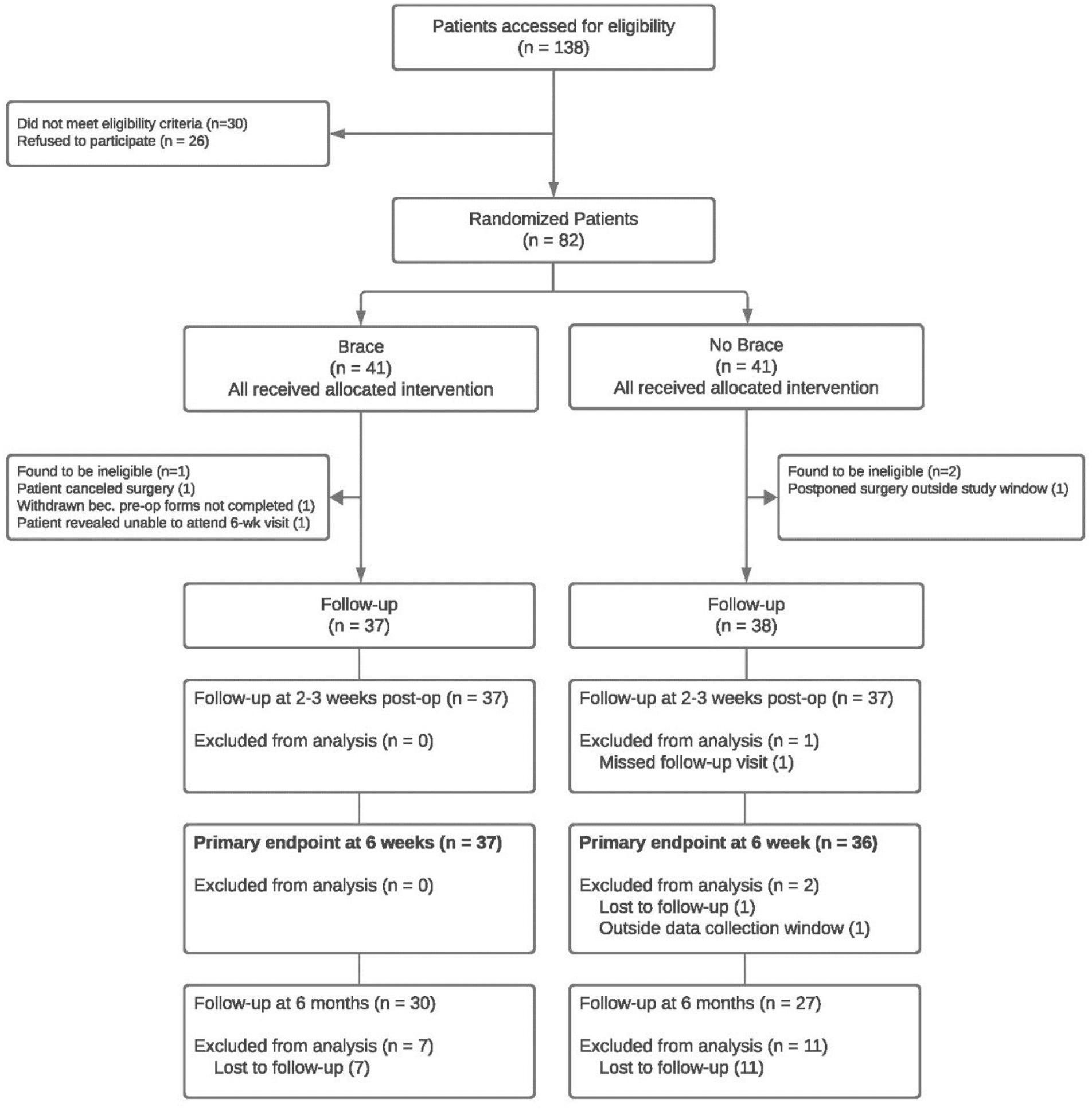
A total of 82 patients were enrolled in the study: 41 in each group. Seven patients were ineligible after randomization. Thirty-seven (90.2%) of Brace and 36 (87.8%) of No Brace patients reached the primary 6-week endpoint. Six-month follow up was over 70% in both groups. Baseline demographics, outcome scores, and radiographic and intraoperative findings were similar between groups. Analyses were adjusted for baseline outcome and cartilage. There were no significant differences in mean NPRS scores between the groups at 3 weeks, 6 weeks, or 6 months. [MH1] There were no significant differences in HOOS scores, physical exam or narcotic prescription at 6 weeks and 6 months. There were no differences in postoperative alpha angle, lateral center edge angle, cross-over sign, or rate of heterotopic ossification. No serious complications were recorded during the trial period. Self-reported brace compliance was excellent (mean 87%, median 95%).
Conclusions:
Use of postoperative bracing after hip arthroscopy for FAIS does not result in short-term added patient benefit. Given the cost of orthoses, we recommend against routine prescription of bracing after hip arthroscopy for FAIS.