Abstract
Objectives:
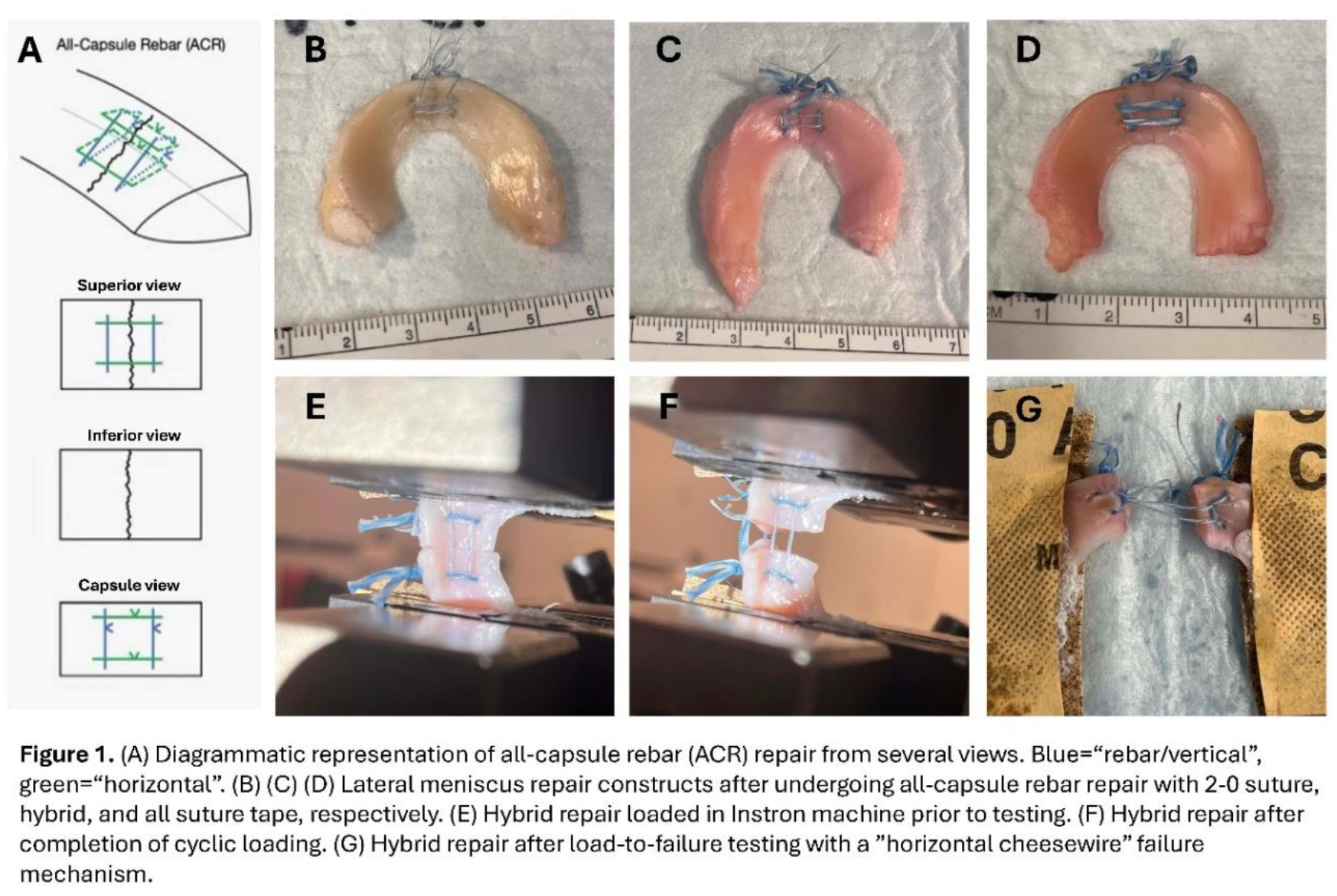
Tape-type sutures are increasingly being utilized in soft tissue repair, with reported increased strength compared to traditional suture. While recent studies have demonstrated that the “hashtag” suture pattern may result in improved biomechanical repair properties in radial meniscus tears, the effect of the type of suture within the “hashtag” is unknown. This study aims to evaluate the biomechanics of the “hashtag” radial meniscus tear repair using suture tape and a hybrid suture tape/non-tape construction compared to a traditional 2-0 suture “hashtag” construct. We hypothesize that suture tape, particularly in the “rebar/vertical” portion of the hashtag repair (Fig 1), would increase the strength of hashtag radial tear repair constructs compared to 2-0 suture with significantly higher load-to-failure values.
Methods:
21 fresh-frozen adult lateral meniscus specimens were utilized. Each specimen underwent hashtag all-capsule repair with either 2-0 suture, suture tape, or a hybrid repair of suture tape in the rebar/vertical and 2-0 suture for the rest of the repair. Specimens were loaded into an Instron 5944 and were subjected to cyclic loading followed by an ultimate load-to-failure test to evaluate construct strength. Load-to-failure (N) and mechanism of failure was recorded for each specimen. Data were analyzed using ANOVA with Tukey’s multiple comparisons test.
Results:
Suture tape (Mean=189.8N, SD=16.1) and hybrid (Mean=191.2N, SD=31.8) constructs demonstrated significantly higher load-to-failure (p=.038 and p=.032, respectively) compared to 2-0 suture constructs (Mean=145.6N, SD=39.6). There was no significant difference between the suture tape and hybrid constructs (p=.996). The primary mechanism of failure in both the 2-0 suture and hybrid constructs was horizontal suture cheese-wiring, while the primary mechanism in the suture tape group was rebar/vertical cheese-wiring. Suture tape constructs demonstrated the least variability in load-to-failure out of the three groups (SD=16.1 vs. 39.6 and 31.8 in hybrid and 2-0 groups, respectively).
Conclusions:
Tape-type sutures increase the repair strength in radial lateral meniscus tears, with the improved strength attributed primarily to suture tape used as the vertical limb or rebar. The type of suture used for the horizontal component of the repair did not significantly affect the strength of the construct. The load-to-failure values observed in constructs utilizing suture tape in the current study outperform historical hashtag repair data with higher failure loads and less variability. This data suggests that suture tape may significantly improve the biomechanical repair strength of radial meniscus repairs. Further studies are necessary to evaluate in vivo efficacy.