Abstract
Objectives:
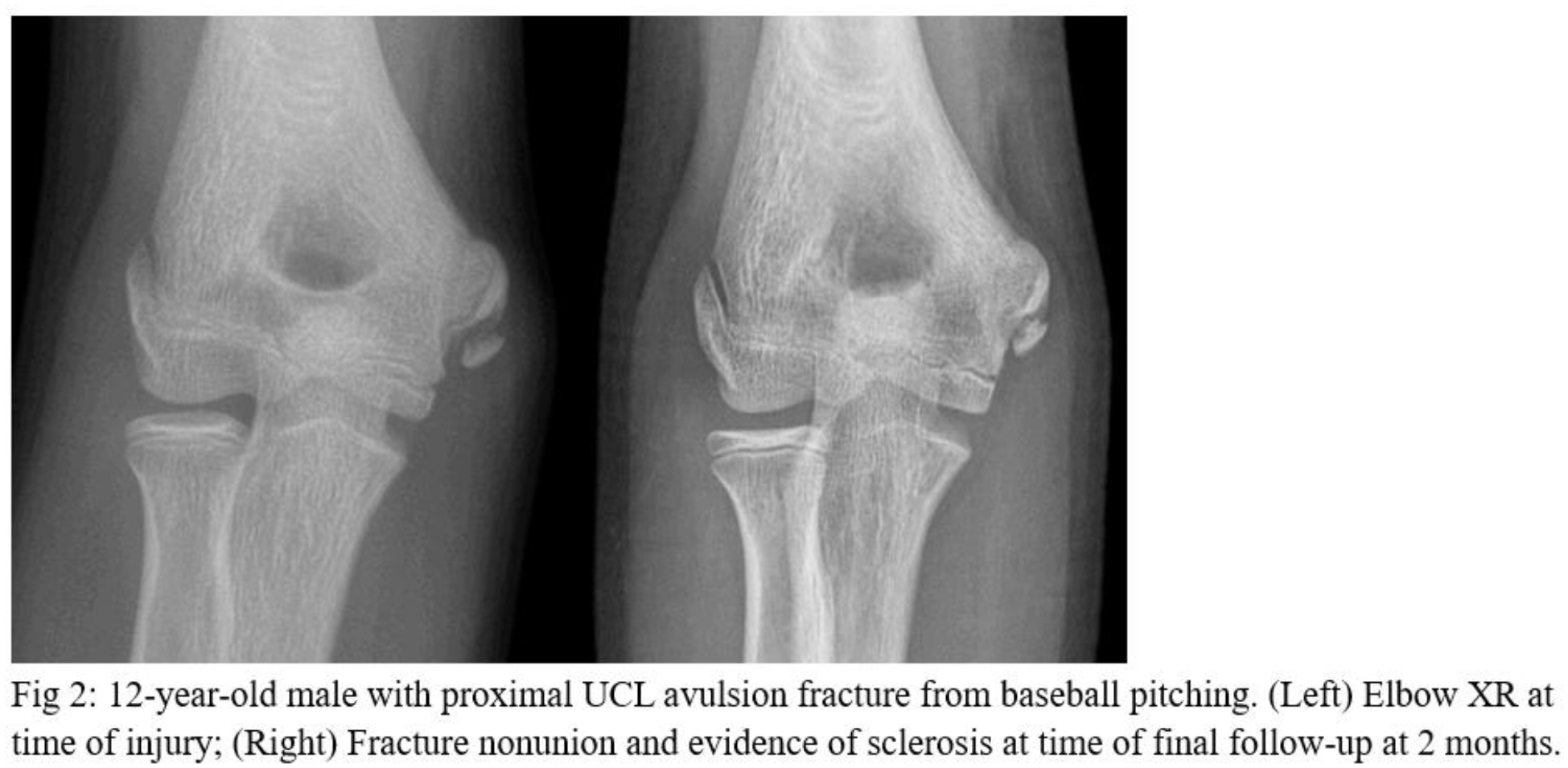
MRI-based correlation studies have recently confirmed that fragmentation of the anteroinferior aspect of the pediatric medial epicondyle represents a bony avulsion of the proximal medial ulnar collateral ligament (UCL). However, there are no studies that detail the outcomes of proximal UCL avulsion fractures. We present a case series detailing clinical and radiographic outcomes of these injuries in the pediatric and adolescent population.
Methods:
A retrospective review of patient records over a 10-year period (2012 to 2022) was performed at a single pediatric tertiary care institution following institutional review board approval. Electronic medical records were screened based on current procedural terminology (CPT), international classification of diseases (ICD) 10, and ICD 9 codes to identify patients < 18 years of age with radiographic evidence of a proximal bony UCL avulsion fracture. Patients were included if the following inclusion criteria were met: 1) Injury films present within 2 weeks of injury date and at time of final follow-up; 2) clinical documentation of final elbow range of motion, stability, and +/- pain; and 3) documentation noting final follow-up.
Results:
Twenty-four patients (83.3% male, 16.7% female) with a proximal bony UCL avulsion fracture of the medial epicondyle and a mean age of 11.6 years (SD 1.7) met the inclusion criteria. Mean follow-up time was 23.6 weeks (SD 42.9). Most injuries occurred during baseball pitching (62.5%), followed by mechanical fall (25%). One patient (4%) had an associated elbow dislocation. Twenty-three patients (96%) were treated non-operatively with a mean total elbow immobilization time of 23.5 days (SD 12.5). One patient underwent early operative UCL repair due to concern for developing instability. Eighteen patients (75%) had evidence of union or interval uniting at time of final radiographs. In the union/uniting group, the mean initial displacement was 1.5 mm (SD 0.8, range 0.5 - 3.2), while the nonunion group had mean initial displacement of 5.0 mm (SD 2.3, range 3 - 8.5) (p < 0.001). At final follow-up, total elbow arc of motion was 138º (SD 3.7º), with mean extension at 0.3º (SD 1.2º) and mean flexion of 138º (SD 3.5º). Mean time to release to sports was 94 days (SD 69) with stability noted in all cases. Mean Timmerman-Andrews score was 99 (SD 2.5), with no significant difference based on bony union (p = 0.8).
Conclusions:
Proximal bony UCL avulsion fractures occur most frequently in pediatric and adolescent throwers. Bony union rates are higher in patients with initial displacement less than ~3mm. Most patients return to activities at about 3 months without surgery with excellent elbow range of motion and Timmerman-Andrews’s score, regardless of union or nonunion.