Abstract
Objectives:
Biomechanically, load distribution on the medial compartment following a medial meniscus posterior root tear (MMPRT) is comparable to the forces observed after a total meniscectomy. MMPRTs are an increasingly recognized pathology that disrupts joint contact mechanics and results in accelerated cartilage degradation. Transtibial pull-out repair has been established as a cost effective procedure to address root tears that restores native joint biomechanics. However, the risk factors for poor outcomes following transtibial pull-out repair are still poorly understood. The onset of MMPRTs can be categorized into two distinct types: an inciting knee injury such as twisting the knee during activity, or an insidious presentation marked by gradual onset of knee pain without a precipitating event. The availability of literature describing the outcomes of transtibial pull-out repair in isolated MMPRT resulting from different injury mechanisms is minimal. The purpose of this study was to compare patient-reported outcome measures (PROMs) for patients undergoing transtibial pull-out repair for MMPRTs resulting from an inciting knee injury to those presenting with an insidious onset. The authors hypothesized that patients who reported an insidious onset of symptoms would have poorer outcomes at minimum 2-year follow up.
Methods:
A prospectively collected database at a single institution was retrospectively queried for patients with isolated medial meniscus posterior root tears who underwent transtibial root repair from March 2017 to November 2021. The cohorts were stratified according to whether the patient reported an instance of an inciting knee injury (traumatic) or if the patient presented with symptomatic knee pain over time with no precipitating event (insidious). The cohorts were matched according to age, gender, chronicity of injury, and body mass index. International knee documentation score (IKDC), Knee Injury and Osteoarthritis Outcome Score (KOOS) JR and Veterans Rand 12 Items Health Survey (VR 12) were compared at baseline and minimum 2-year follow-up.
Results:
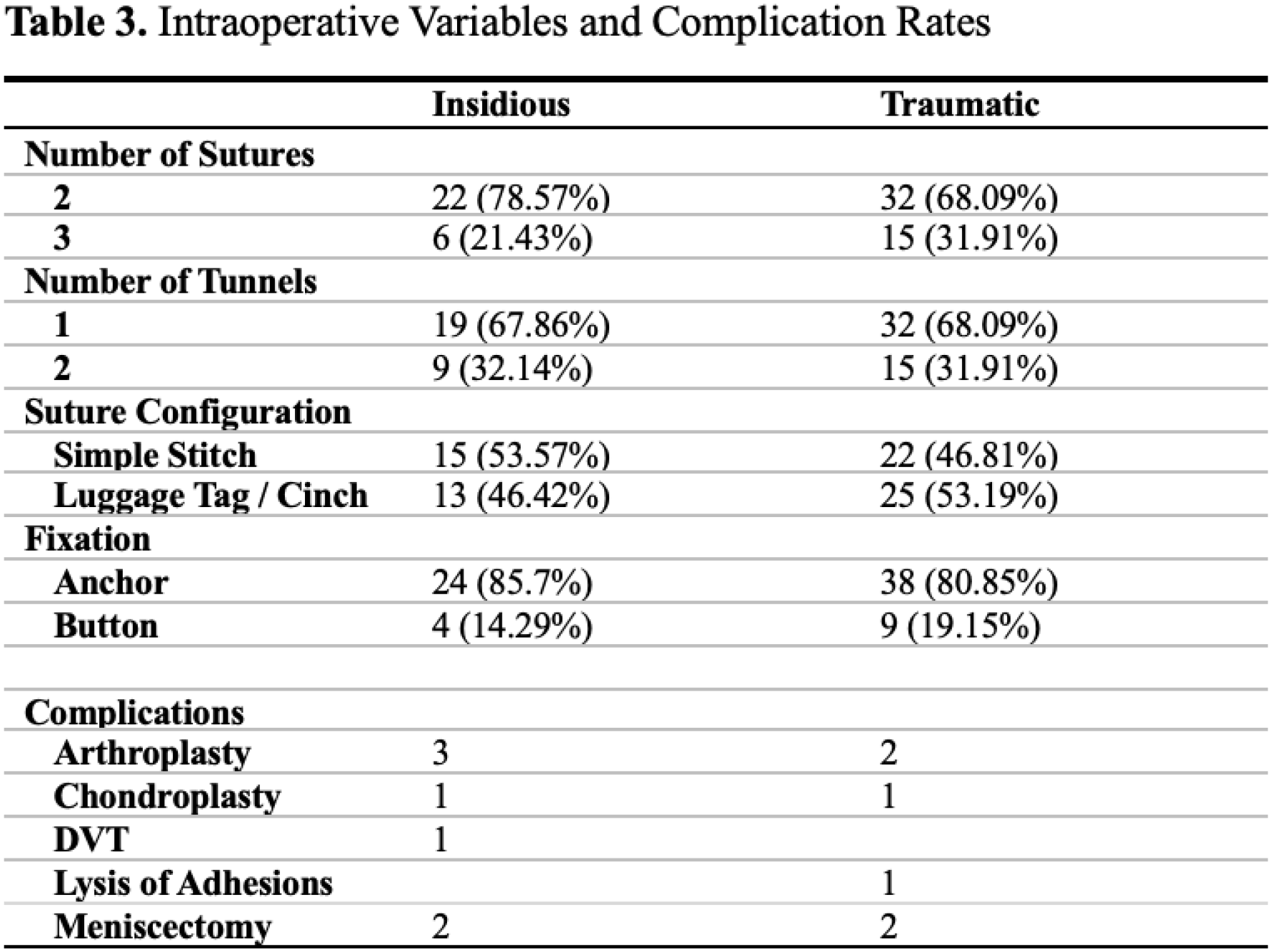
Seventy-five patients who underwent transtibial root repair and completed 2-year follow-up were retained for analysis. The traumatic onset cohort consisted of 47 patients while the insidious onset cohort comprised 28 patients. No significant differences in demographics, comorbidities, surgical technique or patient reported outcome measures were found at baseline (Table 1, Table 2, and Table 3). Mean age was 56.22±7.05 and 54.79±12.31 years for the insidious and traumatic onset cohorts, respectively (p=0.576). The traumatic cohort reported significantly higher IKDC (p=0.001) and KOOS Jr. (p=0.003) scores at minimum 2-year follow-up. Improvement from baseline was also significantly higher for the traumatic onset arm regarding IKDC (p=0.008) and VR12 Mental (p=0.003). The traumatic cohort had higher rates of PASS achievement (p=0.015) for IKDC and both MCID (p=0.048) and PASS achievement (p=0.007) for KOOS Jr (Table 4).
Conclusions:
The main finding of this study was that patients who described a traumatic event inciting their medial based knee pain with an ultimate diagnosis of a posterior medial root tear had statistically significant improvements in PROMs at minimum 2-year follow up compared to patients who did not recall a traumatic event after adjusting for differences in age, gender, BMI and chronicity of injury. Additionally, patients describing an inciting event precipitating their pain were more likely to achieve PASS for IKDC (71.43% vs 35.71% for traumatic and insidious onset groups, respectively) and KOOS Jr. scores (67.86% vs 53.57% for traumatic and insidious onset groups, respectively) as well as MCID for KOOS Jr. scores at final follow-up (78.57% vs 53.57% for traumatic and insidious onset groups, respectively). Patients who reported a precipitating knee injury tended to be younger and to present within 3 months of follow-up in comparison to those with an insidious onset but both measures failed to meet statistical significance. At short-term follow-up, complications and subsequent surgery were not different between groups. In conclusion, patients presenting with an insidious onset of medial meniscus posterior root tears have poorer outcomes which are related to the tear occurring from a different disease process such as osteoarthritis rather than an acute injury. These data may help counseling patients on expectations following for posterior medial meniscus root repairs.