



Abstract
Background:
Ulnar collateral ligament (UCL) reconstruction (UCLR) is commonly performed in Major League Baseball (MLB) pitchers, and there remain limited data on off-speed pitch performance in those that return to play after reconstruction.
Purpose/Hypothesis:
The purpose of this study was to evaluate the effect of primary UCLR on curveball (CB) and change-up (CU) pitch performance in terms of velocity along with novel pitching metrics including spin rate, hard-hit rate, and whiff rate. It was hypothesized that post-UCLR off-speed pitch spin rates, velocity, and whiff rate would decrease significantly compared with pre-UCLR levels, while hard-hit rates would increase.
Study Design:
Cohort study; Level of evidence, 3.
Methods:
Pitchers who underwent UCLR and returned to MLB level of play were identified from public records from 2016 to 2019. The Statcast system was used to collect spin rate, velocity, hard-hit, and whiff rate data for CB and CU pitches for preinjury seasons, as well as the first 2 seasons after return from UCLR. A matched-pair analysis was performed by matching each pitcher to an uninjured healthy pitcher from the same draft class and round.
Results:
A total of 29 pitchers met inclusion criteria and threw the pitches of interest. There were no statistically significant changes in CB or CU mean spin rate, pitch velocity, hard-hit rate, or whiff rate when comparing preinjury levels with the first and second seasons played after reconstruction. There were no significant differences in any pitching metrics when comparing the UCLR cohort with the healthy matched-pair cohort. The mean total number of CU pitches significantly decreased in the first season after UCLR (154.0 vs 67.9; P = .04) and compared with the matched-pair cohort at 1 year (67.9 vs 233.2; P = .001). Pitchers also threw fewer total pitches in the first season after returning from UCLR compared with preinjury baselines and healthy matched pairs.
Conclusion:
The results of this study demonstrate that pitchers who undergo UCLR and return to the MLB level can expect similar off-speed pitch performance in comparison with their preinjury levels and with pitchers without UCL injury.
Ulnar collateral ligament (UCL) injuries remain one of the most common injuries in baseball. These injuries are particularly prevalent among Major League Baseball (MLB) pitchers, with studies reporting that 26% of MLB pitchers have undergone UCL reconstruction (UCLR).1,8 Additionally, UCL injuries typically occur early in a professional pitcher's career at a mean age of 24.4 years, and the total cost of the surgery, rehabilitation, and missed playing time has been estimated to reach upward of $1.9 million per player.14,18,19
Given its high prevalence, financial costs, and potential implications for athletes’ careers, the effect of UCLR on pitcher performance has garnered significant attention in the research community in recent years. Previous studies have primarily focused on postoperative fastball (FB) velocity after UCLR, with some studies reporting significant decreases in postoperative FB velocity,4,6 while other studies have demonstrated no change in pitch velocity 2 years after surgery.9,10,13,17,18 Other factors such as pitch accuracy, pitch movement, pitch selection, and pitch spin rate have more recently gained the attention of the baseball and sports medicine communities and have been used to investigate UCLR outcomes.2,6,7,10-12,16-18
There has been a recent surge of interest in the concept of pitch spin rate, which refers to the revolutions per minute (rpm) that a pitched ball rotates on its axis. Higuchi et al 3 demonstrated that increased spin rate on an FB at the same velocity has been shown to change the expected trajectory of the ball and lead to decreased performance in a group of skilled batters. Similarly, it is believed differences in spin rates of an off-speed pitch such as a curveball (CB) or change-up (CU) can lead to more movement of the pitch, making it more difficult to hit. The installation of Statcast technology in all MLB stadiums in 2015 has allowed for the in-game measurement of spin rate, velocity, and other advanced metrics, and presents a novel approach to analyzing pitching performance and outcome measures after returning from injury beyond traditional statistics such as earned run average and walks and hits per inning.
This study aimed to evaluate the effect of primary UCLR on the off-speed pitches (CB and CU) of MLB pitchers, specifically focusing on advanced pitching metrics including spin rate, velocity, whiff rate, and hard-hit rate. To our knowledge, no study to date has used these pitching metrics to investigate outcomes of UCLR on off-speed pitching performance. We hypothesized that post-UCLR off-speed pitch spin rates, velocity, and whiff rate would decrease significantly compared with pre-UCLR levels, while hard-hit rates would increase. This study sought to build upon previous research that analyzed the effect of UCLR on FB pitches and utilized advanced metrics to provide a more comprehensive understanding of the impact of UCLR on MLB pitcher performance.
Methods
Study Cohort
A retrospective case series was performed to evaluate the effect of primary UCLR on off-speed pitch performance using publicly available data collected by the Statcast system. MLB pitchers who underwent UCLR from 2016 through 2019 were identified from a public database of professional and collegiate pitchers undergoing UCLR managed by baseball researcher Jon Roegele (https://docs.google.com/spreadsheets/d/1gQujXQQGOVNaiuwSN680Hq-FDVsCwvN-3AazykOBON0/edit#gid=755598801). This time period was chosen to ensure pitchers had ≥1 season of pre-UCLR data to determine pitching performance baselines, as well as ≥2 seasons of pitching data after return from UCLR. This database was then cross-referenced against another publicly available database (https://mlbreports.com/tj-surgery/) in a similar manner to previous studies.2,17 Pitchers were included in the case series if they had ≥1 MLB season of pitching before UCLR, returned to MLB level of pitching and pitched in ≥2 seasons after UCLR, and included CB or CU pitches in their pre- and postsurgical pitching repertoires. A CB pitch is breaking pitch that is thrown with topspin, causing it to break downward and sideways as it approaches the plate. A CU pitch is an off-speed pitch designed to look like an FB but travel significantly slower to disrupt a hitter's timing.
A total of 42 MLB pitchers who underwent primary UCLR between 2016 and 2019 were identified. Five pitchers underwent UCLR in 2019 and had not yet returned by play with 2 full seasons of pitching data. Five pitchers underwent UCLR between 2016 and 2018 and did not return to play (RTP) at the MLB level and were excluded from the study. Three pitchers were excluded for not throwing the pitch types of interest (CB or CU). Thus, 29 pitchers met inclusion criteria and were included in the final cohorts: 21 pitchers who threw CBs and 23 pitchers who threw CUs. Fifteen pitchers in this cohort threw both CBs and CUs. The pitcher selection process is outlined in Figure 1. To perform a matched-pair analysis, each pitcher in the UCLR cohort was matched to an uninjured pitcher who included the same pitches of interest in his pitching repertoire. These pitchers were matched by MLB draft class and round and whether they were a starter or reliever.

Flowchart demonstrating the selection of the final study cohort. RTP, return to play; UCLR, ulnar collateral ligament reconstruction.
Data Collection
All pre- and post-UCLR data were collected from a publicly available database that tracked every pitch thrown in MLB games using the Statcast system (www.baseballsavant.com). Four pitching metrics were used as primary endpoints in this study to compare pre- and post-UCLR pitching performance: mean spin rate measured in rpm, mean pitch velocity measured in miles per hour (mph), hard-hit rate, and whiff rate (Table 1). Pitching data were collected for both CB and CU pitches thrown in the season prior to UCL injury and in the first and second seasons after RTP at the MLB level. The year in which the UCL injury occurred and led to operative intervention was excluded from analysis to minimize confounders and potential prodromal symptoms such as muscle fatigue or altered throwing mechanics leading up to injury. In a similar manner, pitching metric data were collected for each of the matched-pair pitchers in the uninjured pitching cohort for the same seasons as their corresponding injured pitcher to which they were matched.
Advanced Pitching Metrics Analyzed a

All definitions are from www.baseballsavant.com. CB, curveball; CU, change-up.
Statistical Analysis
Descriptive statistics were determined for demographic variables with means and standard deviations reported for continuous variables while categorical variables were reported as frequencies and percentages. The distributions of data for each variable were assessed for normality using the Shapiro-Wilk test. One-way analyses of variance were used to analyze within-group differences across the 3 time points. The Bonferroni method was used for post hoc analysis as appropriate. Paired t tests or Wilcoxon signed-rank tests were employed for each matched pairing based on the normality testing result. Statistical significance was set at P≤ .05. All analyses were performed with STATA 17.0 SE (StataCorp, Inc). A post hoc power analysis was performed across all outcomes (spine rate, velocity, whiff rate, and hard-hit rate for both CB and CU pitches).
Results
Pitcher Characteristics
A total of 29 out of 37 pitchers (78.4%) successfully returned to an MLB level of pitching and met inclusion criteria for the study (19 starting pitchers, 10 relief pitchers). The mean age at time of surgery for the UCLR group was 26.7 years (range, 22-33) and for the healthy matched-pair group at their baseline season was 26.5 years (range, 22-33). There was the same proportion of starting and relieving pitchers in the matched-pair group (19 starting pitchers, 10 relief pitchers). Demographic data are reported in Table 2.
Pitcher Demographics a

Data are presented as n (%) unless otherwise indicated. MP, matched pair; UCLR, ulnar collateral ligament reconstruction.
Effect of UCLR on CB and CU Spin Rate, Velocity, Hard-Hit Rate, and Whiff Rate
For CB pitches, the mean preinjury spin rate was 2342 ± 333 rpm. The mean spin rates at 1 and 2 years after UCLR were 2430 ± 302 rpm and 2412 ± 285 rpm, respectively. There was no statistically significant difference in CB spin rate comparing the pre-UCLR season with the first season (P = .06) or the second season of RTP (P = .07). Similarly, there was no statistically significant difference in CB spin rate when comparing seasons 1 and 2 after RTP (P = .83). For CB pitches, there were also no statistically significant differences between mean velocity, whiff rate, or hard-hit rate when comparing the pre-UCLR season with the first and second seasons after RTP (Table 3).
Spin Rate, Velocity, Whiff Rate, and Hard-Hit Rate for Each Pitch Type at Preinjury, First Year of Return to Pitching, and Second Year of Return to Pitching a

mph, miles per hour; Pre, preinjury; rpm, revolutions per minute.
For CU pitches, the mean preinjury spin rate was 1794 ± 243 rpm. The mean spin rates at 1 and 2 years after UCLR were 1733 ± 241 rpm and 1713 ± 227 rpm, respectively. There was no statistically significant difference in CU spin rate comparing the pre-UCLR season with the first season (P = .20) or the second season of RTP (P = .06), and there was similarly no significant difference in CU spin rate comparing seasons 1 and 2 after RTP (P = .21). For CU pitches, there were also no statistically significant differences between mean velocity, whiff rate, or hard-hit rate when comparing the pre-UCLR season with the first and second seasons after RTP (Table 3).
Matched-Pair Analysis
A matched-pair analysis was performed comparing baseline, first season after RTP, and second season after RTP pitching metrics between pitchers who underwent UCLR and uninjured pitchers matched by draft year, round, and starter versus reliever status. For CB pitches, baseline mean spin rate was 2447 ± 366 rpm in the matched-pair group and did not significantly differ from the preinjury spin rate in the UCLR group (P = .22). Similarly, baseline CB mean velocity (79.9 ± 3.7 mph), whiff rate (31.6% ± 10.4%), and hard-hit rate (24.0% ± 12.6%) in the matched-pair group did not significantly differ from the preinjury CB pitching metrics in the UCLR group. There were no statistically significant differences in mean CB spin rate, velocity, whiff rate, or hard-hit rate between the UCLR and matched-pair group in season 1 or 2 after RTP (Table 4).
Matched-Pair Analysis of Spin Rate, Velocity, Whiff Rate, and Hard-Hit Rate for Curveball Pitches a
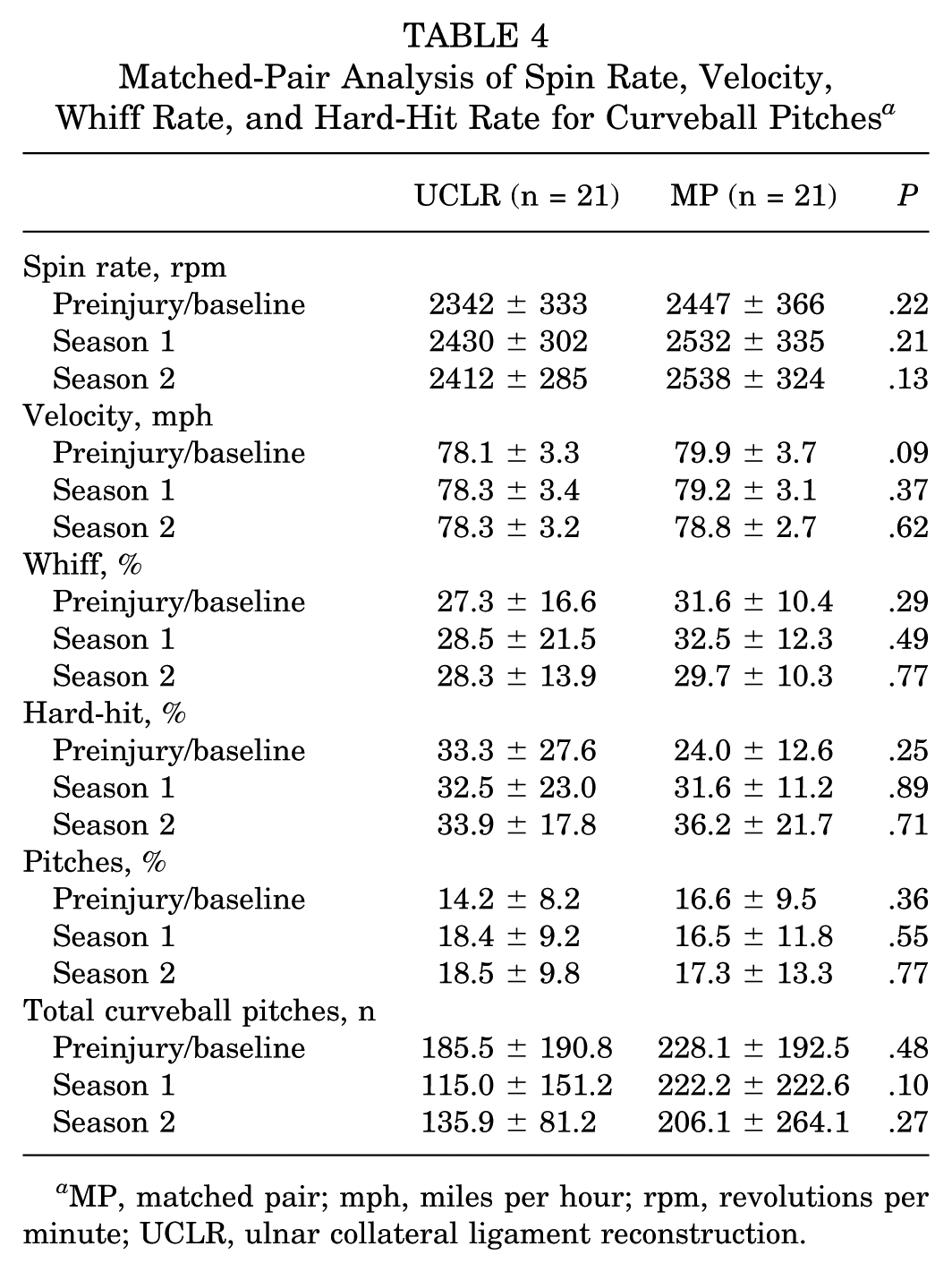
MP, matched pair; mph, miles per hour; rpm, revolutions per minute; UCLR, ulnar collateral ligament reconstruction.
CBs accounted for 14.2% of total pitches thrown in the UCLR group preinjury, 18.4% of total pitches in season 1 of RTP, and 18.5% of total pitches in season 2 of RTP. There were no statistically significant differences in the proportion of CBs thrown in the UCLR group when comparing the preinjury season with the first and second seasons after RTP or when comparing with the proportion of CBs thrown by the matched-pair group at each of the 3 time periods. There was also no significant difference in the total number of CBs thrown in a season before or after UCLR or when comparing the UCLR group with the matched-pair group at each of the 3 time periods (Table 4).
For CU pitches, baseline mean spin rate was 1759 ± 232 rpm in the matched-pair group and this did not significantly differ from the preinjury spin rate in the UCLR group (P = .65). Baseline CU mean velocity (85.7 ± 3.1 mph), whiff rate (32.9% ± 13.5%), and hard-hit rate (27.5% ± 12.8%) in the matched-pair group did not significantly differ from the preinjury CU pitching metrics in the UCLR group. There were no statistically significant differences in mean CU spin rate, whiff rate, or hard-hit rate between the UCLR and matched-pair group in season 1 or 2 after RTP. However, there was a statistically significant increase in mean CU velocity during season 2 after RTP in the UCLR group as compared with the matched-pair group (85.8 ± 2.7 mph versus 84.2 ± 2.8 mph; P = .04).
There were no statistically significant differences in the proportion of CUs thrown when comparing the UCLR and the matched-pair groups in the preinjury/baseline season (12.2% versus 11.1%, P = .58), season 1 after RTP (12.1% versus 14.6%; P = .43), or season 2 after RTP (13.6% vs 14.4%; P = .78). There was, however, a statistically significant decrease in the mean total number of CU pitches thrown in the UCLR group between the preinjury season and season 1 of RTP (154.0 versus 67.9 CU pitches; P = .04). Similarly, the mean total number of CU pitches thrown in the UCLR group in season 1 after RTP was significantly decreased compared with the mean total number of CU pitches thrown by the matched-pair group in season 1 after the baseline season (67.9 versus 233.2 CU pitches; P = .001). By season 2 of RTP, there was no statistically significant difference in the mean total number of CU pitches thrown between the 2 groups (Table 5).
Matched-Pair Analysis of Spin Rate, Velocity, Whiff Rate, and Hard-Hit Rate for Change-up Pitches a
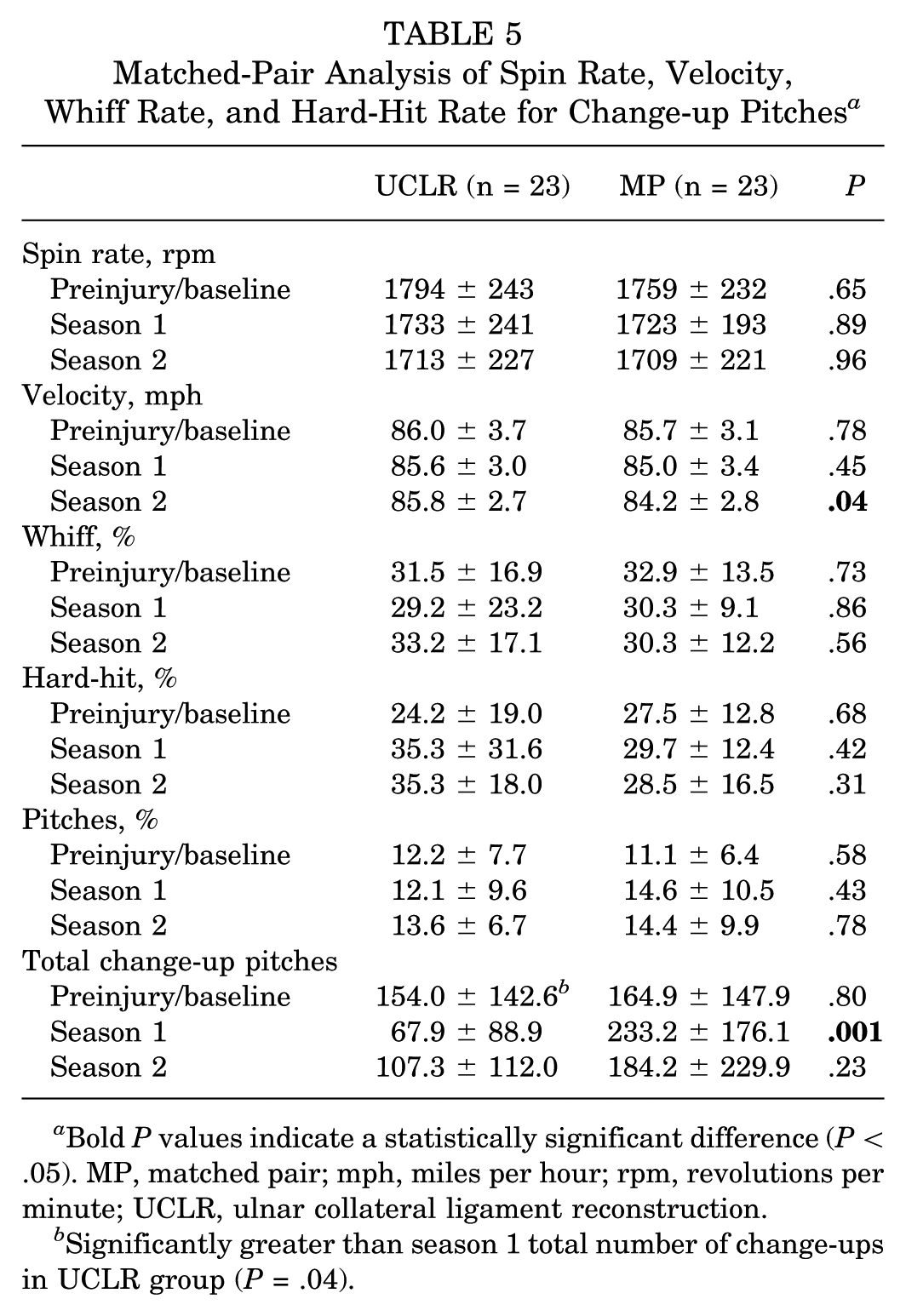
Bold P values indicate a statistically significant difference (P < .05). MP, matched pair; mph, miles per hour; rpm, revolutions per minute; UCLR, ulnar collateral ligament reconstruction.
Significantly greater than season 1 total number of change-ups in UCLR group (P = .04).
At baseline, mean total season pitch counts were similar between UCLR and matched-pair pitchers (1284 vs 1430; P = .45). In the first season after return from injury, UCLR pitchers threw significantly fewer pitches compared with both their preinjury baseline (593.1 vs 1284.3; P = .003) and their matched pairs (593.1 vs 1472.0; P = .002). By season 2, these differences were no longer statistically significant (Table 6).
Total Number of Pitches for UCLR and MP Groups a

Bold P value indicates a statistically significant difference (P < .05). MP, matched pair; UCLR, ulnar collateral ligament reconstruction.
Significantly fewer season 1 total number of pitches in UCLR group compared with preinjury year.
A post hoc power analysis was performed across all primary outcomes (spin rate, velocity, whiff rate, and hard-hit rate for both CB and CU cohorts). The mean observed statistical power was 22%.
Discussion
Our findings demonstrate that MLB pitchers who underwent UCLR and returned to MLB level of competition were able to return to the same level of off-speed pitch performance as measured by advanced pitching metrics. No statistically significant difference was found between preinjury and post-UCLR CB or CU mean spin rate, pitch velocity, whiff rate, or hard-hit rate in the first 2 seasons after RTP. Similarly, no statistically significant difference in pitching metrics was found between those that underwent UCLR and matched pairs of pitchers matched by draft year and round, apart from a small increase in mean CU velocity in season 1 after RTP in the UCLR group as compared with the healthy matched-pair group. We did, however, find pitchers who underwent UCLR threw fewer total CU pitches in season 1 after RTP compared with both their preinjury total CU pitches thrown and the healthy matched-pair group. Pitchers who underwent UCLR also threw fewer total pitches of all pitch types in season 1 after RTP compared with both their preinjury pitch totals and the healthy matched-pair group. To the best of our knowledge, this is the first study to evaluate UCLR outcomes specifically for off-speed pitches using these novel advanced pitching metrics.
Spin rate in particular is a pitching metric that has attracted increased attention in the context of pitching performance. Pitchers and MLB teams are seeking increased spin rates particularly with 4-seam FB (4FB) and slider (SL) pitches to change the expected trajectory of the ball and result in worse batting performance. There was a 17% and 4% increase in mean spin rate for MLB FBs and SLs, respectively, over the course of the 2015 to 2021 seasons.3,15 When it comes to off-speed pitches, different spin rates of CBs could create more or sharper downward movement resulting in swings and misses or mishit balls. Mayo et al 11 evaluated in-game velocity and spin rates of 4FB, 2-seam FB (2FB), and SL pitches and found a significant decrease in 4FB, 2FB, and SL velocity, as well as a significant decrease in 4FB spin rate in the 15 games leading up to UCL injury. This study also reported no change in CB or CU velocity or spin rate leading up to UCL injury; however, they did report a decrease in the percentage of CBs thrown by pitchers in the 15 games leading up to injury.
The findings of this study are consistent with a number of previous studies investigating outcomes of UCLR using both traditional and novel outcome measures. Numerous studies have reported a high rate of RTP after primary UCLR in professional pitchers as well as similar FB velocity in the first 2 seasons played after reconstruction.4,5,9,10 Lansdown and Feeley 6 reported on 80 MLB pitchers and found that pitch velocity for CBs and CUs did not change significantly after UCLR. The same study also reported no change in the relative percentage of CBs and CUs thrown after UCLR, but did find significant reduction in total pitches thrown after reconstruction. Similar findings were reported by Peterson et al 16 who found a significant decrease in the total number of pitches thrown after UCLR, a significant decline in percentage of FBs thrown, and a compensatory but non–statistically significant trend toward increased CB and SL usage. These previous findings are consistent with our findings of similar post-UCLR CB and CU pitch velocities, similar relative pitch percentage of CBs and CUs thrown, and a significant reduction in total CUs thrown in season 1 after RTP.
Several other studies have utilized other outcomes such as CB movement after surgery to measure pitch performance after UCLR. McKnight et al 13 reported on CB movement after UCLR and found no statistically significant difference in mean horizontal, vertical, or total CB movement in the first 3 years after UCLR. Cinque et al 2 reported on UCLR outcomes using advanced pitching metrics and found no significant changes in the spin rate, velocity, whiff rate, or hard-hit rate of 4FBs, 2FBs, or SLs at 2 years after UCLR. However, this study only reported on 4FB, 2FB, and SL and did not look at off-speed pitches.
It should be noted that the CB and CU are different than 4FBs and 2 FBs, as well as SLs where a higher spin rate is desired. Less is known about the ideal spin rate for off-speed pitches. In fact, too high a spin rate could potentially flatten the pitch out and lose effective action. This study is important in that it demonstrates pitchers post-UCLR can get back to “their particular” spin rates or performance of the pitch metric. The finding of an increased spin rate of the CU in RTP season 1 could be secondary to still finding the feel as off-speed pitches are more “feel” pitches than FBs or SLs.
Limitations
This study is not without its limitations. The study is retrospective, and the public nature of the data utilized in this study does not allow for analysis of the influence of different injury characteristics, surgical techniques, specific clinical data, or postoperative rehabilitation protocols. The study sample size is also small, and a post hoc power analysis showed the mean observed power across all outcome measures was 22%, reflecting limited sensitivity of this study to detect small-to-moderate effects. The MLB has only been utilizing the Statcast system for a limited time frame and this limited the number of MLB pitchers who have undergone UCLR that could be included in this study and had appropriate pre- and postinjury data available for analysis of spin rate, hard-hit rate, and whiff rate. Finally, 29 of 37 pitchers (78.4%) successfully returned to an MLB level of pitching and our analysis was limited to these pitchers. Those that returned to other levels of play did not have Statcast data to analyze and thus were excluded.
Conclusion
A cohort of MLB pitchers who underwent UCLR and returned to MLB level of pitching demonstrated no significant changes in spin rate, pitch velocity, hard-hit rate, or whiff rate of off-speed pitches (CB and CU) in their first 2 seasons after RTP or compared with an uninjured matched-pair cohort. The results of this study demonstrate that pitchers who undergo UCLR and return to the MLB level can expect similar off-speed pitch performance in comparison with their preinjury levels and similar pitchers without UCL injury history; however, they may throw fewer total CU pitches and total number of pitches during their first season back from injury.
Footnotes
Final revision submitted September 12, 2025; accepted September 30, 2025.
One or more of the authors has declared the following potential conflict of interest or source of funding: G.J.L. has received support for education from Evolution Surgical. M.E.C. has received support for education from Smith & Nephew and Evolution Surgical and hospitality payments from Stryker Corp. W.W. has received nonconsulting fees from Arthrex and hospitality payments from Arthrex, Stryker Corp, and Smith & Nephew. M.T.F. receives royalties from Smith & Nephew, Stryker, and Wright Medical Technology; consulting fees from Wright Medical Technology, Smith & Nephew, and Tornier/Stryker; support for education from Gemini Medical; hospitality payments from Sparta Biopharma and CONMED; and funding from Major League Baseball and National Institutes of Health. AOSSM checks author disclosures against the Open Payments Database (OPD). AOSSM has not conducted an independent investigation on the OPD and disclaims any liability or responsibility relating thereto.
Ethical approval was not sought for the present study.
