



Abstract
Background:
Elite wrestling is a contact sport characterized by high levels of physical fitness and a high level of injury. Studies have shown that poor “core stability” is associated with increased risk of injury in other sports. This study examines the correlation between the different parameters of “core stability” and the injury rate in elite wrestling.
Hypothesis:
It was hypothesized that poor results on core stability tests would be associated with an increased risk of injury.
Study Design:
Cohort study; Level of evidence, 2.
Methods:
We involved 60 members of the Azerbaijan National Wrestling Team (mean age 25.5 ± 4.6 years) who met the predefined inclusion and exclusion criteria. Baseline assessment of core stability was performed using the Limits of Stability Test on the Biodex Balance System, McGill's Endurance Test Battery, and complex core stability tests. Injuries were defined as tissue damage resulting from sports participation that led to at least 1 day of time loss from training or competition. Data were collected over a 6-month period. Descriptive statistics, including interquartile ranges, were recorded, and Pearson correlation coefficients were calculated to assess relationships between variables.
Results:
A total of 997 injuries were recorded over 6 months (median injury burden: 54.6 days/1000 training hours; median days lost per injury: 16.5 [IQR, 14.0-19.8]). Core stability measures demonstrated significant negative correlations with multiple injury parameters, indicating that better stability performance was associated with reduced injury risk and severity. The McGill Side Bridge (right) test showed the strongest association with injury burden (r = −0.596, P < .001) and days out of training (r = −0.597, P < .001). The dynamic overall score was also highly correlated with injury burden (r = −0.530, P < .001) and injury incidence (r = −0.472, P < .001). Across all injury outcomes, days out of training demonstrated the greatest number of significant correlations, ranging from r = −0.412 to r = −0.597 (all P < .05).
Conclusion:
Our study demonstrates that there is a significant relationship between poor core stability parameters and injury burden. These results could suggest that a specially designed core-specific training program could help reduce injury rates in wrestling, provided that a controlled study—featuring core exercises administered to an experimental group—confirms the link between weak core stability and an increased risk of injury.
Wrestling is a popular sport, currently with 254,318 athlete participants in the United States alone. 1 In 708 BCE, wrestling was included among the main Olympic disciplines. 7 Modern wrestling includes freestyle and Greco-Roman style. 7
Chaabene et al 7 state that high levels of aerobic and anaerobic power, strength, and explosive power, as well as strong neck muscles, are necessary for success in wrestling. The injury rate in elite wrestling published by Park et al 25 in Korea was 4.65 per 1000 training hours. Park et al 25 recorded that most injuries occur in the lower extremities (37.5%), followed by the upper extremities (27.4%), trunk (25.4%), and neck and head area (9.7%). Bernardo et al 4 found that the lower extremities account for 61%, the upper extremities for 29%, and the trunk for 10% of all wrestling injuries. Thomas and Zamanpour 31 reviewed the literature on various aspects of injuries in wrestling and concluded that most research in this area is incomplete and inconsistent, making comparison and meta-analysis of results difficult. Despite these reservations, they deduced the average injury rate to be 16.3 per 1000 athletic encounters (AEs) in competitions and 69.5 per 1000 AEs in training. An AE is 1 walk to the carpet (1-12 minutes) in competition or 1 workout (20 minutes to 2 hours) in training. According to their data, injuries to the upper extremities account for 26% in competitions and 24% in training; the proportion of injuries is 15% and 12% to the trunk, 31% and 20% to the neck and head, and 24% and 39% to the lower extremities, respectively. Fractures account for 6% and 7%; dislocations, 6% and 6%; ligament and cartilage damage, 12% and 17%; contusions, 25% and 5.7%; dissections, bruises, and abrasions, 23% and 4%; and sprains and muscle tears, 38% and 26%. 31
The concept of “core stability” remains controversial. Some sources define “core stability” in terms of anatomy, while others define it as a combination of function and anatomy. 8 Figure 1 is a modified schematic illustration from McGill of the structures included in the “core.” 23 Anatomically, the “core” is a collection of musculoskeletal structures and ligaments of the lumbar spine and pelvis. These structures are responsible not only for stabilizing the spine and pelvis but also for transferring energy between the lower and upper extremities, which is very important in many sports. 32 Some authors additionally refer to “core” as all muscles between the sternum and the knee. 17

Schematic demonstrating anatomic structures included in “mechanical core stability.” 23 The rigidity and stability of the spine are ensured by the multilevel interaction of rigid structures around the spine (A). P represents external load. Rigid structures that make up the body wall (B). Adapted with permission from Wolters Kluwer Health, Inc.: McGill SM. Low back stability: From formal description to issues for performance and rehabilitation. Exerc Sport Sci Rev. 2001;29(1):26-31.
“Core strength” is defined as the ability of the “core” muscles to generate and transfer the force. 12 “Core strength” is also defined as the potential of the “core” muscles to counteract the effects of external forces. 16 “Core endurance” is defined as the ability of the “core” muscles to maintain a certain position for a long time or perform multiple repetitions. 28 “Core stability” is the ability to maintain balance and control passive and active stabilizers in the lumbo-pelvic region, ensuring the correct position of the trunk and hips during static and dynamic movements. “Core stability” can also be considered as maintaining control over the “core” during strength exercises or in response to any posture disorder. 27
A body of work shows a link between the level of core stability and the injury rate in various sports. In a review paper, De Blaiser et al 10 showed that deficiencies in the development of core strength, core endurance, balance, and neuromuscular control in athletes increase the risk of injury. They suggest that when screening an athlete, measurement of core parameters should always be included to assess the risk of injury. The findings of the systematic review by Emami et al 13 are consistent with this, showing a link between weak core stability and an increased risk of injury, based on an investigation involving athletes from 10 different sports. The results from Schuermans et al, 29 who used electromyography, show that less activation of the trunk and gluteal muscles in hockey players is associated with a high risk of injury to the biceps femoris muscle. They conclude that injury prevention should focus on the development of these core muscles and also balance training to improve core stability. 29
A number of studies found a connection between weak core stability and upper extremity injuries. Pogetti et al, 26 using the “lateral flexion endurance” test in athletes participating in handball, baseball, and softball—sports that require a wide range of throwing motions—identified a link between shoulder injuries and reduced core stability.
Many researchers consider core endurance more important for athletes than core stability.18,20,32 In light of this, McGill 23 stated that developing core endurance should be prioritized over core strength development for injury prevention and rehabilitation. Leetun et al, 21 however, showed that in an investigation involving athletes from basketball and track sports, the main predictor of back and lower extremity injuries was the strength of the hip external rotators. In their opinion, for elite athletes, strength during high-speed movement better stabilizes the core; therefore, strength is more important than core endurance. 21 They also suggest that other core stability parameters, such as motor control, may be equally important. Hewett et al 19 also showed that balance exercises improved control of the knee when landing after a jump.
Despite numerous investigations confirming a link between core stability parameters and injury risk in various sports, current evidence evaluating this association in wrestling remains very limited. This study aimed to address this gap by examining the relationship between the results of multiple tests—each reflecting different components of core stability—and injury-related parameters. We hypothesized that poorer core stability test performance would be associated with an increased risk of injury.
Methods
Study Design and Participants
The participants were a convenience sample from the national wrestling squad. Initially, the participants underwent the Biodex Balance System test, McGill's endurance tests, and complex core stability tests. In the 6 months after testing, injury data were collected using the “ORCHARD” system. 24 For the purposes of this study, injury was defined as an athlete missing at least 1 training session because of the recorded injury. Injury counting was done in accordance with the recommendations given in the International Olympic Committee Consensus Statement. 3
To determine the presence and degree of correlation between various parameters of core stability and the level of injury among elite-level wrestlers, the Limits of Stability Test on the Biodex Balance System was chosen to assess motor control as a parameter of core stability, 9 the McGill endurance test battery to assess core endurance, 33 and the complex core stability tests to assess core functional capacity. 22
The inclusion criteria were as follows: (1) a member of the national wrestling team for at least 6 months and (2) age between 18 and 30 years. The exclusion criteria were the following: (1) any acute or unhealed injury at initial screening, (2) any injury incompatible with a sports career that occurred during follow-up, (3) surgical interventions during follow-up, and (4) exclusion from the national team during follow-up. A total of 60 athletes completed all the requirements, and their results were selected for data analysis by the end of the study. This study was approved by the institutional review board of the Azerbaijan Sports Academy (STUDY 3-19-14), and consent for the study was obtained from all included participants.
Variables
A detailed description of the tests is given in Table 1, and a description of injury parameters is given in Table 2. Tests were performed by qualified physiotherapists with at least 3 years’ experience in the relevant field and members of the Sports Medicine Research Laboratory of the Azerbaijan Sports Academy.
Description of All Given Tests

Description of Injury Parameters

Injury Rate
This article follows advice from the International Olympic Committee consensus paper on recording and reporting injury and illness data in sport. 3 Time loss, injury rates, and proportions were defined, based on recommendations given by consensus. 3 The Orchard Sports Injury Classification System was used to collect injury data. 24 Injury data were collected by the sport federation's team of medical doctors employed on a permanent basis.
Statistics
Statistical analysis of the research results was performed using IBM SPSS. 26 In descriptive statistics, the median and interquartile range were used to reflect the differences. To establish correlations, the Pearson coefficient was calculated. The results were considered statistically significant at P < .05.
Results
This study investigated data from 60 male members of the Azerbaijan National Wrestling Team, representing both freestyle and Greco-Roman styles (mean age: 25.5 ± 4.6 years; height: 174.4 ± 9.0 cm; weight: 84.5 ± 19.3 kg; body fat percentage: 15.3% ± 3.9%). At baseline, there was a balanced distribution of athletes across official weight categories and wrestling styles, with equal representation of freestyle and Greco-Roman wrestlers (30:30).
A total of 997 injuries were recorded over the 6-month observation period. The median injury burden was 54.6 days per 1000 training hours, and the median number of days lost per injury was 16.5 (IQR, 14.0-19.8). Injuries to the lower extremities accounted for 28.4% of all cases, the upper extremities for 39%, and the trunk and neck for 32.5%.
The distribution of injury types differed between training and competition. Ligament and cartilage injuries accounted for 64% during training and 53% during competition. Muscle tears were reported in 31% and 36% of cases, respectively. Contusions occurred in 1.5% (training) and 4% (competition), while skin lacerations were documented in 3.4% (training) and 17% (competition).
Across all injury parameters, core stability scores demonstrated significant negative correlations, indicating that better performance was consistently associated with reduced injury risk, severity, and recovery time (Table 3).
Correlations Between Injury and Core Stability Parameters a

The McGill side bridge (right) test showed the strongest individual associations with the following: injury burden (r = −0.596, P < .001), days out of training (r = −0.597, P < .001), injury incidence (r = −0.293, P = .019), and missed competition days (r = −0.468, P = .007). The dynamic overall score was also strongly correlated with injury burden (r = −0.530, P < .001), days out of training (r = −0.513, P = .002), and injury incidence (r = −0.472, P < .001).
Among all injury outcomes, days out of training showed the highest number of statistically significant correlations across 8 core stability tests, ranging from r = −0.412 (core stability left) to r = −0.597 (McGill side bridge right). Similarly, injury burden demonstrated moderate to strong associations with McGill plank (r = −0.436), McGill extension (r = −0.484), and core stability ventral (r = −0.499), all with P < .001.
The McGill test parameters showed statistically significant negative correlations with all injury-related variables assessed. Likewise, the core stability ventral and dynamic overall scores were significantly associated with all injury outcomes, except for days lost due to trunk injury.
Figure 2 shows the relationship between McGill side bridge right performance and both injury burden and days out of training.

The correlation between injury rate parameters and the McGill side bridge test.
The median value of individual injury rate by severity (injury burden) was 54.6 (46.0-65.3). The median value for days out of training was 16.5 (14.0-19.8). Meanwhile, the median score on the McGill side bridge test was 117.5 (103.3-139).
Figure 3 illustrates similar findings for the dynamic overall score.
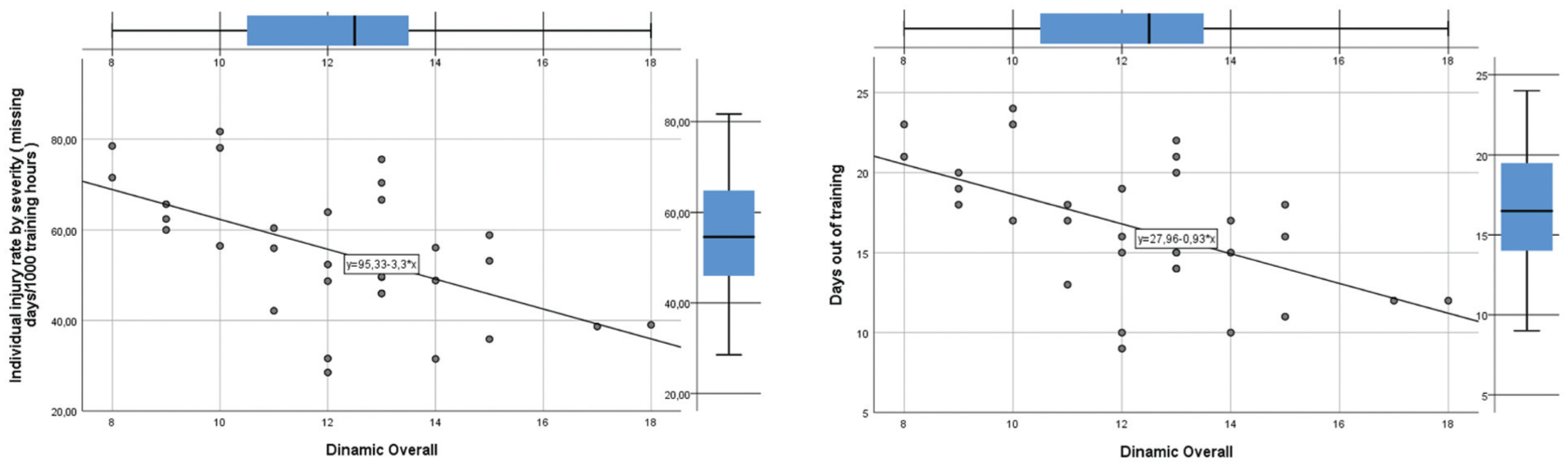
The correlation between injury rate parameters and dynamic overall test result. The dynamic overall score in the study group had a median level of 12.5 (10.3-13.8) and statistically significantly correlated with the injury burden parameter (r = −0.530, P < .001) and days out of training (r = −0.513, P = .002).
Discussion
The major findings from our study demonstrate a consistent and statistically significant association between core stability performance and injury-related outcomes in elite wrestlers. Most notably, injury burden (measured as missing days per 1000 training hours) showed strong negative correlations with nearly all core stability measures. The McGill side bridge (right) test had the strongest association (r = −0.596, P < .001), followed by the dynamic overall score (r = −0.530, P < .001) and the McGill side bridge (left) test (r = −0.528, P < .001). Similarly, days lost from training were significantly correlated with dynamic overall (r = −0.513, P = .002) and core stability ventral tests (r = −0.502, P = .003). In addition, the individual injury incidence rate (events/1000 hours) showed moderate but significant inverse correlations with dynamic overall (r = −0.472, P < .001), McGill side bridge (left) (r = −0.366, P = .003), and core stability ventral (r = −0.398, P = .001) tests. These findings highlight that the side bridge (right and left), dynamic overall, and core stability ventral tests are the most relevant core stability measures associated with injury risk and burden. According to available information, this study is the first to show a correlation between core stability and the risk of injury in wrestlers.
The results indicate inverse correlations between core stability parameters and injury in this group of wrestlers. To minimize the likelihood of a type I error, the strength of correlation was considered strong only for the relationship between injury burden and core stability test results (P < .001); other correlations were interpreted as statistically significant.
The most significant tests associating core stability with injury are the McGill test scores, which correlate significantly with all injury rates except the “days missing because of trunk injuries” parameter. Next, we have the core stability ventral and dynamic overall “core stability” parameters, which correlate with 6 of 8 injury parameters.
The results show that, in general, there is a strong correlation between poor core stability and an increased risk of being severely injured. Although the number of injuries did not have a strong correlation with core stability, the number of days missed, reflecting the severity of the injuries, has a strong correlation with core stability. The correlation between the McGill side bridge test and the injury rate is in good agreement with the findings of Tate et al 30 and Pogetti et al 26 on the effect of reduced scores in this test on the likelihood of shoulder injuries.
Some researchers believe that tests combining various types of loading, such as isometric contractions of the “core” muscles with strength or isometric contractions with dynamic ones, are more informative since they better correspond to household and sports loads. 14 Our results show that complex core stability tests also have a strong correlation with injury rates, especially the “ventral” test, which is holding a plank position in combination with lifting alternately straightened legs with a change of position every 10 seconds. A possible explanation is that, in wrestling and many other sports, athletes often use static contraction of the core muscles to facilitate dynamic work with the limbs.
Our results also show that the ability to maintain balance is associated with a decreased risk of injury. These findings are supported by Carrasco-Huenulef et al, 6 who showed the effect of neuromuscular control on the risk of injury to the anterior cruciate ligament in basketball players. This is also supported by a study by Zazulak et al 34 on the effect of balance on the risk of acquiring a knee injury. According to their result, collegiate athletes with decreased neuromuscular control of the core, especially with impaired response to lateral displacement after a sudden force release, are at increased risk of knee ligament injuries.
Interestingly, while some studies show that there is no direct relationship between the various core stability parameters (eg, high values in endurance tests can be combined with low values in functional tests),15,21 results of this study show the presence of a statistically significant correlation of almost all core stability parameters with injury parameters in wrestlers.
The individual injury rate by severity, “injury burden,” defined as missing days per 1000 training hours (mean, 54.91 ± 14.33), was also used for this study. According to Delfino Barboza et al, 11 when conducting a study on sports injuries, the risk and severity of injuries should be taken into account in the evaluation. Some authors use an injury risk parameter expressed as the number of injuries per 1000 hours of training, but this does not reflect the nature and severity of injuries. Others use the number of missed training days over a month, year, or season but do not take into account the number of training sessions conducted during this period. By using a “injury burden” parameter, we tried to increase the information content, considering both the time during which an athlete is at risk of injury and the severity of the injury, expressed as the number of days missed. 3
Limitations
Our study is not without limitations. Professional athletes undergo various training cycles, including sport-specific training, strength training, endurance training, sparring, and speed development. Different training patterns have different loads and durations, resulting in varying injury risks overall and in the distribution of injuries by type and location. Future studies should include detailed training data (eg, type and duration of training) when collecting injury statistics. Nevertheless, it should be noted that in our case, the athletes of the national team involved in this study trained under almost identical conditions, meaning they were equally exposed to variations in injury risk caused by changes in training load. Therefore, the influence of this limitation on our results is likely less significant. The current study was restricted to a 6-month follow-up due to the active season, during which athletes were under continuous medical surveillance and participated in centralized camps with standardized training. This limited duration is another potential limitation, possibly affecting the reliability of the long-term data. Injury data were collected using time loss as the measure of injury severity, as it is the most commonly used method in sports medicine for quantifying injury severity. However, it has its own limitations—sometimes it is difficult to clearly distinguish between true time loss and a return to normal training. Athletes may return to full participation before the injury has fully resolved or complete healing has been achieved, often modifying their technique or performing at suboptimal levels—particularly when under pressure from coaching staff. Another limitation is the possible influence of other unidentified factors related to core stability, which we were unable to assess in this study.
Conclusion
Our study demonstrates that there is a significant relationship between poor core stability parameters and injury burden. These results could suggest that a specially designed core-specific training program could help reduce injury rates in wrestling, provided that a controlled study—featuring core exercises administered to an experimental group—confirms the link between weak core stability and an increased risk of injury.
Footnotes
Acknowledgements
The authors express sincere gratitude to the staff of the Sports Medicine Research Laboratory for their valuable assistance with the testing procedures. Special thanks are extended to Zarifa Kamilova for her help in coordinating the work of the investigators and to the Azerbaijan Sports Academy for their support and facilitation of the study.
Final revision submitted August 25, 2025; accepted September 18, 2025.
The authors have declared that there are no conflicts of interest in the authorship and publication of this contribution. AOSSM checks author disclosures against the Open Payments Database (OPD). AOSSM has not conducted an independent investigation on the OPD and disclaims any liability or responsibility relating thereto.
Ethical approval for this study was obtained from the Azerbaijan Sports Academy (STUDY 3-19-14/).