




Abstract
Background:
Kickoffs in the National Football League (NFL) are historically one of the most dangerous plays during an NFL game, with high levels of injuries. In 2024, the NFL introduced new rules aimed at reducing injuries during kickoffs, enhancing player safety, and increasing the frequency of kick returns.
Purpose:
To evaluate whether the NFL kickoff rule changes in 2024 had any effect on the incidence of injuries, particularly with a focus on concussions.
Study Design:
Descriptive epidemiology study.
Methods:
Injuries on kickoffs were identified for the 2022, 2023, and 2024 NFL seasons using the transcribed game book for each game on the official NFL website. Injury type was confirmed using the injury report on each team's website for the following week. If an injury was unreported on the subsequent injury report, it was listed as an unspecified injury. Injuries were defined as neuromusculoskeletal complaints documented in the game book for kickoffs and confirmed in the subsequent week's injury report. The injury rate was calculated annually for each injury category by analyzing injury incidence relative to the number of kickoffs and returns, with each analyzed separately. The incidence rate ratio (IRR) was calculated by dividing the IRR of one season by that of another season. Also, 95% CIs for the IRR were calculated, and P values were determined using the exact Poisson method.
Results:
This epidemiological study found that a comparison of the 2024 versus 2022 season showed a statistically significant increase in the overall number of injuries (IRR, 1.10 [95% CI, 1.08-1.11]); P < .001), upper extremity injuries (IRR, 6.74 [95% CI, 6.30-7.21]; P < .001]), and lower extremity injuries (IRR, 2.20 [95% CI, 2.14-2.26]; P < .001), when analyzed by the number of kickoffs. This study found that a comparison of the 2024 versus 2022 season showed a statistically significant increase in the overall number of injuries (IRR, 1.25 [95% CI, 1.23-1.27]; P < .001), upper extremity injuries (IRR, 7.69 [95% CI, 7.20-8.23]; P < .001), and lower extremity injuries (IRR, 2.51 [95% CI, 2.44-2.58]; P < .001), when analyzed by the number of returns. However, when comparing the 2024 and 2022 NFL seasons, 2024 saw a statistically significant decrease in the incidence of concussions when analyzed by both kickoffs (IRR, 0.77 [95% CI, 0.74-0.80]; P < .001) and returns (IRR, 0.88 [95% CI, 0.84-0.92]; P < .001). When compared with the 2023 NFL season, the 2024 NFL season showed a statistically significant rise in overall injuries (IRR, 1.59 [95% CI, 1.56-1.61]; P < .001), lower extremity injuries (IRR, 2.57 [95% CI, 2.49-2.64]; P < .001), upper extremity injuries (IRR, 2.24 [95% CI, 2.15-2.34]; P < .001), and concussions (IRR, 3.85 [95% CI, 3.59-4.13]; P < .001) when analyzed by kickoffs. When the 2023 NFL season was compared with the 2024 NFL season, it showed a statistically significant rise in overall injuries (IRR, 1.05 [95% CI, 1.03-1.07]; P < .001), lower extremity injuries (IRR, 1.70 [95% CI, 1.65-1.75]; P < .001), upper extremity injuries (IRR, 1.49 [95% CI, 1.43-1.55]; P < .001), and concussions (IRR, 2.25 [95% CI, 2.38-2.74]; P < .001) when analyzed by returns. When the 2023 season was compared with the 2022 season, there was a statistically significant decrease in the number of concussions when analyzed by both kickoffs (IRR, 0.20 [95% CI, 0.19-0.21]; P < .001) and returns (IRR, 0.31 [95% CI, 0.29-0.34]; P < .001).
Conclusion:
Our study showed that after the 2024 NFL kickoff rules were implemented, there was a significant increase in overall, lower extremity, and upper extremity injuries compared with the previous 2 seasons, as measured by the number of kickoffs and returns per year. The overall effect of the 2024 NFL kickoff rules on the incidence of concussions remains unclear when compared with the previous 2 seasons, as there was an increase in the incidence of concussions compared with 2023 and a decrease in the incidence of concussions compared with 2022. The kickoff remains an essential component of the game and still presents a challenge, as it is a play with a high injury rate.
Kickoffs in the National Football League (NFL) are one of the most dangerous plays in the sport.2,10,23,31 Comparatively, to the remainder of a football game, the incidence rate of injuries, particularly concussions, is much higher than during other plays. Concussions are a major concern for football players, as they can be career-ending injuries. 3 Concussions can also lead to serious health complications, including major disability and death.3,28,29 Head trauma can predispose players to risks of serious long-term complications, such as chronic traumatic encephalopathy or a mental health disability,1,4,8,22,27 both of which can have a significant effect on a person's daily life.
To curb the concussion crisis and potentially devastating consequences of head trauma, the NFL has undergone many player safety initiatives recently, such as concussion protocols, adjustments to the game rules,11,26 and improvements in technology for player protective equipment. 11 Many of these initiatives have been successful in reducing or preventing complications from concussions and head trauma.6,11,26 There have been several previous rule changes to the NFL kickoff, such as the 2011 rule change that moved the kicking line from the 30-yard line to the 35-yard line and limited players on the kicking team to lining up no more than 5 yards behind the kicking line to reduce their running start. 23 These rule changes were associated with a decrease in overall injuries. 23 While there have been improvements over the years, the kickoff remains a dangerous play.
The latest iteration of adjustments to reduce injuries on kickoffs was the 2024 rule change, which introduced the Dynamic Kickoff. 13 The 2024 rule change implemented a landing zone between a return team's 20-yard and goal lines, where kickoffs must be returned. 13 The 2024 rule changes also moved players on the kicking team to starting behind a new restraining line at the 40-yard line of the return team. 13 The kickoff team players are also not allowed to move until the ball hits the ground, a player in the landing zone, or the end zone. 13 This eliminates the large running start players had previously from the 35-yard line of the kickoff team. 13 The expectation was that this rule change would lead to a significant reduction in overall injuries and increase the number of returns throughout the season.13,16 Because the NFL is the first football league at any level to implement these significant changes, the effect on injuries remains unknown.
This study aimed to evaluate whether the 2024 NFL kickoff rule changes affected injury incidence, particularly concussions. The authors hypothesized that there would be a significant decrease in injuries and concussions during the 2024 season on kickoffs after the implementation of the new NFL kickoff rules.
Methods
Study Design
This research activity was determined to be exempt or excluded from institutional review board oversight in accordance with current regulations and institutional policy. The study design and methodology were adapted from a previous study evaluating play-specific injuries in the NFL and from recent literature comparing injury incidence across professional sports.18-20,23 Injuries were defined as any neuromusculoskeletal complaint that was identified in the game book occurring during a kickoff and confirmed on the subsequent week's injury report. Illnesses and non-neuromusculoskeletal complaints were excluded from the data, consistent with previous injury studies. Injuries on kickoffs were identified for the 2022, 2023, and 2024 NFL seasons using the transcribed game book for each game, available in the schedule section of the official NFL.com website. 17 Injury type was confirmed using the injury report on each team website for the following week, and if unable to identify it on the team website, the NFL.com website injury report section was used as a secondary source. 15 If an injury was unreported on the subsequent injury report, it was listed as an unspecified injury. Injuries were included if they occurred during the NFL regular season (preseason and playoffs were excluded) to produce a consistent time period and an accurate assessment of average game exposure. Illnesses and non-neuromusculoskeletal complaints were excluded from the data, consistent with previous studies on injury.18,19 Data were compiled into the following categories: overall injuries, concussion, other head/neck injuries, upper extremity injuries, lower extremity injuries, torso injuries, and unspecified injuries. Other head/neck injuries were defined as non-concussion neuromusculoskeletal injuries to the head and neck. Torso injuries included any thoracic or lumbar spine injuries, injuries to the thoracic cage, and injuries to the musculature of the abdominal, lumbar, or thoracic regions. Cardiopulmonary and intra-abdominal pathologies were excluded, as they were non-neuromusculoskeletal complaints. Unspecified injuries were defined as injuries recorded in the game book; however, they were not listed on the subsequent injury report the week after the game. Kickoff statistics—including returns, touchbacks, mean return yardage, and mean starting line—were obtained from NFL and team websites that reported these statistics.14,30
Data Analysis
Data analysis methods were adapted from a previous study evaluating injury incidence during NFL kickoffs. 23 Data were collected and tallied in the categories for each year. In the event of a zero value in any injury category, a pseudo-count of 1 was used in place of the zero to facilitate statistical comparison, a method employed in previous studies using count data.7,25 After the completion of counts, the incidence ratio (IR) was calculated for each category using the IR of both injuries per kickoff per 1000 kickoffs and the IR of injuries per returns per 1000 returns. The kickoff analysis included all kickoffs, including returns, and the returns analysis included only returns. The IR was calculated by dividing the number of injuries by the number of kickoffs or returns and then multiplying by 1000. 23 The incidence rate ratio (IRR) was calculated to compare the 2024 season with the 2022 and 2023 seasons by dividing the IR of the 2024 season by the IR of the comparison season. The 2023 season was compared with the 2022 season by dividing the 2023 IR by the 2022 IR. Also, 95% CIs and P values were calculated for the IRR comparison using the exact Poisson method.24,32 MedCalc version 23.2.7 (MedCalc Software Ltd) was used for statistical analysis. 12
Results
A comparison of total injuries by year showed that the 2024 NFL season had the highest number of kickoff injuries, while the 2023 season had the lowest. The 2022 NFL season had the highest number of concussions, and the 2023 season had the lowest number of concussions. The 2024 season had the highest number of upper- and lower-extremity injuries (Table 1).
Total Number of Injuries and Injury Categories on Kickoffs in the NFL by Year a
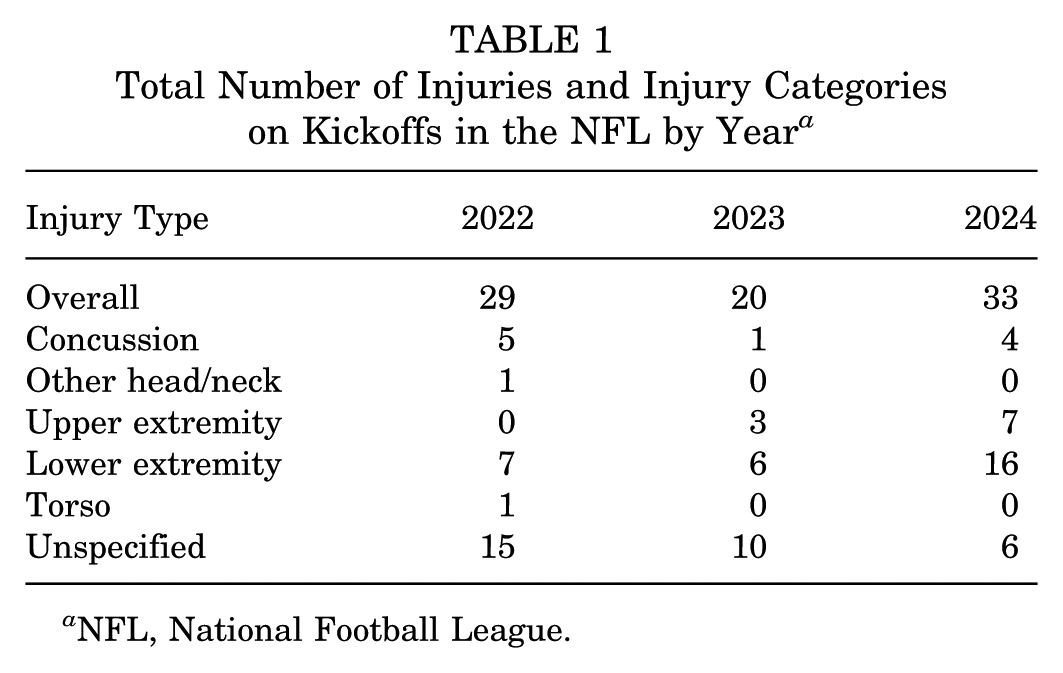
NFL, National Football League.
The 2024 season saw 2803 kickoffs, 1011 returns, and 1803 touchbacks. The mean starting line of scrimmage was highest in 2024 at the 30-yard line. Also, 2024 saw the highest mean return, with a return of 27.6 yards. The 2023 season had 2698 kickoffs, and the fewest returns were 587. Also, 2023 saw the highest number of touchbacks, with 1970. Moreover, 2023 saw the lowest mean starting line of scrimmage at 24.2 yards. The 2022 season had 2698 kickoffs, 1011 returns, and 1612 touchbacks. The 2022 season had the lowest mean return, with a mean of 22.9 yards per return (Table 2).
Kickoff Statistics for Each NFL Season a

NFL, National Football League.
A comparison of the 2024 and 2022 seasons showed a statistically significant increase in the incidence of overall injuries for both categories of all kickoffs (P < .001) and returns (P < .001). However, comparison of the 2024 and 2022 seasons showed a statistically significant decrease in the incidence of concussions for both categories of all kickoffs (P < .001) and returns (P < .001). Upper extremity injuries saw a statistically significant increase in the incidence of injuries in 2024 for both kickoffs (P < .001) and returns (P < .001). Lower extremity injuries saw a statistically significant increase in the incidence of injuries in 2024 for both kickoffs (P < .001) and returns (P < .001) (Table 3).
2024 Versus 2022 Incidence Comparison of Kickoffs and Returns a

IR, incidence rate; IRR, incidence rate ratio.
signifies a pseudo-count value of 1 in place of a 0 value for comparison.
A comparison of the 2024 and 2023 seasons showed a statistically significant increase in the incidence of overall injuries for both categories of all kickoffs (P < .001) and returns (P < .001). A comparison of the 2024 and 2023 seasons showed a statistically significant increase in the incidence of concussions for both categories of all kickoffs (P < .001) and returns (P < .001) in 2024. Upper extremity injuries saw a statistically significant increase in the incidence of injuries in 2024 for both kickoffs (P < .001) and returns (P < .001). Lower extremity injuries saw a statistically significant increase in the incidence of injuries in 2024 for both kickoffs (P < .001) and returns (P < .001) (Table 4).
2024 Versus 2023 Incidence Comparison a

IR, incidence rate; IRR, incidence rate ratio.
signifies a pseudo-count value of 1 in place of a 0 value for comparison.
A comparison of the 2023 and 2022 seasons revealed a statistically significant decrease in the incidence of overall injuries for all kickoffs (P < .001), but a significant increase in the incidence of injuries during returns (P < .001). Moreover, in 2023, there was a statistically significant decrease in concussion incidence for both categories of kickoffs (all, P < .001) and returns (P < .001). Upper extremity injuries saw a statistically significant increase in the incidence of injuries in 2023 for both kickoffs (P < .001) and returns (P < .001). Lower extremity injuries showed a statistically significant decrease in 2023 for kickoffs (P < .001), but an increase when analyzed per return (P < .001) (Table 5).
2023 Versus 2022 Incidence Comparison a

IR, incidence rate; IRR, incidence rate ratio.
signifies a pseudo-count value of 1 in place of a 0 value for comparison.
Discussion
The major findings of this study were that, in the 2024 NFL season, there was a significant increase in the incidence of overall injuries, both when analyzed by the total number of kickoffs and when considering kickoff returns only, compared with the 2023 and 2022 NFL seasons. Concussions during the 2024 NFL season decreased compared with 2022, when analyzed by both kickoffs (IRR, 0.77 [95% CI, 0.74-0.80]; P < .001) and returns (IRR, 0.88 [95% CI, 0.84-0.92]; P < .001). However, 2024 saw an increase when compared with the 2023 NFL season for concussions when analyzed by both kickoffs (IRR, 3.85 [95% CI, 3.59-4.13]; P < .001) and returns (IRR, 2.25 [95% CI, 2.38-2.74]; P < .001). There was a significant increase in both lower extremity injuries during the 2024 NFL season compared with the 2023 season by both kickoffs (IRR, 2.57 [95% CI, 2.49-2.64]; P < .001) and returns (IRR, 1.70 [95% CI, 1.65-1.75]; P < .001). There was also a significant increase in upper extremity injuries during the 2024 NFL season compared with the 2023 season by kickoffs (IRR, 2.24 [95% CI, 2.15-2.34]; P < .001) and returns (IRR, 1.49 [95% CI, 1.43-1.55]; P < .001). Similar results were found when the 2024 season was compared with the 2022 NFL seasons, with 2024 showing an increase in upper extremity injuries (IRR, 6.74 [95% CI, 6.30-7.21]); P < .001) and lower extremity injuries (IRR, 2.20 [95% CI, 2.14-2.26]) by kickoffs, and upper extremity injuries (IRR, 7.69 [95% CI, 7.20-8.23]; P< .001) and lower extremity injuries (IRR, 2.51 [95% CI, 2.44-2.58]; P < .001) by returns. This study also showed that the 2024 NFL kickoff rule change led to an increase in the incidence of overall injuries when compared with 2022 by kickoffs (IRR, 1.10 [95% CI, 1.08-1.11]; P < .001) and returns (IRR, 1.25 [95% CI, 1.23-1.27]; P < .001), and when compared with 2023 by kickoffs (IRR, 1.59 [95% CI, 1.56-1.61]; P < .001) and returns (IRR, 1.05 [95% CI, 1.03-1.07]; P < .001).
The 2024 NFL season saw a kickoff rule change, which correlated with an increase in overall injuries from the previous 2 seasons, and a mixed effect on concussions despite new league rules intended to decrease their occurrence.2,10,23,31 While injuries outside of concussions can have a devastating impact on a player's career, 9 the biggest concern for player safety on kickoffs is concussions.2,10,23,31 Concussions are injuries that can have significant consequences beyond the game of football. Particularly if a concussion goes unidentified in a game, the player is at risk of second impact syndrome, and potentially major disability or death.3,28,29 Concussions will remain a challenge for the NFL, and studies should evaluate the effectiveness of player safety rule implementations.
The new kickoff rule, implemented in 2024, aimed to improve player safety, reduce kickoff injuries, and increase kickoff returns.13,25 This study found that after 1 year of implementation, these rule changes led to a significant rise in injuries and concussions when the 2024 NFL season was compared with 2023. Although the NFL has implemented several successful player safety initiatives in the past,6,11,23,26 it appears that the 2024 kickoff rule changes did not result in any improvement in player safety after 1 year. The effect of these rules on the incidence of concussions remains unclear, as 2024 had a decrease in concussions when compared with 2022, but a rise when compared with 2023. It is plausible that the rules may have a protective effect against concussions compared with previous kickoff iterations, based on 2022 findings. However, these results regarding the number of concussions could be influenced by the increase in kickoff returns in 2024 compared with previous seasons. This could have led to additional exposure for potential injuries for the 2024 season. However, this study analyzed injuries both by the total number of kickoffs and by only those plays in which the kickoff was returned. The 2023 season may be an outlier, with low return numbers and a low concussion rate. Future studies should evaluate whether the rules have any latent effects in subsequent years by extending the analysis for additional years. They should also assess whether the increased kickoff exposure results in an increase in injuries in subsequent seasons and whether concussion rates remain consistent over the years. At this point, only 1 year of data is available; however, more data will become available as additional seasons are played. During this interim period, league officials should evaluate whether other potential initiatives could reduce the incidence of injuries on kickoffs.
While the kickoff remains a part of the game of football, there is clear evidence that it is one of the most dangerous plays for players.2,10,23,31 To place these concerns into perspective, Mack et al 10 conducted an epidemiologic study on concussion rates in the NFL from 2015 to 2019 and found that kickoffs had the highest mean rate of concussions, with a rate of 0.69 concussions per 100 plays. Future rule changes and player-safety initiatives may be considered to reduce the incidence of injuries, particularly concussions, during kickoffs. If, over time, the 2024 rule changes do not demonstrate a positive effect on kickoff injuries, a return to previous rules with new modifications may be considered. Some potential changes could include increasing the area of the touchback zone, requiring players to wear protective head caps during kickoffs, or even potentially eliminating the kickoff altogether. The current evidence suggests that protective head cap efficacy is controversial,5,21 and eliminating the kickoff would likely disrupt the fan and player experience. However, experimenting with these options may be necessary to help curb the injury problem on kickoffs.
Limitations
The results of this study should be perceived based within the limitations of this study. This study does contain several limitations. The first limitation is the potential for missed injuries that occurred during kickoffs and were not reported in the game book transcription or on the injury report. These are potential limitations in the data; however, game book transcriptions have been successfully used in previous studies to identify these injuries. The second limitation is that only the regular season was evaluated. There is potential that the rules made a difference throughout training camp, preseason events, or the playoffs. However, to provide a consistent comparison among the seasons, the 18-week NFL regular season was used. The third limitation of this study is that several subcategories of injuries had zero reported injuries, and a pseudo-count was used to facilitate comparison of numbers. This was done to allow for statistical comparison of numbers, as a zero value would be undefined in statistical analysis. Although this is a limitation, previous studies have successfully employed this approach to analyze count data.7,25 A fourth limitation is that unspecified injuries were included, which do not specify the injury or severity. This only specifies that a player was identified as needing some sort of attention from the medical/training staff. However, disregarding these events could lead to an underestimation of injury incidence on kickoffs. A fifth limitation is that this study covers only 1 year of analysis, as only 1 year of data is available under the current rules. Future studies should include additional analysis, as players and coaches will adapt strategies to these rule changes. The final limitation is that this study did not evaluate other potential causes of injuries, such as player fitness levels, previous or underlying injuries, environmental factors, or player positions. While it would be ideal to evaluate all these factors, there is a significant potential for recall bias, given that the injuries occurred roughly 3 years ago. In addition to these factors, player positions may also significantly affect injuries, as special teams players may underreport them to avoid losing their jobs. They may also be less concerned about injury, given the added potential for more playing time. These are significant factors that may also affect kickoff injury numbers. Future studies should examine whether these potential factors contribute to kickoff injuries.
Conclusion
Our study found that after the 2024 NFL kickoff rules were implemented, there was a significant increase in overall, lower extremity, and upper extremity injuries compared with the previous 2 seasons, when analyzed by the number of kickoffs and returns per year. The overall effect of the 2024 NFL kickoff rules on the incidence of concussions remains unclear when compared with the previous 2 seasons, as there was an increase in the incidence of concussions compared with 2023 and a decrease in the incidence of concussions compared with 2022. The kickoff remains an essential component of the game and still presents a challenge, as it is a play with a high injury rate.
Footnotes
Acknowledgements
The authors acknowledge Michelle McCarroll, PhD, and Devika Pavuluri, MPH, for their support and administrative guidance on this research.
Final revision submitted September 8, 2025; accepted September 24, 2025.
One or more of the authors has declared the following potential conflict of interest or source of funding: This research was supported, in whole or in part, by HCA Healthcare and/or an HCA Healthcare-affiliated entity. The views expressed in this publication represent those of the author(s) and do not necessarily represent the official views of HCA Healthcare or any affiliated entities. J.T.R. receives royalties and consulting fees from Arthrex, Inc. AOSSM checks author disclosures against the Open Payments Database (OPD). AOSSM has not conducted an independent investigation on the OPD and disclaims any liability or responsibility relating thereto.
