




Abstract
Background:
Orthopaedic sports medicine fellowships are highly competitive, yet objective data defining characteristics of successful applicants remain limited.
Hypothesis:
It was hypothesized that greater academic productivity, top-tier residency training, and certain demographic factors would be associated with matching into a top-ranked orthopaedic sports medicine fellowship.
Study Design:
Cross-sectional study.
Methods:
We retrospectively reviewed applicants who matched into one of the top 10 orthopaedic sports medicine fellowships from 2020 to 2025, as identified by previous applicant preference rankings. Applicant data were obtained from publicly available sources and verified by 2 independent reviewers. Variables included sex, degree type, residency program ranking, geographic region, and research productivity (total publications, primary publication count, H-index, and sports-related publications). Multivariate logistic regression assessed predictors of matching into top 5 versus 6th- to 10th-ranked programs.
Results:
Among 226 matched applicants, 87.7% were male and 99.1% held a doctorate in medicine degree. The mean total publication count was 12.4, mean H-index was 8.2, and 30.5% trained at a top 20 orthopaedic residency. Applicants matching into top 5 programs had significantly higher research metrics than those in the 6th- to 10th-ranked programs: total publications (20.1 vs 4.7), primary publication count (6.2 vs 1.6), and sports-related publications (11.4 vs 1.9). On regression analysis, total publications, H-index, and residency ranking were independent predictors of matching into a top 5 program.
Conclusion:
Matching into a top orthopaedic sports medicine fellowship is associated with higher academic productivity and training at a top-tier residency program.
Keywords
The selection process for orthopaedic sports medicine fellowships is highly competitive, with only a minority of applicants matching into their top-choice program. 13 As interest in sports medicine grows, so does competition for positions in the most sought-after fellowships. 5 Despite this, there remains a lack of objective data defining the characteristics of successful applicants. Previous studies have primarily identified subjective selection criteria, providing limited practical guidance for applicants looking to strengthen their credentials and improve their chances of matching into a highly ranked program. 6
Some objective criteria, such as academic productivity and training background, have been reported to influence fellowship match outcomes in other orthopaedic subspecialties.6,8,14,16,21 However, the extent to which these factors apply to sports medicine fellowship selection remains unclear. Understanding of objective characteristics valued in the selection process may help applicants better position themselves competitively and provide program directors with data to support holistic and evidence-based decision making.
The purpose of this study was to objectively characterize the profiles of applicants who successfully matched into the top 10 orthopaedic sports medicine fellowship programs over the 5 years from 2020 to 2025. First, we aimed to identify which applicant characteristics are associated with matching into any of the top 10 programs. Second, among this cohort, we assessed which factors are predictive of matching into a top 5–ranked program versus a 6th- to 10th-ranked program. Specifically, we examined whether research productivity, residency ranking, medical degree type, and geographic factors influence these outcomes. We hypothesized that academic productivity and training at a top-ranked residency program are associated with an increased likelihood of matching into a top 5–ranked sports medicine fellowship. By identifying these metrics, this study aimed to provide actionable insights for future applicants and contribute to the broader understanding of fellowship selection trends in orthopaedic sports medicine.
Methods
Study Design and Data Collection
This study was a retrospective analysis of orthopaedic surgery applicants who successfully matched into one of the top 10 most desirable orthopaedic sports medicine fellowship programs from 2020 to 2025. The top 10 programs were identified based on a previously published study that ranked the most desirable fellowships according to fellowship applicants who matched in 2022 (Table 1). 5 These rankings reflect applicant preferences and do not represent institutional academic output or objective program quality metrics.
Top 10 Orthopaedic Sports Fellowship Program as Ranked by Fellowship Applicants a
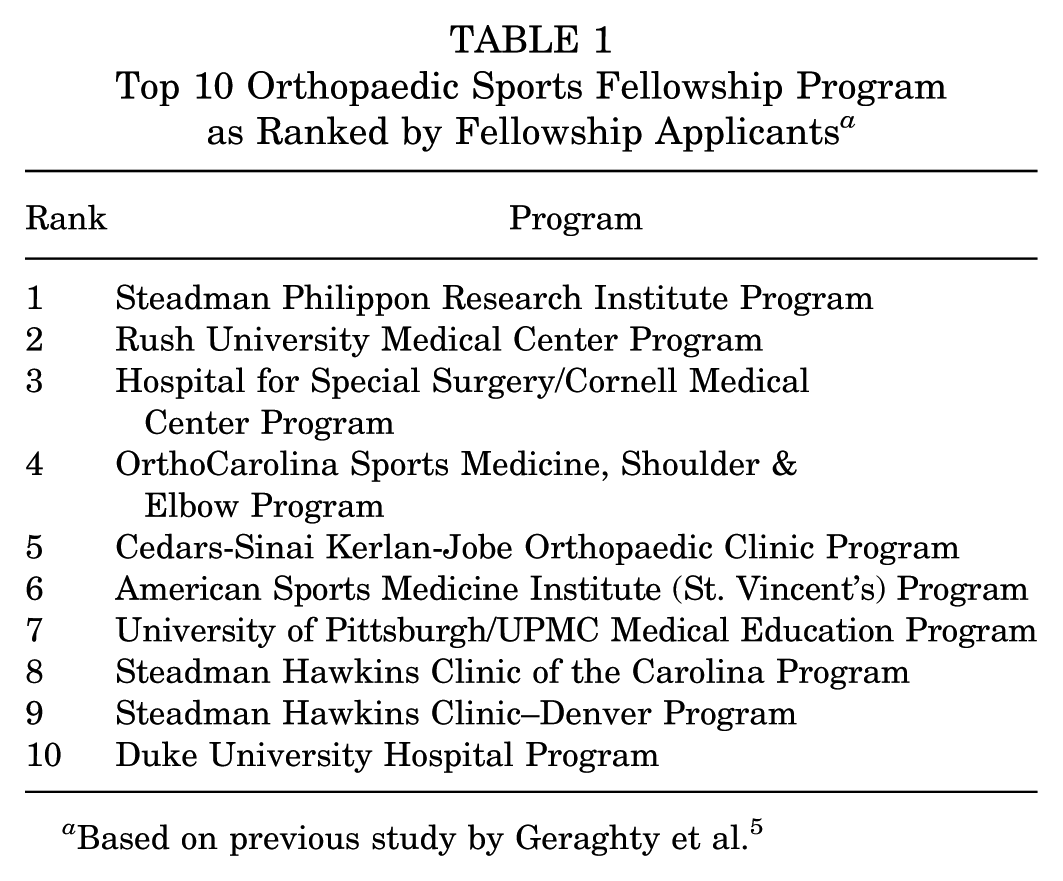
Based on previous study by Geraghty et al. 5
Data were collected from publicly available sources, including institutional websites, professional profiles, and publicly accessible research metrics such as PubMed, Scopus, and ResearchGate. Variables were extracted and verified by 2 independent reviewers (B.M.M., J.C.H.) to ensure accuracy and consistency, and discrepancies were resolved by a third independent author (E.H.R.). Interrater reliability was assessed using Cohen kappa coefficient and demonstrated strong agreement (0.87).
For each matched applicant, data were collected on residency program, sex, research productivity, and geographic region. Residency program tier was defined by whether the applicant trained at a top 20 orthopaedic residency program, based on the Doximity reputation ranking as of March 2025. These rankings are influenced by multiple factors, including program reputation, alumni feedback, and research output.7,18 We also recorded whether the applicant's residency was affiliated with one of the top 10 orthopaedic sports medicine fellowships. Geographic region was categorized based on definitions from the US Census Bureau: West (WA, OR, CA, ID, NV, UT, AZ, MT, WY, CO, NM, AK, and HI), Midwest (ND, SD, NE, KS, OK, MN, IA, WI, IL, MI, IN, OH, and WV), South (TX, MS, AR, LA, KY, TN, MO, AL, FL, GA, SC, NC, VA, and Puerto Rico), and Northeast (MD, Washington DC, PA, DE, NJ, NY, CT, MA, RI, VT, NH, and ME).
Research productivity was assessed through 3 metrics: total peer-reviewed publications, H-index, and sports publications. Total publication counts and sports publication counts were limited to those published up until January of the year before the applicant began fellowship, as this reflects the body of work available to programs when applications were submitted (eg, for 2020-2021 fellows, the cutoff was January 2019). H-index was determined using the applicant's current value as found on Scopus, as historical H-indices could not be retroactively assessed. Sports publications were defined as those published in a journal focused on sports medicine or orthopaedic sports surgery, or articles related to core sports procedures (eg, hip arthroscopy), regardless of the journal. Journals included but were not limited to the following: American Journal of Sports Medicine, Orthopaedic Journal of Sports Medicine, Journal of Shoulder and Elbow Surgery, Arthroscopy: The Journal of Arthroscopic and Related Surgery, and Journal of Bone and Joint Surgery when the topic specifically addressed sports-related content. Two independent reviewers (B.M.M., J.C.H.) evaluated each publication to determine whether it met criteria for inclusion.
Study Population and Inclusion Criteria
Applicants were included in the study if they successfully matched into one of the top 10 orthopaedic sports medicine fellowships during the years 2020 to 2025. Only individuals with verifiable academic and demographic data were included in the final analysis. Only programs where the entire fellowship class could be identified were included.
Statistical Analysis
Descriptive statistics were reported as means, standard deviations, and interquartile ranges for continuous variables, and as proportions for categorical variables. Two additional subgroup analyses were performed comparing male and female applicants, as well as applicants who matched into a top 5 research program and those who matched into programs ranked 6 to 10. Data were assumed to be nonparametric given low sample sizes. Categorical variables were compared using chi-square tests. Nonparametric Wilcoxon rank-sum tests were used to compare numeric variables. Multivariate backward elimination logistic regression was used to evaluate which applicant factors were most predictive of matching into a higher ranked (top 5) fellowship. The R2 statistic was used to maximize fit. All collected data were included.
Ethical Considerations
This study utilized publicly available data and did not involve direct interaction with human participants; thus, it was exempt from institutional review board approval.
Results
Demographics
Between 2020 and 2025, a total of 226 orthopaedic surgery applicants successfully matched into one of the top 10 orthopaedic sports medicine fellowship programs. Cedars-Sinai Kerlan-Jobe was omitted from this study because of incomplete matched fellow data and applicant profiles, leaving 9 orthopaedic sports medicine fellowship programs for analysis. Among the included fellows, 87.6% (n = 198) were male. The majority held a doctorate in medicine (MD) degree (99.1%), while 0.9% held a doctorate in osteopathic medicine (DO) degree.
Residency Program Ranking
Among matched applicants, 30.5% completed residency at a top 20 orthopaedic surgery program. Additionally, 12.3% of fellows trained at a residency affiliated with one of the top 10 orthopaedic sports medicine fellowships. These metrics varied by fellowship (Table 2).
Demographics and Residency Characteristics of Top 10 Sports Medicine Fellows (2020-2025) a

Data are presented as percentages.
Research
The mean H-index among matched fellows was 8.2 (SD, 7.8), with a median of 6 (IQR, 3-11). The mean total peer-reviewed publication count at the time of application was 12.4 (SD, 22.2), with a median of 6 (IQR, 2-15). The mean number of primary publications was 3.9 (SD, 5.7) and sports-related publications mean was 7.4 (SD, 21.4). Research productivity varied among matched fellows by fellowship program (Figure 1). Rush University fellows had the highest mean total publications at the time of application (34.6), while fellows at Steadman Hawkins Clinic of the Carolina Program reported the lowest mean at 1.8 publications.

Mean total publications, primary author publications, and sports publications of applicants accepted to top 10 fellowship programs over the years 2020 to 2025 at the time of application. ASMI, American Sports Medicine Institute; HSS, Hospital for Special Surgery; UPMC, University of Pittsburgh Medical Center.
Geographic Analysis
A total of 31.8% of applicants matched to a fellowship within the same geographic region as their residency training. This varied by fellowship program (Table 2).
Male Versus Female Applicants
There were no statistically significant differences between male and female applicants. A greater proportion of female applicants trained at a top 20 orthopaedic residency compared with their male counterparts (42.9% vs 28.8%) (Table 3). There were no statistically significant differences in research productivity between male and female applicants.
Comparison of Fellowship Applicants by Sex

Residency Ranking
Applicants from top 20 orthopaedic residency programs had significantly higher research productivity compared with those from non–top 20 programs. The mean total publication count was 22.2 versus 8.2 (P < .001), primary publication count 6.5 versus 2.8 (P < .001), H-index 12.9 versus 6.2 (P < .001), and sports-related publication count 14.0 versus 4.1 (P < .001) (Table 4; Figure 2).
Comparison of Fellowship Applicants From Top 20 Doximity-Ranked Orthopaedic Residencies Versus Nonranked Programs

Bold P values indicate statistical significance at P < .05.
Top 5 Versus 6 to 10 Fellowships
Applicants who matched to a top 5 fellowship had significantly higher research productivity than those in 6th- to 10th-ranked programs. The mean total publication count was 20.1 versus 4.7 (P < .001); primary publication count, 6.2 versus 1.6 (P < .001); H-index, 11.9 versus 4.4 (P < .001); and sports-related publications, 11.4 versus 1.9 (P < .001) (Figure 2). Additionally, top 5 matches were more likely to have trained at a top 20 orthopaedic residency (49.6% vs 10.8%; P < .001) and graduate from a residency program affiliated with a top 10 fellowship (20.9% vs 3.6%; P < .001) (Table 5).

Comparison of research productivity among applicants who matched into top 5 versus 6th- to 10th-ranked fellowship programs.
Comparison of Applicants Who Matched to Top 5 Versus 6th- to 10th-Ranked Orthopaedic Sports Medicine Fellowships a
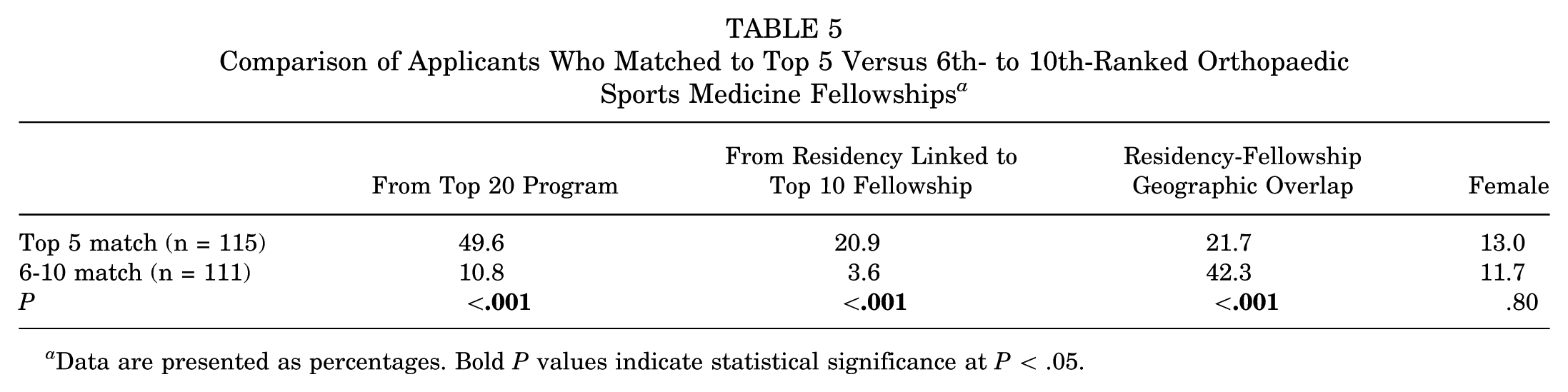
Data are presented as percentages. Bold P values indicate statistical significance at P < .05.
Further, in logistic regression the only factors that significantly influenced an applicant's ability to match into a top 5 fellowship program were coming from a top 20 residency program (odds ratio [OR], 3.4; 95% CI, 1.4-8.8; P < .01) and current H-index (OR, 1.17; 95% CI, 1.1-1.3, P < .01). R2 was maximized at 0.31.
Discussion
This study provides an objective analysis of factors associated with successful matches into top orthopaedic sports medicine fellowship programs, addressing a gap in the literature regarding quantifiable applicant characteristics. The salient findings of this study included that (1) residency program prestige conferred a measurable advantage in matching to top programs; (2) greater research productivity was linked to more competitive matches; (3) and applicant sex failed to show any significant effect on success rate. These results support our initial hypothesis that research productivity and training at a top-tier residency are associated with successful matching into top-ranked fellowships. Together, these findings highlight objective characteristics that may influence fellowship match outcomes and offer actionable insights for those navigating the application process.
The 10 orthopaedic sports medicine fellowship programs included in this analysis were selected based on previous rankings derived from applicant preferences, rather than objective institutional metrics such as research output. 5 Nevertheless, research productivity appears to be a critical factor in successfully matching to these highly sought-after positions. Our data suggest a direct relationship between program desirability and applicant academic output. Specifically, applicants matching into top 5 fellowships had, on average, nearly 4 times the number of total publications compared with those matching into fellowships ranked 6 through 10. Similar trends have been reported across other orthopaedic subspecialties, where applicants with higher publication counts demonstrate greater success in the fellowship match process.9,15,22 These findings support the notion that sustained engagement in research may serve as a key differentiator among highly competitive applicants.
Beyond total publication volume, the relevance of the research topic and level of involvement in manuscript preparation also appear to influence match outcomes. In this study, both the number of first-author publications and the number of sports medicine–related publications were significant predictors of matching into a top-tier program. These findings are consistent with previous work in other subspecialties, including shoulder and elbow surgery, where applicants with a higher number of first-author publications were more likely to be ranked favorably by fellowship programs. 20 First authorship likely reflects meaningful intellectual contribution and leadership in research efforts, while sports-specific publications may indicate a focused interest in the subspecialty and alignment with program priorities. It is possible that these factors reflect an ability to be autonomous and productive during the fellowship year, thereby making the applicant more sought after by program faculty. Taken together, these findings underscore the importance of not only the volume, but also the relevance and authorship role, of academic work in differentiating the most competitive fellowship candidates.
Although research involvement was a predictor of matching to a more desirable fellowship, it remains unclear whether research productivity directly influences selection decisions or serves as a surrogate for other applicant attributes. High research output may reflect strong mentorship, access to academic resources, networking opportunities, and the ability to balance scholarly activity with clinical demands. Sustained research engagement may also foster relationships with faculty mentors who can advocate during the selection process, making research a pathway for building professional networks. While a recent survey of orthopaedic sports medicine fellowship directors ranked research productivity as the fourth most important factor, following interview performance, letters of recommendation, and residency program quality, these elements may be more interconnected than they appear. 1 Applicants with robust research involvement are often those who have benefited from strong mentorship, trained at academically prestigious institutions, and earned faculty support through shared scholarly work.4,19 As such, research productivity may serve as an objective marker for the more subjective qualities that fellowship programs value. These trends may become even more relevant as medical education continues to shift away from traditional objective grading metrics, such as United States Medical Licensing Examination step 1 scores, Alpha Omega Alpha designation, and class rank. In this evolving landscape, factors such as residency reputation, research productivity, and letters of recommendation may play an increasingly prominent role in fellowship selection.
In addition to individual academic productivity, the prestige of an applicant's residency program was a significant factor in fellowship match outcomes. In this study, applicants from top 20 orthopaedic residency programs were more likely to match into a top 5 sports medicine fellowship compared with those from non–top 20 programs. This finding aligns with previous research suggesting that residency pedigree influences fellowship placement across orthopaedic subspecialties.10,11 It has been proposed that fellowship programs may use residency reputation as a screening tool when selecting applicants to interview, resulting in more interview opportunities for those from highly regarded institutions. 11 Training at a nationally recognized orthopaedic residency program may offer several advantages, including enhanced access to mentorship from faculty with established academic reputations and greater exposure to institutional research infrastructure. However, it is essential to acknowledge that residency program rankings are themselves influenced in part by research output. As a result, applicants from highly ranked programs may benefit from greater research opportunities, which could independently improve their competitiveness for a fellowship. This pattern may also reflect historically entrenched “pipelines,” as recent data suggest that top sports medicine fellowship programs frequently select applicants from a small number of the same residencies each year. 21 Although graduating from a highly ranked residency is not a prerequisite for matching into a top sports medicine fellowship, the data suggest it may confer a competitive advantage in an increasingly selective match environment.
In addition to academic and institutional factors, we examined sex representation among matched fellows. There were no statistically significant differences in any studied metric of research productivity between male and female applicants. However, only 12.3% of matched fellows in this cohort were women, which is lower than the proportion of female orthopaedic surgery residents nationally (~23%). 17 This finding is consistent with previous reports on female representation in orthopaedic sports medicine. 12 Because the percentage of female applicants to orthopaedic sports medicine fellowships during this period is unknown, these findings cannot be used to evaluate potential selection bias. Nonetheless, increasing overall female representation in orthopaedics may help address longstanding disparities in specific subspecialties. Previous studies have emphasized the importance of early exposure, mentorship, and inclusive recruitment strategies in supporting sex diversity.2,12
A final factor examined in this study was degree type. Although applicants holding either an MD or a DO degree are eligible to apply to orthopaedic sports medicine fellowships, DO applicants represented a very small minority of matched fellows in our cohort, and none matched into a top 5 program. This observation aligns with previous studies noting lower match rates for DO applicants in competitive orthopaedic residency programs. 3 However, because the percentage of DO applicants to these fellowships during the study period is unknown, we cannot conclude selection bias or broader application trends. The factors contributing to this pattern are likely multifactorial and warrant further investigation.
Limitations
This study has several limitations. First, the analysis was limited to applicants who successfully matched into top 10 most desirable orthopaedic sports medicine fellowship programs and therefore does not include data on unmatched applicants or those who matched into lower-ranked fellowships, limiting comparisons across the full applicant pool. Second, data were collected from publicly available sources, which may introduce information bias due to incomplete or outdated online profiles. Although data were independently verified by multiple reviewers, some variables, such as publication counts or program affiliations, may have been misclassified. Third, the current H-index was used as a proxy for research impact, but this may not accurately reflect academic productivity at the time of application. In particular, applicants who matched into top 5 programs may have published more during fellowship, potentially inflating their H-index. Another limitation involves the fellowship program rankings, which were based on previously published data evaluating the preferences of 107 applicants (approximately 14% of the total applicant pool) from a single fellowship program. 5 While this limited sample may reduce generalizability, we selected these rankings as a consistent and reproducible method of identifying highly sought-after programs. They were not intended to represent program quality, as fellowship selection is highly individualized and influenced by factors such as clinical interests, geography, and mentorship. Previous studies have shown that most applicants match into one of their top choices, reinforcing the subjective nature of program rankings. 13 Additionally, research productivity and residency program prestige may be interrelated, as applicants from top-tier institutions often have greater access to mentorship and academic resources. This may contribute to a pipeline effect, where early advantages influence both research output and match outcomes. Finally, the retrospective design of this study limits the ability to draw causal conclusions, and other unmeasured factors such as interview performance, strength of letters of recommendation, or mentorship relationships also contribute meaningfully to match outcomes.
Conclusion
This study highlights key applicant characteristics linked to successful matches at highly sought-after orthopaedic sports medicine fellowship programs. Higher research output and completion of residency at a top-ranked institution were significantly associated with matching into higher-ranked fellowships. These findings may serve as a valuable reference for applicants seeking to enhance their profiles and for program directors evaluating trends in the selection landscape.
Footnotes
Final revision submitted August 2, 2025; accepted September 1, 2025.
One or more of the authors has declared the following potential conflict of interest or source of funding: R.M.F. is a board or committee member of the American Academy of Orthopaedic Surgeons, AOSSM, American Shoulder and Elbow Surgeons, Arthroscopy Association of North America, International Cartilage Regeneration & Joint Preservation Society, and International Society of Arthroscopy, Knee Surgery, and Orthopaedic Sports Medicine; is on the editorial or governing board of Journal of Shoulder and Elbow Surgery and Orthopedics Today; is a paid speaker for Allosource, Arthrex, JRF, and Ossur; receives research support from Arthrex, Aesculap Biologics, and Smith & Nephew; receives consulting fees from Allosource, Arthrex, and JRF; and receives publishing royalties and financial or material support from Elsevier. E.C.M. is a board or committee member of AOSSM, the American Journal of Sports Medicine, Orthopedics, and Orthopedics Today; is president-elect of the AOSSM; receives research support from Arthrex, Breg, Ossur, and Smith & Nephew; receives publishing royalties and material support from Elsevier; is a paid speaker for Vericel; is a paid consultant for Zimmer; and receives royalties and has intellectual property interests with Zimmer Biomet Holdings, Inc. AOSSM checks author disclosures against the Open Payments Database (OPD). AOSSM has not conducted an independent investigation on the OPD and disclaims any liability or responsibility relating there to.
Ethical approval was not sought for the present study.
