




Abstract
Background:
While most baseball fields have dirt pitching mounds, some fields have turf mounds. In addition, portable turf surface mounds are often used for bullpen or practice sessions, off-season training, or when assessing pitching mechanics in a biomechanics laboratory. Pitching on dirt surface mounds permits metal cleats to be worn, which are often discouraged on turf surface mounds because of potential damage to the turf.
Purpose:
To assess differences in shoulder and elbow kinetics and pitching kinematics in college pitchers between pitching on a dirt surface mound with metal cleats versus pitching on a turf surface mound with turf shoes.
Study Design:
Controlled laboratory study.
Methods:
A total of 18 college pitchers pitched both on a dirt surface mound and on a turf surface mound. All pitchers were tested using a 240-Hz, 12-camera motion analysis system, and 28 kinematic and 7 kinetic parameters were calculated. Differences in kinematic and kinetic parameters between pitching on dirt surface and turf surface mounds were assessed with paired within-participant t tests employing the Benjamini-Hochberg method to correct for multiple comparisons (adjusted P < .05).
Results:
Two kinetic parameters showed significant differences, with maximal elbow varus torque (to resist valgus loading) and maximal shoulder internal rotation torque significantly greater when pitching on a dirt surface mound compared with pitching on a turf surface mound. Maximal lead knee height, elbow flexion, knee flexion, rotational separation between upper trunk and pelvis, maximal shoulder external rotation, and forward trunk tilt were significantly greater when pitching on a dirt surface than on a turf surface. Pelvic drift at maximal lead knee height and arm slot angle were significantly greater pitching on a turf surface than on a dirt surface.
Conclusion:
Of the 35 kinematic and kinetic comparisons, 10 of the comparisons (29%) were significantly different between pitching on a dirt surface mound and pitching on a turf surface mound. Kinematic differences only involved body segment and joint positions and not angular velocity magnitudes or timings. Kinetic differences demonstrated that elbow valgus and shoulder loading were slightly greater pitching on a dirt surface with metal cleats compared with pitching on a turf surface with turf shoes.
Clinical Relevance:
Compared to pitching on a dirt surface mound, pitching on a turf surface mound may decrease joint stress and injury risk for the throwing shoulder and elbow, although differences in kinematics between mounds should also be considered.
Keywords
There are various types of portable pitching mounds with various types of turf surfaces that are used in baseball training facilities and research laboratory settings9-11,13,17,18 to simulate pitching biomechanics in a baseball game. On occasion, these portable turf surface mounds are used in baseball games. However, baseball pitchers typically pitch on dirt (clay) surface mounds in baseball games, and not on a turf surface, which allows them to wear baseball cleats with metal spikes (known as metal cleats). Metal cleats are commonly used among high school, college, and professional baseball pitchers, which help prevent the feet from slipping while pitching, and promote a stable landing base in which to transfer energy from the ground to the lower extremity, trunk, and upper extremity.1,2 A proper transfer of energy up the kinetic chain enhances mechanical pitching efficiency and may decrease injury risk during pitching.1,2 In contrast, nonmetal cleats are also used by younger baseball pitchers, and these include molded thermoplastic polyurethane (TPU) and molded rubber cleats, which are more common in youth and little league baseball given metal cleats are generally not allowed. Molded cleats use rubber or hard plastic studs that are permanently attached to the sole, offering comfort and flexibility, while TPU cleats feature harder plastic spikes for a more aggressive grip, often with a lighter and stiffer sole. Pitchers who pitch on a turf surface mound, such as portable turf mounds, often use baseball turf shoes, which have a relatively flat sole with numerous very small rubber studs that do not cause damage to the turf surface. Gdovin et al19,20 conducted the only known studies that assessed pitching biomechanics and lower extremity muscle activation between molded cleats and turf shoes, using youth baseball pitchers who pitched both on artificial turf surface mound and on flat ground.19,20
Not using metal cleats may adversely affect mechanical pitching efficiency and pitching kinematics (ie, body segment positional orientation and speeds of movement) and kinetics (eg, shoulder and elbow forces and torques). Moreover, portable pitcher's mounds with a turf surface are legal and can and sometimes are used in high school or college baseball games. 4 These aforementioned characteristics between dirt and turf surface mounds make it important to know if pitching biomechanics differ between pitching from these 2 mound surfaces while wearing different types of shoes. However, it should be emphasized that not all portable mounds with turf surfaces are the same and some portable turf surface mounds are advertised to be “spike resistant” and thus allowing metal cleats. For example, the website for the “ProMounds Collegiate Practice Pitching Mound with Green Turf” states the following: “This 4' wide mound is made with high density foam, PRAT (ProMounds Rubber Armor Technology) technology, spike resistant artificial turf and a built-in pitching rubber…The spike resistant artificial turf completes the mound giving you a real game feel” (https://www.promounds.com/collegiate-pitching-mound-with-green-turf). Nevertheless, metal cleats are generally not recommended for use on mounds with a turf surface because they can damage the turf, and the wear and tear of the spikes can decrease the overall life expectancy of the mound from 5 to 8 years down to only 1 year (https://portablepitchingmounds.com/frequently-asked-questions/).
In addition to dirt versus turf mound surface and metal cleats versus turf shoes footwear, another important consideration when assessing pitching biomechanics from portable dirt and turf surface mounds is mound dimensions, which should be constructed in accordance with official baseball rules for whatever level of pitching that is occurring. Mound dimensions do vary between youth/little league pitchers and pitchers at high school, college, and professional levels. However, pitching mound dimensions are the same for all baseball games played on regulation fields where the pitching distance is 18.44 m (60 ft, 6 inch) and the distance from base to base (the base path) is 27.43 m (90 ft), which includes all baseball games at high school, college, and professional levels, and these mound dimensions are in accordance with Official Baseball Rules: 2024 Edition. 21
Fleisig et al 15 and Diffendaffer et al 7 conducted the only known 2 studies that compared pitching biomechanics between mounds of different dimensions; both of these studies examined pitching biomechanics while throwing full-effort fastballs on varying mound heights. Using youth (age, 12.6 ± 0.5 years) pitchers who threw from both 15 cm (6 inch) and 25 cm (10 inch) mound heights, Fleisig et al 15 reported 10 significant differences in pitching kinematics between the 2 mound heights, but no significant differences in ball velocity, shoulder kinetics, and elbow kinetics between the 2 mounds. Diffendaffer et al conducted a similar mound height study, but these authors used college pitchers instead of youth pitchers and examined 4 different mound heights (15 cm, 20 cm, 25 cm, 30 cm) instead of 2 mound heights. Diffendaffer et al reported 7 significant pitching kinematic differences and 5 significant pitching kinetic differences among the different mound heights.
However, there are no known studies that have examined the biomechanical effects of pitching from regulation size turf and dirt surface mounds. Therefore, the purpose of this study was to compare pitching biomechanics between pitching from a regulation turf surface mound compared with pitching from a regulation dirt surface mound. We hypothesized that relatively few pitching kinematic and kinetic significant differences would occur between pitching on regulation turf versus dirt surface mounds.
Methods
A total of 18 college baseball pitchers participated in this study at the end of their competitive baseball season. The institutional review board at California State University, Sacramento (Sacramento, CA, USA) approved this study. Exclusion criteria included all pitchers injured at the time of testing, pitchers who had undergone elbow or shoulder surgery within the previous 18 months, pitchers who could not pitch with maximal effort, pitchers who pitched with a sidearm or submarine delivery (ie, arm slot angles >70° as previously defined 10 ). Inclusion criteria included healthy pitchers who all employed a windup pitching delivery in baseball games, pitchers who pitched with overhead or three-quarter delivery (ie, arm slot angles <70° as previously defined 10 ), pitchers who exclusively wore turf shoes only when pitching on turf surface mounds, pitchers who wore metal cleats only when pitching on dirt surface mounds, and pitchers who had ≥3 years’ experience pitching on both dirt surface mounds wearing metal cleats and pitching on turf surface mounds wearing turf shoes.
A “Real Feel Portable” pitching mound (Athalonz) was used during all pitching trials. This mound could be converted between a dirt (clay) surface mound (Figure 1) and a turf surface mound (Figure 2).

Pitching on a dirt surface mound.
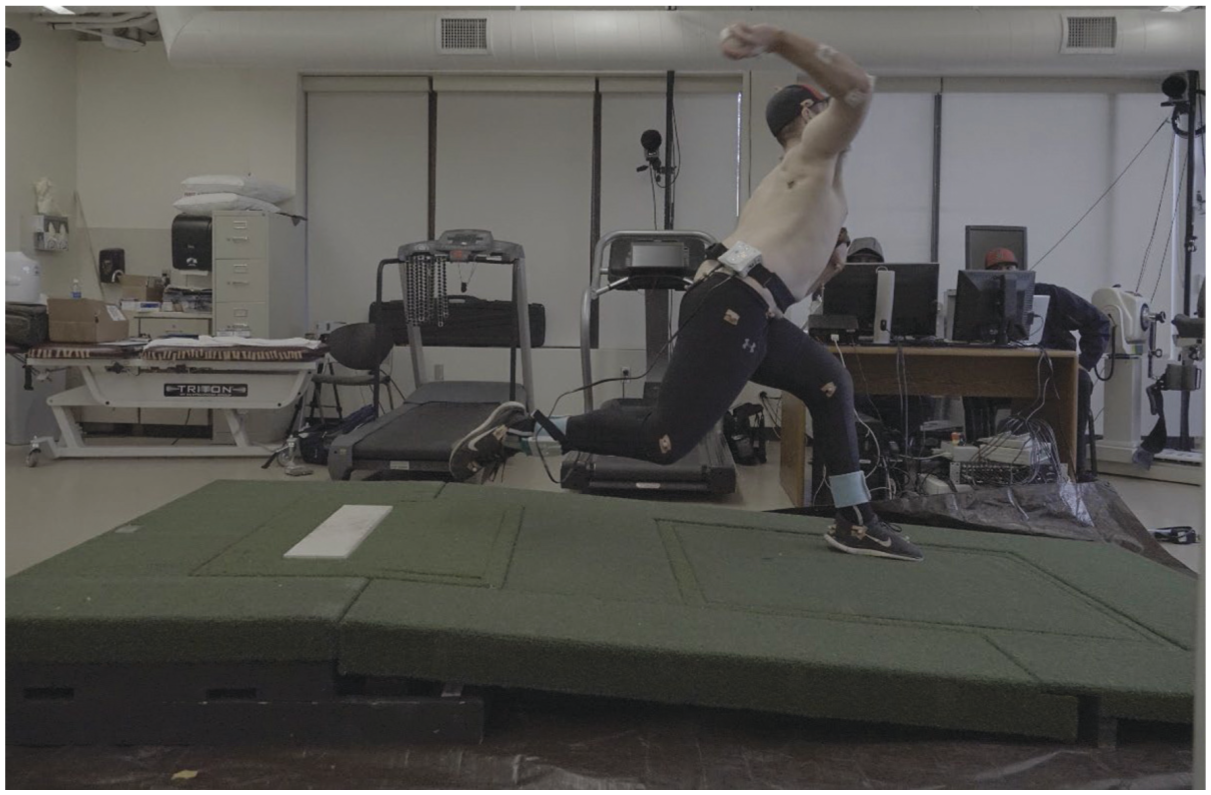
Pitching on a turf surface mound.
The pitching mound dimensions for both the turf surface and dirt surface mounds were in accordance with Official Baseball Rules: 2024 Edition. 21 Specifically, the size of the pitching rubber (plate) was 61 cm (24 inch) by 15 cm (6 inch), was 25 cm (10 inch) above home plate level, and was 15 cm (6 inch) from the start of the sloped section. The sloped section was 183 cm (6 ft) long toward home plate with a rise to run ratio of 2.54 cm (1 inch) vertical drop for every 30 cm (12 inch) horizontal distance (5° slope). A level area on top of the mound was 15 cm (6 inch) in front of the pitching rubber, 46 cm (18 inch) to each side of the rubber, and 56 cm (22 inch) to rear of the rubber, making the level area 152 cm (5 ft) wide by 86 cm (34 inch) deep, which included the 15-cm width of the pitcher's rubber. For the dirt surface mound, the sloped section contained a 91 cm (3 ft)–wide removable landing tray filled with 57,000 cm3 of professional grade Hilltopper mound clay (136 kg, 300 lbs), and it accommodated up to a 213-cm (7-ft) stride from the pitcher (Figure 1). Moreover, the top-level section (which included pitching rubber) contained a removable drive tray filled with 21,000 cm3 of professional grade Hilltopper mound clay (45 kg, 100 lbs) (Figure 1). The drive and landing trays of clay for the dirt surface mound (Figure 1) could be removed and replaced with drive and landing trays of artificial turf and converted to a turf mound with artificial turf surface (Figure 2). As mentioned previously, metal cleats were not recommended on the artificial turf surface because they could damage and increase the wear and tear of the turf. The drive and landing trays for the dirt surface mound were of exactly the same size and dimensions as the drive and landing trays for the turf surface mound (Figures 1 and 2).
Although all participants had previous experience pitching on outdoor field dirt surface mounds wearing metal cleats and portable turf surface mounds wearing turf shoes, they had never pitched from a portable dirt mound before. Therefore, all participants came in to the biomechanics lab 1 week before testing to get acclimated to pitching on the portable turf surface and dirt surface mounds that were used in testing. When using the dirt mound, all participants wore their metal cleats that they wore during baseball games. When pitching on the turf surface mound, all participants wore turf shoes that they normally wore when they pitched on turf surface mounds. All participants acknowledged that they felt comfortable pitching on both the turf and the dirt surface mounds and that the dirt surface mound felt similar to pitching on the dirt surface mounds during real baseball games. After being acclimated to pitching on the portable turf and dirt surface mounds, all participants filled out a 2-item questionnaire asking them to give an overall pitching experience pitching on the dirt surface and turf surface mounds, with the choices being poor (1), fair (2), average (3), good (4), and exceptional (5).
A total of 38 retroreflective markers were attached to each participant's trunk, upper extremity, and lower extremity and standardized as previously described.9,11,15,18 With markers attached, each participant performed his pregame warm-up regimen of stretching, nonthrowing drills, throwing drills, pitching on the mound, and other desired preparation. Each participant was instructed to prepare as if he were pitching in a baseball game. The warm-up was not standardized because high-level pitchers (eg, college, professional) are specific in how they warm up and each pitcher has his own warm-up regimen. Once a participant indicated he was ready to pitch, he threw 5 full-effort fastball pitches from the dirt surface mound and 5 full-effort fastball pitches from the turf surface mound using a windup pitching delivery, directed toward a strike zone positioned 18.44 m from the pitching rubber. To minimize an order effect, half of the participants pitched first from the dirt surface and then from the turf surface, and the other participants pitched first from the turf surface and then from the dirt surface. Ball velocity was measured at ball release using a Stalker Sport 2 digital sports radar gun (Stalker Radar). A Digital Real-Time 12-camera motion analysis system (Qualisys) was employed to collect 3-dimensional motion data for each pitch at 240 Hz. Data were processed using Qualisys analysis software and BioPitch software (Version 12.0; American Sports Medicine Institute).
Position-time data from all fastball pitches were filtered employing a fourth-order Butterworth low-pass filter with a cutoff frequency of 13.4 Hz. Joint centers of the wrists, elbows, ankles, and knees were defined as the midpoints between their respective medial and lateral markers, while each hip joint was defined as a point 10% inward from the trochanter marker toward the contralateral trochanter marker.8,10,16,17 Any gaps were filled by interpolation.
The pitching motion was defined by phases (Figure 3) 16 : windup (initial movement to maximal knee height), stride (maximal knee height to foot contact), arm cocking (foot contact to maximal shoulder external rotation), arm acceleration (maximal shoulder external rotation to ball release), arm deceleration (ball release to maximal internal rotation), and follow-through (maximal internal rotation to end of motion).

Phases and key events of a pitch. 16 ER, external rotation; IR, internal rotation; Max, maximal.
Pitching kinetic and kinematic parameters were calculated for the 5 fastball pitches and averaged, as previously described.9,11,15,18 Four kinetic parameters (Figure 4) 16 were measured near the instant of maximal shoulder external rotation (elbow varus torque, shoulder horizontal adduction torque, shoulder internal rotation torque, and anterior shoulder force), and the remaining 3 kinetic parameters (Figure 3) 16 were measured near the instant of ball release (elbow flexion torque, elbow proximal force, and shoulder proximal force).

Definition of kinetic parameters: (A) forces applied by the trunk to the upper arm at the shoulder, (B) torques applied by the trunk to the upper arm about the shoulder, (C) forces applied by the upper arm to the forearm at the elbow, and (D) torques applied by the upper arm to the forearm about the elbow.
Of the 28 kinematic parameters (Figure 5), 16 2 were measured during the windup: maximal knee height (expressed as percentage of body height) and pelvic drift (distance from throwing side ankle to midpoint of pelvis in direction toward home plate) at the instant of maximal knee height. Ten kinematic parameters were measured at the instant of lead foot contact: (1) elbow flexion (Figure 5A); (2) shoulder external rotation (Figure 5B); (3) shoulder horizontal adduction (Figure 5C); (4) shoulder abduction (Figure 5D); (5) knee flexion (Figure 5F); (6) stride length (Figure 5H); (7) foot position (Figure 5H); (8) foot angle (Figure 5H); (9) pelvic rotation—straight line from rubber to home plate was defined as 0º and became more positive as the pelvis “opened” and faced the batter (Figure 5, G and H); (10) rotational separation between pelvis and upper trunk—straight line from rubber to home plate was defined as 0º and became more positive as the pelvis or upper trunk opened and faced the batter and negative when pelvis or upper trunk rotated away from the batter (Figure 5, G and H).

Definition of kinematic parameters: (A) elbow flexion, (B) shoulder external rotation, (C) shoulder horizontal adduction, (D) shoulder abduction (E) contralateral (lateral) trunk tilt and arm slot angle, (F) knee flexion and forward trunk tilt, (G) pelvic angular velocity and upper trunk angular velocity, and (H) stride length, foot angle (shown in “closed” position), and foot position (shown in “open” position).
Three kinematic parameters were measured near the instant of maximal shoulder external rotation: (1) maximal elbow flexion; (2) maximal shoulder horizontal adduction; and (3) maximal shoulder external rotation. Seven kinematic parameters were measured at the instant of ball release: (1) ball velocity, (2) elbow flexion, (3) shoulder abduction, (4) forward trunk tilt (Figure 5F), (5) lateral trunk tilt (Figure 5E), (6) arm slot angle (Figure 5E), and (7) knee flexion. Four angular velocity kinematic parameters of the pelvis (Figure 5G), upper trunk (Figure 5G), elbow extension, and shoulder internal rotation occurred during arm cocking and arm acceleration phases. Timings of maximal pelvic angular velocity and maximal upper trunk angular velocity were represented on a normalized time scale, where 0% was the time at lead-foot contact and 100% was the time at ball release.
Differences in kinematic and kinetic parameters between pitching on a dirt surface mound and pitching on a turf surface mound were assessed using paired t tests, employing SPSS statistical software (Version 29; IBM SPSS, Inc). To correct for multiple comparisons, all unadjusted 2-tailed P values were ranked and the Benjamini-Hochberg method was applied to control the false discovery rate, employing a level of significance of P < .05 for adjusted P values.
Results
The participants’ mean ± SD age, body mass, and height were 19.4 ± 0.5 years, 86.6 ± 8.9 kg, and 188.4 ± 4.9 cm, respectively. Shoulder and elbow kinetics between pitching on a dirt surface mound versus pitching on a turf surface mound are shown in Table 1. Only 2 of the 7 kinetic parameters showed significant differences, with maximal elbow varus torque and maximal shoulder internal rotation torque being significantly greater pitching on a dirt surface compared with pitching on a turf surface.
Maximal Shoulder and Elbow Forces and Torque Between Dirt Surface and Turf Surface Mounds a

Data are presented as mean ± SD.
Significant difference (adjusted P < .05) between dirt and turf surface mounds.
Body segment and joint positions between pitching on a dirt surface mound versus pitching on a turf surface mound are shown in Table 2. During windup, maximal lead knee height was significantly greater pitching on a dirt surface compared with a turf surface, and pelvic drift at maximal lead knee height was significantly less pitching on a dirt surface compared with a turf surface. At lead foot contact, elbow flexion, knee flexion, and rotational separation between upper trunk and pelvis were significantly greater pitching on a dirt surface compared with a turf surface. Maximal shoulder external rotation was significantly greater pitching on a dirt surface compared with a turf surface. At ball release, forward trunk tilt was significantly greater pitching on a dirt surface compared with a turf surface, and arm slot angle was significantly less pitching on a dirt surface compared with a turf surface.
Body Segment and Joint Position Between Dirt Surface and Turf Surface Mounds a
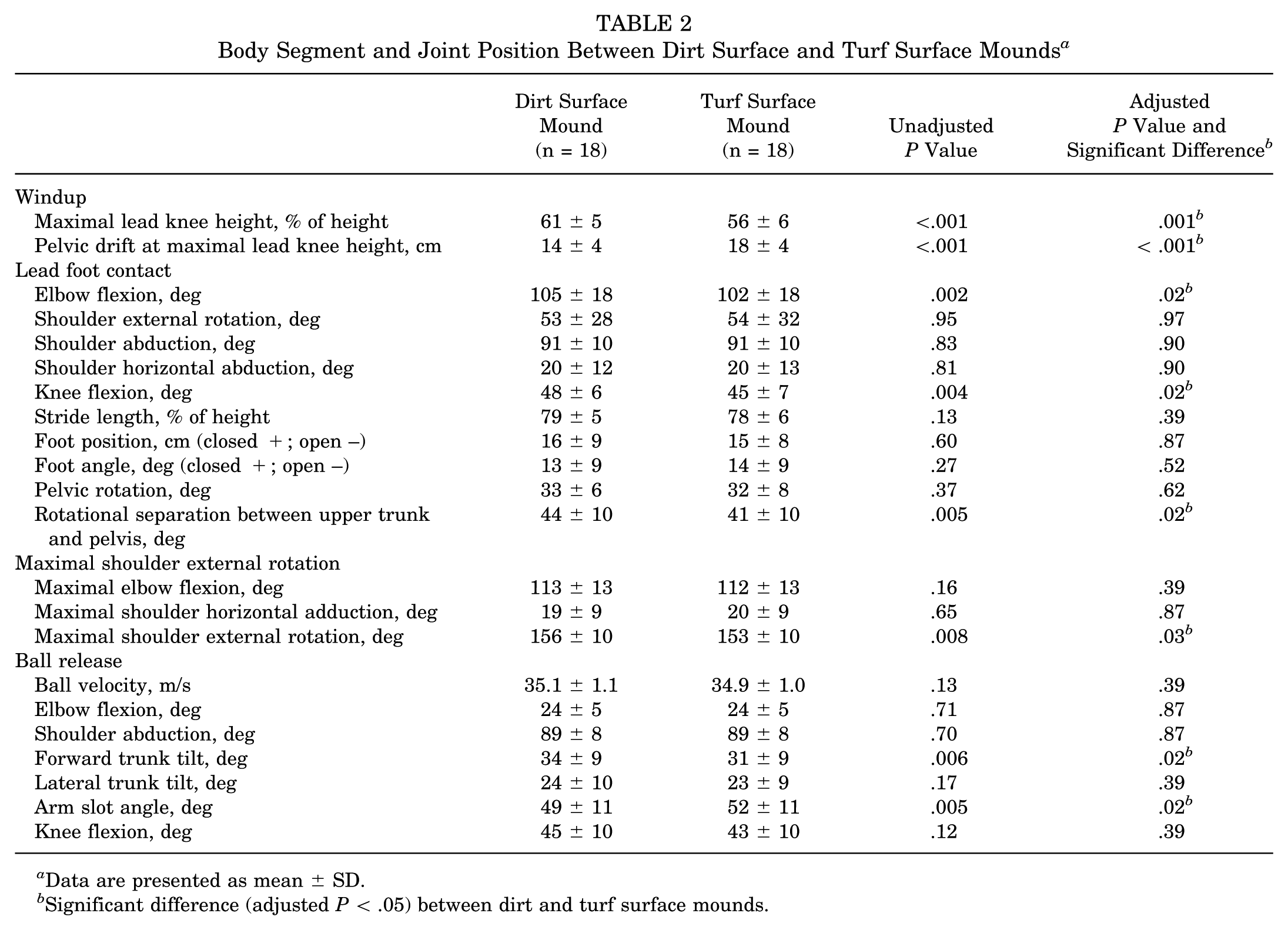
Data are presented as mean ± SD.
Significant difference (adjusted P < .05) between dirt and turf surface mounds.
The magnitude and timing of maximal angular velocities between pitching on a dirt surface mound versus pitching on a turf surface mound are shown in Table 3, and there were no significant differences.
Magnitude and Timing of Maximal Angular Velocity Between Dirt Surface and Turf Surface Mounds a

Data are presented as mean ± SD. Timing parameters are expressed on a normalized time scale, where 0% is the time of lead foot contact and 100% is the time of ball release.
Significant difference (adjusted P < .05) between dirt surface and turf surface mounds.
From the 2-item questionnaire, the overall mean ± SD experience pitching was 4.3 ± 0.7 for the dirt surface mound and 3.9 ± 0.6 for the turf surface mound. Based on a paired t test result, there was no significant difference (P = .13) in the rating of the overall experience between pitching from dirt and turf mounds.
Discussion
As hypothesized, kinematic and kinetic differences were found between pitching on a dirt surface mound wearing metal cleats and pitching on a turf surface mound with turf shoes. This combination of cleat/shoe and mound surface is important because there are multiple different types of baseball cleats and shoes that are used on multiple different types of dirt/turf mound surfaces.
Of the 35 kinematic and kinetic comparisons, just over a quarter of these comparisons (10 out of 35) resulted in significant differences. Although this implies that overall pitching mechanics in college pitchers are more similar than different between pitching from dirt and turf surface mounds, the numerous kinematic and kinetic differences that were found suggest that pitching kinematics and kinetics do differ some between dirt and turf surface mounds. Given that college pitchers pitch on a dirt surface mound and not a turf surface mound in most baseball games, the results of this study are important in assessing how pitching biomechanics differ between pitching on a dirt surface mound compared with a turf surface mound. However, the current study only assessed 2 very specific mounds and mound surfaces, and pitching biomechanics on additional dirt and turf surface mounds should be assessed in the future. Because of these pitching kinematic and kinetic differences, and given that most high school, college, and professional baseball games are played on dirt surface mounds, turf surface mounds should only be employed in the off-season by youth/little league pitchers, and dirt surface mounds should be employed in the preseason and in-season for older pitchers who normally pitch on dirt surface mounds.
Elbow injury risk was indirectly assessed based on kinetic values, with greater elbow kinetics being associated with potential greater elbow injury risks.3,12 With the current epidemic of medial elbow injuries of the ulnar collateral ligament (UCL) in baseball pitchers, one kinetic variable of particular interest is maximal elbow varus torque, which was significantly greater when pitching on a dirt surface mound compared with pitching on a turf surface mound. Elbow varus torque, generated to resist elbow valgus, is important because it has been associated with elbow injuries, including UCL injuries.3,12 Anz et al 3 reported a significant association between elbow injury and elbow varus torque, reporting that at maximal external rotation their injured group had significant greater elbow varus torque (91.6 N·m) compared with their noninjured group (74.7 N·m). The 91.6-N·m elbow varus torque value by Anz et al in their injured group is nearly identical to the 91.8-N·m elbow varus torque values when pitching on a dirt surface mound, which implies that the college pitchers examined in the current study may be at risk of UCL injuries. Moreover, the risk of UCL injury may be slightly greater when pitching on a dirt surface mound compared with pitching on a turf surface mound. Repetitive elbow varus torque puts strain on the UCL,3,12 which is the primary static restraint to elbow valgus during pitching. Part of the reason UCL injuries in high-level pitchers (eg, college and professional) are increasing, with approximately 1 in 4 major league professional pitchers injuring their UCL, 6 is because a direct relationship has been reported between ball velocity, maximal elbow varus torque, and UCL injuries in higher level pitchers. 5 However, although in the current study ball velocity was slightly greater pitching on a dirt surface (35.1 ± 1.1 m/s) compared with pitching on a turf surface (34.9 ± 1.0), this difference was not statistically significant. Moreover, although elbow varus torque was significantly less pitching on a turf surface compared with a dirt surface, the difference was only 3% to 4% (3.1 Nċm from Table 1). Nevertheless, it is possible that even small increases in elbow torque done repetitively pitch after pitch may overload and fatigue muscles and strain ligaments over time, increasing elbow injury risk over time, although future research is needed to test this hypothesis.
Shoulder injury risk was also indirectly assessed based on kinetic values, with greater shoulder kinetics associated with potential greater shoulder injury risks.3,12 Given that overall shoulder kinetics were slightly higher when pitching on a dirt surface mound compared with pitching on a turf surface mound, pitching on a dirt surface may result in slightly higher shoulder injury risk compared with pitching on a turf surface. Although shoulder internal rotation torque was significantly less pitching on a turf surface compared with pitching on a dirt surface, the difference was only 3% to 4% (3.5 Nċm from Table 1). Nevertheless, it is possible that even small increases in shoulder internal rotation torque done repetitively pitch after pitch may overload and fatigue muscles and strain ligaments over time, increasing shoulder injury risk over time, although future research is needed to test this hypothesis.
Given that in-season pitching will typically involve pitching on a dirt surface mound for college pitchers (high-level and professional pitchers also), pitching on a turf surface mound may be most appropriate in the off-season given overall lower shoulder and elbow torques. Then, as preseason approaches, a transition to dirt surface mounds should occur to progress overall loading. This can also potentially decrease stress and strain on the shoulder and elbow in the off-season. Moreover, Fleisig et al 14 reported slightly less elbow varus torque and shoulder internal rotation torque during 37-m flat-ground throws compared with pitching on a turf surface mound. Therefore, progressing from lower to higher shoulder and elbow kinetics from off-season to preseason might involve ≤37 m flat-ground throwing initially, gradually progressing to longer distance flat-ground throwing (eg, between 37 m and 55 m), then progressing to pitching on a turf surface mound, and finally progressing to pitching on a dirt surface mound. This progression allows gradual shoulder and elbow loading from off-season to preseason to in-season.
Although 30% of the 28 kinematic variables were significantly different between pitching from turf and dirt surface mounds, most of these differences were relatively small (between 2% and 10%). Nevertheless, all 8 of the significant differences shown in Table 2 are believed to be clinically important between pitching from dirt and turf surface mounds because even small increases in elbow and shoulder stress done repetitively pitch after pitch may overload and fatigue muscles and strain ligaments over time, increasing elbow and shoulder injury risk, although future research is needed to test this hypothesis. Of interest, the only kinematic differences that were significant involved body segment and joint positions, as there were no significant differences in angular velocity magnitudes or timings. These significant differences suggest that pitching mechanics differ some between pitching on a turf surface and pitching on a dirt surface. This implies that the mound surface (dirt vs turf) and footwear (metal cleats vs turf shoes) had an effect on the position of body segments and joint angles, but did not affect movement speeds of the pelvis, upper torso, elbow, or shoulder. These kinematic differences were likely influenced by the significant kinetic differences observed. This is an important reason why pitching on a turf surface should only occur in the off-season and not in the preseason or in-season, where pitching should be as specific as possible and under the same conditions as those that occur in baseball games.
The only other known studies that examined pitching biomechanics while pitching on different types of pitching mounds were conducted by Fleisig et al 15 and Diffendaffer et al, 7 and both these studies examined pitching biomechanics while pitching from mounds of varying heights, not from mounds of different surfaces. Like the current study, those authors reported a limited number of pitching kinematic and kinetic differences between pitching on different height mounds. Therefore, pitching biomechanics are more similar than different when pitching on mounds with either varying dimensions (ie, different mound heights) or varying surfaces (dirt vs turf).
During windup, the greater maximal lead knee height pitching on a dirt surface mound compared with a turf surface mound may have been due to pitchers’ feeling more stable and with a more natural environment with metal cleats on a dirt surface compared with turf shoes on turf surface. Although the difference was not significant, the overall experience pitching on a dirt surface was rated higher than pitching on a turf surface from the 2-item questionnaire, and this higher rating may have given the pitchers more confidence as well as a sense of greater stability pitching on a dirt surface compared with pitching on a turf surface.
Limitations
One important limitation in the current study is that only 1 specific type of portable turf surface mound and 1 specific type of portable dirt surface mound were tested, and there are numerous pitching mounds with various turf and dirt surfaces that are used in baseball for training, bullpen sessions, pitching biomechanical testing, and sometimes even in baseball games. Further research is needed to assess pitching biomechanics on different turf and dirt surfaces compared with the turf and dirt surfaces used in the current study. Moreover, different types of baseball cleats and shoes should also be assessed, especially in pitchers who do not wear metal cleats and pitch on dirt surface mounds exclusively. Another limitation is that arm slot pitching styles only involved pitchers who employed overhead or three-quarter pitching deliveries, and these arm slots have been previously defined. 10 Pitchers who employed side arm or submarine pitching styles were excluded from the current study. Therefore, future research should examine pitching biomechanics in sidearm and submarine style pitchers between pitching on a turf surface and pitching on a dirt surface. Another limitation is the rectangular dimensions of the portable mound. Real mounds during baseball games are large circles 5.5 m (18 ft) in diameter. Nevertheless, all participants acknowledged that they felt comfortable pitching from both turf and dirt surface mounds and that the dirt surface felt similar to pitching from the dirt surface used during real baseball games. Another limitation is that there were no ground-reaction force data collected from the lead foot to assess the ground-reaction forces generated from metal cleats landing on a dirt surface mound and from turf shoes landing on a turf surface mound, and this should be the focus of future research.
Conclusion
Of the 35 kinematic and kinetic comparisons, 10 of the comparisons (29%) revealed significant differences between pitching on a dirt surface mound versus pitching on a turf surface mound. This implies that although overall pitching mechanics are more similar than different when pitching on dirt and turf mounds, several pitching mechanics are different and should be considered when deciding if and when turf or dirt mounds will be used throughout the year. Shoulder and elbow kinetics revealed that pitching on a dirt surface mound with metal cleats resulted in slightly higher elbow valgus and shoulder loading compared with pitching on a turf surface mound with turf shoes. Kinematic differences only involved body segment and joint positions and not angular velocity magnitudes or timings. If baseball pitchers throw primarily on dirt surface mounds in baseball games, then pitching on turf surface mounds is more appropriate in the off-season, while dirt surface mounds should be used exclusively in the preseason and in-season.
Footnotes
Acknowledgements
The authors acknowledge Michael Sousa-Johnson, Ryan Anthony Angeles, Scott Jurgens, and Tim Markison, JD, BS, and his staff, for all their assistance in helping to collect data during all pitching trials.
Final revision submitted June 18, 2025; accepted July 15, 2025.
The authors declared that there are no conflicts of interest in the authorship and publication of this contribution. AOSSM checks author disclosures against the Open Payments Database (OPD). AOSSM has not conducted an independent investigation on the OPD and disclaims any liability or responsibility relating thereto.
Ethical approval for this study was obtained from California State University, Sacramento.
