




Abstract
Background:
Adventure sports have grown in popularity over the past several decades, with evidence of more significant growth since the beginning of the COVID-19 pandemic. Previous literature has described head and neck injuries for this group of sports, although neither general musculoskeletal injuries nor injuries during the pandemic have been described.
Purpose:
To determine whether rates of adventure sports injuries changed from before to during and after the pandemic, using 10 years of national emergency department (ED) data, and to describe injury trends and demographics of injured patients.
Study Design:
Descriptive epidemiology study.
Methods:
All data were extracted from the National Electronic Injury Surveillance System (NEISS), a publicly available database operated by the US Consumer Product Safety Commission of approximately 100 US EDs representative of hospitals across the United States. NEISS was queried using its Query Builder function for adventure sports injuries from January 1, 2013, to December 31, 2022. Consistent with previous literature, our definition of adventure sports included snow skiing, snowmobiling, snowboarding, skateboarding, water skiing, mountain climbing, surfing, mountain biking, and motocross. Linear regressions and paired t tests were utilized for data analysis.
Results:
Based on the National Estimate (NE), there were 60,005 cases (NE = 2,534,437) of adventure sports–related injuries. Injuries were more common in males for all sports. The most common diagnosis was “fracture” for 5 of the 9 included sports. From 2013 to 2022, there were significant increases in skateboarding (P = .04; β = −0.660; 95% CI, –6618.181 to −244.437), surfing (P = .008; β = −0.778; 95% CI, –1018.419 to −209.193), and mountain biking (P = .009; β = 0.770; 95% CI, 279.601 to 1441.466) injuries. When comparing prepandemic (2013-2019) with peri- and postpandemic injuries (2020-2022), the only sports with a significant increase in injury rates during and after the pandemic were mountain biking (P = .0002; 95% CI, –8712.70 to −4097.96) and motocross (P = .0002; 95% CI, –12824.66 to −6230.77).
Conclusion:
Our study demonstrated that from 2013 to 2022, there were significant increases in skateboarding, surfing, and mountain biking injuries. There were significant increases in injury frequency from before to during and after the pandemic for mountain biking and motocross. Male athletes experienced the greatest percentage of injuries in all 9 sports, with adolescents comprising the most affected age group in the majority of these sports. These data may be useful in the development of injury awareness and prevention programs.
Keywords
Over the past several decades, adventure sports, as a category encompassing several nontraditional sports, have become increasingly popular. 29 Adventure sports encompass a broad range of outdoor activities that involve both exploration and physical challenge. They should be differentiated from extreme sports (a subset of adventure sports), which typically involve higher levels of physical risk. Adventure sports are now widely accepted as a distinct entity, as demonstrated by the advent and rising popularity of the X games and the introduction of several of these sports into the Olympics. 29 Consistent with previous literature, our definition of adventure sports included 9 sports: snow skiing, snowmobiling, snowboarding, skateboarding, water skiing, mountain climbing, surfing, mountain biking, and motocross.4,29
Since the advent of adventure sports in the 1960s, participation has grown significantly.6,7 However, we speculate that recent changes in participation in this category of sports may be more nuanced than previously described. Specifically, throughout the COVID-19 pandemic as organized team sports became less accessible due to social-distancing mandates, there had been a documented rise in the popularity of individual recreational activities, including several types of adventure sports. 4
Given that adventure sports are considered to be nontraditional and are thus not typically directly associated with one’s school as is the case for organized sports, there is a paucity of literature describing injury patterns among participants. Sharma et al 29 described head and neck injuries amongst adventure sports participants, although this study did not include trends in the time period surrounding the pandemic and did not include other musculoskeletal injuries. Additionally, it has been demonstrated that rates of upper extremity injuries due to individual, outdoor activities (eg, skateboarding) increased over the course of the pandemic 28 ; however, this has not been analyzed for all injuries caused by adventure sports at large. Further, injuries for certain adventure sports (eg, skiing, 37 mountain biking 16 ) have been described but have not compared pre-, peri- or postpandemic rates.
Due to previously described increases in risk of injury and death among adventure sports participants 29 and because of rising participation in several of these sports, 28 we aimed to determine whether rates of adventure sports injuries changed from before to during and after the pandemic using 10 years of national emergency department (ED) data. We additionally present sex- and age-specific analyses. We hypothesized that (1) injuries in all sports would significantly increase from before to during and after the pandemic, (2) fractures and strains or sprains would cause the greatest percentage of injuries, (3) affected body parts would vary by sport, (4) male patients would comprise the majority of those affected, and (5) most injuries would occur in young adults.
Methods
National Electronic Injury Surveillance System Database
In this retrospective study, we utilized the National Electronic Injury Surveillance System (NEISS) database to understand injuries caused by 9 adventure sports in all patients between January 1, 2013, and December 31, 2022, applying no exclusion criteria. NEISS is a deidentified and publicly available national database that is operated by the US Consumer Product Safety Commission. The database includes ED visits collected from a stratified probability sample of approximately 100 US hospitals. Included hospitals must have a minimum of 6 beds and a 24-hour operating ED. Several epidemiological studies have utilized the NEISS database to characterize sports injuries.1,23,24,35,37 Institutional review board approval was not required for this study, as only publicly available data were included.
Data Extraction
In this study, we aimed to include those sports that were defined as adventure sports, but not as extreme sports. As such, consistent with previous literature,4,29 we included sports that combined exploration and physical activity, but that did not pose excessive risk. Product codes included 3283 for snow skiing. 1290 for snowmobiling, 5031 for snowboarding, 1333 for skateboarding, 1264 for water skiing, 1258 for mountain climbing, 1261 for surfing, 5033 for mountain biking, and 5036 for motocross. For each injury case, the patient’s demographic information (eg, age, sex, and race), date of visit, diagnosis, and body area involved were available. We included patients of all ages in our injury extraction.
Statistical Analysis
The data were analyzed using IBM SPSS Statistics Version 28.0 (IBM Corp LLC). A statistical sample weight was assigned for each ED based on the inverse of the probability of selection, thereby allowing for a National Estimate (NE) of injuries to be calculated across the United States using NEISS cases. Weighting was therefore done to calculate NE values based on injury frequencies. The distribution of injuries by age, sex, diagnosis, and body region were analyzed using descriptive statistics. Linear regression was used to analyze the relationship between the year and annual adventure sports–related injuries across the study period, with the number of injuries as the dependent variable and the year as the independent variable. The significance (P value), regression coefficient (β), and 95% CI were reported when the data were statistically significant (P < .05). A paired t test was used to compare injury frequencies before versus during and after the pandemic. The P value and 95% CI were reported when results were statistically significant (P < .05).
Results
There were a total of 60,005 (NE = 2,534,437) adventure sports–related injuries that presented to US EDs from January 1, 2013, to December 31, 2022. There were 297,952 snow skiing, 60,698 snowmobiling, 246,865 snowboarding, 1,055,730 skateboarding, 47,929 water skiing, 50,243 mountain climbing, 108,788 surfing, 109,556 mountain biking, and 556,676 motocross NE injuries. When analyzing aggregate data from all adventure sports, injuries were most common among males, and adolescents aged 11 to 20 years were the most commonly injured age group (Table 1).
Demographic Characteristics of Adventure Sports NEISS Cases and Nationally Estimated Injuries from January 1, 2013, to December 31, 2022 a

NE, national estimate; NEISS, National Electronic Injury Surveillance System.
Injuries were more common in males than females for all sports. The weighted percentage of males injured was 58.6% in snow skiing, 75.5% in snowmobiling, 72.0% in snowboarding, 78.6% in skateboarding, 69.3% in water skiing, 61.3% in mountain climbing, 74.2% in surfing, 85.0% in mountain biking, and 89.8% in motocross (Table 1, Figure 1).

Percentage of nationally estimated adventure sports injuries by sex.
After weighting, adolescents (11-20 years) were the most commonly injured demographic in snow skiing (31.2%), snowboarding (49%), skateboarding (56.1%), water skiing (34.9%), surfing (28.4%), and motocross (36.4%). Young adults (21-30 years) experienced the greatest percentage of injuries in mountain climbing (39.8%), while adults (31-45 years) were the most commonly injured in snowmobiling (29.9%) and mountain biking (30.0%) (Table 1, Figure 2).

Percentage of nationally estimated adventure sports injuries by age group.
Pandemic-Related Trends
When comparing prepandemic (2013-2019) to peri- and postpandemic injuries (2020-2022), the only sports with a significant increase in injury rates were mountain biking (P = .0002; 95% CI, –8712.70 to −4097.96) and motocross (P = .0002; 95% CI, –12824.66 to −6230.77). The remaining 7 sports demonstrated insignificant changes in injury rates from pre- to peri- and postpandemic: snow skiing (P = .64; 95% CI, –16100.31 to 10520.88), snowmobiling (P = .31; 95% CI, –1665.25 to 4567.82), snowboarding (P = .81; 95% CI, –9822.72 to 12213.67), skateboarding (P = .57; 95% CI, –19270.45 to 32740.93), water skiing (P = .37; 95% CI, –1025.55 to 2472.89), mountain climbing (P = .06; 95% CI, –58.61 to 2254.71), and surfing (P = .16; 95% CI, –1194.45 to 5901.50).
Injury Diagnoses
The most common diagnosis was “fracture” for 5 sports: snowboarding (32.5%), skateboarding (30.3%), mountain climbing (27.5%), mountain biking (32.2%), and motocross (31.3%). The most common diagnosis was “foreign body” (musculoskeletal injury caused by a solid object embedded in the patient by force) for 2 sports: snow skiing (29.8%) and snowmobiling (27.8%). The most common diagnosis for water skiing was “strain or sprain” (29.3%) and for surfing was “laceration” (musculoskeletal injury presenting with a wound caused primarily by an object cutting, slashing, or slicing the patient) (28.6%).
The most commonly affected body parts were in the upper extremity for 5 sports: snowmobiling (15.4%), snowboarding (19%), skateboarding (13.3%), mountain biking (19.1%), and motocross (12.8%). The most commonly affected body parts were in the lower extremity for 2 sports: snow skiing (17.8%) and mountain climbing (17.9%). Finally, head injuries were among the top 3 most common injuries for 7 sports: snow skiing (15.1%), snowboarding (18.2%), water skiing (18.3%), mountain climbing (9.3%), surfing (13.1%), mountain biking (11.2%), and motocross (10.2%). Head injuries were most common for water skiing (18.3%) (Table 2).
Most Common Diagnoses and Affected Body Parts for Adventure Sports Injuries a
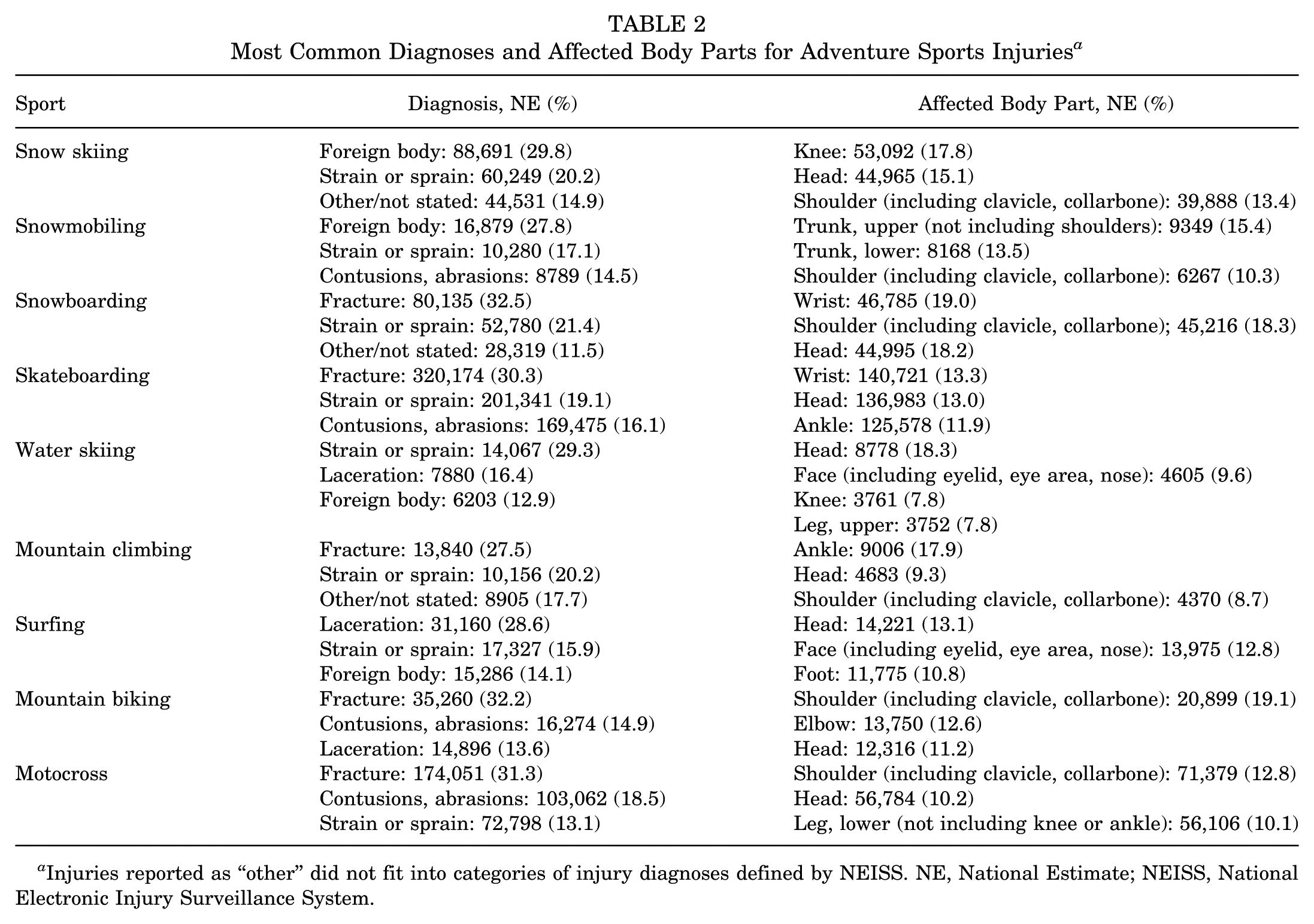
Injuries reported as “other” did not fit into categories of injury diagnoses defined by NEISS. NE, National Estimate; NEISS, National Electronic Injury Surveillance System.
Longitudinal Injury Trends
Linear regression analysis of the frequency of total injuries for each adventure sport between 2013 and 2022 revealed significant changes for only 3 sports: skateboarding (P = .04; β = −0.660; 95% CI, –6618.181 to −244.437), surfing (P = .008; β = −0.778; 95% CI, –1018.419 to −209.193), and mountain biking (P = .009; β = 0.770; 95% CI, 279.601 to 1441.466). The changes in injury frequency from 2013 to 2022 for the other 6 sports were not significant: snow skiing (P = .74; β = −0.12; 95% CI, –2456.387 to 1821.212), snowmobiling (P = .08; β = −0.575; 95% CI, –810.091 to 60.539), snowboarding (P = .14; β = −0.502; 95% CI, –2612.671 to 440.296), water skiing (P = .11; β = −0.533; 95% CI, –441.723 to 56.741), mountain climbing (P = .69; β = −0.145; 95% CI, –272.334 to 189.462), and motocross (P = .06; β = 0.62; 95% CI, –33.209 to 2080.021) (Figure 3).

Nationally estimated adventure sports injury frequencies from 2013 to 2022.
Discussion
The most important finding in our study establishes that from January 2013 to December 2022, there were 2,534,437 NE adventure sports–related injuries. Indeed, this large frequency of injuries reinforces the need for increased understanding of the types of injuries sustained by adventure sports participants.
Interestingly, our findings suggest a decrease in the frequency of adventure sports injuries when compared with Sharma et al’s 29 study investigating adventure sports injuries from 2000 to 2011, which identified >4,000,000 NE injuries using NEISS. This is notable given that our definition of adventure sports encompassed the 7 sports in Sharma et al’s study, along with two additional sports, water skiing and mountain climbing. 29
Though the etiology of changes in injury rates is unknown, these findings may be hopeful and could reflect that injury prevention initiatives in several adventure sports have been efficacious. For instance, programs have been implemented to increase safety helmet use among skiers and snowboarders. 21 Similarly, many publicly managed climbing areas in the United States have implemented climbing injury prevention programs, which include annual climbing infrastructure inspections and approval of new climbing routes. 20 Finally, greater on-site management and access to urgent care clinics may also contribute to the reduction of injuries presenting to the ED. Alternatively, these findings may suggest changes in participation in these sports, particularly during the time period of COVID-19.
Broadly, our findings indicate that adventure sports injuries fluctuated between 2013 and 2022, with no significant linear trend in included sports except for skateboarding, surfing, and mountain biking. These fluctuations may be attributable to changes in the popularity of individual sports, as well as variable weather conditions, given the outdoor nature of all 9 sports. Further, we found no significant difference in adventure sports injuries from before to during and after the pandemic for included sports except for mountain biking and motocross. While further investigation is necessary to understand what factors caused increased injury rates in only these 2 sports, it is notable that athletes could participate in these sports without coming into close contact with others. As such, athletes did not have to violate social-distancing mandates to participate in these sports. It is also notable that both sports had the greatest percentage of male participants of the 9 investigated sports (mountain biking, 85.0%; motocross, 89.8%). Hence, we found that the 2 sports with the greatest increase in injury rates were also the 2 with the greatest proportion of male participants. Previous literature has demonstrated that males are more likely to take risks than females. 13 Additionally, individuals who participate in adventure sports widely have risk-seeking personalities. 34 Finally, it has been suggested that risk seekers engaged in more risk-taking behaviors during the pandemic due to a state of boredom. 17 As such, we may hypothesize that males were more likely to increase their participation rates in mountain biking and motocross during the pandemic because of a desire to seek out a high-risk activity. This, in turn, may have led to the significant increase in injury rates.
It should be noted that head injuries were among the top 3 most common injuries for 8 of the 9 included adventure sports. This is of particular importance because such injuries generate profound economic and social threats. The costs associated with head injuries in adventure sports have been described in 3 phases. 32 The first is the cost of evacuation (transportation to a medical facility, provision of acute medical care, etc), the second is the cost of rehabilitation (physical therapy, follow-up procedures, etc), and the third is the cost to the community (days missed from work, provision of social support for injured patients, etc). Though variable based on injury severity, the cumulative cost for all 3 of these phases per patient can range from $30,000 to $2 million. 3 In addition to their economic effect, head injuries may result in significant social implications. Patients who have sustained head injuries may experience deterioration of relationships, reduced income, feelings of loneliness or depression, drug dependence, and suicide attempt or completion.15,29,36 Indeed, many patients who sustain severe injuries may experience these behavioral health concerns, highlighting the importance of multidisciplinary services that should be offered to this set of patients to optimize all aspects of their mental and physical health during recovery.
We found that adolescents were the most commonly injured demographic in 9 of the 9 included adventure sports. This may be due to increased participation in adventure sports among this age group or because this subpopulation is more likely to take risks and thus sustain more injuries. Adventure sport education and injury prevention measures should, therefore, be targeted toward this group. While many high school and collegiate sports organizations have strict safety guidelines and have adopted peri- and postinjury measures including time-effective concussion policies, 19 such measures are more difficult to implement for adolescents participating in adventure sports. This is because many adventure sports take place in environments where guidelines are difficult to implement and medical care may not be available on-site. As a result, greater emphasis should be placed on the widespread implementation of safety strategies and the use of safety helmets and other protective gear. To our knowledge, current literature suggests that safety helmets should be used for snow skiing,12,30 snowmobiling,10,25 snowboarding,12,30 skateboarding,22,27 mountain climbing,5,26 mountain biking, 8,9 and motocross.11,18 Current literature calls for the investigation of a potential role for safety helmet usage in water skiing 2,14 and surfing.31,33
Limitations
Because this was a retrospective study relying on a single database, there were several inherent limitations. Patients who received treatment in non-ED settings (including on-site clinics, urgent care centers, and outpatient facilities) were excluded, resulting in a possible underestimation of injury rates. Additionally, NEISS NEs are extrapolated from only 100 EDs that are meant to be representative of all US EDs. As such, our NEs may differ from the true number of adventure sports injuries. Further, we do not have data on the number of athletes participating in included sports over the course of the study period. This precludes the ability to determine the etiology of changes in injury rates (eg, improved safety measures vs changes in underlying participation in the sport). In addition, because the pandemic occurred relatively recently, we did not have as many years of postpandemic data as prepandemic data. Future studies should reexamine the data once more time has passed. Finally, because we could only access NEISS coding for the injured body part and injury diagnosis, our analyses could not fully describe each injury sustained. For example, in water skiing, strains/sprains were the most common diagnosis while the head was the most affected body part. Though strains could not occur in the head, they could occur in the knee and leg, which were the third and fourth most commonly affected body parts in water skiing, respectively.
Conclusion
Our study demonstrated that from 2013 to 2022, there were significant increases in skateboarding, surfing, and mountain biking injuries. There were significant increases in injury frequency from before to during and after the pandemic for mountain biking and motocross. Male athletes experienced the greatest percentage of injuries in all 9 sports, with adolescents comprising the most affected age group in the majority of these sports. These data may be useful in the development of injury awareness and prevention programs.
Footnotes
Final revision submitted March 25, 2025; accepted April 23, 2025.
One or more of the authors has declared the following potential conflict of interest or source of funding: A.M.S. is a paid consultant for the Stryker Corporation. R.L.P. is a diplomate of the American Board of Orthopaedic Surgery; is a council of delegates member of AOSSM; is a committee member of AOSSM, Arthroscopy Association of North America, ISHA: The Hip Preservation Society, Eastern Orthopaedic Association, New England Orthopaedic Society, and Society of Military Orthopaedic Surgeons; is an associate editor of the Journal of Cartilage & Joint Preservation; is an editorial or governing board member of Arthroscopy, Sports Medicine, and Rehabilitation and Journal of Sport Rehabilitation; and has received a grant, support for education, and hospitality payments from Gotham Surgical Solutions and Devices and Arthrex Inc. AOSSM checks author disclosures against the Open Payments Database (OPD). AOSSM has not conducted an independent investigation on the OPD and disclaims any liability or responsibility relating thereto.
Ethical approval was not sought for the present study.
