




Abstract
Background:
Groin pain in soccer players arises from various causes, most commonly kicking, and as such can significantly affect performance. A new form of exercise, the cross-motion swing exercise (CMS), may help prevent groin pain but is untested.
Purpose:
To evaluate the effectiveness of the CMS in preventing groin pain in high school soccer players.
Study Design:
Randomized controlled trial; Level of evidence, 1.
Methods:
This study involved 135 male high school soccer players <18 years from 4 teams competing in a high school soccer league in Japan. Teams were randomly assigned to an intervention group (2 teams; n = 65 players) or a control group (2 teams; n = 70 players). The intervention group performed the CMS in addition to their usual warm-up, emphasizing coordination and kicking movements, while the control group continued their usual warm-up exercise. The intervention period lasted 16 weeks, with compliance monitored weekly. Data were collected through weekly Google form surveys. The primary outcome was the incidence of groin pain at any time during the study period.
Results:
The intervention group had a significantly lower incidence of groin pain (9.4%) compared with the control group (23.1%). Cox proportional hazards regression analysis indicated a significantly reduced risk of groin pain in the intervention group (hazard ratio, 0.309; 95% CI, 0.108-0.880; P = .028). The number of injuries was 6 in the intervention group and 18 in the control group, and injuries due to the kicking motion were 0 in the intervention group (0%) and 7 in the control group (38.9%).
Conclusion:
The CMS significantly reduced the incidence of groin pain in high school soccer players. This suggests that coordination-based exercise, closely mimicking the appropriate sports-specific movement, was effective in reducing injury. The study supports incorporating the CMS into regular training to reduce the incidence of groin pain in male high school soccer players.
Trial Registry and the Registration Number
This study has been registered as a clinical trial with the Universal Medical Information Network (UMIN) under the registration number UMIN000051311.
Groin pain in athletes is often due to musculoskeletal pathology, and sports with a high incidence of groin pain include soccer, rugby, and hockey.14,18 Groin pain is particularly common in soccer, with the incidence accounting for 12% to 18% of all injuries in professional soccer players in 1 season.16,23 The Doha agreement meeting 24 classifies groin pain in athletes into 4 categories: adductor-related, iliopsoas-related, inguinal-related, and pubic-related. Among soccer players, adductor-related groin pain is the most prevalent, accounting for 63% to 75% of cases.16,17,25 On the other hand, the physical strain specific to soccer, such as kicking and sudden changes in direction, is more likely to cause degeneration of the pelvis and pubis compared with other sports. 2 The severity of groin pain varies, 8 but in many cases, athletes are forced to take a long break from sports,7,19,22 making it a serious issue. Therefore, it is essential to consider preventive measures.
Many studies on groin pain prevention programs have focused on the adductor muscles due to their frequent involvement.4,9,11,12 For example, the Copenhagen adduction exercise (CAE) has been shown to reduce the incidence of groin pain by 41% in semi-professional soccer players. 12 However, randomized controlled trials that incorporated the CAE into preventive programs for youth soccer players have yielded conflicting results, with some studies reporting significant reductions in groin pain incidence and others not.4,10 From a primary prevention perspective, it is important to evaluate the effectiveness of preventive exercises tailored toward injury and sports-specific characteristics in young athletes. Because most groin pain is caused by kicking, 20 we suggest that exercises closely mimicking kicking movements be included in preventive programs. A skilled soccer kicking motion is characterized by extension and abduction of the shoulder, accompanied by twisting of the trunk toward the nonkicking side, together with a wide range of motion of the hip on the kicking side, occurring with precise timing of associated muscle activity.3,21 In a previous study, Saito et al 19 defined the series of coordinated movements in kicking as cross-motion swing and incorporated this movement into 1 of the examination checklists for patients with groin pain. 19 Based on this method, we devised the cross-motion swing exercise (CMS) to improve the control and coordination of the kicking movement around the pelvis.
This study aimed to compare the incidence of groin pain between a group of male high school soccer players who performed the CMS as a preventive exercise and a control group that only conducted regular warm-ups. We hypothesized that incorporating the CMS into warm-up exercises would reduce the incidence of groin pain. Because the mechanism of this preventive exercise is clearly different from the mechanism of conventional preventive exercises that strengthen the adductor muscles, we hope that it may serve as a new approach to prevent groin pain.
Methods
Study Design and Participant
The participants were male high school students <18 years from 4 teams competing in a high school soccer league in Japan. We contacted 5 teams in the prefecture’s top league regarding the possibility of participation and obtained consent from each school’s principal and coach. Teams already performing exercises similar to the intervention were excluded from the study. Participating athletes provided informed consent for the study, and signed consent was obtained from both the athletes and their parents. Players who had groin pain at the start of the study, those who were not playing due to other injuries at the start of the study, and those who had previous hip orthopaedic surgery or did not give consent to participate in the study were excluded from the study. This study complied with the Declaration of Helsinki and was approved by the Saitama Medical University Ethics Review Committee (Approval No. 2023-010). There was no public or patient involvement in the design of this trial.
Randomization
This cluster randomized controlled trial was registered with the Universal Medical Information Network (UMIN) at the University of Tokyo Hospital (Registration No. UMIN000051311) and was conducted from August 2023 to December 2023. Randomizing individual athletes within each team was determined to be impractical. Therefore, following the methodology of previous studies, teams were randomized as clusters using the envelope method. After obtaining consent to participate in the study, the lead researcher opened the envelopes that revealed the group assignments and divided each team into 2 groups: an intervention group and a control group. When conducting interventions within a school, individual randomization can raise ethical concerns. However, cluster randomization can avoid such issues. Moreover, participants within the same cluster are more likely to share information about the presence or absence of interventions, potentially reducing observation bias. These reasons justified the choice of this design.
Blinding
It was not possible to blind players, coaches, or the principal investigator to group allocation. Data management was recorded using coded numbers and collected only by the principal investigator (H.M.).
Intervention
The control group performed their usual warm-up routine, while the intervention group performed the CMS in addition to their usual warm-up. These exercises were mandated to be performed before each practice and game, with the intervention period lasting 16 weeks.
Control Group
The control group continued with their usual warm-up routines as implemented by their team coaches. These routines typically included jogging, general stretching exercises, and dynamic movements that were commonly practiced within their teams. The exact nature of these warm-up routines varied between teams but generally consisted of the following elements:
Jogging: Warm up by jogging slowly around the grounds.
General stretching exercises: Dynamic stretches targeting major muscle groups, including hamstrings, quadriceps, calves, and hip flexors.
Dynamic movements: Exercises such as high knees, butt kicks, and side step to further warm up the muscles and joints.
These warm-ups took about 15 to 20 minutes.
Intervention Group
In addition to the usual warm-up routines described above, the intervention group performed the CMS in 2 directions: backward to forward and outward to inward, using the following methods:
Backward to forward direction: Players stood in pairs facing each other, using their kicking side arm to hold the other arm for balance. The player performed a backswing by flexing and horizontally abducting the arm on the pivot side while simultaneously extending the kicking leg (Figure 1, A and B). Then, the player swung the arm on the pivot side down toward the hip of the kicking side, while swinging the kicking leg forward (Figure 1, C and D). This movement was repeated while coordinating the swing of the arm and leg.
Outward to inward direction: Players stood in pairs facing each other, using their kicking arm to hold the other arm for balance, with the toe of the pivot side pointing slightly outward. The player performed an outward swing by abducting the arm of the pivot side while simultaneously abducting the kicking leg (Figure 1, E and F). Then, the player swung the arm on the pivot side down toward the hip of the kicking side, while swinging the kicking leg inward (Figure 1, G and H). This movement was repeated while coordinating the swing of the arm and leg.

Following the methods of cross-motion swing exercise. (A) A front and back view of the backward swing. (B) A side view of the backward swing. (C) A front and back view of the forward swing. (D) A side view of the forward swing. (E) A front and back view of the outward swing. (F) A side view of the outward swing. (G) A front and back view of the inward swing. (H) A side view of the inward swing.
In both swings, players were instructed to maintain core stability, maintain balance on the pivot foot, avoid relying too much on the arm they are using for support, and involve the scapula and pelvis in their movements. Based on previous studies, 10 athletes were instructed to stop if they experienced pain >3 out of 10 on a numerical rating scale (NRS) during exercise. There were 2 sets of 10 repetitions on both the left and right sides in both directions. The time required to complete this series of exercises was approximately 2 to 3 minutes. The principal investigator (physical therapist with >10 years of experience in sports rehabilitation, H.M.) provided guidance on the CMS to each team at the start of the study.
Compliance
Players in the intervention group reported the number of days they performed the CMS each week using a Google form survey. Team representatives, coaches, and trainers were contacted weekly to confirm the progress of the exercises and questionnaires. The principal investigator visited the intervention group once every 2 weeks to monitor the implementation of the CMS.
Outcome Measures
Basic information was collected using a paper questionnaire (Supplemental File 1), including age, height, weight, dominant leg (the leg that frequently controls the soccer ball), field position (attacker, midfielder, defender, or goalkeeper), years of experience, injury status, past medical history, and presence or absence of groin pain. Players who stopped playing due to injury were excluded from the study. The study period was 16 weeks during the league season. Players reported their practice time, game playing time, and occurrence of groin pain weekly using a Google Form survey (Supplemental File 2). In cases where ambidextrous players experienced groin pain, the injury was classified as affecting the dominant leg, regardless of which side was injured. Symptomatic players also reported details such as pain intensity (NRS), pain location, and injury status. Groin pain was defined as pain in the groin during sports activities, irrespective of time loss or the need for treatment, based on previous research. 10 The location of groin pain was explained to players by a body chart image based on the Doha classification method 24 (Supplemental Files 1 and 2). Cases of groin pain reinjury were recorded if the pain had completely healed during the study period and the player had returned to full play, or if pain reoccurred in a different area from the area previously reported. 1
Exposure
Each week, players reported their practice time, game playing time, and number of games they participated in. Each measurement was used to calculate the total exposure time for both groups.
Sample Size
The sample size was calculated using the power analysis application G*Power 3.1.9.7 (http://www.gpower.hhu.de/). To compare injury rates using the χ2 test, the effect size (w) was set at 0.3 (α = .05; 1–β = 0.8). For baseline and exposure time comparisons using the unpaired t test, the effect size (d) was set at 0.5 (α = .05; 1–β = 0.8). The effect size level was set to medium for all analyses. Consequently, the calculated sample size was 88 participants for the χ2 test and 128 participants for the t test. To ensure both sample sizes met the threshold, accounting for a 10% exclusion rate, we decided to recruit 150 participants for this study.
Statistical Analysis
Statistical analysis was conducted using SPSS Statistics for Windows, Version 29.0 (IBM Corp; Released 2022). Differences in baseline characteristics between the intervention and control groups were compared using univariate analysis. Age, height, weight, body mass index (BMI), and years of experience were tested for normal distribution using the Shapiro-Wilk test. For normally distributed data, unpaired t tests were used for group comparisons, while Mann-Whitney U tests were used for non-normally distributed data. The Fisher exact test was used to compare the proportion of dominant legs, and the χ2 test was used to compare the proportion of positions. The incidence of groin pain during the intervention period was compared using the χ2 test. After checking the normality of the practice time, game playing time, and total time, comparisons were made using unpaired t tests and Mann-Whitney U tests. Cox proportional hazards regression was performed to calculate hazard ratios (HR, 95% CI) between the intervention and control groups, with factors that showed significant differences (P < .05) in group comparisons added as independent variables. In cases where significant differences in baseline characteristics were observed between groups, the variables were adjusted for as potential confounding factors in the statistical analysis.
Results
A flow chart of participants at each stage of the study is shown in Figure 2. Five high school soccer teams were invited to participate in the study. Four teams, comprising 143 players, accepted the invitation. One team was excluded because it was already performing exercises similar to the intervention content. Of the players who agreed to participate, 7 players with groin pain and 1 player who had stopped playing due to injury were excluded, leaving 135 players for the study. After randomization, the intervention group consisted of 2 teams with 65 players, and the control group consisted of 2 teams with 70 players. The baseline characteristics of the players are shown in Table 1. A significant difference was observed only in BMI when comparing the groups (P = .030). The median response rate during the intervention period was 93.8% (interquartile range, 75-100). After examining the box plot, 6 players (1 in the intervention group and 5 in the control group), with a response rate of <37.5%, were excluded from the analysis as outliers. Four of these players discontinued the study due to injury (2 anterior cruciate ligament injuries, 1 clavicle fracture, and 1 lumbar spondylolysis).

Flow chart of participants at each stage of the study.
Baseline Characteristics of the Players a
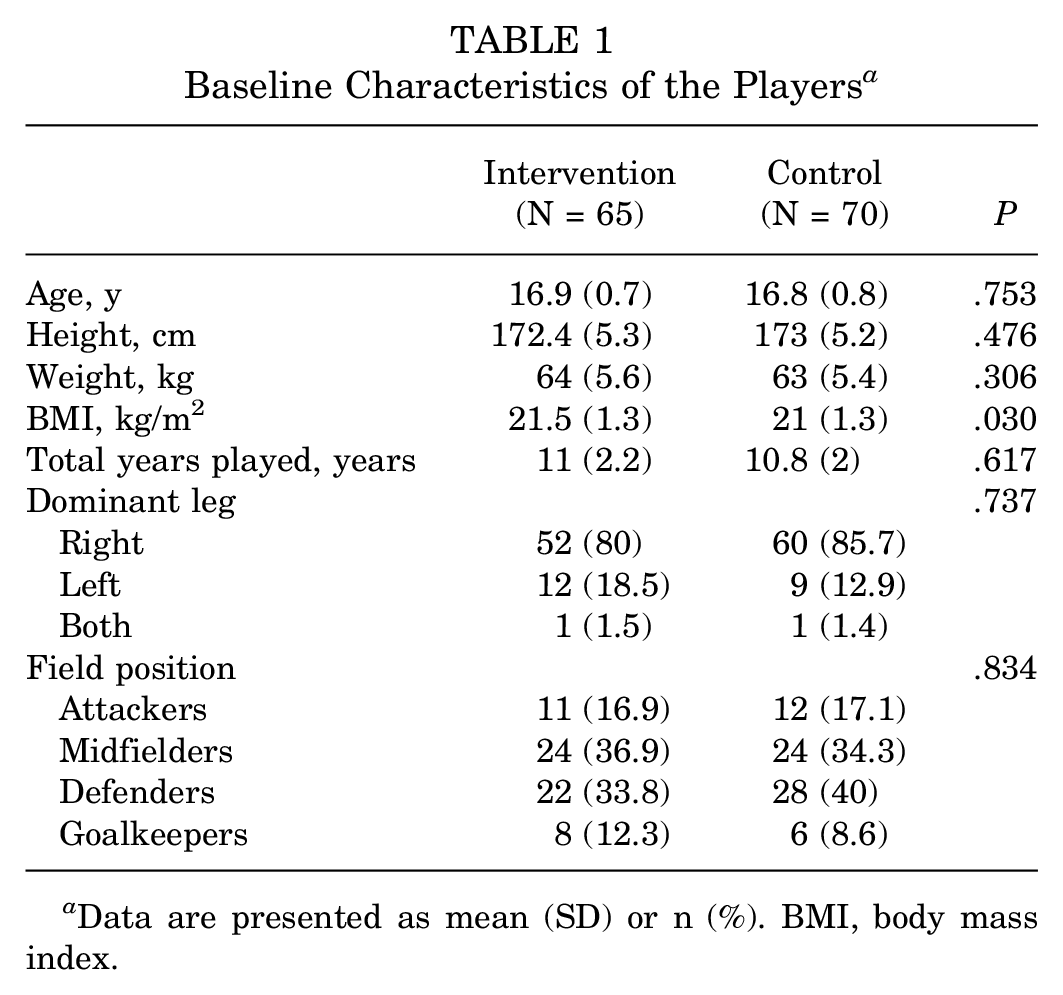
Data are presented as mean (SD) or n (%). BMI, body mass index.
Incidence of Groin Pain and Exposure Time
The incidence of groin pain and exposure time during the intervention period are shown in Table 2. The number of players who reported groin pain at any time during the 16-week survey was 6 players (9.4%) in the intervention group and 15 players (23.1%) in the control group, which was significantly lower in the intervention group (P = .035). The relative risk in the intervention group compared with the control group was 0.648 (95% CI, 0.462-0.909). There was no significant difference between the groups in total activity time and practice time (P = .131 and P = .232, respectively). However, the intervention group had significantly more game playing time (P = .009).
Incidence of Groin Pain by Number of Injured Players and Exposure Time a

Data are presented as n (%) unless otherwise indicated. MD, mean difference; RR, relative risk.
Hazard Ratio
The results of Cox proportional hazards regression, which included BMI and game playing time as independent variables, are shown in Table 3. The incidence of groin pain was statistically significantly reduced in the intervention group compared with the control group (HR, 0.309; 95% CI, 0.108-0.880; P = .028).
Results of Cox Proportional Hazards Regression a

BMI, body mass index; CMS, Cross-motion swing exercise; HR, hazard ratio.
Number of Injuries and Injury Details
The number of injuries, including reinjuries, was 6 in the intervention group (0 reinjuries) and 18 in the control group (3 reinjuries). The incidence of groin pain per 1000 hours was 0.7 (95% CI, 0.1-1.3) in the intervention group and 2.1 (95% CI, 1-3.2) in the control group. There were no incidences of groin pain caused by kicking in the intervention group, whereas there were 7 cases (38.9%) in the control group. The mean NRS was 5.7 ± 1.5 in the intervention group and 3.9 ± 1.7 in the control group, and an unpaired t test showed that the NRS was significantly higher in the intervention group (P = .038; power = .616). In the control group, the mean NRS for groin pain caused by movements other than kicking was 4.7 ± 1.8, which was not significantly different from the NRS in the intervention group (P = .283; power = .297). There was 1 case of groin pain with time loss (16.7%) in the intervention group, with a loss of 2 days, and 2 cases (11.1%) in the control group, with a mean loss of 9.5 ± 2.1 days. Details of the groin pain incidents are shown in Table 4.
Incidence of Groin Pain per 1000 Hours and Injury Details a

NRS, numerical rating scale.
Compliance With the Prevention Program
The mean adherence rate to CMS implementation in the intervention group was 85.2%, with a mean of 4.6 ± 0.9 days per week. Reasons for not being able to perform the CMS included examination periods, breaks from club activities, and poor health.
Discussion
This study aimed to evaluate the effectiveness of the CMS in preventing groin pain among male high school soccer players. The findings indicated that incorporating the CMS into the warm-up routine significantly reduced the incidence of groin pain compared with a control group that followed their regular warm-up routine. This suggests that the CMS, which closely mimics the complex movements involved in soccer kicking, may provide a more targeted and effective preventive measure for this specific demographic.
Since Hölmich et al 13 reported the effectiveness of active treatment in managing groin pain, 13 various studies on preventive exercises based on their research have been conducted. For example, Harøy et al 12 demonstrated that the CAE reduced groin pain incidence by 41% in semi-professional soccer players. However, this study differs from ours in several key aspects. Harøy et al focused on semi-professional players, while our study targets high school athletes whose physical development and injury risk profiles differ substantially. Furthermore, their study was a large-scale study involving 652 players from 35 teams, and this difference in sample size can be considered a major strength of their research. On the other hand, other studies on youth soccer players have shown mixed results when implementing CAE, with some reporting significant reductions in groin pain incidence and others not.4,10 This inconsistency suggests a need for preventive programs that are specifically tailored to the unique biomechanics and injury risks of younger athletes. Our study contributes to this field by introducing the CMS, which more closely mimics the kicking movements integral to soccer, potentially providing a more effective preventive measure for this demographic.
The CMS focuses on both mimicking the kicking mechanism as well as improving coordination during this movement,3,21 which involves complex coordination of shoulder, trunk, and hip movements. This functional approach may help improve muscle coordination and reduce strain on the adductor and iliopsoas muscles, as well as the pelvis, which are closely related to groin pain in soccer players. In fact, in a comparison of the situations in which groin pain occurred in this study, 7 out of 18 cases were caused by kicking in the control group, while none of the 6 cases in the intervention group were caused by kicking. In addition, previous studies have also reported that patients with groin pain have reduced hip abduction and rotation range of motion and delayed contraction of the transverse abdominis.5,11,15 From these, the benefits seen in our study may be through improved coordination and control of the hip and trunk, as well as gains in hip joint and muscle flexibility, and optimized trunk muscle activation by the CMS. These factors are plausible explanations for the reduced risk of injury during high-intensity activity and the significant reduction in the incidence of groin pain in the intervention group.
The details of the reported groin pain included some important information. Although the sample size was small, the reported pain intensity (NRS) of groin pain was significantly higher in the intervention group than in the control group (P = .038). This result raises the concern that participants in the intervention group were aware of the purpose of the study and did not report mild pain. On the other hand, when comparing the groin pain caused by reasons other than kicking in the control group with the pain in the intervention group, there was no significant difference (P = .283). This suggests that groin pain produced by causes other than kicking may be more severe than groin pain caused by kicking. Causes of groin pain other than kicking include sudden changes of direction and sprinting. 20 However, there have been no reports examining the relationship between the cause of pain and the intensity of the pain, and the number of cases in our survey was very small. Thus, further careful investigation is needed in future studies. Compared with previous studies of groin pain,16,17,25 our study had fewer reports of pain in the adductor area and more reports of pain in the iliopsoas and inguinal area. This may be because the participants were younger than in previous studies, and hip and pelvic pain during growth may have been elicited as pain in the anterior pelvic area. 6
The implementation of the CMS as a preventive exercise in regular training sessions is potentially highly beneficial for young athletes. Given the high incidence of groin pain among soccer players and its effect on performance and participation, integrating such targeted exercises can play an important role in injury prevention strategies. The high adherence rate (85.2%) observed in this study indicates that the exercise protocol is feasible and can be easily incorporated into daily routines without causing significant disruption or requiring extensive resources. However, coaches may require training to properly implement and supervise the CMS. On the other hand, showing the benefit of reduced injury incidence could be a further motivation for both coaches and players to adopt and consistently practice the CMS.
Limitations
This study has several limitations. First, we were unable to blind participants and coaches, which may have introduced bias due to expectancy effects (placebo effect) or behavioral changes (Hawthorne effect) in the intervention group. Similarly, the researchers collecting the information were not blinded, which may have introduced data collection bias, such as researchers subconsciously overestimating the data in the intervention group. Future studies should consider incorporating blinded assessments by third-party evaluators to minimize potential biases. In addition, using a sham group that undergoes a placebo exercise program may be effective in eliminating bias for participants and coaches. Second, the duration of this study was relatively short (16 weeks), and the long-term effects of the CMS on preventing groin pain are unknown. In addition, the study participants were limited to male high school students. Thus, longer-term and more comprehensive studies are needed to confirm the durability of the preventive effect of the CMS and examine its effects in different age groups, sexes, and competition levels. Third, our study did not directly compare the CMS to other established prevention programs, such as the CAE. Conducting direct comparative studies would provide valuable insights into the relative effectiveness of different preventive exercises. Fourth, this study was unable to accurately evaluate and compare the types of practice that each team underwent. Therefore, we cannot deny the possibility that differences in the types of practice that each team experienced may have influenced the incidence of groin pain. Although we tried to standardize participants’ skills and environments as much as possible by recruiting participants from a specific soccer league, we could not achieve complete uniformity. One evidence is that the game playing time of the intervention group was significantly longer, which may be because there were more skilled players in the intervention group. Finally, the injury locations in this study were based solely on player reports and were not confirmed by medical professionals clinically or with magnetic resonance imaging findings. Future research should incorporate clinical evaluations and imaging diagnostics to obtain more accurate and detailed injury information.
Conclusion
The CMS significantly reduces the incidence of groin pain in high school male soccer players. The CMS, focusing on the mechanics of the kicking motion in soccer, may promote proficiency in kicking skills and reduce the sport-specific load on the pelvic region. Thus, performing exercises that focus on coordination and sports-specific movement may be a potentially effective strategy for injury prevention and enhancing player performance in male high school soccer players.
Supplemental Material
sj-pdf-1-ojs-10.1177_23259671251351333 – Supplemental material for Preventive Effect of Cross-motion Swing Exercise on Groin Pain in High School Male Soccer Players: A Cluster Randomized Controlled Trial
Supplemental material, sj-pdf-1-ojs-10.1177_23259671251351333 for Preventive Effect of Cross-motion Swing Exercise on Groin Pain in High School Male Soccer Players: A Cluster Randomized Controlled Trial by Hiroshi Mori, Sadao Niga, Yasuaki Mizoguchi, Yu Okubo, Hiroshi Hattori, Toby Hall and Kiyokazu Akasaka in The Orthopaedic Journal of Sports Medicine
Supplemental Material
sj-pdf-2-ojs-10.1177_23259671251351333 – Supplemental material for Preventive Effect of Cross-motion Swing Exercise on Groin Pain in High School Male Soccer Players: A Cluster Randomized Controlled Trial
Supplemental material, sj-pdf-2-ojs-10.1177_23259671251351333 for Preventive Effect of Cross-motion Swing Exercise on Groin Pain in High School Male Soccer Players: A Cluster Randomized Controlled Trial by Hiroshi Mori, Sadao Niga, Yasuaki Mizoguchi, Yu Okubo, Hiroshi Hattori, Toby Hall and Kiyokazu Akasaka in The Orthopaedic Journal of Sports Medicine
Footnotes
Acknowledgements
We thank the coaches and players of the high school soccer teams in Saitama, Japan, for their valuable cooperation.
Final revision submitted March 3, 2025; accepted March 14, 2025.
The authors have declared that there are no conflicts of interest in the authorship and publication of this contribution. AOSSM checks author disclosures against the Open Payments Database (OPD). AOSSM has not conducted an independent investigation on the OPD and disclaims any liability or responsibility relating thereto.
Ethical approval for this study was obtained from Saitama Medical University (Approval number 2023-010).

References
Supplementary Material
Please find the following supplemental material available below.
For Open Access articles published under a Creative Commons License, all supplemental material carries the same license as the article it is associated with.
For non-Open Access articles published, all supplemental material carries a non-exclusive license, and permission requests for re-use of supplemental material or any part of supplemental material shall be sent directly to the copyright owner as specified in the copyright notice associated with the article.
