




Abstract
Background:
Close monitoring and heated irrigation fluids have been frequently used to avoid hypothermia and associated complications during hip arthroscopic surgery. Saline fluids are used extensively in hip arthroscopic surgery, but they are routinely stored at room temperature and are cooler than the patient's core temperature.
Purpose:
To investigate the efficacy of heated irrigation fluids to prevent hypothermia during hip arthroscopic surgery and whether the core temperature measured rectally during hip arthroscopic surgery differs from the core temperature measured at the temporal region.
Study Design:
Randomized controlled trial; Level of evidence, 2.
Methods:
Patients who underwent hip arthroscopic surgery for the treatment of femoroacetabular impingement syndrome between 2021 and 2023 were prospectively enrolled and divided into 2 groups: those whose irrigation fluids were stored at room temperature (group 1) and those whose irrigation fluids were heated to 36°C to 38°C (group 2). A probe inserted in the rectal mucosa was used to measure the patient's body temperature every 15 minutes. The patient's temperature was also measured at the temporal region with a laser thermometer. A body temperature <36°C, detected by either method, was considered as hypothermia. The method that detected hypothermia more quickly was investigated, and the effect of the heated irrigation fluids was explored. Statistical analyses were conducted to compare temperature measurements and the incidence of hypothermia between the groups using appropriate tests for categorical and continuous variables based on the data distribution.
Results:
There were 60 patients randomized and allocated to group 1 and 56 patients to group 2. Hypothermia, defined as a temperature <36°C, occurred in 32 patients (53.3%) in group 1 and 24 patients (42.9%) in group 2. There was no difference between the groups using heated or room-temperature fluids in the onset of hypothermia (P = .425). Significantly more hypothermia cases were detected by the rectal temperature measurement than by the temporal temperature measurement (54 vs 2 patients, respectively; P < .001). The rectal temperature measurement was also quicker in detecting hypothermia (69.6 ± 47.2 vs 138.2 ± 56.8 minutes, respectively; P < .001).
Conclusion:
This study demonstrates that the usage of either room-temperature or heated irrigation fluids did not influence the incidence of hypothermia. Rectal measurements of core body temperature detected hypothermia earlier during hip arthroscopic surgery.
Registration:
NCT05396924 (ClinicalTrials.gov)
Hip arthroscopic surgery has increasingly become the treatment of choice for orthopaedic surgeons in the management of hip abnormalities.7,11,12,14 In the United States alone, its incidence has increased by 85% since 2011. 30 This surge in popularity is caused by higher scores on general health–related quality of life scales.21,27,33 Despite its advantages, hip arthroscopic surgery is characterized by a notoriously longer surgical time, which may often translate into complications such as traction-related neurapraxia, groin pain, fluid extravasation, and hypothermia.2,4,25 Studies have reported that a long surgery duration is a significant risk factor for intraoperative hypothermia due to extended exposure to room-temperature irrigation fluids, prolonged patient immobility, and extended exposure of body surfaces to cooler operating room environments. 25 Additionally, research has indicated that anesthesia-induced vasodilation increases heat loss and that the risk of hypothermia escalates with surgical procedures lasting more than 1 hour. 5 Similarly, a prolonged traction time during hip arthroscopic surgery, commonly exceeding 2 hours in complex cases, has been correlated with an increased risk of hypothermia and associated complications. 4
Intraoperative hypothermia, defined as a core body temperature <36°C, has been described as a frequent but overlooked phenomenon during open and arthroscopic surgery,3,8,25,35 with studies reporting an incidence of up to 72% in orthopaedic surgery and up to 20.2% in arthroscopic surgery. 17 Undesirable perioperative hypothermia increases the risk of surgical site infections 19 and morbid cardiac events such as ventricular tachycardia. 10 The clinical significance of intraoperative hypothermia is underscored by its association with various adverse outcomes. A meta-analysis revealed that patients with hypothermia had a significantly higher risk of surgical site infections, increased intraoperative blood loss, and postoperative chills/shivering compared with patients with normothermia. 34 Additionally, intraoperative hypothermia has been linked to prolonged stays in the postanesthesia care unit and extended hospitalization stays. 20 Measures such as heated sterile blankets, heated irrigation fluids, and routine usage of regional anesthesia have been proposed to avoid hypothermia. Among these, the use of heated irrigation fluids has shown promise in reducing the risk of hypothermia during arthroscopic surgery. Studies have reported that maintaining irrigation fluid temperatures between 37°C and 39°C can significantly attenuate decreases in core body temperature during arthroscopic procedures.16,23,26,31,32,35 For example, a study by Kim et al 16 demonstrated that the use of warmed irrigation fluids during shoulder arthroscopic surgery reduced the incidence and severity of intraoperative hypothermia. Despite these findings, there is currently no consensus on how to effectively monitor hypothermia during hip arthroscopic surgery or how to avoid it altogether.
The primary aim of this study was to investigate the effectiveness of heated irrigation fluids in preventing the occurrence of hypothermia. The secondary aims were to investigate whether the core temperature measured rectally during hip arthroscopic surgery differs from the core temperature measured at the temporal region and to demonstrate which method detects the changes in core temperature more quickly. Our hypothesis was that irrigation fluid temperature would have no effect on the prevalence of hypothermia and that both measurement modalities would have similar accuracy rates.
Methods
Study Design
After obtaining approval from the local ethics committee of Ankara Bilkent City Hospital, the study protocol followed the PRISMA (Preferred Reporting Items for Systematic Reviews and Meta-Analyses) guidelines for prospective studies. The study was subsequently registered at ClinicalTrials.gov (NCT05396924).
Patients scheduled for primary hip arthroscopic surgery at our institution between October 2021 and October 2023 were assessed for eligibility. Exclusion criteria included previous surgery on the index hip (revision surgery), a history of thyroid disease (hypothyroidism/hyperthyroidism), adrenal insufficiency, hypopituitarism, and an unwillingness to participate. Inclusion criteria were patients aged 18 to 50 years with a clinical diagnosis of femoroacetabular impingement syndrome who were willing to participate in the study. After exclusion, patients meeting the study criteria were randomized into 2 groups: those whose irrigation fluids were stored at room temperature (group 1) and those whose irrigation fluids were heated to 36°C to 38°C (group 2) by a small vacuum furnace that was set at a standard temperature for this study. The room temperature at our institution is routinely kept between 18°C and 20°C (~64.4°F-68°F). A coin toss was used to allocate patients to either group.
Surgical Procedure
Surgery was indicated for cam-, pincer-, or mixed-type femoroacetabular impingement syndrome and labral tears within the joint. Patients were placed in the supine position and on a traction table (Alphamaxx Mobile OR Table; Maquet). To protect the groin area, a soft cylindrical perineal support with a diameter of 20 cm and a height of 35 cm was used. Traction was started after the proper induction of anesthesia. After ensuring an adequate hip joint space to address central compartment abnormalities, standard anterolateral, middle anterior, and distal anterolateral accessory portals were created, and interportal capsulotomy was performed. An arthroscopic pump (Smith & Nephew) was routinely used at a pressure of 50 mm Hg. Irrigation fluids routinely stored at room temperature were used for patients in group 1, while heated irrigation fluids (36°C-38°C) were used for patients in group 2. Initially, existing pincer lesions were addressed using an over-the-top labral approach. After sufficient excision of pincer lesions, labral refixation was performed using suture anchors through the distal anterolateral accessory portal. Subsequently, traction was released, and the peripheral compartment was visualized. Existing cam lesions were excised under arthroscopic and fluoroscopic guidance. The capsule was then repaired, and the surgical procedure was considered completed.
Temperature Measurements
Patients underwent surgery in the same operating room of approximately 25 m2 under the same ambient temperature conditions set every morning at 19°C. Baseline heating in our waiting and operating rooms included the application of a heating blanket (Bair Hugger Warming Blanket System; 3M) placed beneath the patient. The surgical time was calculated from when the patient was placed under anesthesia until proper skin closure. The type of anesthesia was decided by the attending anesthesiologist according to the patient's status and potential comorbidities (ASA [American Society of Anesthesiologists] score, difficulty with intubation, presence of a spinal deformity, and patient's choice). General, spinal, epidural, and combined (spinal + epidural) anesthesia types are routinely available at our institution.
After initial anesthesia, the patient's body temperature was monitored using a probe (Reusable Temperature Probe; GE HealthCare) inserted 10 to 15 cm in the rectal mucosa. Measurements were taken every 15 minutes. In addition to the rectal measurement, a temporal measurement was carried out during the same time interval using a battery-powered laser temporal thermometer (infrared thermometer; Schnell). The batteries of the thermometer were changed at the beginning of every week by the same investigator performing the measurements. Finally, room temperature was also noted every 15 minutes, in parallel with body temperature measurements. All temporal and rectal temperature measurements were performed by the same investigator (I.K.) during all procedures.
A temperature <36°C, detected by either method (rectal or temporal), was considered as hypothermia. Upon the detection of hypothermia, an air heater was added to the heating blanket and aimed at the patient's torso beneath the sterile blanket to avoid possible additional complications and to increase patient comfort. The progression to normothermia was re-evaluated thereafter. Data were compared between the 2 groups by a blinded investigator (E.V.), and variables contributing to hypothermia were examined. Furthermore, the method that detected hypothermia faster was investigated.
Postoperative Rehabilitation and Complications
After surgery, all patients were started on a standard rehabilitation protocol with partial weightbearing mobilization, followed by isometric exercises. Phases 1 to 4 18 of the rehabilitation protocol were then applied with minor individual changes according to the patient's condition.
Data regarding intraoperative anesthesia were postoperatively reviewed by a single investigator (E.V.) for episodes of tachycardia (pulse >100 beats per minute [bpm]), which is one of the most frequent complications of hypothermia. Intraoperatively, the situation was dealt with by the anesthesiologist, and the patients were brought to healthy heart rhythms as soon as possible. The episodes, when present, were recorded, as were the total episode duration (minutes) and maximum pulse rate (bpm). The results were finally compared between the groups.
Statistical Analysis
A 34% difference between the 2 groups was assumed for the sample size calculation. 26 A significance level (α) of .05 and a power (1 –β) of 0.80 (80%) were used, resulting in a minimum sample size of 28 per group based on a power analysis. To account for potential participant dropouts, a final sample size of 50 per group was planned. Data were analyzed using SPSS (Version 25.0; IBM). Categorical variables were presented as frequencies and percentages. Continuous variables were presented as means ± standard deviations. The chi-square test (Fisher exact test for small sample sizes or with expected cell counts <5) was used to compare categorical variables between the groups. For normally distributed continuous variables, the independent-samples t test was used, while the Mann-Whitney U test was used for nonnormally distributed continuous variables. P < .05 was considered to be statistically significant.
Results
During the study period, 122 patients underwent hip arthroscopic surgery. Of these patients, 1 allocated to group 1 and 5 allocated to group 2 refused to participate. A total of 116 patients were included in the final analysis (Figure 1).

Study flowchart.
Thus, 60 patients were allocated to group 1 and 56 patients to group 2. Baseline patient characteristics were comparable between the 2 groups. The mean surgical time was 142.8 ± 40.8 minutes in group 1 and 130.9 ± 37.0 minutes in group 2 (P = .223). The mean irrigation amount, mean room temperature, and mean rectal and temporal temperature measurements were comparable between the groups (P > .05) (Tables 1 and 2).
Patient and Surgical Characteristics a

Data are reported as n (%) unless otherwise specified.
Mann-Whitney U test.
Chi-square test.
Temperature Measurements a

Data are reported as n (%) unless otherwise specified.
Mann-Whitney U test.
Data regarding 2 patients from Group I was missing.
Chi-square test.
A temperature <36°C was measured in 32 patients (53.3%) in group 1 and 24 patients (42.9%) in group 2 (48.3% in overall cohort). The rate of hypothermia was similar between the 2 groups (P = .425). After the application of an additional heater, 41.6% of patients in group 2 showed an increase in core body temperature, while only 20.0% of patients in group 1 displayed the same pattern of recovery. In increasing patient comfort intraoperatively, the results were not statistically significant.
Among patients with hypothermia, the rectal measurement first detected hypothermia in 54 of 56 cases, while the remaining 2 cases were initially detected through the temporal measurement. The rectal measurement was significantly faster in the detection of hypothermia compared with the temporal measurement (69.6 vs 138.2 minutes, respectively; P < .001) (Figure 2).

Time to detect hypothermia between the 2 measurement modalities.
Tachycardia occurred significantly less in patients without hypothermia compared with patients in whom hypothermia was detected (P < .001). While the maximum pulse rate was similar between the groups, the episodes of tachycardia in patients with hypothermia lasted significantly longer compared with those without hypothermia. All relevant details are presented in Table 3.
Intraoperative Tachycardia a
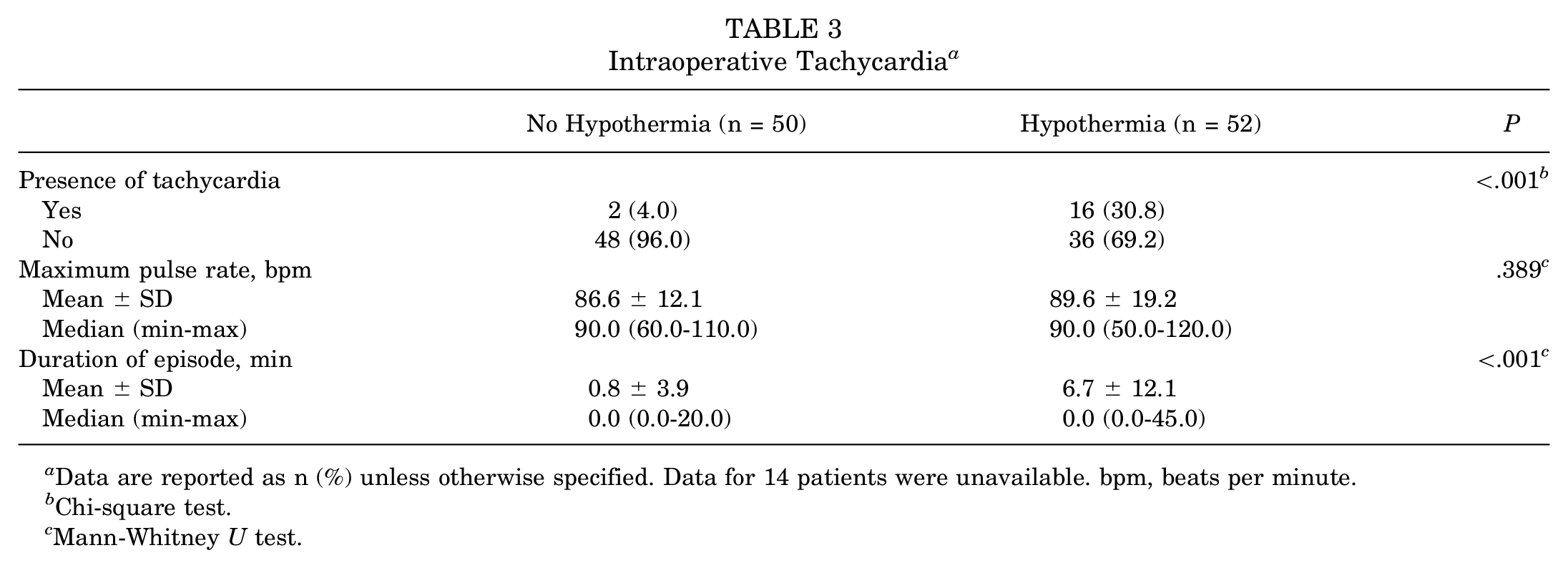
Data are reported as n (%) unless otherwise specified. Data for 14 patients were unavailable. bpm, beats per minute.
Chi-square test.
Mann-Whitney U test.
Discussion
The most important finding of this study was that heated irrigation fluids had no effect on preventing the development of intraoperative hypothermia. In patients undergoing hip arthroscopic surgery, hypothermia was a common phenomenon, affecting up to 53.3%, and intraoperative tachycardia was also more frequent (30.8% vs 4.0%, respectively) and lasted longer (6.7 vs 0.8 minutes, respectively) in patients with hypothermia compared with those without hypothermia. Rectal measurements of body temperature in patients undergoing hip arthroscopic surgery were apparently faster in detecting hypothermia compared with noninvasive measurements at the temporal region (69.6 vs 138.2 minutes, respectively). The results were partially consistent with our initial hypothesis. As expected, irrigation fluids had no effect on decreasing the prevalence of hypothermia, but rectal measurements did prove to be more effective in detecting it.
The number of studies reporting on hypothermia during hip arthroscopic surgery is limited. In a study by Suri et al 32 involving 46 patients, the rate of hypothermia was reported to be 61% when measured by a nasopharyngeal method. In another study by Parodi et al 25 of 73 patients undergoing esophageal temperature measurements, the incidence of hypothermia was reported to be 2.7%. The huge discrepancy between studies is justified by the fact that one of the studies used 36°C as a threshold while the other used 35°C, emphasizing that we still do not have a clear cut-off value for standardization. In our series of 116 patients, hypothermia was detected in 48.3% of cases with a threshold of <36°C. Among patients with hypothermia, rectal measurements first detected hypothermia in 54 of 56 cases. Variations in body temperature measurements in the literature can be attributed to the different methods used. Rectal measurements have been noted to change more slowly compared with measurements taken from the pulmonary artery, nasopharynx, tympanic membrane, esophagus, and bladder.1,29 Additionally, a study conducted on patients in the emergency department revealed lower sensitivity and specificity in measurements taken from the temporal region compared with rectal measurements. 22 Another similar study reported measurements from the temporal region to be 0.5°C higher than rectal measurements. 6 This study also found hypothermia to be detected earlier through rectal measurements.
The relevant literature has predominantly addressed the effect of irrigation fluid temperature on hypothermia in the context of shoulder arthroscopic surgery. Studies have indicated that the usage of heated irrigation fluids during shoulder arthroscopic surgery reduces the incidence of hypothermia.16,31 However, a randomized controlled study by Oh et al 23 involving 72 patients suggested that the use of heated irrigation fluids did not affect the detection of hypothermia. Similarly, Parodi et al, 26 utilizing esophageal measurements, found that body temperature decreased in both interventional groups, with a greater decrease observed in the room-temperature irrigation fluid group. None of the patients in the group using heated irrigation fluids experienced a drop in body temperature <35°C in that study. 26 In contrast to these findings, our study found that the use of heated irrigation fluids had no significant effect on the occurrence of hypothermia during hip arthroscopic surgery. We speculate that the discrepancy between these 2 studies may be attributed to the use of different measurement methods for core temperature and to the operated joints. Another point worth mentioning is the fact that we could be dealing with “regional hypothermia” or “pseudo-hypothermia” in the area around the hip joint. Because all hypothermia cases were detected by rectal measurements and because all fluids were primarily concentrated in the area below the abdomen, this could have led to a temporary regional decrease in temperature, independently of the irrigation fluid used. Future research on this topic might help to elucidate this point.
Various methods exist for perioperative body temperature measurements, including skin, tympanic membrane, bladder, esophageal, nasopharyngeal, pulmonary artery, and jugular bulb measurements. While each method has its limitations, the gold standard remains measurements from the pulmonary artery. However, pulmonary artery temperature measurements require invasive catheter insertion with the risk of several serious complications.9,13 Esophageal measurements appear to be a suitable alternative to pulmonary artery measurements, yielding similar results. Rectal measurements, although decreasing slowly than the core temperature, are less invasive. 1 Skin measurements at the temporal region are a totally noninvasive and easier method but may differ by up to 2°C from the core temperature. 29 Considering that hip arthroscopic surgery may not always involve general anesthesia and can be performed under regional (spinal/epidural) anesthesia, esophageal measurements may not be feasible in patients undergoing surgery under regional anesthesia. In such cases, rectal measurements, which are less invasive than pulmonary artery measurements, and measurements from the temporal region, which are easy to perform, can be considered based on the above information.
Factors such as prolonged surgical duration, low body mass index, perioperative hypotension, and type of irrigation fluid increase the likelihood of hypothermia. 25 Undesirable perioperative hypothermia not only increases the risk of surgical site infections 19 and morbid cardiac events (eg, ventricular tachycardia) 10 but also poses the risk of harmful complications including coagulopathy. 28 In a prospective study, Frank et al 10 demonstrated that patients allowed to become hypothermic did not differ from those in whom normothermia was maintained in terms of the incidence of intraoperative ventricular tachycardia and myocardial ischemia. However, they observed a higher incidence of postoperative cardiac events in patients who were not actively warmed during surgery. 10 While not one of its aims, the present study also observed a significantly higher number and longer-lasting episodes of tachycardia in patients with hypothermia, which is not surprising given the aforementioned literature. Hip arthroscopic surgery is a relatively long procedure, especially during its learning curve. Complications related to irrigation fluids have already been reported in the literature.15,24,26 Notably, despite the high incidence of hypothermia, no major or minor complications were recorded in this study.
The results of this study should be interpreted in light of its limitations. This was a single-center, single-surgeon study, and it lacks the presence of a negative control (eg, not arthroscopic procedure) to demonstrate that hip arthroscopic surgery is indeed responsible for hypothermia versus other confounding factors during surgery/anesthesia. Different operating room settings with less or more experienced surgeons might yield different results. The lack of a gold-standard method (such as a pulmonary artery catheter equipped with a thermistor) to compare the accuracy of the rectal and temporal measurements during this study risks the overestimation of hypothermia and the skewing of the results for fluid temperature. On the other hand, similar to several previous studies, we used a widely accepted threshold (<36°C) to define hypothermia, thus limiting the margin of error. This study, as well as its aim, was focused on a time-zero event and immediate hypothermia-related tachycardia and does not present data regarding the long-term complications or clinical results of the examined patient groups. Furthermore, even though not statistically significant, there was a high variability in total surgical duration that was likely caused by the heterogeneity of the procedures included. This led to a relatively wide standard deviation in the critical element of time that can dilute outcomes. Despite our concise data on intraoperative episodes of tachycardia, further information on intraoperative arrhythmia would have provided a more detailed picture of hypothermia-related complications. A more comprehensive study with a follow-up and reports of complications would have been more valuable in the clinical setting. Despite these limitations, this is a prospective randomized controlled study on a topic not frequently investigated.
Conclusion
This study demonstrates that the usage of either room-temperature or heated irrigation fluids did not influence the incidence of hypothermia. Rectal measurements of core body temperature detected hypothermia earlier during hip arthroscopic surgery.
Footnotes
Final revision submitted January 23, 2025; accepted March 11, 2025.
The authors have declared that there are no conflicts of interest in the authorship and publication of this contribution. AOSSM checks author disclosures against the Open Payments Database (OPD). AOSSM has not conducted an independent investigation on the OPD and disclaims any liability or responsibility relating thereto.
Ethical approval for this study was obtained from Ankara Bilkent City Hospital (E2-21-862).
