




Abstract
Background:
Posterior glenoid labral injuries are more common in football players than in the general population. Arthroscopic repair with all-suture anchors has proven to be an effective technique to address other abnormalities, allowing for low-profile constructs that minimize damage to surrounding tissue. Few studies have examined the outcomes of posterior labral repair with all-suture anchors in football players.
Hypothesis:
It was hypothesized that after labral repair with all-suture anchors, functional outcomes would improve, revision rates would be low, return-to-sport rates would be high, and clinical outcomes would be comparable with those seen after arthroscopic repair performed with traditional solid anchors among football players.
Study Design:
Case series; Level of evidence, 4.
Methods:
The authors identified patients in the institution’s ongoing data repository who were football players when they underwent arthroscopic posterior glenoid labral repair using all-suture anchors. The authors collected baseline (preoperative) and follow-up demographic, clinical, surgical, and functional outcome data, with a minimum follow-up time of 2 years. Patient-reported outcome measures included the American Shoulder and Elbow Surgeons (ASES) score and the Western Ontario Shoulder Instability Index (WOSI).
Results:
The authors identified 52 male football athletes (mean age at surgery, 18.5 years) with both baseline and follow-up data (mean follow-up time, 3.8 years), with all competing at either the high school (n = 41 [79%]) or collegiate (n = 11 [21%]) level. Mean outcome scores improved significantly from baseline to follow-up for both the ASES score (baseline: 63.2; follow-up: 97.1) and the WOSI (baseline: 48.1; follow-up: 94.0). Overall, 37 of 52 (71%) returned to football at their preinjury level after surgery. However, only 38 of 52 athletes attempted to return to sport. Among athletes who attempted to return to sport, 97% (37/38) were able to return. There were no significant differences in follow-up ASES or WOSI scores between high school and collegiate athletes, between blocking and nonblocking positions, or between isolated posterior labral repair and combined labral repair.
Conclusion:
The results demonstrated excellent outcomes, including large and significant improvements in ASES and WOSI scores, in football players. While 29% did not return to football, 97% of those who attempted to return to play did so at their preinjury level. This study shows encouraging results for the use of all-suture anchors for posterior labral repair in this population of athletes.
Although traditionally underdiagnosed because of its vague symptoms of pain and loss of function, a posterior labral abnormality is increasingly recognized as an important clinical entity. Posterior shoulder instability was traditionally estimated to account for only 2% to 12% of shoulder instability cases overall; however, a recent large consecutive case series of 1763 patients by Mohr and colleagues 32 found that the posterior labrum was involved in approximately 65% of labral tears and accounted for approximately 20% of isolated labral tears. Football players are at a particularly high risk, with rates of posterior shoulder instability up to 15 times higher than in the general population.3,14
Contact athletes and football players are at an increased risk of posterior glenoid labral injuries due to either acute trauma or repetitive microtrauma by shear forces on an adducted, internally rotated, and forward-flexed upper extremity.6,14,21,27,37,55 Careful evaluations of chronicity, age, activity level, tissue quality, and concomitant conditions help to determine candidates for nonoperative versus operative management. 23 Nonoperative management has demonstrated up to 70% subjective functional improvements and return-to-sport (RTS) rates as the primary treatment modality for athletes with tears associated with repetitive microtrauma rather than single traumatic events.20,33,47 Surgical interventions have demonstrated excellent functional outcomes in those who failed nonoperative management or in those with traumatic causes and/or osseous abnormalities, with low recurrence rates and good RTS rates. ‡ Arthroscopic posterior labral repair with suture anchors has been utilized for over 3 decades. 50 Specifically, posterior labral repair with hard-body suture anchors and capsulorrhaphy has demonstrated effectiveness, even among populations at a high risk of reinjuries,4,39 such as football players.4,7,8,11,19,22,36,43
In recent years, advancements in surgical anchor technology have led to the development of all-suture soft anchors for labral repair.30,50,53 These anchors were intentionally developed with low-profile constructs that minimize damage to surrounding bony and soft tissue upon anchor placement and/or failure, allowing more fixation points with less articular cartilage damage while demonstrating comparable biomechanical properties to traditional hard anchors, such as metal, bioabsorbable, biocomposite, or polyetheretherketone suture anchors. § Contact athletes may additionally benefit from the preserved structural integrity of the glenoid rim and a decreased risk of postage-stamp fractures from compressive forces after repair with smaller diameter all-suture anchors compared with wider hard anchors. 26 Because of these advantages, all-suture anchors make an especially attractive option for football players and contact athletes at a high risk of injuries21,27 after labral repair for shoulder instability. 48 Despite recent encouraging reports of positive outcomes after labral repair with all-suture anchors,15,16,52,53 to our knowledge, there are no clinical studies that have investigated the performance of all-suture anchors in posterior glenoid labral repair in football athletes.
Given the paucity of literature on the topic, we sought to evaluate the clinical outcomes of arthroscopic posterior labral repair with all-suture anchors among football athletes. We hypothesized that patient-reported function would significantly improve, that revision rates would be low, that RTS rates would be high, and that clinical outcomes would be comparable with those seen after arthroscopic repair performed with traditional solid anchors among football players.
Methods
Study Design and Participants
Before the initiation of this study, we obtained institutional review board approval (No. 6284), and all patients provided informed consent before their participation in this study. For the development, conduct, and reporting presented in this article, we followed the STROBE (Strengthening the Reporting of Observational Studies in Epidemiology) guidelines. 51 As part of a larger study on outcomes after labral repair with all-suture anchors, we retrospectively identified all glenoid labral repair procedures performed by 1 of 4 sports medicine subspecialty–trained orthopaedic surgeons (M.A.R., B.A.E., J.R.D., E.L.C.), between 2015 and 2021, at the Andrews Sports Medicine and Orthopaedic Center, a high-volume outpatient sports medicine institution. Potential participants were included in the current subset analysis if they (1) underwent primary arthroscopic posterior glenoid labral repair using only all-suture soft anchors, (2) were competitive football athletes at the time of injury/surgery, (3) were enrolled in our ongoing data repository with preoperative patient-reported outcomes collected, and (4) were at least 2 years after surgery. Potential participants were excluded from the current study if they (1) underwent revision labral repair as the index procedure, (2) underwent an open labral repair procedure, (3) underwent arthroscopic labral repair with any hard anchor, (4) underwent concomitant rotator cuff repair or any bone/tendon transfer procedures (excluding biceps tenodesis) alongside labral repair, or (5) had glenohumeral osteoarthritis identified intraoperatively. Patients who underwent concomitant biceps tenodesis as well as those who had labral repair performed in locations in addition to the posterior labrum were included in the current study. We included football players of all ages and levels of competition.
Surgical Technique
Our standard posterior labral repair technique utilized a lateral decubitus position, with the operative extremity in suspended traction with the arm in approximately 45° of abduction and 20° of forward flexion. Standard posterior, anterior, and accessory posterior portals were routinely used for diagnostic arthroscopic examination and repair. If anterior labral fixation was necessary, then an accessory anterior subscapularis portal was created. The labrum was elevated from the glenoid using a soft tissue elevator, and the glenoid was prepared with an arthroscopic shaver to create a bleeding bony bed, taking care to avoid damaging glenoid or humeral chondral surfaces. The labrum was repaired from inferior to superior with 1 anchor for every hour of the clockface using knotted and/or knotless all-suture 1.8-mm and/or 2.6-mm anchors (FiberTak Soft Anchor; Arthrex). A curved drill guide was used to ensure appropriate suture anchor placement and fixation. We subsequently used a suture passer to shuttle the anchor’s stitch through the capsulolabral complex, and then the shuttle stitch was used to convert the knotless mechanism of the anchor before tensioning appropriately. The suture limbs were left intact and docked through an accessory portal to allow for sequential retensioning of all anchors once they had been placed to reduce creep within the repair construct. 19 Subsequent anchors were placed in a similar fashion until adequate labral repair had been achieved. 19 Capsular repair of the capsulotomy site was performed in some cases for additional stability if a patulous capsule was identified intraoperatively.
Patients were referred to a physical therapist immediately on postoperative day 1, with the shoulder immobilized in a sling for 4 weeks for standard posterior tears <180° and for 6 weeks for tears >180°. Patients followed a progressive rehabilitation protocol to improve range of motion and strength, and athletes were allowed to return to sport according to the surgeon’s discretion after demonstrating symmetric strength and full range of motion, usually beginning around 4 months after surgery.
Data Collection
Clinical and Surgical Data
For eligible athletes, we first collected demographic, injury, and surgical data via a review of their electronic health records, including age, sex, football position, level of competition, labral tear location and size, presence of a chondral defect at the time of surgery, presence of a bony Bankart lesion at the time of surgery, presence of a Hill-Sachs lesion at the time of surgery, concomitant labral repair performed, number and type of anchors utilized, and whether the operative shoulder underwent revision surgery at our institution. We carefully reviewed operative reports as well as intraoperative photographs to ensure the use of all-suture anchors for index labral repair. We did not routinely collect postoperative imaging as part of clinical follow-up visits, and these data are thus not reported in the current analysis. Clinical data were collected and managed using REDCap (Research Electronic Data Capture) tools hosted at Ascension St Vincent’s and the American Sports Medicine Institute. REDCap is a secure web-based software platform designed to support data capture for research studies.17,18
Patient-Reported Outcomes
To collect baseline patient-reported functional data, we enrolled patients undergoing labral repair into an ongoing electronic data repository platform (OBERD; Universal Research Solutions) before surgery and administered preoperative surveys. The OBERD system then periodically distributed outcome surveys to enrolled patients using automated emails and/or SMS messages over time at regular intervals, including at 2 years postoperatively. We contacted those who did not respond to the electronic survey request via institutional review board–approved methods of communication up to 15 times, including telephone, text, email, and/or social media, to attempt to collect postoperative patient-reported outcomes. Functional outcome surveys administered preoperatively and at least 2 years after surgery included the patient-reported component of the American Shoulder and Elbow Surgeons (ASES) score and the Western Ontario Shoulder Instability Index (WOSI).30,38,45 The ASES score and WOSI are both validated instruments for the evaluation of shoulder function in patients with labral abnormalities, with reported minimal clinically important difference values of 6.4-7.831,44 and 14 points,2,24,42 respectively. Lastly, we collected data on return to preinjury levels of sport and the reasons/contextual factors associated with successful or unsuccessful return as well as revision shoulder surgery at outside institutions after index posterior labral repair.
Statistical Analysis
We calculated summary statistics for baseline and/or follow-up demographic, clinical, surgical, and outcome data across football athletes. We compared baseline and follow-up ASES and WOSI scores using a paired t test across the entire cohort as well as within high school and collegiate athlete groups separately. Using an independent t test, we also compared follow-up ASES and WOSI scores between those who underwent combined Bankart repair and posterior labral repair and those who underwent posterior labral repair only, between those who underwent any combined procedure and those who underwent isolated posterior labral repair, between those who underwent labral repair with knotted all-suture anchors and those who underwent labral repair with knotless all-suture anchors, between those who underwent capsular closure/repair and those who did not, between athletes in blocking positions (offensive linemen, defensive linemen, tight ends, fullbacks) and athletes in nonblocking positions (all others), and lastly between collegiate athletes and high school athletes. Finally, we examined the association between preinjury demographic variables (age and follow-up time) and ASES and WOSI scores or successful RTS at follow-up using linear regression and logistic regression, respectively. For all analyses, we considered P < .05 to be statistically significant. All statistical analyses were performed using SPSS Statistics (Version 28.0; IBM).
Results
From an initial potential sample of 201 athletes (all sports), 74 football athletes were eligible and enrolled in our ongoing registry, underwent posterior glenoid labral repair with all-suture anchors, and had baseline (preoperative) data collected (Figure 1). We successfully collected postoperative patient-reported outcomes from 52 of the 74 male football athletes (70%) (Figure 1) at a mean follow-up time of 3.8 years. Demographic, injury, and surgical data for the included cohort are shown in Table 1. The majority of football athletes participated at the high school level (79%), followed by the collegiate level (21%), at the time of injury/surgery (Table 1). Offensive linemen and linebackers were the most common positions, and of those with position data available, 41% (17/41) were in blocking positions, and 59% (24/41) were in nonblocking positions (Table 1). Isolated posterior labral repair constituted the majority of repair procedures performed. Concomitant labral repair with posterior labral repair procedures are shown in Table 1, with the most common being anterior (Bankart) repair (29%). Additionally, 2 athletes (4%) had chondral defects, and 4 athletes (8%) had Hill-Sachs lesions, identified at the time of surgery (Table 1). None had reverse Hill-Sachs lesions. Also, 2 athletes (4%) underwent concomitant biceps tenodesis during labral repair because of extension of the labral tear into the biceps anchor (Table 1). The median number of all-suture anchors used for labral repair was 4 (range, 3-8), and 77% were 1.8 mm in size.

Flowchart of cohort composition.
Demographic, Injury, and Surgical Data (n = 52) a
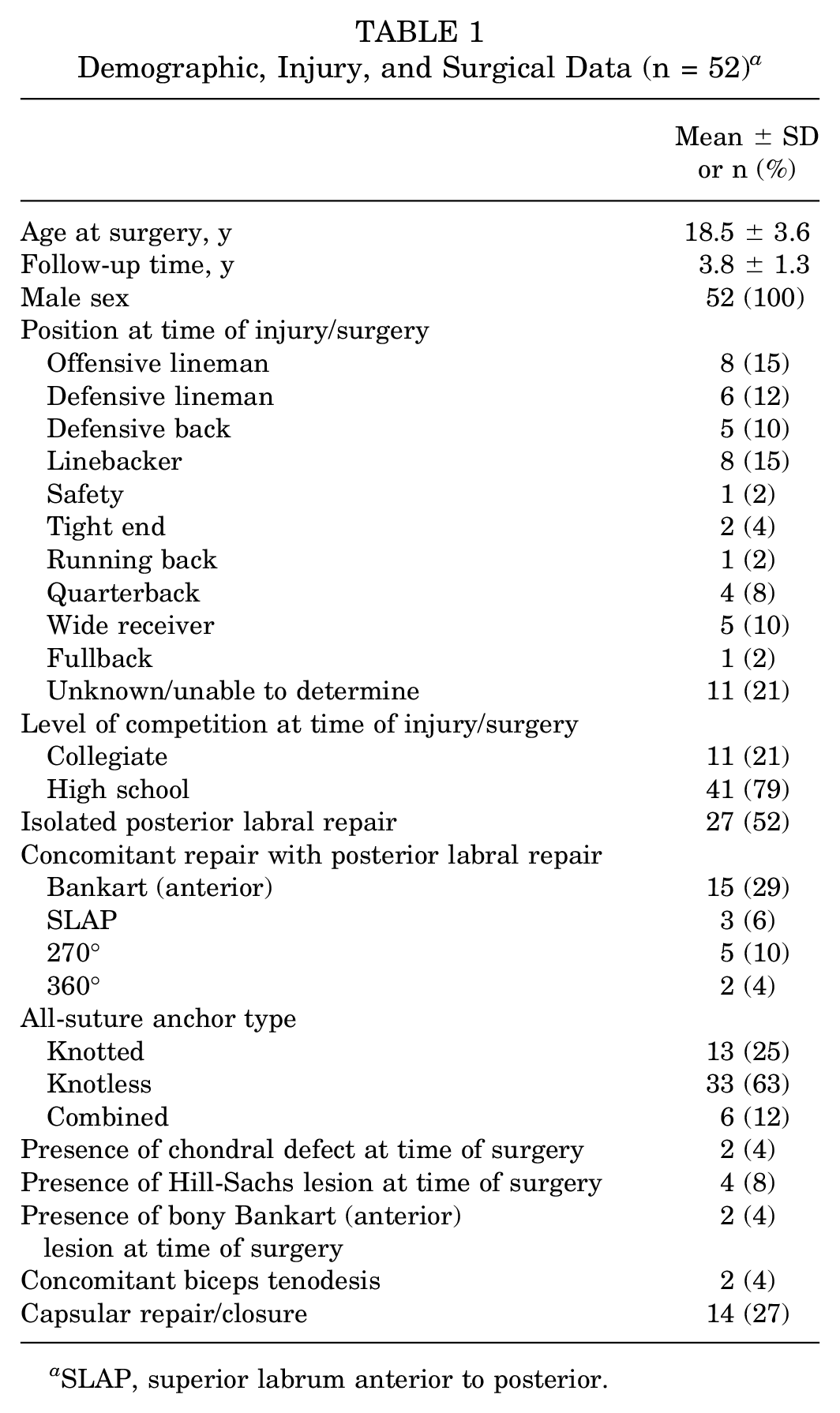
SLAP, superior labrum anterior to posterior.
ASES and WOSI scores at baseline (preoperative) and follow-up for the entire cohort and stratified by level of competition (high school and collegiate) are shown in Table 2. Within the overall cohort (n = 52), both ASES and WOSI scores significantly improved from baseline to follow-up. Within each level of competition (high school and collegiate), ASES and WOSI scores also significantly improved from baseline to follow-up.
Patient-Reported Outcome Scores a

Data are presented as mean ± SD. The ASES and WOSI are scaled from 0 to 100, with 100 representing best shoulder function. All P values were calculated using a paired-samples t test. ASES, American Shoulder and Elbow Surgeons; WOSI, Western Ontario Shoulder Instability Index.
Follow-up ASES and WOSI scores did not differ between athletes who underwent anterior (Bankart) repair in combination with posterior labral repair and those who underwent isolated posterior labral repair (ASES: 97.2 ± 7.2 and 96.7 ± 6.2, respectively; P = .84) (WOSI: 94.2 ± 7.3 and 92.0 ± 15.1, respectively; P = .61). Similarly, follow-up ASES and WOSI scores did not differ between athletes who underwent any concomitant labral repair with posterior labral repair and those who underwent isolated posterior labral repair (ASES: 97.7 ± 6.3 and 96.4 ± 6.6, respectively; P = .48) (WOSI: 94.7 ± 6.6 and 91.4 ± 15.9, respectively; P = .42).
Compared with athletes who underwent labral repair with knotted all-suture anchors (n = 13), those who underwent labral repair with knotless all-suture anchors (n = 33) reported higher ASES scores (92.9 ± 8.8 and 98.1 ± 5.1, respectively; P = .02) and WOSI scores (85.5 ± 20.5 and 95.6 ± 8.5, respectively; P = .03) at follow-up. However, we found that the knotless and knotted anchor groups differed in follow-up time (shorter in knotless group), and when controlling for follow-up time on linear regression, anchor type was no longer associated with follow-up ASES or WOSI scores. Athletes who did (n = 14) and did not (n = 38) undergo capsular repair/closure did not differ in follow-up ASES or WOSI scores (ASES: 95.9 ± 7.4 and 97.2 ± 6.1, respectively; P = .53) (WOSI: 94.0 ± 9.1 and 92.1 ± 14.7, respectively; P = .66).
Lastly, follow-up ASES and WOSI scores did not differ between collegiate football athletes and high school football athletes (ASES: 98.1 ± 3.0 and 96.9 ± 6.9, respectively; P = .74) (WOSI: 92.7 ± 10.3 and 94.2 ± 9.8, respectively; P = .26). Follow-up ASES and WOSI scores also did not differ between blocking and nonblocking positions (P = .33 and P = .46, respectively).
Examining the predictors of follow-up ASES scores, a longer follow-up time was associated with lower ASES scores at follow-up (P = .03). Age at the time of surgery was not associated with follow-up ASES scores (P = .72). For the WOSI, neither age (P = .86) nor follow-up time (P = .10) was associated with WOSI scores at follow-up.
RTS outcomes are shown in Table 3. A total of 14 athletes did not attempt to return to preinjury sport after their labral repair. The most common reasons for not attempting to return included graduation and lack of sufficient talent to move to the next level (12/14), followed by decreased interest (2/14) (Table 3). Of those who attempted to return, 37 of 38 (97%) were able to return to their preinjury level of sport. One athlete attempted to return but was unable to, citing decreased shoulder performance in sport after his labral surgery. At final follow-up, to our knowledge, there were no cases of recurrent instability requiring subsequent revision surgery in this cohort, either at our institution or at outside centers.
Return-to-Sport Outcomes (n = 52)

Those who attempted to return to play excludes those who did not return because of graduation/insufficient talent or for personal reasons (n = 14).
Discussion
Multiple techniques for posterior labral repair are successful in terms of improving pain and function3 -8,11,27,37,43 and enabling RTS, utilizing a variety of hard-body suture anchors.4,7,8,11,22,36,39 We performed this retrospective analysis to examine the outcomes of posterior labral repair using both knotted and knotless all-suture anchors in a population of football players at a higher risk of injuries than the general population.14,27,37,39,48 We confirmed our hypotheses that these athletes would demonstrate statistically significant and clinically important improvements in patient-reported function and high rates of return to preinjury levels of sport for those who attempted to return.
The low-profile construct and smaller cross-sectional area of all-suture soft anchors preserve bone stock and permit the placement of glenoid fixation points, with a decreased risk of chondral damage, osteolysis, or glenoid rim fractures upon anchor placement and/or pullout relative to traditional hard anchor materials, while demonstrating comparable biomechanical properties. ‖ Early clinical and radiographic studies have validated the use of all-suture anchors in glenoid labral repair.1,12,15,16,29,46,52,53 With a 15% probability of subsequent shoulder injuries and a 10% probability of recurrent instability after labral repair, 39 football players and other contact athletes may benefit from labral repair with all-suture anchors because of the preserved bone stock and structural integrity of the glenoid better tolerating repetitive compressive forces, a decreased risk of osteochondral damage upon anchor pullout, and decreased artifacts upon reimaging of subsequent injuries.35,37
Our findings are comparable to those for arthroscopic repair among football athletes with hard-body anchors and/or anchorless repair. We found mean improvements in the ASES score of 33 points and the WOSI score of 45 points from baseline to follow-up, which are markedly greater than the reported minimal clinically important difference values in the literature.44,49 Of the football players in our cohort who attempted RTS at their previous level or higher, 97% of patients were able to do so. Arner and colleagues 4 reported a 93% RTS rate among football athletes undergoing arthroscopic posterior capsulolabral repair with (n = 44) and without (n = 12) suture anchors, with 79% returning to preinjury levels and no difference between anchor types regarding function or stability. Similarly, Bradley and colleagues7,8 reported RTS rates of 92%, with 68% returning to preinjury levels, in separate case series of 100 and 200 shoulders with posterior labral injuries, demonstrating the superiority of anchored over anchorless repair in their later study. Additionally, we found a significant improvement in early functional outcomes using knotless anchors compared with knotted anchors in our cohort. After controlling for follow-up time, our findings were consistent with a review by Matache and colleagues, 29 showing no significant difference in clinical outcomes between knotted and knotless anchors for various types of labral repair. In a study that did not specify the type of arthroscopic repair performed, Robins and colleagues 39 evaluated RTS among National Collegiate Athletic Association (NCAA) Division I football players, including 38% of players with isolated posterior instability, reporting that approximately 85% returned to sport overall. The same study also reported a significant increase in the percentage of games played and returning to play at the same or higher level after labral repair. 39 No athletes in our cohort required revision surgery at our institution, and to our knowledge, none underwent revision at outside centers. In contrast, 10% of football players in the Robins et al 39 study required reduction and/or revision surgery for recurrent instability.
Regarding modern all-suture anchors, clinical outcome studies evaluating repair of distinct types of labral injuries with all-suture anchors have found good functional outcomes.15,16,52 To our knowledge, this is the first study reporting the clinical outcomes of posterior labral repair with all-suture anchors in football players. The earliest clinical outcome case series evaluating glenoid labral repair with all-suture anchors in the general population demonstrated significant improvements in functional outcomes for anterosuperior tears 53 and 360° labral tears 1 at 1 and 2 years, respectively. More recent retrospective and prospective studies on glenoid labral repair for anterior, posterior, and/or multidirectional instability have also demonstrated significant postoperative improvements in functional scores and low rates of instability and redislocations in the general population.15,16,52 However, there remains a paucity of experimental studies comparing clinical outcomes and RTS rates between all-suture anchors and hard-body anchors for glenoid labral repair. Among imaging outcome studies, a randomized controlled trial found significantly decreased levels of glenoid osteolysis at 6 months after labral repair with all-suture anchors compared with biocomposite anchors, 46 and multiple case series have found minimal bony edema, subchondral cyst formation, or tunnel expansion at 1 to 2 years postoperatively.1,53 To date, and to our knowledge, the current study is the largest cohort of posterior labral repair cases using all-suture anchors and the only one in football athletes specifically.
Posterior labral tears were most common in our cohort among offensive linemen, defensive linemen, and linebackers, which is consistent with the report by Mannava and colleagues 28 on elite collegiate athletes at the National Football League Combine. An increased prevalence of posterior labral injuries in these positions has been attributed to repetitive microtrauma from blocking- and block shedding–type activities inherent to these positions. 21 However, despite these positions being most represented, there were no significant differences in either functional outcomes or RTS rates between blocking and nonblocking positions. We conducted a sensitivity analysis comparing isolated posterior labral repair with all combinations of concomitant repair procedures and found no significant differences in outcomes. There were no differences in RTS rates or functional outcomes based on whether athletes had more extensive labral injuries and concomitant labral repair with posterior labral repair, despite our cohort having 15 patients undergoing Bankart repair, 5 with 270° labral tears, and 2 with 360° tears. These findings are consistent with previous reports of nonsignificant differences in RTS rates among NCAA Division I football athletes who underwent anterior, posterior, or combined anterior and posterior repair. 39 Additionally, there was no significant difference in outcomes between those who underwent capsular repair and those who did not. As RTS rates are highly contextual, it must be noted that all athletes in our cohort were football players, with football being a contact sport that permits tighter capsulolabral repair without loss of function compared with other overhead sports, such as baseball, in which pitchers notoriously have more difficulty returning to baseline performance levels after labral repair because of the unique overhead shoulder biomechanics involved.4,7,8,11,22 These results should be interpreted with caution in our cohort because 14 patients did not attempt to return for various reasons. Their RTS success, had they attempted to return, could not be evaluated.
Related to the RTS findings in the current study, only 1 patient in our cohort who attempted to return to sport was unable to return to his previous level because of his shoulder function specifically, citing decreased shoulder-related performance. The other 14 of 15 patients who did not return to competitive football were because of insufficient talent to move to the next level of competition (eg, from high school to college), disinterest, or other personal reasons. Similar reasons have been cited by previous reports that included high school athletes.4,7,8,11,22 This was not unexpected, given that the mean age of our cohort was 18.5 years, an age at which athletes typically graduate from high school and often lose the opportunity to play organized football. Indeed, only 7.5% of high school athletes go on to play football at the collegiate level across all divisions, 34 and many of these athletes would likely not have returned to play football at the next level, regardless of their labral injury.
Most anchors used in the present study were 1.8 mm in size; however, some 2.6-mm anchors were used early on because of concerns over the first-generation 1.8-mm anchors’ deployment mechanism. Surgeons transitioned to the second-generation 1.8-mm anchors that addressed these concerns when they were released. Although the larger diameter 2.6-mm anchors theoretically increase the risk of glenoid rim fractures because of the loss of osseous structural integrity,26,54 no cases of glenoid rim fractures were identified, regardless of anchor diameter, in this cohort of football athletes with a median of 4 anchors per repair. Among the included cases, no instances of all-suture anchor failure during placement or tensioning were identified either.
Limitations related to this study include the size of the included cohort and that we were only able to collect postoperative patient-reported outcomes in 70% of eligible football athletes after posterior labral repair. It is possible that players for whom we were unable to collect postoperative patient-reported outcomes had different outcomes than those included in the present study. While revision surgical procedures at our center were captured via an electronic health record review, it is possible that patients unavailable for follow-up may have undergone revision surgery at outside institutions. Additionally, the retrospective nature of our study was an important limitation, as we were only able to collect data based on routine postoperative encounters and follow-up patient-reported outcomes. Postoperative radiological imaging data were not routinely obtained, unless clinically indicated, and thus were not available to assess for osteolysis and/or glenoid rim fractures. Among cases in which the anchor size was known, 77% were 1.8 mm; however, these data were not documented reliably in all cases, limiting our ability to evaluate the effect of anchor size on outcomes. The retrospective nature of our study may have been associated with recall bias, particularly for details related to RTS and timing/contextual factors. It is possible that those with worse outcomes were more likely to remember their experience and respond to our survey, contributing to declining ASES scores with longer follow-up times. 25 Midterm to long-term follow-up studies on all-suture anchors are planned to evaluate the significance of these outcomes over time. The number of patients who did not return to football for reasons other than their shoulder (eg, insufficient talent or personal reasons) may have also affected the outcomes that we found, as it is possible that some of these patients could have been limited by their shoulder if they had the opportunity to continue playing. The relatively high percentage of concomitant anterior or superior labral injuries is another limitation when evaluating outcomes of posterior labral tears. However, it is reassuring that patients overall did well, despite the high percentage of more significant labral injuries, and that those who underwent combined repair did not have different outcomes than those who underwent isolated posterior repair. Lastly, our results may not be generalized to all football players, as our patient population included a majority of high school athletes.
Conclusion
This study found that using all-suture anchors for posterior labral repair in football athletes demonstrated clinical outcomes similar to those of other posterior labral repair techniques while possibly minimizing potential complications associated with hard-anchor repair. In the present study, patient-reported outcomes at least 2 years after surgery were high. While 29% did not return to football, 97% of those who attempted to return to sport did so at their preinjury level. This study shows encouraging results for the use of all-suture anchors for posterior labral repair in this specific population of athletes.
Footnotes
Final revision submitted January 29, 2025; accepted February 24, 2025.
Presented as a poster at the annual meeting of the AOSSM, Nashville, Tennessee, USA, July 2025.
One or more of the authors has declared the following potential conflict of interest or source of funding: This study was funded in part by Arthrex (RDGT0696). The funding agency had no role in the collection, analysis, or interpretation of the data presented herein. Additionally, the funding agency had no involvement in the writing of the article or the decision to submit the study for publication. A.E.L. has received support for education from Arthrex, Smith & Nephew, and Zimmer Biomet. M.A.R. has received support for education from Arthrex, Smith & Nephew, and Zimmer Biomet and nonconsulting fees from Arthrex. B.A.E. has received consulting fees and royalties from Arthrex. J.R.D. has received consulting fees from Arthrex, Bioventus, DJO, Royal Biologics, and Smith & Nephew and royalties from Arthrex and In2Bones. E.L.C. has received support for education from Prime Surgical and Zimmer Biomet; consulting fees from Arthrex, DJO, Smith & Nephew, and Zimmer Biomet; nonconsulting fees from Medical Device Business Services; royalties from Arthrex; and hospitality payments from Encore Medical. AOSSM checks author disclosures against the Open Payments Database (OPD). AOSSM has not conducted an independent investigation on the OPD and disclaims any liability or responsibility relating thereto.
Ethical approval for this study was obtained from Sterling IRB (No. 6284).