




Abstract
Background:
The quadriceps tendon (QT) autograft is increasingly becoming the graft of choice for reconstructing of the anterior cruciate ligament (ACL), likely because recent clinical studies demonstrate low harvest-site morbidity and failure rates. Both full-thickness QT (FQT) and partial-thickness QT (PQT) graft techniques have been described for ACL reconstruction, but there is currently limited research to guide surgeons on which thickness is optimal.
Purpose:
To analyze and compare the material and mechanical properties of PQT and FQT grafts versus the standard patellar tendon (PT) graft.
Study Design:
Controlled laboratory study
Methods:
A total of 8 PQTs and 8 FQTs, each 10 mm wide, were harvested from the extensor mechanism from matched paired donors with a 10-mm PT graft. Specimens were loaded in tension to failure while load and displacement were continually recorded. Mechanical and material properties were calculated and compared using a 1-way analysis of variance.
Results:
FQT grafts had a greater cross-sectional area and were stronger and stiffer compared with PQT and PT grafts (P < .05). There were no significant differences in strength and stiffness between the PQT and PT grafts when loaded to failure. Both quadriceps grafts recorded a lower ultimate strain at failure compared with the PT grafts (P < .05).
Conclusion:
The biomechanical results from this study demonstrate that PQT grafts have similar biomechanical properties to the current gold standard PT grafts.
Clinical Relevance:
These results suggest PQT grafts are mechanically sufficient and may be preferred, as they do not carry concerns of residual postoperative weakness and knee pain that are associated with FQT and PT grafts, respectively.
Anterior cruciate ligament (ACL) injuries are common, making ACL reconstruction (ACLR) one of the most frequently performed orthopaedic procedures. 21 Surgeons are faced with several decisions during ACLR preoperative planning, including deciding which graft will provide optimal patient outcomes. Common autograft options include bone–patellar tendon–bone (BPTB), hamstring tendon (HT), and quadriceps tendon (QT). BPTB is currently the most frequently used graft but QTs are gaining popularity, with reported use up from 2.5% in 2010 to an estimated 20% in a recent survey of surgeons taken at a national conference. 3 The increased clinical use of QT grafts is likely fueled by research demonstrating decreased graft-site morbidity and reduced knee pain when harvesting QT versus BPTB grafts.15,18,20 In addition, QTs offer a thicker graft with a greater load to failure, 26 increased collagen and fiber density, 11 and stronger remaining tendon after harvest, 2 prompting some to claim it is the graft of the future. 33 Furthermore, a 2024 report by D’Ambrosi et al 7 revealed a significant and steady increase in research on ACLR with QT, from a mean of 10 papers per year from 1982 to 2017, to 260 publications in 2018 alone.
QT autografts can be harvested as all soft tissue or with a bone block from the superior patella, and both are considered safe and viable options for ACLR with comparable clinical outcomes, complications, and revision rates.17,22 However, QT grafts without bone do have a lower risk for patellar fracture and can be used in pediatric cases with open physes.8,9 There are also variations in QT graft thickness, with techniques describing methods to harvest both partial-thickness QT (PQT) and full-thickness QT (FQT) grafts.
While studies indicate there are no differences in clinical failure or complications between FQT and PQT grafts for ACLR, 16 recent concerns have surfaced regarding reduced postoperative ipsilateral quadriceps strength after harvesting FQT autografts. A 2023 study by Letter et al 19 demonstrated patients with FQT autografts have reduced isokinetic extension strength in their operative leg at 1 year postoperative compared with patients with PQT autografts. Similarly, Parrino et al 25 recently demonstrated that harvesting an FQT autograft significantly impairs electromechanical and neuromuscular function compared with harvesting a PQT graft. These studies suggest it may be advantageous to harvest PQT versus FQT grafts to avoid these potential complications. However, there are limited biomechanical data to describe the change in graft strength that occurs when the depth of QT harvest is reduced. One previous cadaveric study by Strauss et al 29 reported no significant differences in load to failure between FQT versus PQT grafts without bone. However, their study did not report the thickness or cross-sectional area (CSA) and it was therefore not possible to measure the material properties. In addition, most of the specimens used failed at the bone-tendon interface and therefore did not fully describe the mechanical behavior of the tendon. Clinically, a systematic review from 2023 found no difference between FQT graft with or without bone block for ACLR and concluded that both are safe and viable options for ACLR with comparable clinical outcomes, complications, and revision rates. 22 The purpose of our in vitro study was to quantify and compare the mechanical properties of PQT and FQT grafts without bone blocks, as prepared for use in an ACLR, and compare them with all–soft tissue patellar tendon (PT) grafts to further inform the surgical decision-making process. We hypothesized that PQT grafts have similar biomechanical properties compared with PT grafts.
Methods
Specimen Preparation
Institutional review board approval was not required for this laboratory investigation utilizing de-identified donated cadaveric matched pairs of knee specimens. Eight paired specimens (62.5 ± 13.0 years of age) were procured and stored at −30°C. Specimens were thawed at room temperature for 24 hours, and the extensor mechanism was harvested for grafts. A double-edged knife 10 mm in width was used to create 10-mm wide segments of each graft (Figure 1). The knife was designed for a cut depth of 6 mm. The PQT grafts were harvested by carefully by transecting through the tendon at the 6-mm depth that was precut by the double-edged knife. In contrast, the FQT grafts were cut deeper to include the full thickness of the tendons. All of the FQT and PQT grafts were harvested from the central aspect of the tendon from medial to lateral. The specimens were procured without the bony attachments. Once prepared, the CSA of each sample was measured using digital calipers.
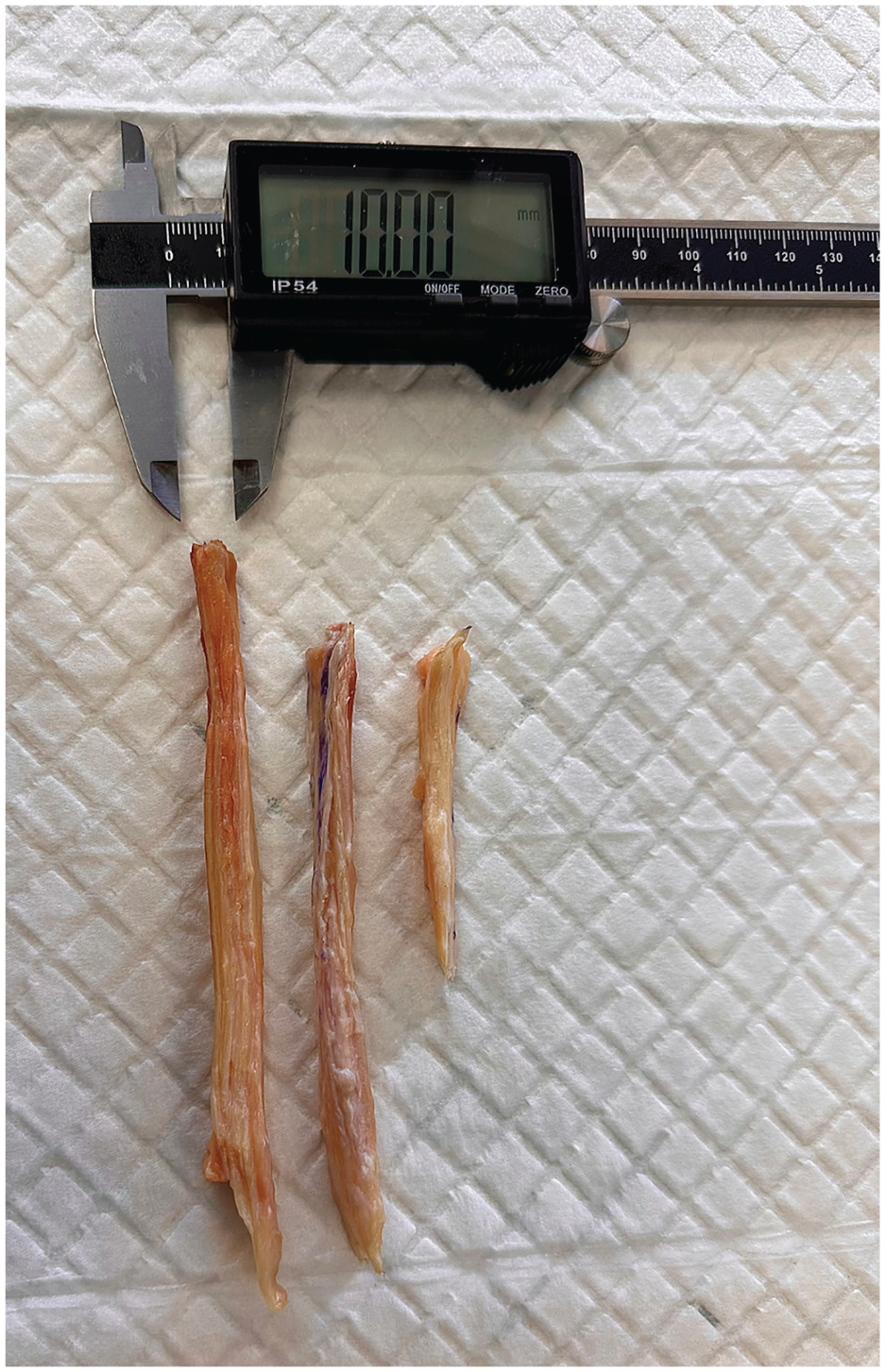
From left to right, harvested full-thickness quadriceps tendon, partial-thickness quadriceps tendon, and patellar tendon, with a caliper set at 10 mm for reference.
Biomechanical Testing
Once prepared, each sample was mounted onto custom tensile testing clamps with the 40-mm gauge section exposed (40 mm for FQT and PQT and 20 mm for PT). The clamps were secured to the frame of the hydraulic testing system (Omega 501-60; MTS Systems Corp). Dry ice was placed in customized holders around both the distal and the proximal ends of the clamp to ensure the specimen ends were rigidly secured (Figure 2). A 5-mm tensile preload was applied followed by 5 cycles of tensile loading from 50 N to 250 N. The tensile load returned to 5 N after the cyclic loading was completed, followed by a load to failure at a rate of 5 mm/s until the specimen ruptured, indicated by a 30% drop in load. Load and displacement were continuously recorded at 128 Hz.

A partial-thickness quadriceps tendon specimen fixed within a freeze clamp attached to the hydraulic testing system.
Data Analysis
An a priori analysis was performed using previously reported ultimate stress data comparing BPTB and QT allografts to confirm our study would be sufficiently powered with alpha set at .05 and (1-β) set at 0.80. 26 Output from the MTS machine was processed using a custom scripted (Python Software) to determine maximal load, yield load, maximal displacement, stiffness, and toughness. Stress-strain curves were created and evaluated to determine ultimate stress, ultimate strain, elastic modulus, and normalized toughness. After verification of normally distributed dependent variables, outcome measures between the 3 grafts (FQT, PQT, and PT) were compared using 1-way analysis of variance adjusted for multiple comparisons using the Bonferroni-Šídák test with significance set at P < .05.
Results
Mechanical Properties
The CSA of the FQT (77.8 ± 11.6 mm2) was significantly greater than both the PQT (51.4 ± 9.5 mm2) and the PT (43.3 ± 9.5 mm2) (P < .0001). There was no significant difference in CSA between PQT and PT specimens (P = .34).
When loaded in tension to failure, the FQT recorded a significantly greater maximal load, yield load, and stiffness compared with both the PQT and the PT (P < .05) (Figure 3). There were no significant differences in displacement or toughness between any of the 3 graft materials, and there were no significant differences between the PT and PQT samples for any of the mechanical properties measured.
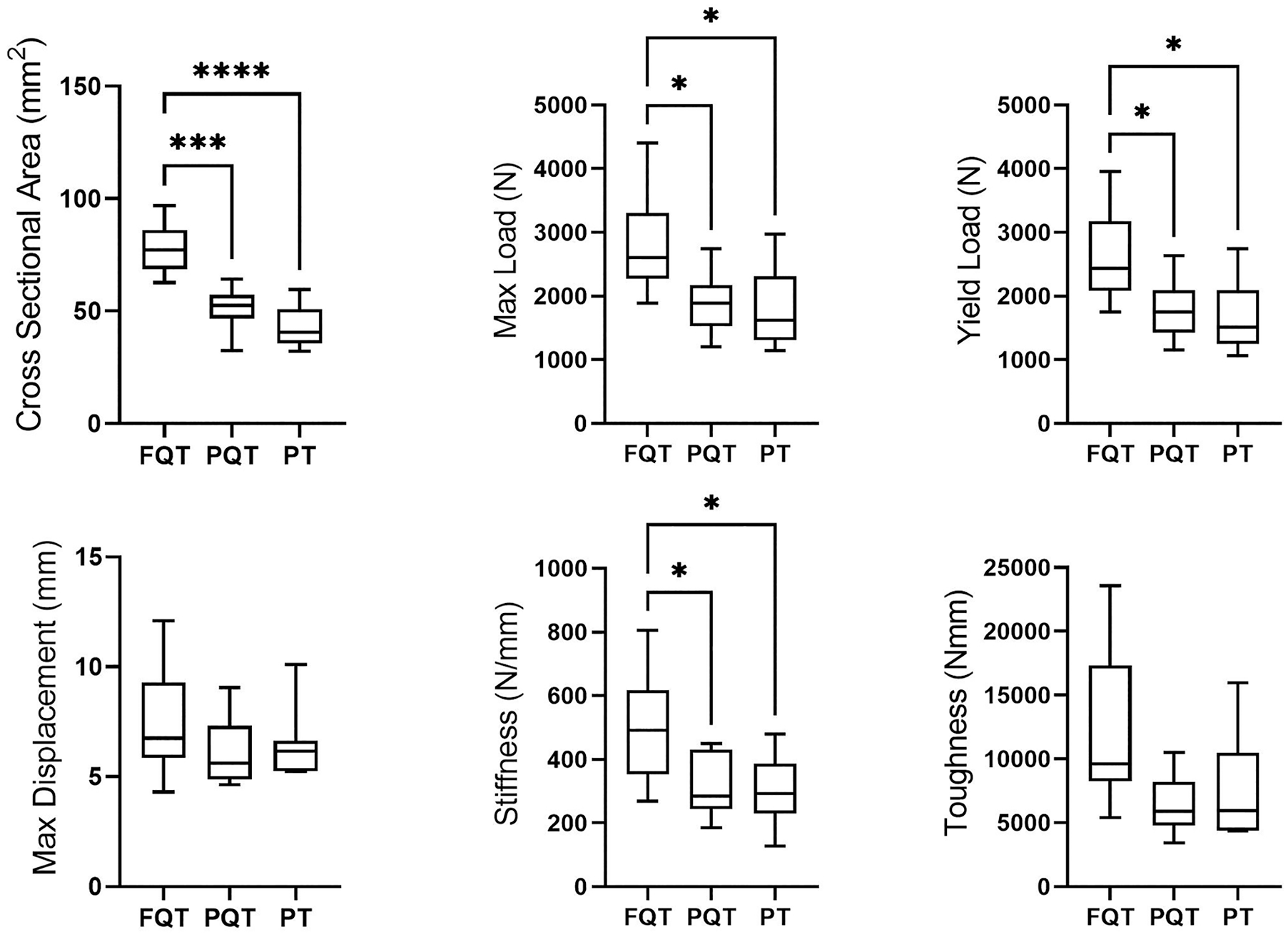
Mechanical properties for each of the 3 grafts tested. FQT, full-thickness quadriceps tendon; Max, maximum; PQT, partial-thickness quadriceps tendon; PT, patellar tendon. * = P < .05. *** = P < .001. **** = P < .0001.
Material Properties
Stress-strain curves were generated from failure data to determine the material properties of each specimen. Ultimate stress and elastic modulus were not significantly different between the 3 graft materials (Figure 4). PT specimens had significantly greater ultimate strain (0.32 ± 0.08) compared with both the FQT (0.22 ± 0.08; P = .03) and PQT (0.17 ± 0.05; P = .002) specimens. PT specimens also demonstrated greater normalized toughness (7.6 ± 2.0 MPa) compared with both FQT (4.5 ± 1.8 MPa; P = .005) and PQT (3.5 ± 1.3 MPa; P < .001) graft materials. There were no significant differences in any of the material properties between FQT and PQT specimens.

Normalized data from the stress-stain curve comparing the 3 grafts: FQT, full-thickness quadriceps tendon; PQT, partial-thickness quadriceps tendon; PT, patellar tendon. *P < .05. ** P < .005. *** P < .001.
Discussion
This cadaveric biomechanical study assessed PQT grafts and compared them with both FQT grafts and PT grafts harvested from the same cadaveric donor. The results demonstrate that the soft tissue mechanical properties of a 10-mm PQT are not significantly different than a 10-mm PT graft, the current gold standard. These results add to the growing body of literature on QT autografts for ACLR by demonstrating that PQT grafts are a mechanically viable option that allows preservation of the native QT to protect against postoperative quadriceps extension weakness.
Data presented in this study are comparable with previous research studies on ACLR grafts. Two previous biomechanical analyses of ACLR grafts assessed BPTB grafts and reported mean load-to-failure values of 1784 N and 1810 N, which are similar to the mean load to failure of 1723 N for the PT grafts without bone blocks measured in this study.29,31 The biomechanical performance of PQT grafts has not yet been widely studied, and among the current literature only 1 other study has reported on the mechanical properties of PQT grafts and compared them with other common grafts for ACLR. 29 However, the methods of that study were suboptimal given that they did not describe the thickness of their PQT grafts versus their FQT grafts, nor CSA for any of their grafts, and they did not consider material properties. The mean load to failure for PQT grafts within this study by Strauss et al 29 was 972 N, which was much lower than our PQT load to failure of 1881 N, and may be attributed to a significantly lower CSA or thickness of their PQT grafts. Nevertheless, our PQT graft values did perform comparably with those of BPTB grafts reported in multiple biomechanical studies.4,26,31 Our PQT grafts also performed similarly to the native ACL in terms of maximal load to failure. Woo et al 24 and Noyes et al 32 conducted biomechanical evaluations of the native ACL and reported 2160 N and 1725 N for mean load to failure, respectively, and the load to failure for our PQT grafts is right in between these two values. Likewise, Shani et al 26 reported that cadaveric FQT grafts had an ultimate load to failure of 2186 N, which is similar to the ultimate load of 2746 N for FQT grafts measured in the present study. Notably, the FQT grafts within the aforementioned study were harvested with a bone block from the patella, and subsequently 7 out of 12 failed at the bone-tendon interface. The bone-tendon interface may be an area of weakness that explains relatively lower values for load to failure of FQT grafts within other studies as compared to our study. The biomechanical study by Strauss et al reported an even lower mean load-to-failure value for their FQT grafts with bone block, which may too be further explained by the fact that 8 out of 8 of their FQT grafts failed at the bone-tendon interface.
Major strengths of our study are that we assessed the mechanical and material properties of our grafts and used matched pairs for our comparisons. We chose to forgo the harvest of bone blocks and harvest all–soft tissue specimens to eliminate any premature failure that may occur at the bone-tendon interface and test our grafts at the site of most common clinical rupture—which was midsubstance. van der List et al 30 sought out to confirm this by evaluating the knee magnetic resonance imaging studies of 353 patients with ACL tears, and they found that 81% of ACL tears occurred along the midsubstance of the tendon. 30 Further, in terms of premature failure at the bone-tendon interface, in the study by Strauss et al 29 all 8 out of 8 of their FQT grafts with bone failed at the bone-tendon interface and had a load to failure (1450 N) much lower than that of the all–soft tissue FQT grafts assessed within our study (2746 N). They also interestingly did not find a significant difference in load to failure between their FQT graft groups, with or without bone, which indicates that the presence of bone did not significantly improve the performance of the graft during testing and, if anything, may weaken performance. Another major strength of our study was using matched pairs for our analysis. Although there is no clear consensus, multiple studies show that tendon integrity and performance may vary depending on age, weight, height, race, diet, or other intrinsic factors unique to one specific person.4,5,10,12,27 Therefore, our goal was to compare graft specimens from contralateral legs of the same cadaver to minimize the effect of variability between cadavers and maximize the reliability and reproducibility of our results. Nevertheless, future studies should be done on younger specimens that are more representative of the cohort of patients that typically undergo ACLR to maximize applicability.
A 2023 meta-analysis of randomized controlled trials (RCTs) evaluated donor-site morbidity such as anterior knee pain, difficulty kneeling, or a combination, after different autograft ACLRs. 18 Their analysis included 21 RCTs and demonstrated that patients with QT grafts had an 88% lesser odds of donor-site morbidity compared with those who received PT grafts. This suggests FQT grafts have a mechanical advantage over PT grafts and less graft-site morbidity. However, potential donor-site weakness remains a concern when harvesting FQT grafts.
Donor-site weakness after harvesting HTs for ACLR grafts has been well-established, leading to a decrease in clinical use over the years.1,23 Similarly, recent attention is being placed on donor-site weakness associated with graft harvest from QTs. Holmgren et al 14 compared isokinetic strength 7 months after ACLR between patients with FQT, HT, and BPTB autografts and reported that those with FQT grafts had significantly worse isokinetic quadriceps strength compared with those with HT and BPTB grafts harvested. Subsequent studies investigated quadriceps donor-site weakness in the setting of PQT grafts and found that leaving a remainder of some of the native QT tissue, as done with PQT grafts, preserved quadriceps strength.19,25 The preservation of quadriceps strength in patients who had PQT versus FQT grafts may partially be attributed to the high rate of donor-site healing after PQT harvest, which is reportedly 93% healed at 6 months on average.6,28 A decrease in quadriceps strength is likely concerning for all active individuals, particularly among professional athletes whose post-ACLR fitness and strength determine their ability to return to sport. 13 Future studies should expand on this topic by examining QT grafts harvested with various CSAs to determine the optimal combined width and thickness that may minimize postoperative quadriceps weakness and maximize strength of the ACLR construct, respectively.
Limitations
As with all time-zero cadaveric biomechanical studies, we were unable to evaluate the biological healing of grafts over time, which may affect their long-term mechanical properties. Future studies should investigate any long-term differences in graft biologic remodeling, risk of osteoarthritis, and rehabilitation course when QT grafts of varying thickness are used for ACLR. The age of the cadavers used was greater than the mean age of most patients undergoing ACLR; however, the use of matched pairs allowed for equal comparison between the 3 grafts. Also, only the soft tissue of the PTs was evaluated, while in contrast most surgeons use PT with a bone block on each end (BPTB), construct for an ACLR. We chose to compare PT grafts with QT grafts, each without bone, for a more direct comparison of their mechanical and material properties. This was also done to limit any premature failure that may occur at the bone-tendon interface of these grafts when tested in the laboratory as reported in other studies.26,29 We believe that our method provides a better representation of the true performance of these grafts within the knee when used for ACLR, given that the site of most common failures of the native ACL is midsubstance. 30 All soft tissue QT grafts without bone were examined in this study because they perform clinically equivalent to QT grafts with bone, while having a lower risk for patellar fracture and the versatility to be used in cases of pediatric patients with open physes.8,9,22 Future clinical studies should prospectively investigate the outcomes and failure mechanism of patients who undergo an ACLR with FQT or PQT grafts, with and without bone, and compare with patellar grafts, with and without bone, to enhance our overall understanding and guide treatment.
Conclusion
The results presented in this cadaveric biomechanical study demonstrate that PQT grafts have similar properties to PT grafts. Clinically, this suggests use of PQT grafts can limit postoperative weakness and knee pain associated with FQT and BPTB grafts, respectively, without compromising the immediate postoperative strength of the ACLR.
Footnotes
Final revision submitted December 11, 2024; accepted February 3, 2025.
One or more of the authors has declared the following potential conflict of interest or source of funding: This study was supported by a grant to J.D. from the American Medical Society for Sports Medicine. AOSSM checks author disclosures against the Open Payments Database (OPD). AOSSM has not conducted an independent investigation on the OPD and disclaims any liability or responsibility relating thereto.
Ethical approval was not sought for the present study.