




Abstract
Background:
Anterior cruciate ligament (ACL) injuries are common in sports. These injuries often present with ≥1 meniscal tears, which may affect pre- and postoperative patient outcomes.
Purpose:
To compare patient-reported outcome measures (PROMs) between isolated ACL reconstruction (ACLR) and ACLR with concomitant meniscal surgery, such as meniscal repair or arthroscopic partial meniscectomy, over 2 years to aid in preoperative counselling and rehabilitation.
Study Design:
Cohort study; Level of evidence 3.
Methods:
This retrospective study included 415 consecutive patients who underwent ACLR at a tertiary referral hospital between January 2009 and December 2022. PROMs—including the Knee injury and Osteoarthritis Outcomes Score (KOOS) and the Lysholm score—were assessed preoperatively and at the 2-year follow-up between the isolated ACLR group and the ACLR with meniscal surgery group using the Mann-Whitney U test. A Wilcoxon signed-rank test within groups was used to assess preoperative to the 2-year follow-up improvements. Also, 95% CIs were utilized to provide the likely values of the true population mean. Two-tailed significance tests were used, and the statistical significance level was set at P < .05.
Results:
The patients in the 2 groups (isolated ACLR group, n = 205 and ACLR with meniscal surgery group, n = 210) had similar baseline characteristics for age, sex, and body mass index (P > .05). The meniscal surgery group showed significantly worse Lysholm scores (71.1 [95% CI, 68.8-73.5] vs 74.9 [95% CI, 72.6-77.1]; P = .017) and KOOS domain scores preoperatively compared with the isolated ACLR group: KOOS Symptoms, 72.4 (95% CI, 69.9-75) versus 77.3 (95% CI, 75-80) (P = .011); KOOS Activities of Daily Living, 81.4 (95% CI, 79-83.7) versus 85.6 (95% CI, 83.6-87.6) (P = .006); KOOS Pain, 76.3 (95% CI, 73.9-78.8) versus 81(95% CI, 78.7-83.2) (P = .006); and KOOS Quality of Life, 39.4 (95% CI, 36.4-42.5) versus 43.9 (95% CI, 41-46.9) (P = .028). However, the KOOS Sport and Recreation domain had a lower and insignificant mean (35.6 [95% CI, 31.7-39.4] vs 39.9 [95% CI, 36.2-43.6]; P = .061). Both groups significantly improved across all PROMs at the 2-year follow-up (P < .001). When compared with the isolated ACLR group, the meniscal surgery group had lower postoperative scores for Lysholm scores (93.8 [95% CI, 92.6-95] vs 95.3 [95% CI, 94.3-96.4]; P = .017), the KOOS Sport and Recreation Function (87.5 [95% CI, 85.1-90] vs 89.6 [95% CI, 87-92.2]; P = .025), and the KOOS Pain (97 [95% CI, 96-98] vs 96.7 [95% CI, 95.9-97.6]; P = .010), with insignificant differences in other KOOS domains (P > .05).
Conclusion:
The study demonstrated that patients undergoing ACLR with concurrent meniscal surgery initially showed slightly poorer functional scores compared with those who underwent isolated ACLR. Both groups showed significant postoperative improvements. However, patients requiring surgical intervention for concurrent meniscal injuries can expect poorer functional outcomes than those requiring isolated ACLR, even after 2 years. These data may be important when counselling patients presenting with ACL tears who need to receive surgical treatment.
Keywords
Anterior cruciate ligament (ACL) injuries are a common occurrence among athletes, especially those who regularly engage in sports involving deliberate contact. 15 These injuries are known to frequently result in knee instability and often coincide with other intra-articular damage, such as meniscal tears. 17 In fact, isolated ACLs occur <10% of the time compared with most injury cases, which tend to be accompanied by additional damage.4,24 Therefore, surgeons should anticipate accompanying injuries, such as those to the meniscus, when diagnosing and treating ACL tears.24,19
In terms of treatment, ACL reconstruction (ACLR) is widely considered the gold standard for addressing ACL injuries in active patients or athletes. 16 This procedure plays a vital role in restoring functional stability to the knee joint and in preventing the deterioration of the knee joint over time. 11 In more complex cases where unstable meniscal injuries are also present, additional treatments—such as meniscal repair (MR) or arthroscopic partial meniscectomy (APM)—may be required.
However, the question remains whether the presence of concurrent meniscal injuries requiring either MR or APM surgery has a significant effect on the outcomes of patients undergoing surgical procedures. It is a widely accepted fact that patients who are also dealing with a concurrent meniscal injury tend to experience a higher degree of discomfort. 2 This trend has been confirmed by preoperative patient-reported outcome measures (PROMs), which consistently show worse function in these patients. However, patients tend to show considerable improvements after 2 years regardless of the severity of their initial functional scores or the presence of concurrent meniscal injury. 13
In the postoperative phase, there was no consensus on the differences between the outcomes of patients who underwent isolated ACLR and those who underwent ACLR and meniscal surgery. Previous studies have found no significant differences in outcomes between patients who underwent isolated ACLR and those who underwent ACLR and meniscal surgery.6,8,23 However, other studies report less favorable outcomes when the procedure is performed in conjunction with meniscal surgery.10,13
This retrospective analysis has a 2-fold objective. First, it aimed to compare the 2-year outcomes of patients who underwent ACLR, both with and without a concurrent meniscal injury requiring surgery. Second, by analyzing the patient-reported functional scores, this study aimed to provide valuable insights for preoperative counselling to help patients better understand their rehabilitation protocol and potential timeline for recovery. We hypothesized that patients with a meniscal injury at the time of ACLR would experience a similar degree of improvement and postoperative function as those patients who undergo ACLR but have no meniscal injury.
Methods
A retrospective analysis of a consecutive series of patients who underwent ACLR between 1 January 2009 and 31 December 2022 was performed. The inclusion criteria were as follows: (1) patients with or without concomitant meniscal injuries at the time of ACLR; (2) patients achieving full range of motion (2° extension and 140° of flexion); (3) patients of all ages; and (4) patients who completed the 2-year follow-up by filling out the questionnaires. The exclusion criteria were as follows: (1) ACL rupture associated with multiligament knee injuries; (2) revision ACLR; (3) ACLR with osteotomy surgery; or (4) presence of fractures or grades ≥1 articular cartilage injury.
This study received ethical approval from the National Health Care Group domain-specific review board under the reference number 2023/00283.
The patients underwent follow-up appointments with their primary surgeon at the 2-year follow-up. During the follow-up, patients completed the questionnaires measuring the Knee injury and Osteoarthritis Outcomes Score (KOOS) and the Lysholm knee score. These PROMs further provide insight into the success of the surgery and how the patients progress postoperatively.
Relevant clinical information—including patients’ age, sex, body mass index, and activity levels—was extracted from electronic medical records and registry data. Activity levels were defined as competitive (at the national level or above), intermediate (competed at varsity or local level competitions), recreational, or nonsporting according to the patient. All concurrent meniscal injuries were identified during diagnostic arthroscopy. The institution's electronic medical record system was used to trace intraoperative arthroscopic findings and the performed surgical procedures.
Statistical Package for Social Sciences Version 26.0 for Windows (IBM) was used for the statistical analysis. The chi-square test was used for discrete variables, and the Mann-Whitney U test and the Wilcoxon signed-rank test were used to analyze the continuous variables of the nonparametric data. Also, 95% CIs were used to provide the likely values of the true population mean. The significance tests were 2-tailed, and the statistical significance level was set at P < .05.
A priori power analysis for the Lysholm score was conducted for the sample size, with an alpha level of .05 and a power of 0.80 as the significance threshold; the minimum sample size needed with this effect size was 376. Thus, our obtained sample size of 421 was adequate to test the study hypothesis.
Results
This analysis included 205 patients who underwent isolated ACLR. The second group included 210 patients who underwent ACLR with meniscal surgery, with 51.4% (108/210) having isolated MR, 43.3% (91/210) having isolated APM, and 5.2% (11 of 210) having both surgeries (medial APM + lateral MR or lateral APM + medial MR). The distribution of the cases is presented in Figure 1.

Case selection and distribution. ACLR, anterior cruciate ligament reconstruction.
The isolated ACLR and ACLR + meniscal surgery groups were composed of 205 and 210 patients, respectively. Both groups of patients had comparable preoperative descriptive data, body mass index, and activity levels (Table 1).
Patient Characteristics of the 2 Groups a

Values are reported as mean (95% CI). ACL, anterior cruciate ligament; BMI, body mass index.
A statistically significant (P < .001) increase was observed across all PROMs in both groups (Table 2). In the isolated ACLR group, the Lysholm score improved from 74.9 (95% CI, 72.6-77.1) to 95.3 (95% CI, 94.3-96.4). KOOS scores improved across all the domains—KOOS Symptom scores increased from 77.3 (95% CI, 75-79.7) to 94.3 (95% CI, 92.9-95.6), KOOS Activities of Daily Living (ADL) scores increased from 85.6 (95% CI, 83.6-87.6) to 98.2 (95% CI, 97.4-98.9), KOOS Pain scores increased from 81 (95% CI, 78.7-83.2) to 97 (95% CI, 96-98), KOOS Sport and Recreation Function scores increased from 39.9 (95% CI, 36.2-43.6) to 89.6 (95% CI, 87-92.2), and KOOS Quality of Life (QoL) scores increased from 43.9 (95% CI, 41-43.9) to 85 (95% CI, 82.4-87.7). A statistically significant improvement (P < .001) was observed across all PROMS in the ACLR + meniscal surgery group. The Lysholm score improved from 71.1 (95% CI, 68.8-73.5) to 93.7 (95% CI, 92.5-94.8). Similarly, KOOS scores improved across various domains. The KOOS domain scores improved from 72.4 (95% CI, 69.9-75) to 97.8 (95% CI, 97.2-98.4) for KOOS Symptoms, from 81.4 (95% CI, 79-83.7) to 97.8 (95% CI, 97.2-98.4) for KOOS ADL, from 76.3 (95% CI, 73.9-78.8) to 96.7 (95% CI, 95.9-97.6) for KOOS Pain, from 35.6 (95% CI, 31.7-39.4) to 87.5 (95% CI, 85.1-90) for KOOS Sport and Recreation Function, and from 39.4 (95% CI, 36.4-42.5) to 81.9 (95% CI, 79-84.8) for KOOS QoL. This suggests that all patients who undergo surgery, regardless of their meniscal status and treatment method (MR or APM), will experience improved outcomes after 2 years.
Preoperative and 2-Year Functional Scores in the Isolated ACLR and ACLR + Meniscal Surgery Groups a

Values are reported as mean (95% CI). ACL, anterior cruciate ligament; ADL, activities of daily living; KOOS, Knee injury and Osteoarthritis Outcome Score; Postop, postoperative; Preop, preoperative; QoL, Quality of Life.
In general, the preoperative PROMs for the ACL and meniscal surgery groups were statistically significantly worse than those for the ACL group for the Lysholm score (71.1 [95% CI, 68.8-73.5] vs 74.9 [95% CI, 72.6-77.1]; P = .017) and generally worse for KOOS scores across all domains: KOOS Symptoms, 72.4 (95% CI, 69.9-75) versus 77.3 (95% CI, 75-80) (P = .011); KOOS ADL, 81.4 (95% CI, 79-83.7) versus 85.6 (95% CI, 83.6-87.6) (P = .006); KOOS Pain, 76.3 (95% CI, 73.9-78.8) versus 81 (95% CI, 78.7-83.2) (P = .006); and KOOS QoL, 39.4 (95% CI, 36.4-42.5) versus 43.9 (95% CI, 41-46.9) (P = .019). However, the KOOS Sport and Recreation Function was not statistically significant (P = .061) despite a lower mean of 35.6 (95% CI, 31.7-39.4) versus 39.9 (36.2-43.6).
The functional scores of both groups were reevaluated at the 2-year follow-up. As indicated in Table 3, both the Lysholm score (95.3 [95% CI, 94.3-96.4] vs 93.8 [95% CI, 92.6-95]; P = .030) and KOOS scores for both Pain (97 [95% CI, 96-98] vs 96.7 [95% CI, 95.9-97.6]; P = .010) and Sport and Recreation Function (89.6 [95% CI, 87-92.2] vs 87.5 [95% CI, 85.1-90]; (P = .025) showed statistically significant better outcomes for patients in the isolated ACLR group. Other KOOS domain scores—including KOOS Symptoms (94.3 [95% CI, 92.9-95.6] vs 92.7 [95% CI, 91.3-94.2]; P = .630), KOOS ADL (98.2 [95% CI, 97.4-98.9] vs 97.8 [95% CI, 96-98]; P = .203), and KOOS QoL (85 [95% CI, 82.4-87.7] vs 81.9 95% CI, 79-84.8]; P = .096)—were worse for the patients in ACLR + meniscal surgery group but were not statistically significant. Despite the additional procedures, patients in the ACLR + meniscal surgery group who had worse outcomes were unable to achieve the same overall function as the patients in the isolated ACLR group.
Preoperative and 2-Year Functional Scores in Isolated ACLR and ACLR + Meniscal Surgery Groups a

Values are reported as mean (95% CI). ACL, anterior cruciate ligament; ADL, activities of daily living; KOOS, Knee injury and Osteoarthritis Outcome Score; Postop, postoperative; Preop, preoperative; QoL, Quality of Life.
The meniscal injury group was further subdivided into MR and meniscectomy groups to identify trends in these procedures (Table 4). Preoperatively, there were no statistically significant differences between the 2 groups in the Lysholm and KOOS scores (Symptoms, ADL, Pain, Sport and Recreation Function, and QoL). At the 2-year follow-up, however, the meniscectomy group demonstrated significantly higher scores: Lysholm, 95.2 (95% CI, 93.7-96.7) versus 91.9 (95% CI, 89.9-93.9) (P < .001); KOOS Symptoms, 95.2 (95% CI, 93.6-96.8) versus 89.9 (95% CI, 87.4-92.4) (P < .001); KOOS ADL, 97.9 (95% CI, 97-98.9) versus 95.4 (95% CI, 93.9-96.9) (P < .001); and KOOS QoL, 87.6 (95% CI, 83.8-91.3) versus 74.9 (95% CI, 70.5-79.2) (P < .001), indicating a superior functional recovery. KOOS Pain scores were also marginally better in the meniscectomy group (98.4 [95% CI, 97.8-99.1] vs 97.2 [95% CI, 96.1-98.3]; P = .034). These findings suggest that, despite improvements in both groups, patients undergoing meniscectomy achieved better functional outcomes at 2 years compared with those who had MR.
Subgroup Analysis of the ACLR + Meniscal Surgery Population a

Values are reported as mean (95% CI). ACL, anterior cruciate ligament; ADL, activities of daily living; KOOS, Knee injury and Osteoarthritis Outcomes Score; Postop, postoperative; Preop, preoperative; QoL, Quality of Life.
Preoperatively, no statistically significant differences were found between medial and lateral repairs across all functional scores—including the Lysholm score (72.4 [95% CI, 67.6-77.1] vs 74.1 [95% CI, 68.3-79.8; P = .152) and KOOS domain scores: Symptoms, 73.9 (95% CI, 68.8-79.1) versus 71.2 (95% CI, 65.6-76.7) (P = .331); ADL, 79.3 (95% CI, 75.3-83.3) versus 75.4 (95% CI, 68.4-82.4) (P = .643); Pain, 83.7 (95% CI, 79.7-87.7) versus 77.9 (95% CI, 70.6-85.2) (P = .235); Sport and Recreation Function, 40.9 (95% CI, 32.7-49.1) versus 38.5 (95% CI, 29.8-47.1) (P = .756); and QoL, 39.8 (95% CI, 34.2-45.4) versus 37.1 (95% CI, 29.3-44.9) (P = .382). Both groups showed improvements at the 2-year follow-up, achieving comparable outcomes with no statistically significant differences (Table 5). Lysholm scores and KOOS domain scores were similar: Lysholm scores, 94.8 (95% CI, 92.8-96.8) versus 95.3 (95% CI, 92.4-98.2) (P = .717); KOOS Symptoms, 96.4 (95% CI, 94.7-98.1) versus 94.6 (95% CI, 91.2-98) (P = .677); KOOS ADL, 98.1 (95% CI, 97-99.3) versus 97.8 (95% CI, 96-99.6) (P = .764); KOOS Pain, 98.5 (95% CI, 97.7-99.3) versus 98.2 (95% CI, 96.7-99.7) (P = .948); KOOS Sport and Recreation Function, 90.9 (95% CI, 87.3-94.5) versus 89.5 (95% CI, 83.4-95.6) (P = .598); and KOOS QoL, 86.4 (95% CI, 80.4-92.4) versus 89.7 (95% CI, 84.8-94.7) (P = .994). These findings suggest that both medial and lateral MR yield similar functional outcomes across all PROMs in patients after ACLR preoperatively and at the 2-year follow-up.
Subgroup Analysis of the Meniscal Repair Population a

Values are reported as mean (95% CI). ACL, anterior cruciate ligament; ADL, activities of daily living; KOOS, Knee injury and Osteoarthritis Outcomes Score; Postop, postoperative; Preop, preoperative; QoL, Quality of Life.
No statistically significant differences were observed between medial and lateral meniscectomy groups across all functional scores preoperatively—including Lysholm scores (72.7 [95% CI, 67.5-77.8] vs 67.9 [95% CI, 62.4-73.4]; P = .152) and KOOS domain scores (Symptoms, 73.6 [95% CI, 67.5-79.8] vs 71.8 [95% CI, 65.2-78.3]; P = .509); ADL, 76.5 [95% CI, 71.3-81.8] vs 74.8 [95% CI, 68.2-81.4]; P = .607; Pain, 82.6 [95% CI, 77.6-87.5] vs 82 [95% CI, 76.2-87.7]; P = .728; Sport and Recreation Function, 33.1 [95% CI, 24.4-41.7] vs 38.5 [95% CI, 29.1-48]; P = .305; and QoL, 41.1 [95% CI, 34.2-48] vs 41.3 [95% CI, 32.9-49.7]; P = .937). Both groups showed improvements at the 2-year follow-up, achieving comparable outcomes with no statistically significant differences (Table 6). Lysholm scores and KOOS domain scores were similar (Lysholm scores, 92.2 [95% CI, 88.8-95.7] vs 91 [95% CI, 88-93.9]; P = .335; KOOS Symptoms, 89.7 [95% CI, 86.4-93.1] vs 88.1 [95% CI, 83.5-92.7]; P = .709; KOOS ADL, 95.8 [95% CI, 93.9-97.7] vs 93.9 [95% CI, 91-96.8]; P = .577; KOOS Pain, 97.5 [95% CI, 96.5-98.6] vs 96 [95% CI, 93.3-98.6]; P = .773; KOOS Sport and Recreation Function, 82.7 [95% CI, 77.3-88] vs 82.9 [95% CI, 75.9-89.9]; P = .769; and KOOS QoL, 73.4 [95% CI, 67.7-79.1] vs 72.7 [95% CI, 64.5-81]; P = .878). Therefore, the laterality of meniscectomy did not affect the pre- and postoperative PROMs.
Subgroup Analysis of the Meniscectomy Population a
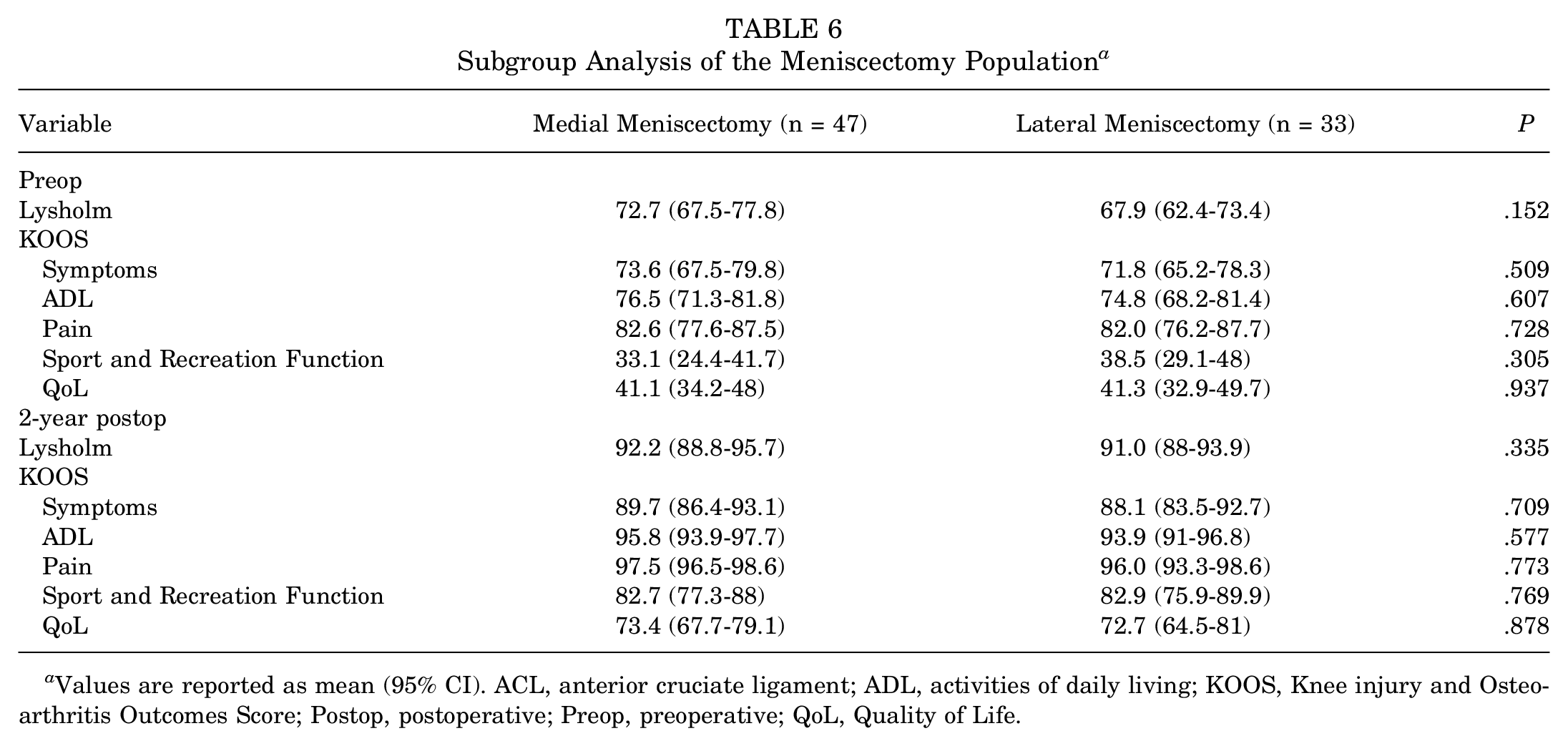
Values are reported as mean (95% CI). ACL, anterior cruciate ligament; ADL, activities of daily living; KOOS, Knee injury and Osteoarthritis Outcomes Score; Postop, postoperative; Preop, preoperative; QoL, Quality of Life.
Discussion
The most important findings of our study was that patients with meniscal injury requiring surgery had worse preoperative outcomes (Lysholm scores, 71.1 vs 74.9; P = .017; KOOS Symptoms, 72.4 vs 77.3; P = .011; KOOS ADL, 81.4 vs 85.6; P = .006; KOOS Pain, 76.3 vs 81; P = .006; and KOOS QoL, 39.4 vs 43.9; P = .028) than those who underwent an isolated ACLR. Furthermore, patients with concomitant meniscal surgery continued to have worse outcomes postoperatively (Lysholm scores, 93.8 vs 95.3; P = .017; KOOS Sport and Recreation Function, 87.5 vs 89.6; P = .025; and KOOS Pain, 97 vs 96.7; P = .010) and up to 2 years after the surgery.
Numerous studies have examined patient outcomes after ACLR, both with and without meniscal surgery.3,7,9,10,13,18,22 However, these studies vary in their design, patient population, and follow-up duration, all of which significantly influence the results. While these studies are informative, their applicability to our specific patient population and time duration is limited.
Our preoperative findings are consistent with various studies that showed functional scores were significantly worse for patients with concomitant meniscal injury.9,18 However, it differs from the findings of Singh et al, 22 who reported comparable preoperative Tegner (3.45 vs 3.32) and Lysholm scores (68.9 vs 74.3) between the isolated ACLR group and ACLR group with meniscal injury, respectively. Concomitant meniscal injury might suggest a larger force on impact, leading to a worse preoperative functional outcome. Furthermore, other studies suggest that the meniscus acts as a secondary stabilizer within the knee, and damage to the meniscus can lead to further functional impairment.14,20 Last, another possible reason that could explain the poorer PROMs could be the meniscal injury resulting in increased nociception impacting the function of the patient.1,5,12
Our postoperative findings are consistent with previous studies that have demonstrated a negative correlation between meniscal status and knee function after ACLR.3,7,10,13 McConville et al 13 suggested that patients who underwent partial and complete meniscal surgery reported more subjective complaints according to the Lysholm questionnaire. Similarly, Laxdal et al 10 noted that concomitant meniscal injury led to poorer patient-reported outcomes, specifically on the KOOS, International Knee Documentation Committee, and Tegner scores.
On the other hand, our study findings differ from those of Kowalchuk et al, 8 who analyzed patient-reported outcomes after ACLR and found that concomitant meniscal injuries were not significant predictors of PROMs. Similarly, other studies reported no significant difference in function.6,23 Spindler et al 23 found that meniscal injury status was not a risk factor for patient-reported outcomes. However, they suggested that lateral meniscal injury status is a predictor of patient-reported outcomes for the KOOS Sport and Recreation Function as well as the KOOS QoL over a 6-year minimum follow-up.
Nevertheless, our finding that postoperative outcomes are worse in patients who had concomitant meniscal surgery can have several explanations. Firstly, our patients had worse preoperative PROMs compared with other studies that had insignificant differences in preoperative and postoperative PROMs. 22 Secondly, rehabilitation protocols might differ between various studies and should be studied in greater detail. Last, another explanation for our finding could be that concomitant meniscal injury can cause further joint damage for the patients, causing the difference in outcomes. 10
The subgroup analysis of the patients with meniscal surgery showed that patients who undergo meniscectomy have higher PROMs postoperatively compared with those who undergo MR. This is similar to the Sarraj et al 21 study, which described better PROMs in meniscectomies at the 2-year follow-up. This difference between the 2 groups could be attributed to the difference in postoperative rehabilitation protocols, as patients who had MR have more restrictions in weightbearing compared with those who had meniscectomy.
Thus, no established consensus exists on patient-reported outcomes for isolated ACLR and ACLR + meniscal surgery. Follow-up duration is an important parameter that influences patient-reported outcomes. The papers reviewed did not describe a short-term follow-up duration like our study, except for the study by McConville et al 13 that also provides a 2-year follow-up, which might explain the difference in results. Furthermore, activity levels and motivation could vary among different populations, affecting the rehabilitation regimen and potentially explaining the differences.
The conclusions drawn from our study aid in patient counselling and determining a relevant rehabilitation protocol. The longitudinal progression after surgical interventions, such as meniscectomy or MR, compared with isolated ACL injury cases, reveals comparable rates of improvement over time. However, a notable distinction exists wherein patients undergoing concurrent procedures do not fully attain parity with those experiencing isolated ACL injuries. This will aid in patient counselling and expectation management. Moreover, our findings highlight the need for postoperative rehabilitation protocols, particularly in cases where ACLR is accompanied by meniscal procedures to maximize patient outcomes.
Limitations
However, our study does have some limitations. Biases that might affect study outcomes include temporal bias with changes in surgical techniques and apparatus over time, which could introduce variability. However, this study required this large timeframe to account for the high sample size and power. In addition, selection bias in this cohort could present in the selection of patients with inherently better outcomes due to the exclusion of more complicated ACLR cases. However, we deem this to be a negligible source of variability as most patients with ACL injury in this institution did not have multiligament issues or revision surgeries, which allows the generalizability of results. Moreover, we did not perform any subgroup analysis considering such factors as graft type, duration of ACL injury and surgery, and articular cartilage lesions, which could have influenced the data set. While there is ongoing debate about the relevance of this factor, our study is currently unable to address it. Another limitation was the short-term follow-up period of 2 years. Our conclusions are relevant for this period and may not reflect long-term patient outcomes, which are equally, if not more, important.
Conclusion
Our study demonstrated that patients who underwent ACLR with concurrent meniscal surgery initially showed poorer functional scores compared with those who underwent isolated ACLR. Both groups showed significant postoperative improvements. However, patients requiring surgical intervention for concurrent meniscal injuries could expect poorer functional outcomes than those who had isolated ACLR, even after 2 years. These data may be important when counseling patients with ACL tears who need to receive surgical treatment.
Footnotes
Final revision submitted January 6, 2025; accepted January 27, 2025.
The authors have declared that there are no conflicts of interest in the authorship and publication of this contribution. AOSSM checks author disclosures against the Open Payments Database (OPD). AOSSM has not conducted an independent investigation on the OPD and disclaims any liability or responsibility relating thereto.
Ethical approval for this study was obtained from the National Healthcare Group (2023/00283).
