Abstract
Objectives:
Positive youth development (PYD) is an emerging concept focused on individual goal setting to support early growth of life skills in the future generation. Athletics is a widely acknowledged method of promoting such traits. There has been promising evidence of incorporation of physical activity and PYD, however, there is minimal review of the implementation of athletic-based PYD interventions and its impact on youth. Combining these two concepts could create a structured atmosphere that emphasizes participant autonomy allowing for establishment of traits such as resiliency, self-efficacy, and intrinsic motivation. We aimed to synthesize the evidence of how participation in sports-based PYD programs impacts the physical and mental health of children among various communities, as well as identify specific life skills that are developed.
Methods:
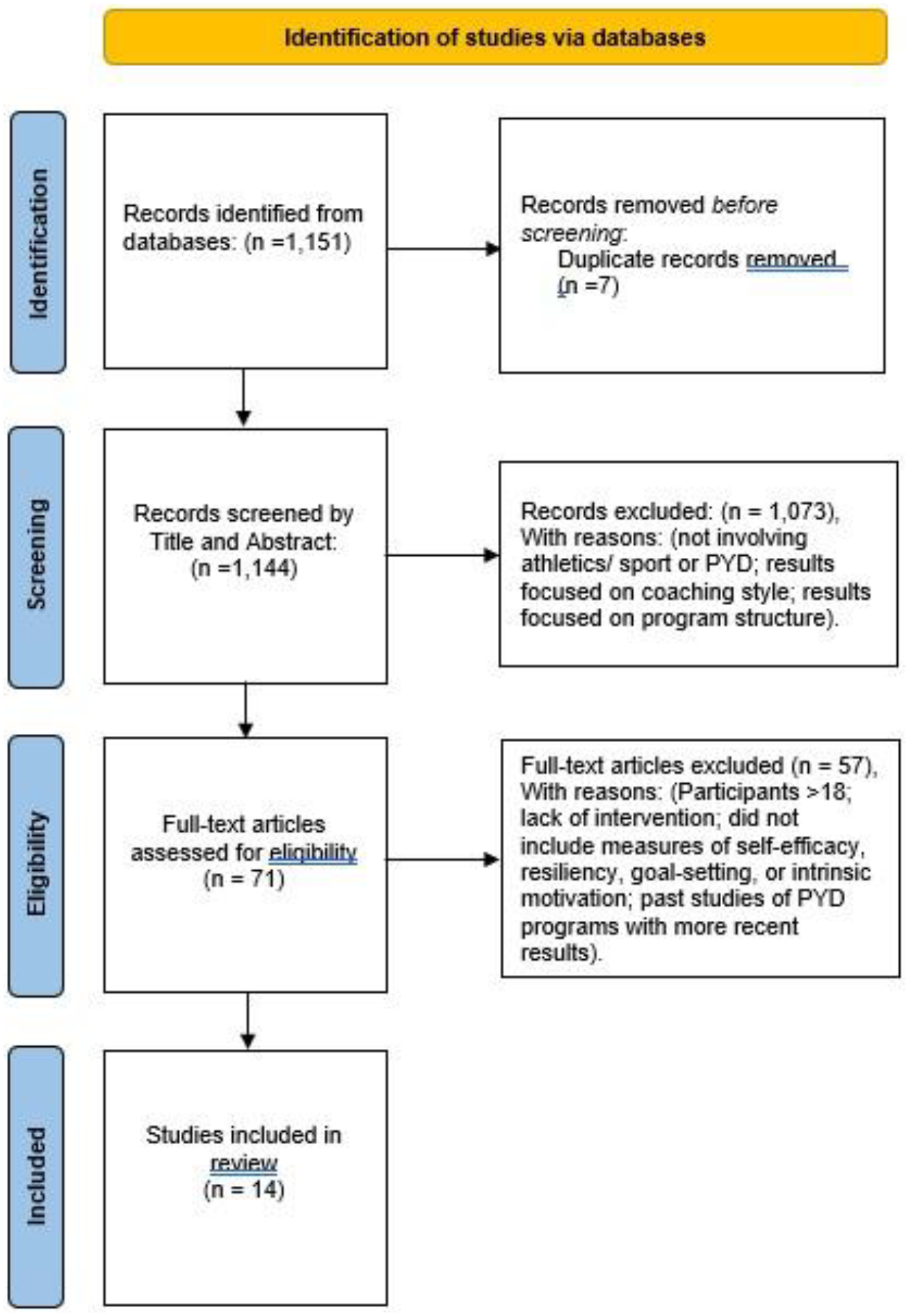
A comprehensive review of the current literature was performed following the Preferred Reporting Items for Systematic Reviews and Meta-Analyses (PRISMA) guidelines. A search including the keywords “positive youth development”, “adolescent”, and “sport” was performed using the databases of PubMed, SCOPUS, and EBSCO Sportdiscus on April 9, 2023, resulting in 1,144 distinct articles. A total of 14 studies met inclusion criteria and were included in the synthesis. These studies were then independently assessed and had qualitative and quantitative data extracted for review.
Results:
Sport-based PYD programs found that adolescents not only improved their physical activity but also expressed an increased competence to handle stress and create a notion of their future life images compared to prior intervention. Sport experiences also positively influenced perceived self-efficacy in three domains: initiative, effort, and persistence. Quantitatively, adolescents in intervention groups reported higher scores of perceived self-efficacy than those in control groups. In individuals who already scored high on initial self-perception testing, a positive effect was appreciated on their social development and goal-setting ability after athletic camp intervention. Studies assessing the PYD impact on minority populations found a similar increase in self-image, and even reported that children of color benefitted the most in many psychosocial domains. Notably, studies performed with inner-city children found that establishment of a trusted mentor resulted in increased empathy and social connections for the children.
Conclusions:
Implementation of sport-based PYD programs is capable of boosting self-efficacy, resilience, and intrinsic motivation in youth. Employment of such programs also benefits individuals of diverse backgrounds, with an even more profound benefit in underserved communities. We plan to utilize this structure to establish a program between our university’s highly accomplished student-athletes to connect with the youth of surrounding communities. These athletes are looked up to by children and present a prominent opportunity to instill life skills into the youth locally, and eventually, nationally.