Abstract
Objectives:
In the United States, there is an increasing trend for youth athletes to begin specializing in a single sport at younger ages. Previous research has shown that when a high school athlete trains for one sport at the exclusion of other sports, early sport specialization is associated with increased physical injuries and decreased mental health. The indicators included fractures, sprains, burnout, and depression. However, the effect of early sport specialization on physical injuries and mental health in college athletes has not been explored at length. The precise aim of this investigation was to determine whether an association existed between early sport specialization in high school and subsequent indicators in college.
Methods:
The SAFE Consortium is a multicenter partnership involving several universities. For this investigation, a retrospective cohort design was chosen to assess the effects of early sport specialization across the NCAA’s three levels of competition (1 Division I, 1 Division II, and 1 Division III). All athletes involved were active on an NCAA roster. Athletes completed a questionnaire which recorded demographics, sport specialization status, injury characteristics, burnout symptoms, and depression indications.
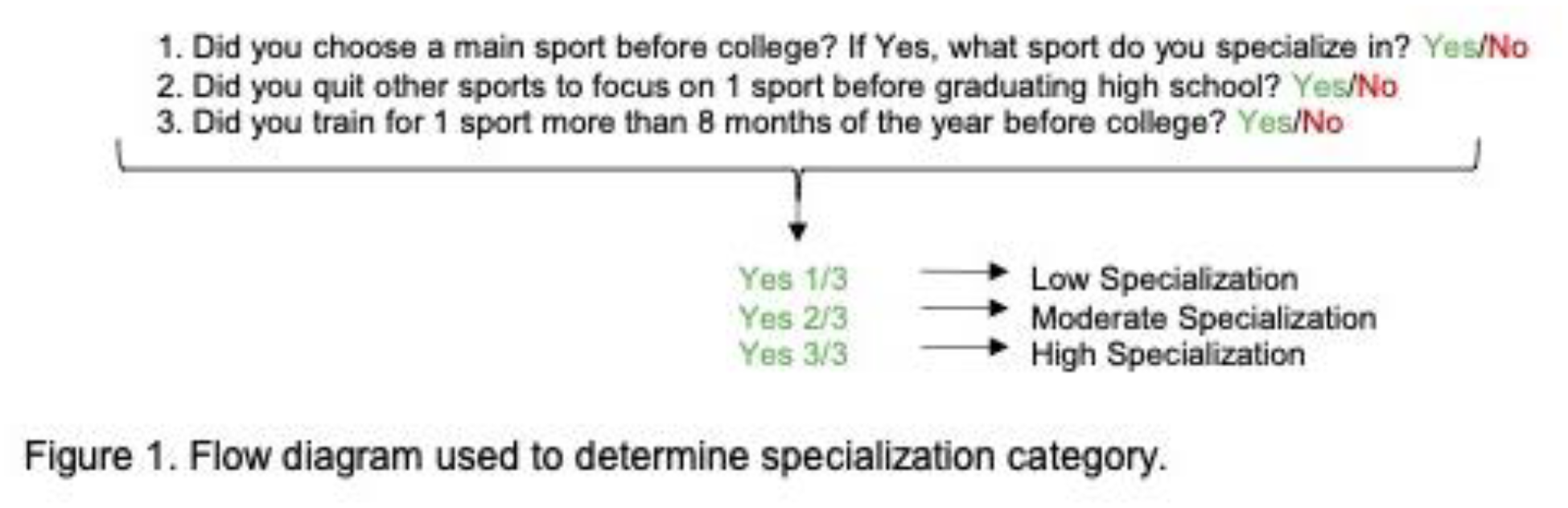
Sport specialization status employed a previously validated 3-point scale (Figure 1). The questions stressed athletic participation prior to college matriculation. Burnout symptoms combined previously published questions that were modified with an emphasis on athletic involvement (Figure 2). The total number of symptoms was calculated per athlete. Depression indications used an adapted version of the Whooley depression screening tool created by the School of Medicine at the University of California, San Francisco.
Results:
211 (92 male, 119 female) college athletes completed the questionnaire. The number of athletes in each specialization category was as follows: high [102 (48.3%)], moderate [69 (32.7%)], and low [40 (19.0%)]. Highly specialized athletes were more likely than those from the low specialization category to report an injury (χ2 = 19.81, df = 1, p < 0.0001). Relatedly, moderately specialized athletes were more likely than low specialized athletes to report an injury (χ2 = 15.19, df = 1, p < 0.0001). For the 157 (74.4%) athletes who reported a physical injury, the injuries were then further characterized as upper extremity injuries (UEIs) and lower extremity injuries (LEIs). The amount of UEIs and LEIs is shown in Table 1.
Similarly, highly specialized athletes, as compared to low specialized, reported more symptoms of burnout (3.3 ± 1.2 vs. 1.5 ± 2.2; p = 0.0002). In comparison to the low specialization category, moderate specialization was associated with more symptoms of burnout as well (3.1 ± 2.1 vs. 1.5 ± 2.2; p = 0.01). Finally, high specialization, when compared to the low specialized athletes, was associated with an increased likelihood for depression (χ2 = 14.8, df = 1, p = 0.0001). Moderately specialized athletes also exhibited a greater likelihood of reporting depression, in contrast to the low specialization category (χ2 = 5.05 df = 1, p = 0.02).
Conclusions:
The SAFE investigators found that college athletes who were classified under the high and moderate specialization categories were at a heightened risk for injury. Further, the 2 upper specialization levels were associated with more burnout symptoms, on average, compared to low specialized athletes. Likewise, those with high and moderate specialization were associated with a positive depression screening. Even though benefits exist for early sport specialization, such as athletic development and scholarship attainment, the results show that early sport specialization is associated with increased physical injuries and decreased mental health as a college athlete. In closing, many stakeholders - athletes, parents, coaches, and sport administrators - should be aware of the subsequent indicators associated with early sport specialization across the United States.