Abstract
Objectives:
Mucoid degeneration of the anterior cruciate ligament (ACL) is an uncommon clinical condition with reported prevalence below 0.5%.
Methods:
This is a case control study where a retrospective series of 10 patients were identified to have mucoid degeneration of the ACL from 2002 to 2023. They were evaluated and treated by two senior attending orthopedic sports medicine surgeons. Magnetic resonance images (MRI) were evaluated for multiple anatomic and morphometric measures. Tissue samples were obtained at the time of arthroscopic partial debridement of the ACL for all patients. Intra-operative ACL samples and cadaveric control tissues were prepared for histologic examination of microstructure and composition, and gene expression using multiplex transcriptional profiling. For the gene expression analysis
Results:
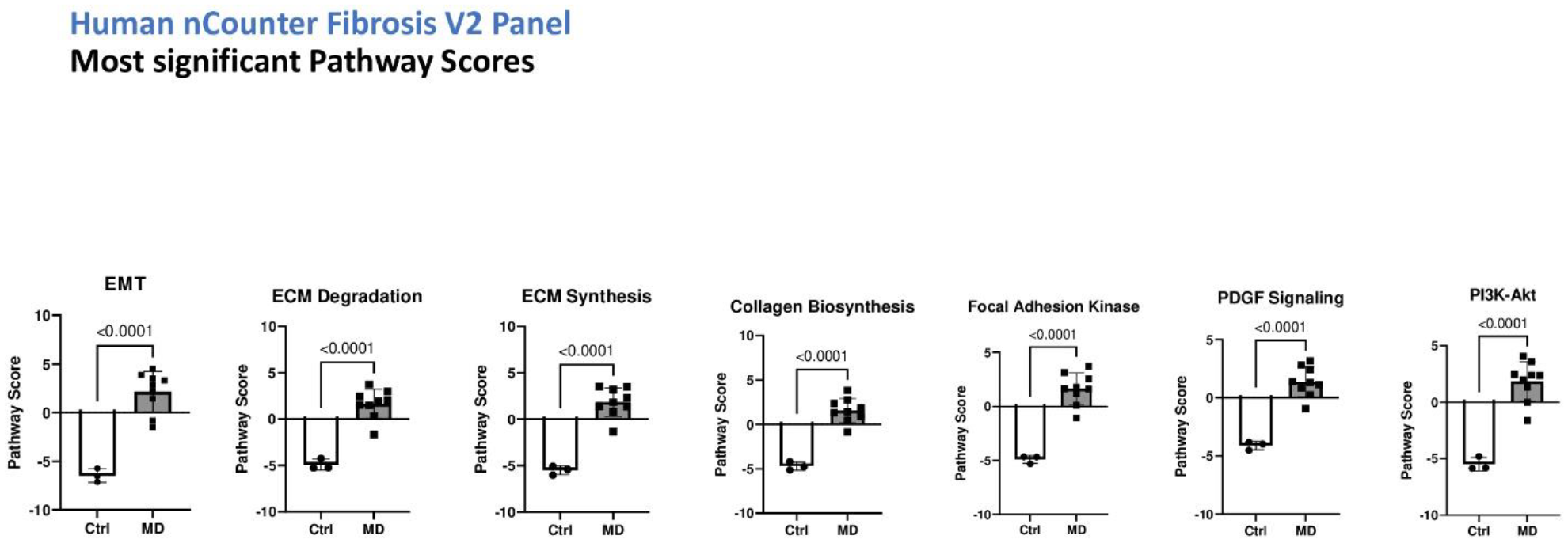
All 10 patients reported pain and limited knee flexion. MRI exhibited a bulbous appearance of the ACL. There was an increased posterior tibial slope (PTS), narrow notch width index, and increased signal intensity of the ACL. Medial meniscus tear and cartilage degeneration were reported with high prevalence. The histological analysis showed significant differences in the architecture of the tissue compared with normal ACL controls, with disorganized collagen matrix and increased glycosaminoglycan content. NanoString analysis demonstrated a total of 155 differentially expressed genes (DEGs) between the mucoid degeneration and control groups after adjustments for multiple comparisons (p<0.05), with the top 20 DEGs summarized in Table 1. Among all the DEGs identified the 5 most upregulated ones include Fibronectin 1 (FN1), COL5A1, COL6A3, COL3A1 and COL1A2. There were also significant differences in the pathway scores for epithelial-to-mesenchymal transition (EMT), Extracellular matrix Degradation and Synthesis, Collagen Biosynthesis, Focal Adhesion Kinase, PDGF Signaling and PI3K-Akt (Fig. 1). The histology findings demonstrate distinct changes in the structure and composition of the ACL, and we hypothesize that repetitive microtrauma of the ACL may lead to cumulative damage that ultimately results in mucoid degeneration. Increased posterior tibial slope and narrow notch width index may contribute to cumulative loading of the ligament and subsequent mucoid degeneration. Identification of biomechanical risk factors may help to identify high risk patients.
Associated injury of the medial meniscus and medial compartment cartilage also suggests that mucoid degeneration of the ACL may be part of an early degenerative process in the knee.
Conclusions:
Mucoid degeneration of the ACL is an uncommon condition that may represent the result of repetitive microtrauma to the ligament. Current interventions address the condition after it has progressed to an irreversible biological state. By defining the cellular and molecular mechanism(s) of the condition, we aim to broaden treatment options to potentially identify biologic interventions. The association of mucoid degeneration and medial compartment osteoarthritis suggests that patients may benefit from earlier interventions.