




Abstract
Objectives:
Univariable analyses of knee geometry, anteroposterior (AP) laxity, and muscular strength have revealed associations with risk of first-time, noncontact ACL injury in females. However, multivariable analyses assessing the risk associated with combinations of these factors have been limited. As a result, it is unclear how these factors act interdependently to exacerbate or attenuate risk of injury. Therefore, the purpose of this study was to characterize the risk of first-time, noncontact ACL injury associated with pairwise combinations of factors related to geometry, laxity, and strength.
Methods:
First-time, noncontact ACL injury events were identified as they occurred in 61 female high school and collegiate athletes over a four-year period. Simultaneously, 61 sex- and age-matched control subjects, with no history of lower extremity injury, were selected from the same team. Magnetic resonance imaging was acquired bilaterally, and articular geometries were obtained. On contralateral, uninjured case and control knees, AP knee translation was measured using a KT-2000 arthrometer, knee flexion strength was measured with a Biodex System 2, and hip adduction strength was measured using a fixated, isometric dynamometer. Six features were considered: (1) slope of the lateral tibial plateau articular cartilage not covered by meniscus (“middle cartilage slope”) and (2) covered by the posterior horn of the meniscus (“posterior cartilage slope”), (3) AP translation of the tibia relative to the femur, (4) posterior stiffness, (5) knee flexion strength, and (6) hip adduction strength. First, each feature was compared between cases and controls using Student’s t-test (α = 0.05). Next, the features were used to build a generalized additive model with two pairwise interactions, with ACL injury as the dependent variable. Univariable relationships between each feature and absolute risk of ACL injury, as well as pairwise interaction effects, were inspected with partial dependence plots, which describe the (potentially nonlinear) shape of those associations. Absolute risk was defined as the change in probability of experiencing an ACL injury associated with varying values of each feature, accounting for the average effect of all other features. For example, an absolute risk value of 0.2 signifies a 20% increase in absolute risk.
Results:
Compared to their uninjured teammates, injured athletes had greater middle cartilage slope (0.6° ± 3.8° vs. -3.8° ± 4.2°, p < 0.001) and greater posterior cartilage slope (13.3° ± 6.3° vs. 8.5° ± 5.5°, p < 0.001) of the lateral tibial plateau. Injured subjects also had greater AP laxity (15.0 ± 3.0 mm vs. 13.6 ± 2.4 mm, p = 0.006) than uninjured controls. Partial dependence plots for each of the six features show associations with absolute risk (
Conclusions:
In this cohort of high school and collegiate female athletes, the model revealed two important interactions among lateral tibial cartilage slope, hip adduction strength, and knee laxity. Increased hip adduction strength and decreased AP translation both acted in combination to decrease risk of first-time, noncontact ACL injury in athletes with greater cartilage slope. The risk associated with increased middle cartilage slope may be reduced in athletes with greater hip adduction strength (
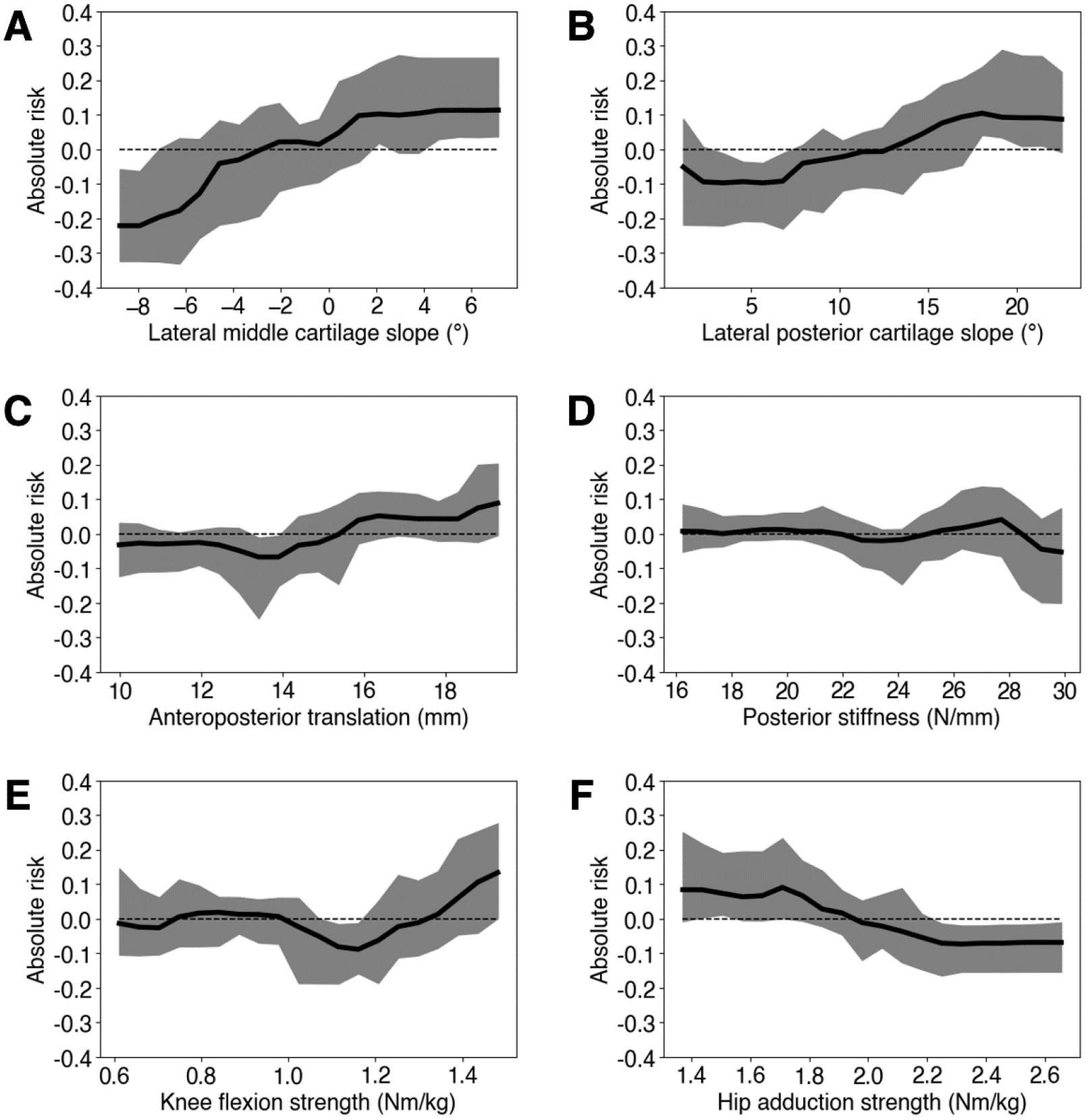
Partial dependence plots showing the effect on ACL injury risk of A) lateral middle cartilage slope, B) lateral posterior cartilage slope, C) AP translation, D) posterior stiffness, E) knee flexion strength, and F) hip adduction strength. Shaded regions represent 95% confidence intervals.

Partial dependence plot showing the effect on ACL injury risk of the interaction between lateral middle cartilage slope and hip adduction strength.

Partial dependence plot showing the effect on ACL injury risk of the interaction between lateral posterior cartilage slope and AP translation.