Abstract
Objectives:
To (1) define the time to achievement of clinically significant outcomes (CSOs) following primary gluteus medius and/or minimus repair and (2) identify predictors of delayed CSO achievement.
Methods:
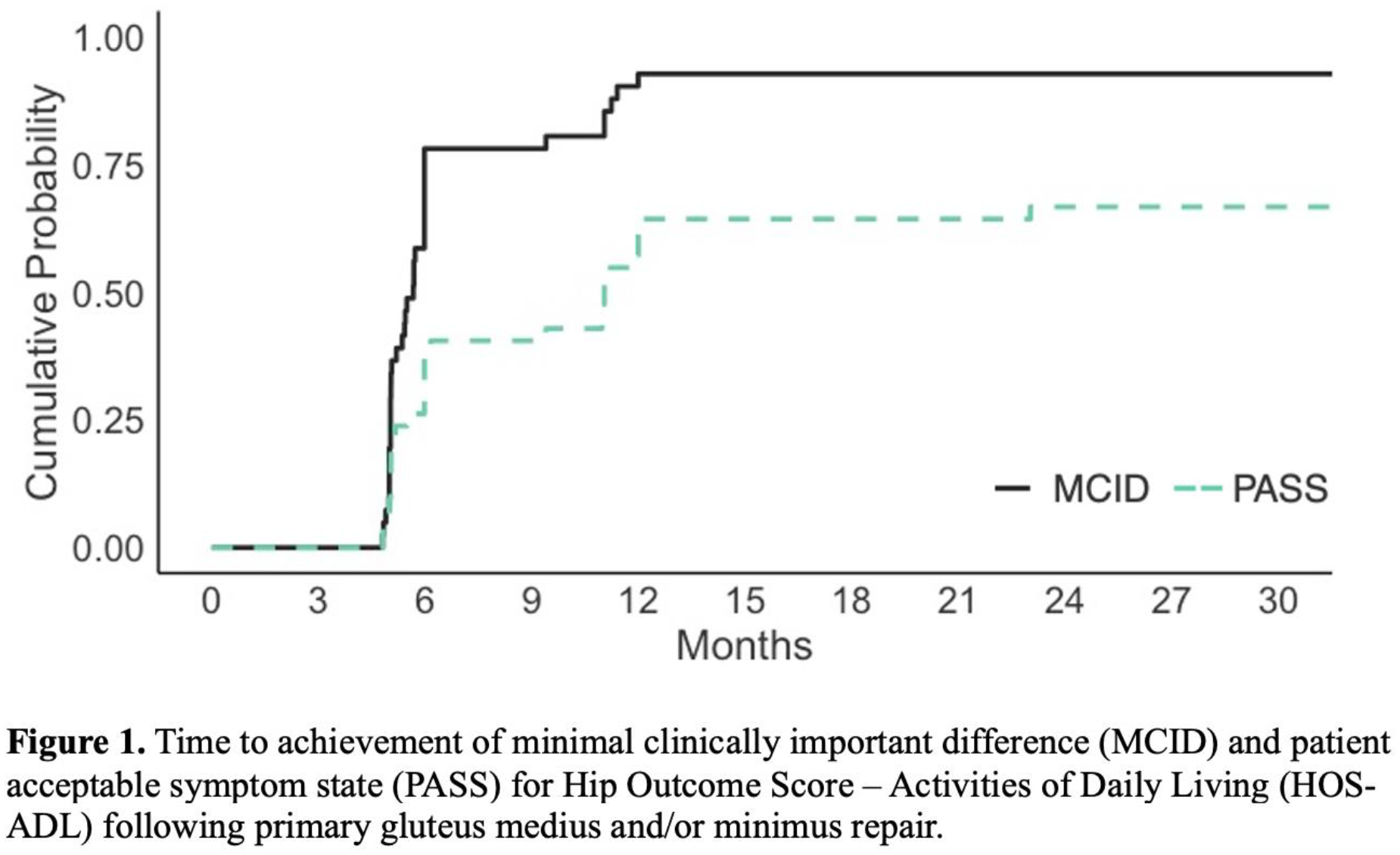
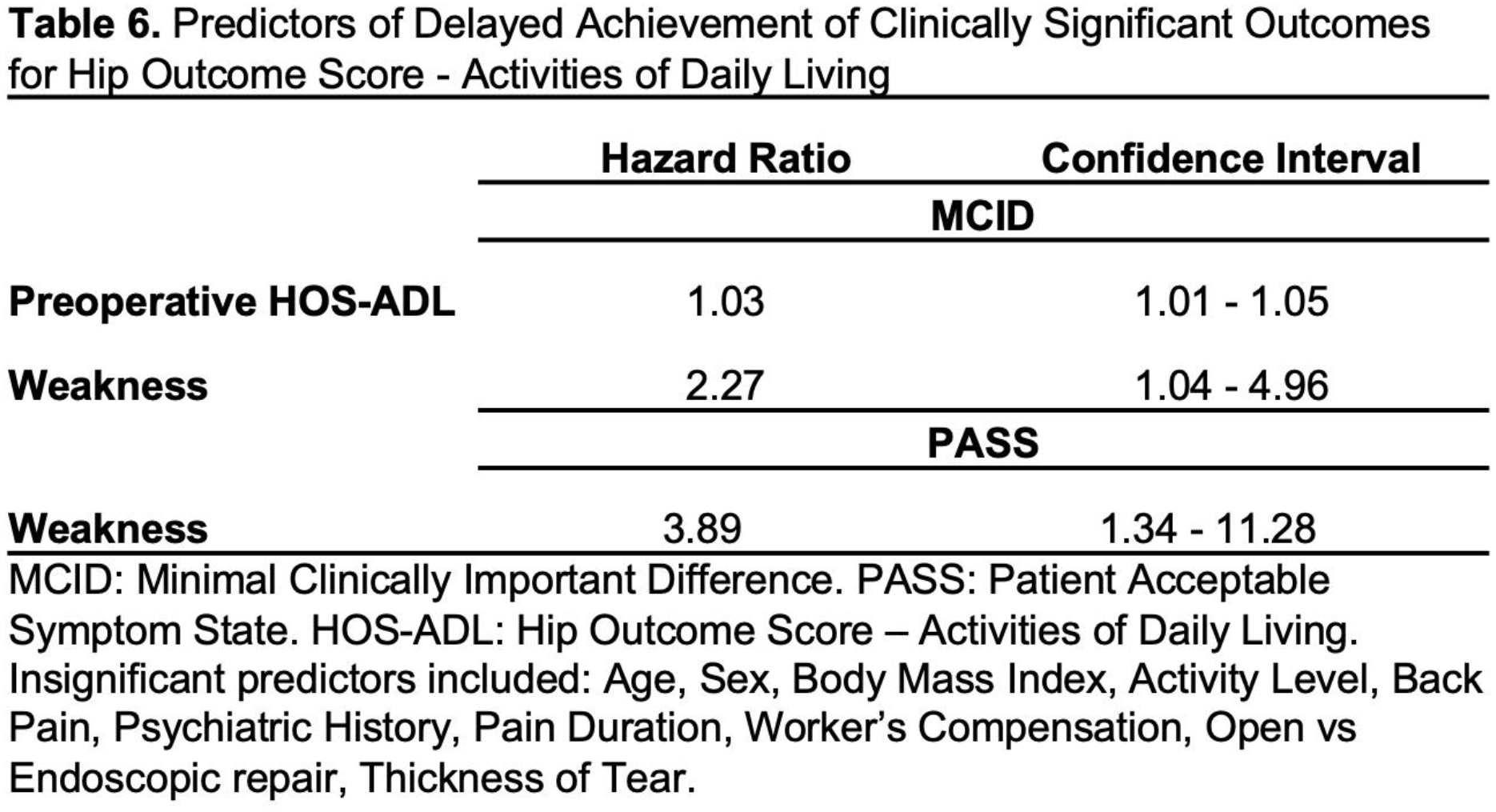
Patients who underwent primary gluteus medius and/or minimus repair between January 2012 and January 2020 with complete preoperative, 6-month, 1-year, and 2-year Hip Outcome Score – Activities of Daily Living (HOS-ADL) were retrospectively identified. Cohort-specific minimal clinically important difference (MCID) and Patient Acceptable Symptom State (PASS) were calculated. The time to achievement of MCID and PASS were analyzed using Kaplan-Meier survival analysis. Multivariate stepwise cox proportional hazards regressions were used to identify predictors of delayed MCID and PASS achievement.
Results:
Fifty primary gluteus medius and/or minimus repairs were identified (age 59.4 ± 9.7 years old, BMI 27.9 ± 6.2 kg/m2, 94% female patients). Tears were partial thickness (78%) and involved both the gluteus medius and minimus tendons (60%) in most cases. Endoscopic and open repair were performed in 70% and 30% of cases, respectively. Labral repair was performed in 30% of cases. Most patients achieved MCID by 5.66 months and PASS by 11.03 months. The 2-year cumulative probability of MCID and PASS achievement was 92.7% and 66.7%, respectively. Preoperative abduction weakness on physical exam predicted delayed achievement of MCID (HR = 2.27, CI 1.04 – 4.96) and PASS (HR = 3.89, CI 1.34 – 11.28).
Conclusions:
Findings from this study demonstrate that most patients undergoing primary gluteus medius and/or minimus repair achieved MCID by 6 months and PASS by 12 months. Preoperative abduction weakness on physical exam predicted delayed achievement of MCID and PASS.