Abstract
Objectives:
The recent development of advanced analytics and biomechanical analysis has been widely embraced throughout Major League Baseball (MLB), driving player development and personnel decisions. At the same time, the rate of ulnar collateral ligament (UCL) injury has been rising steadily over the past decade. The purpose of this study was to evaluate the effect of commonly used advanced analytic or biomechanical pitching metrics on UCL injury rates.
Methods:
We performed a retrospective case-control study on all MLB pitchers who underwent UCL reconstruction or primary repair from April 2018 to May 2023. Exclusion criteria included pitchers without two qualifying seasons (i.e. >100 pitches in a calendar year) of pre-operative data or who had previously undergone surgery on their UCL. Matched controls were identified in a 2:1 manner by using season, age, position, handedness, and pitch count as covariates, similar to previous studies. Biomechanical pitch-tracking data evaluating mean velocity, pitch type and percentage, release extension, spin rate, vertical and horizontal movement, approach angle, and release point were collected. Industry-standard advanced metrics such as Fangraphs Wins Above Replacement (fWAR), expected fielding-independent pitching (xFIP), and Skill-interactive Earned Run Average (SIERA) were compared. Recently developed advanced metrics that measure overall movement of pitches (Stuff+), strike-zone command (Location+), and overall ability (Pitching+) were also examined. Data was obtained entirely from public web sources. Statistical analysis of the season prior to injury (T1, T2, and T3) and index season of injury consisted of unpaired t-tests comparing the cases versus matched controls. Subgroup analyses of starting and relieving pitchers, along with right- and left-handed pitchers was also conducted to identify specific risk factors. Changes in the three seasons prior to injury were also analyzed to see if large changes between seasons were independent risk factors for UCL injury, providing potential insight into offseason training regimens.
Results:
112 MLB pitchers who underwent UCLR or UCL-repair were compared to 224 matched controls. Mean age was 28.1
Conclusions:
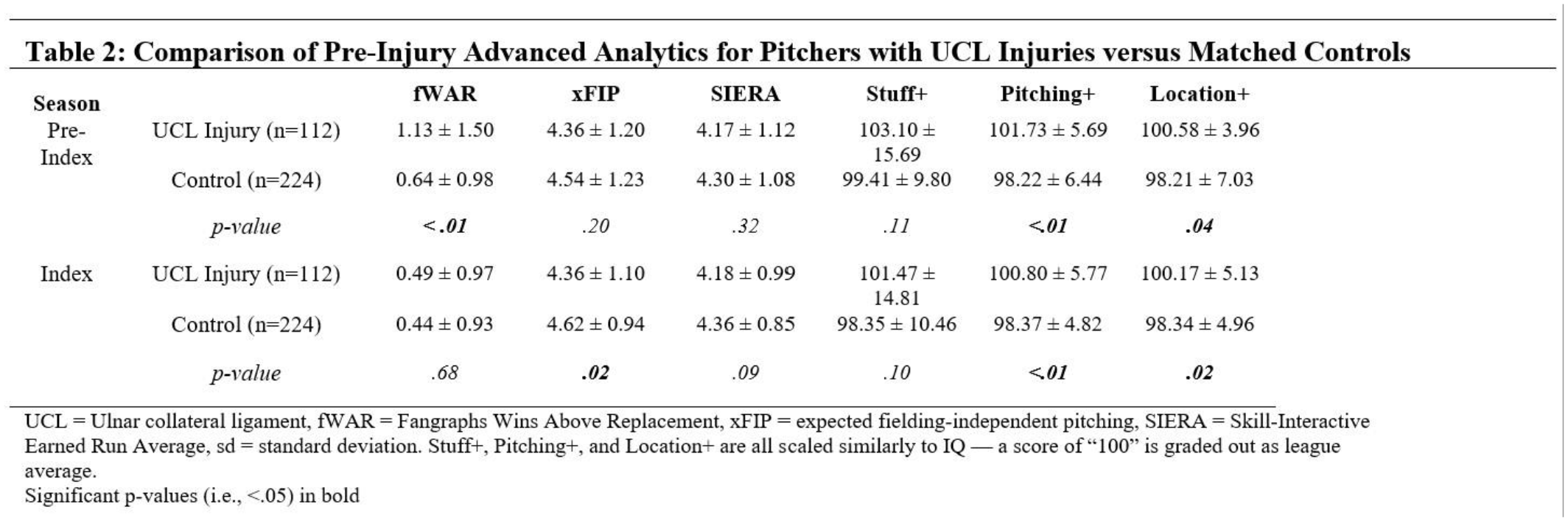
MLB pitchers who throw harder, have superior strike-zone command and overall pitching ability (Pitching+) were more at risk for UCL injury. Superior performance-based rate metrics also predisposed to injury. More horizontal release points and approach angles were potentially protective against UCL injury, while pitch counts, vertical release points, and overall pitch movement were similar but slightly higher in cases. Large offseason and yearly increases in Pitching+ were also found to be risk factors for UCL injury, suggesting that perhaps more regulated training regimens may help prevent injury. In this analysis, several advanced analytic and biomechanical performance metrics commonly used in MLB were evaluated as potential risk factors for UCL injury for the first time.