




Abstract
Background:
Numerous studies have investigated pitching kinematics associated with elbow varus torque, but these studies were limited in the parameters analyzed and/or the number of pitchers tested.
Purpose/Hypothesis:
The purpose of this work was to evaluate numerous kinematic parameters in a large sample of elite adult pitchers. It was hypothesized that several kinematic parameters would be associated with variations in elbow varus torque.
Study Design:
Descriptive laboratory study.
Methods:
A deidentified biomechanical database of 523 pitchers (425 professional; 98 collegiate) was analyzed. For each pitcher, 21 kinematic parameters and normalized elbow varus torque (% body weight × height) were calculated. A stepwise multivariate linear regression model evaluated significant findings. In addition, biomechanical differences were identified between the high- and low-torque groups using Mann-Whitney U tests.
Results:
Forty percent of the variance in normalized torque was explained by 11 kinematic parameters. Comparison of the high- and low-torque groups demonstrated significant differences in 10 of these parameters (all except pelvic angular velocity). Compared with the low-torque group, the high-torque group had greater ball velocity, shoulder abduction at foot contact, elbow flexion at foot contact, maximum knee extension velocity during arm acceleration, maximum elbow extension velocity during arm acceleration, and trunk contralateral tilt at ball release. In addition, the high-torque group had lower upper trunk tilt at foot contact, shoulder external rotation at foot contact, maximum external rotation, and shoulder abduction at ball release.
Conclusion:
Normalized elbow varus torque was associated with ball velocity and 10 other kinematic parameters. Ball velocity and 9 of these kinematic parameters were significantly different between the high-torque and low-torque groups. These parameters may be related to increased pitch velocity but also increased load within the throwing elbow.
Clinical Relevance:
This study provides pitchers, coaches, and trainers with objectives for modification of pitching mechanics to reduce elbow torque and possible risk of injury, particularly kinematics in the early phase of the pitching motion.
The biomechanics of the elbow joint play a crucial role in the performance and injury risk of baseball pitchers. Professional pitchers must coordinate their muscles and joints to throw a baseball at speeds approaching 100 mph (161 kph), 36 which imparts high joint torques and forces that can cause hazardous loads on the elbow and shoulder. 7 Of particular concern is the epidemic rise of ulnar collateral ligament (UCL) injuries.6,9,15,17,20
During pitching, peak elbow varus torque for adult pitchers is reportedly near 100 N m.3,16,31 As biomechanical models have calculated that the UCL, elbow muscles, and osseous articulation each contribute about one-third of the peak varus torque during pitching,4,31 UCL provides approximately 33 N m for adult pitchers. This UCL load is near its physiologic limit as cadaveric studies have documented the UCL can withstand up to 30 to 35 N m of torque before failure.25,26,34 Many studies have examined the kinematic parameters related to elbow varus torque; however, these studies analyzed a limited number of parameters and/or a limited sample of pitchers. § A comprehensive analysis of multiple parameters in a large database of elite adult baseball pitchers is needed to fully understand their relationship with elbow varus torque.13,29 Therefore, the purpose of this work was to analyze the relationships of multiple parameters with elbow varus torque within a large database of elite collegiate and professional pitchers. It was hypothesized that multiple kinematic parameters are associated with elbow varus torque.
Methods
Participants
This study was deemed exempt from institutional review board approval. A deidentified retrospective dataset that included 523 pitchers (mean ± SD: age, 21.2 ± 2.3 years; height, 1.89 ± 0.06 m; weight, 93.7 ± 9.8 kg) who had been evaluated previously by the American Sports Medicine Institute (ASMI) was included in this study. The dataset consisted of 98 collegiate players and 425 professional players. To be eligible for inclusion in the current study, each pitcher had to feel healthy at the time of testing, have no significant injuries in the previous 12 months, and be able to pitch at least 5 fastballs during the biomechanical testing.
Motion Capture Data Collection
Each included participant wore only skin-tight athletic shorts, socks, athletic shoes, and a baseball hat during the motion capture session. A total of 39 reflective markers (Motion Analysis Corp) were attached bilaterally with double-sided tape at the distal end of the third metatarsal, lateral malleolus, medial malleolus, heels, lateral femoral epicondyle, medial femoral epicondyle, greater trochanter, anterior superior iliac spine, posterior superior iliac spine, lateral superior tip of the acromion, sternal end of clavicle, lateral humeral epicondyle, medial humeral epicondyle, forearm, ulnar styloid, and radial styloid. Additional markers were placed on the dorsal surface of the throwing hand, inferior angle of the throwing-side scapula and C7 of the spine. Four additional markers were attached to a baseball hat on the front, top, and bilateral sides of the head.
Before the motion capture, participants performed their own warm-up routine as if they were about to play in a game. They were allowed to throw as much as they wanted before beginning the maximum-effort fastballs. Participants threw the pitches toward a catcher or a target strike zone located above home plate at regulation distance from the pitching rubber (18.44 m). Ball velocity and pitcher kinematics were then recorded for 5 to 10 full-effort fastballs. Fastball velocity was measured using a radar gun (Stalker Sports Radar, Plano), while motion of the reflective markers was recorded with a 12-camera automated motion capture system sampling at 240 Hz (Motion Analysis Corp). A fourth-order 13.4-Hz Butterworth low-pass filter was applied to the marker position-time data. The global x-y-z coordinate system was defined using the center of the pitching rubber as the origin. The x-direction was defined as a vector to home plate, the z-direction was defined as a vector pointing vertically, and the y-direction was the cross-product of the z and x coordinates that indicated directional movement between first and third base.
Kinematic Parameters
For each pitch, 21 kinematic variables were calculated as previously described. 30 At the instant of stride foot (or lead foot) contact, stride length (expressed as % height), lead foot position, lead foot angle, pelvis rotation, trunk axial rotation, upper trunk tilt, throwing arm elbow flexion, shoulder abduction, and shoulder external rotation were measured. During the arm cocking phase, maximum pelvic rotation velocity, percent time of maximum pelvic rotation velocity, maximum upper trunk rotation velocity, and the percent time of maximum upper trunk rotation velocity were recorded. At the instant of maximal external rotation, shoulder external rotation angle was recorded. During the arm acceleration phase, maximum shoulder internal rotation angle velocity and maximum elbow extension angle velocity were recorded. At the instant of ball release, trunk forward tilt, trunk contralateral tilt (ie, trunk side tilt toward the glove side), and shoulder abduction were measured. Finally, the changes in knee flexion from foot contact to ball release were calculated.
Elbow varus torque was calculated with BioPitch software (ASMI) using velocity and acceleration data from the motion tracking, scaled inertial properties of upper extremity segments, and inverse dynamics calculations.16,36 Elbow varus torque values were normalized (% body weight × height).
In addition to the variables used for regression analysis, biomechanical efficiency was determined for each pitch as ball velocity divided by normalized varus torque. Biomechanical efficiency (also sometimes called “pitch efficiency”) is a single metric considered for both performance and injury risk.1,11,12
Data Analyses
A stepwise multivariate regression was performed to assess the kinematic parameters associated with elbow varus torque. This test was conducted to determine which biomechanical metrics were independent predictors of elbow varus torque across all participants. The data were then separated into normalized high-torque (n = 174), moderate-torque (n = 175), and low-torque (n = 174) groups. This approach is similar to a study by Crotin et al 11 that explored the determinants of biomechanical efficiency in adult baseball pitchers.
Because a Shapiro-Wilk test suggested a deviation from normality for both high- and low-torque groups, the 2 groups were compared using Mann-Whitney U tests on the significant predictors from the multivariate regression. All analyses were conducted in SPSS (Version 29.0, 2022, International Business Machines Corporation), with an a priori level of significance of α = 0.05.
Results
Biomechanical Determinants of Normalized Elbow Varus Torque
The results of the stepwise multivariate linear regression analysis indicated that 11 variables accounted for 40% of the variance in normalized elbow varus torque for the 523 pitchers (Table 1). The regression model indicated that normalized elbow varus torque had positive correlations with maximum knee extension velocity at foot contact, shoulder abduction at foot contact, elbow flexion at foot contact, maximum elbow extension velocity, trunk contralateral tilt at ball release, and ball velocity (Table 1). Conversely, there were inverse relationships between normalized elbow varus torque and maximum external rotation, upper trunk tilt at foot contact, the percent time of maximum pelvic rotation velocity, shoulder abduction at ball release, and shoulder external rotation at foot contact (Table 1). Ball velocity had the greatest contribution (R2) to normalized elbow varus torque. The next biggest contributors were shoulder abduction at foot contact, maximum knee extension velocity, and elbow flexion at foot contact.
Model Summary and Coefficients From the Stepwise Multivariate Regression to Explain Variance Elbow Varus Torque

R2 contribution to normalized elbow varus torque from this explanatory variable and all preceding variables in the table.
Differences Between the High- and Low-Torque Groups
When comparing the high-torque and low-torque groups, the low-torque group had greater height, whereas mass was significantly different between the groups (Table 2). Biomechanical efficiency differed significantly between the groups. This difference was due mostly to the difference in normalized torque between the groups, as the high-torque group had a 1% higher velocity (mean, 38.0 vs 37.1 m/s) but 28% higher normalized torque (0.0637 vs 0.0461) (Table 2).
Characteristics for High and Low Elbow Varus Torque Groups a

Data shown as mean ± SD.
Significant difference between the high-torque and low-torque groups (P < .05).
Mann-Whitney U tests comparing high- and low-torque groups showed significant differences for 10 of the 11 predictors from the multivariate regression. At foot contact, upper trunk tilt and shoulder external rotation angle were significantly lower in the high-torque group, whereas elbow flexion and shoulder abduction angle were greater in the high-torque group. The maximum external rotation angle was found to be greater in the low-torque group. During the arm acceleration phase of the pitch, maximum knee extension velocity and maximum elbow extension velocity were greater in the high-torque group. At the instant of ball release, trunk contralateral tilt was greater in the high-torque group, while shoulder abduction was greater in the low-torque group (Table 3). Ball velocity was also higher in the high-torque group (Table 2). The only variable in the multivariate regression that was not significantly different between the groups was timing of maximum pelvic angular velocity.
Kinematic Parameters With Significant Differences (P < .05) Between High and Low Elbow Varus Torque Groups a
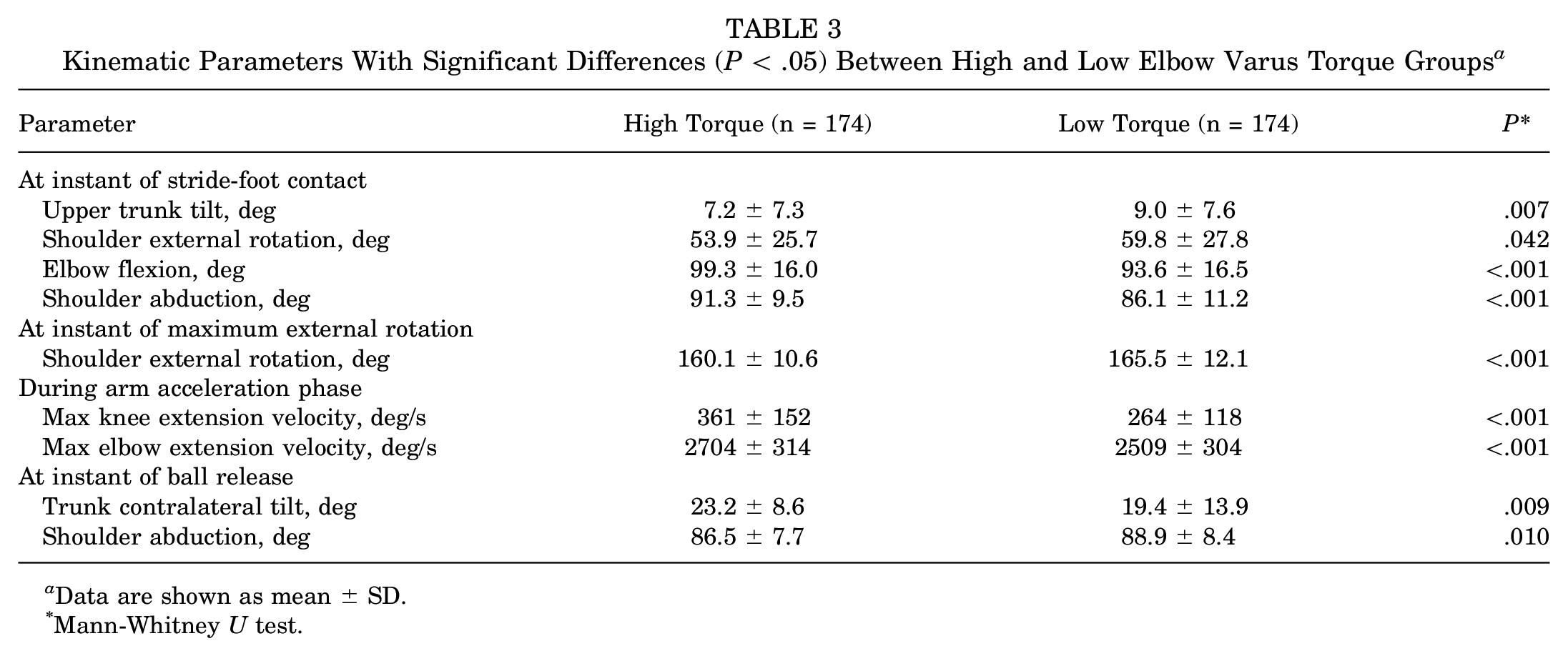
Data are shown as mean ± SD.
Mann-Whitney U test.
Discussion
As hypothesized, there were kinematic relationships with normalized elbow varus torque. Most of these kinematic variables were considered to be modifiable, 18 which could help lower elbow varus torque; 11 of these variables interacted to explain 40% of the variance in normalized elbow varus torque. In addition, 10 of these variables were found to be significantly different between the high- and low-torque groups.
Relationship Between Normalized Torque and Kinematics at Stride-Foot Contact
Many of the variables contributing to normalized elbow varus torque occurred during early stages of the pitch. At foot contact, shoulder external rotation was found to be correlated negatively with elbow varus torque, while shoulder abduction and elbow flexion were found to be positively correlated. These findings are consistent with those of Crotin et al. 11 While findings indicate that lower degrees of upper trunk tilt and shoulder external rotation resulted in greater normalized torque, these 2 variables have the lowest effect when compared with the other variables. If results from this study are to be used by coaches and biomechanists to adjust the mechanics of pitchers to lower their elbow torque mechanics, it is encouraging that nearly half of these differences were at the instant of foot contact, as flaws earlier in the pitching motion are easier to change. 17
One of the most scrutinized parameters in pitching is shoulder external rotation at foot contact, as countless news stories, coaches, and scientists have written about how this parameter (or “late arm” or “inverted W”) leads to higher elbow torque and risk of injury. 13 The study results support this theory, as the high-torque group demonstrated a “later arm” (ie, less shoulder external rotation at foot contact) than the low-torque group. Internal shoulder rotation or insufficient external rotation at foot contact has been associated with a greater risk of medial elbow injury risk. 19
Contrary to previous studies, shoulder abduction <90° at the instant of foot contact was found in the low-torque group, although the previous literature indicated abduction closer to 90° as optimal.19,24 However, all shoulder abduction values found in this study, both at foot contact and at ball release, were within 5° of 90°. The results from the study by Werner et al 35 suggested that lowered arm elevation at foot contact may reduce elbow varus torque in professional pitchers; it may be inferred from our results that lowering shoulder abduction at the instant of foot contact may be beneficial to decreasing normalized elbow varus torque and lowering injury risk. Additional investigation on the relationship between shoulder abduction at foot contact and the maximum value of elbow varus torque is warranted.
Elbow flexion at foot contact was greater for the high-torque group than the low-torque group. This is somewhat inconsistent with previous studies that reported greater elbow flexion at foot contact and a shorter arm path correlating with lower elbow varus torque.14,35 These discrepancies may be due to differences regarding when and how elbow flexion was measured during the pitch and whether elbow varus torque was normalized.
Relationship Between Normalized Torque and Kinematics After Stride-Foot Contact
Consistent with previous studies,1,2,11 data from the current study showed a negative correlation between maximum shoulder external rotation and elbow varus torque. From a physics perspective, decreased shoulder rotation provides less range of motion for rotating the arm forward, requiring greater shoulder internal rotation acceleration, internal rotation torque, and greater elbow varus torque. Interestingly, the high-torque group produced greater ball velocity, even with less maximum external rotation of the shoulder, than the low-torque group.
During the arm acceleration phase of the pitch, maximum knee extension velocity and maximum elbow extension velocity had the 2 greatest effects on normalized elbow varus torque. Interestingly, maximum knee extension velocity was the only lower body parameter with a significant kinematic finding. Lower extremity mechanics can be affected by fatigue, and, therefore, future work examining the impact of compensatory lower body kinematics on normalized elbow varus torque is warranted. 10
A positive correlation between trunk contralateral tilt at ball release and elbow varus torque is consistent with other studies.11,16,22,23,27,33 However, Aguinaldo and Chambers 1 reported that elbow varus torque decreased as trunk contralateral tilt increased. Although the high-torque group had greater trunk tilt, they also had less shoulder abduction at ball release. Previous research has shown that trunk contralateral tilt and shoulder abduction usually increase together, 16 thus significantly different mechanics were demonstrated by the high-torque and low-torque groups.
Ball velocity was found to be correlated positively with elbow varus torque, which is consistent with the findings of Oyama et al. 27 Thus, while 9 kinematic variables in the current study were identified that can be used to decrease elbow varus torque and improve the safety of pitchers, decreased elbow varus torque also correlated with decreased ball velocity. Pitchers, coaches, and trainers wanting to enhance velocity may improve performance, but the risk of injury may increase as well.5,28,29 Thus, further study is needed to determine the balance between fastball velocity and injury prevention qualities associated with elbow varus torque.
Limitations
Although this study found kinematic variables associated with normalized elbow varus torque, the regression model accounted for only 40% of this torque. There may be unstudied factors as, or even more, important than the ones included here. Other limitations in study design may also have affected the statistical findings. Pitchers were not tested under game conditions, as motion capture occurred in a laboratory and bullpen settings. The sample analyzed was also limited to elite adult pitchers. Future research including youth and high school pitchers is necessary. Future studies can also look at the kinematic parameters associated with increased normalized elbow varus torque in off-speed pitches.
Another limitation of this study is that we focused solely on linear relationships. The stepwise multivariate linear regression did not test for other relationships. Kinematic parameters may have quadratic or higher order relationships with varus torque, where the magnitude of the torque increases at high or low kinematic values. For example, Matsuo et al 23 showed a parabolic-shaped relationship between shoulder abduction and maximum elbow varus torque.
Furthermore, as with previous biomechanical investigations, we analyzed kinematic parameters associated with increased elbow torque on the assumption that increased torque increases the risk of injury; future research testing direct correlations between pitching biomechanics and elbow injuries is needed. Despite these limitations, our analysis provides insight into kinematics associated with high elbow torque.
Conclusion
Normalized elbow varus torque was associated with 11 parameters. Compared with low-torque pitchers, high-torque pitchers had greater ball velocity but also significant differences in mechanics from foot contact to ball release. This study provides pitchers, coaches, and trainers with objectives for modification of pitching mechanics to reduce elbow torque and possible risk of injury, particularly kinematics in the early phase of the pitching motion.
Footnotes
Final revision submitted May 23, 2024; accepted June 4, 2024.
The authors have declared that there are no conflicts of interest in the authorship and publication of this contribution. AOSSM checks author disclosures against the Open Payments Database (OPD). AOSSM has not conducted an independent investigation on the OPD and disclaims any liability or responsibility relating thereto.
Ethical approval for this study was waived by Ascension Health (reference No. RAL20230005).
