




Abstract
Background:
Osteoarthritis (OA) poses a significant global burden, with conventional treatments like corticosteroid and hyaluronic acid (HA) injections commonly used. Emerging injectable biologics, including bone marrow aspirate concentrate (BMAC), show promise in OA management.
Purpose:
To investigate the clinical efficacy of BMAC injection compared with other injection treatments for knee OA.
Study Design:
Systematic review; Level of evidence, 1.
Methods:
A systematic review was conducted using PubMed, Embase, Cochrane Library, and Google Scholar to identify randomized controlled trials with Level 1 evidence that compared the clinical efficacy of BMAC with other injections. The visual analog scale for pain and the Pain subscale of the Knee injury and Osteoarthritis Outcome Score (KOOS) were used as clinical scores representing pain. For functional assessment, the Western Ontario and McMaster Universities Osteoarthritis Index and the International Knee Documentation Committee subjective form were used. For studies comparing BMAC with HA, each clinical score was standardized to pain and function scales based on the minimal clinically important difference (MCID).
Results:
Eight studies, consisting of a total of 937 patients, were included. Patients treated with BMAC showed a significant improvement in clinical scores compared with baseline, starting at 1 month postinjection. For pain scores at 6-month (P = .033) and 12-month follow-up (P = .011), BMAC demonstrated favorable results over HA, with a statistically significant difference. However, these differences did not exceed the MCID. When BMAC was compared with other injections, no significant differences were observed in the degree of clinical score improvement. No serious adverse events or events significantly associated with BMAC compared with other treatments were reported.
Conclusion:
BMAC injections demonstrated effectiveness in providing pain relief and functional improvement for patients with knee OA. When BMAC was compared with other intra-articular injection options, distinct differences surpassing the MCID were not evident. Further research is deemed necessary to investigate the role of BMAC in the treatment of knee OA.
Keywords
Osteoarthritis (OA) is a prevalent articular cartilage pathology, exerting a substantial global impact on chronic disability.19,33,40,43 Conventional treatments, such as corticosteroid and hyaluronic acid (HA) injections, are widely used in clinical practice. To address the need for effective therapy and symptom relief in OA, injectable biologics have been introduced.1,10,21,34,39 Platelet-rich plasma (PRP) has undergone extensive investigation over the years. 16 PRP provides a product derived from the patient's own blood within the joint. 7 It aims to alter the internal environment of the joint for the purposes of cartilage regeneration and reduction of inflammation. 20 According to multiple studies, PRP has demonstrated superior outcomes compared with other injectable options, such as saline, corticosteroids, and HA, albeit with modest benefits.5,17,22
In recent years, cell-based therapies have emerged as a promising avenue for managing knee OA.14,26 Among them, considerable focus has been placed on the use of mesenchymal stem cells (MSCs) sourced from various origins. The potential of MSCs in rejuvenating compromised articular cartilage and slowing the progression of knee OA has been reported in a preclinical study. 49 Bone marrow–derived MSCs present as a diverse amalgamation of cells with at least 2 distinct functions. Some MSCs participate in expediting bone formation and regenerative repair, whereas others act as immunomodulatory and trophic factors.31,36,38 Bone marrow aspirate concentrate (BMAC) contains a limited number of MSCs, primarily comprising hematopoietic stem cells, platelets, cytokines, and cells in various stages of differentiation.35,41 Supported by insights from basic studies on the role of MSCs in an intra-articular inflammation, there exists a rationale for their use in treating OA.13,40,46
Drawing on previously published meta-analyses and systematic reviews, Bolia et al 11 reported that a single BMAC or stromal vascular fraction (SVF) injection into the knee joint of patients with OA led to symptomatic improvement at short-term follow-up. However, SVF appeared to be more effective than BMAC in reducing knee pain, with significant variation across studies. Keeling et al 30 reported that BMAC injection effectively improved pain and clinical scores in patients with knee OA at short to midterm follow-up. However, BMAC did not demonstrate clinical superiority compared with PRP and microfragmented adipose tissue or compared with placebo. Belk et al 6 reported that patients undergoing knee OA treatment with PRP or BMAC could expect improved clinical outcomes compared with those receiving HA. Combining the results of these studies conducted to date, BMAC has generally demonstrated comparable or partially superior results to other cell-based treatments. Most studies have reported results based on a comparison of outcomes at the final follow-up.
Building on this background, we aimed in the current study to review studies that investigated the clinical efficacy of BMAC injections compared with other injection treatments for OA. We focused on serial data based on the follow-up period to examine the trends in efficacy over time. We hypothesized that clinical efficacy would differ between BMAC injection and other treatments and that effectiveness of treatment based on the follow-up period would also differ.
Methods
Search Strategy
The review was registered a priori in the PROSPERO prospective register of systematic reviews (ID: CRD42023492483) and was conducted according to a predefined protocol in line with the PRISMA (Preferred Reporting Items for Systematic Reviews and Meta-Analyses) guidelines. A comprehensive search strategy was devised to identify relevant studies. We systematically searched PubMed, Embase, the Cochrane Library, and Google Scholar for articles published up to December 1, 2023. The search terms used were [(“bone marrow” OR “bone marrow aspirate concentrate” OR “BMAC” OR “bone marrow concentrate”) AND (“intra-articular” OR “intraarticular” OR “injection”) “knee” AND “osteoarthritis”[mesh]].
Study Eligibility
The inclusion criteria were as follows: (1) adult patients diagnosed with OA; (2) studies that included interventions with intra-articular injections of autologous BMAC reporting clinical efficacy; (3) studies with a minimum follow-up period of 12 months; and (4) Level 1 randomized controlled trials (RCTs) that were published in English. The exclusion criteria were as follows: (1) non-English articles; (2) studies with incomplete data; and (3) studies with Levels 2 to 5 evidence, including cadaveric studies, animal studies, case reports, systematic reviews, or biomechanical studies. Two independent reviewers screened the search results to determine eligibility.
Data Extraction
Two reviewers (J.H.H. and S.-H.J.) independently collected data, including information such as author names, publication year, study design, level of evidence, types of intra-articular injection, mean follow-up duration, sex, age, Kellgren-Lawrence (K-L) grade, number of patients, and patient-reported outcome measures.
Patient-reported outcome measures that were recorded included those for pain and function. The visual analog scale (VAS) for pain and the Knee injury and Osteoarthritis Outcome Score (KOOS) Pain subscore were used as clinical scores representing pain. For functional assessment, the Western Ontario and McMaster Universities Osteoarthritis Index (WOMAC) and the International Knee Documentation Committee (IKDC) subjective form were used. Each score was standardized to pain and function scales based on the previously reported minimal clinically important difference (MCID): 15.4 points for KOOS Pain, 28 19.1 points for VAS pain, 47 8 points for WOMAC, 2 and 8.6 points for the IKDC subjective score. 8
Methodological Quality
The risk of bias of the included articles was evaluated independently using the Cochrane Collaboration risk-of-bias tool. 27 The following bias domains were assessed: selection bias, performance bias, detection bias, attrition bias, reporting bias, and other biases. Each of the included studies was assigned a score indicating low, unclear, or high risk of bias within each respective bias domain. In addition, funnel plots were used to assess publication bias in the pain and function scores.
Statistical Analysis
Statistical analyses were conducted using the appropriate meta-analysis techniques. Descriptive statistics, such as the mean and standard deviation for the numerical variables, were recorded. In cases where the studies did not provide a standard deviation in their results, we calculated it based on other provided statistical values, following the method outlined by Furukawa et al. 24
A sufficient number of studies comparing BMAC and HA were available for meta-analysis. For the analysis of the integrated scales, a meta-analysis was performed using mean differences (MDs) with 95% CIs. In cases of overlapping patient groups, studies with larger sample sizes were selected for the analysis. Heterogeneity was assessed using the I2 statistic; if I2 was <50% (indicating low heterogeneity), a fixed-effects model was used; otherwise, a random-effects model was used. Statistical significance was set at P < .05. All statistical analyses were performed using R software (Version 4.2.1; R Foundation).
Results
Characteristics of the Included Studies
In this systematic review and meta-analysis, 1292 relevant studies were identified from various databases. After we removed duplicates and reviewed the full texts, 12 studies were evaluated for eligibility. Ultimately, we included 8 studies3,4,9,18,25,32,37,45 (N = 937 patients) that met our inclusion criteria (Figure 1). All studies were Level 1 RCTs. The characteristics of the included studies are shown in Tables 1 and 2.

PRISMA flow diagram of the study inclusion process. BMAC, bone marrow aspirate concentrate; RCT, randomized controlled trial.
Overview of the Included Studies a

All included studies were randomized controlled trials with Level 1 evidence. BMAC, bone marrow aspirate concentrate; CSI, corticosteroid injection; HA, hyaluronic acid; PRP, platelet-rich plasma; SVF, stromal vascular fraction; UCT, umbilical cord tissue-derived mesenchymal stromal cells.
Patient Demographics of Included Studies a

BMI, body mass index; K-L, Kellgren-Lawrence; NR, not reported.
Data are presented as mean or mean ± SD unless otherwise indicated.
Data are presented as the count of patients for grades 1/2/3/4 or as mean ± SD.
Methodological Quality of the Included Studies
The risk-of-bias assessment for each included study is shown in Figure 2A, and a summary of the overall risk of bias is depicted in Figure 2B. In almost all of the included studies, there was an unclear to high risk of bias in the areas of allocation concealment, blinding of participants and personnel, and blinding of outcome assessment. A primary reason for these results was that none of the studies reported using a sham procedure during the BMAC harvest process, which appears to be a consequence of the invasiveness of the BMAC harvest. The funnel plots showing the assessment of publication bias in the pain and function scores are provided in Appendix Figure A1 (available in the online version of this article).

Risk-of-bias assessment (A) for each included study and (B) overall summary according to bias domain.
BMAC Versus HA
The results of comparison between BMAC and HA were based on 4 studies.9,18,25,32 Clinical scores representing pain and function, measured at each follow-up time point, were standardized for meta-analysis. In the meta-analysis of pain scores, no significant heterogeneity was observed (I2 = 36%; τ2 = 0.08; P = .20), and a common-effect model was used. For the meta-analysis of function scores, substantial heterogeneity was noted (I2 = 63%; τ2 = 0.6; P = .07), leading to the use of a random-effects model. Sensitivity analysis was performed to assess the impact of including lower quality studies on the heterogeneity of the meta-analyses. However, this analysis did not yield meaningful results due to the limited number of included studies.
Regarding the results of the meta-analysis for pain scores (Figure 3), no significant difference was found between BMAC and HA at 1-month (MD, 0.36; 95% CI, –0.14 to 0.87; P = .159) and 3-month follow-up (MD, 0.28; 95% CI, –0.07 to 0.63; P = .118). However, the results significantly favored BMAC over HA at the 6-month (MD, 0.38; 95% CI, 0.03 to 0.72; P = .033) and 12-month visits (MD, 0.48; 95% CI, 0.11 to 0.84; P = .011). These differences did not reach the MCID for either KOOS Pain (15.4 points 28 ) or VAS pain (19.1 points 47 ). Among the studies reporting results beyond 12 months, Boffa et al 9 reported a VAS measurement at 24 months favoring BMAC over HA with a statistically significant difference. Lamo-Espinosa et al 32 reported VAS at 48 months favoring BMAC over HA with a statistically significant difference.
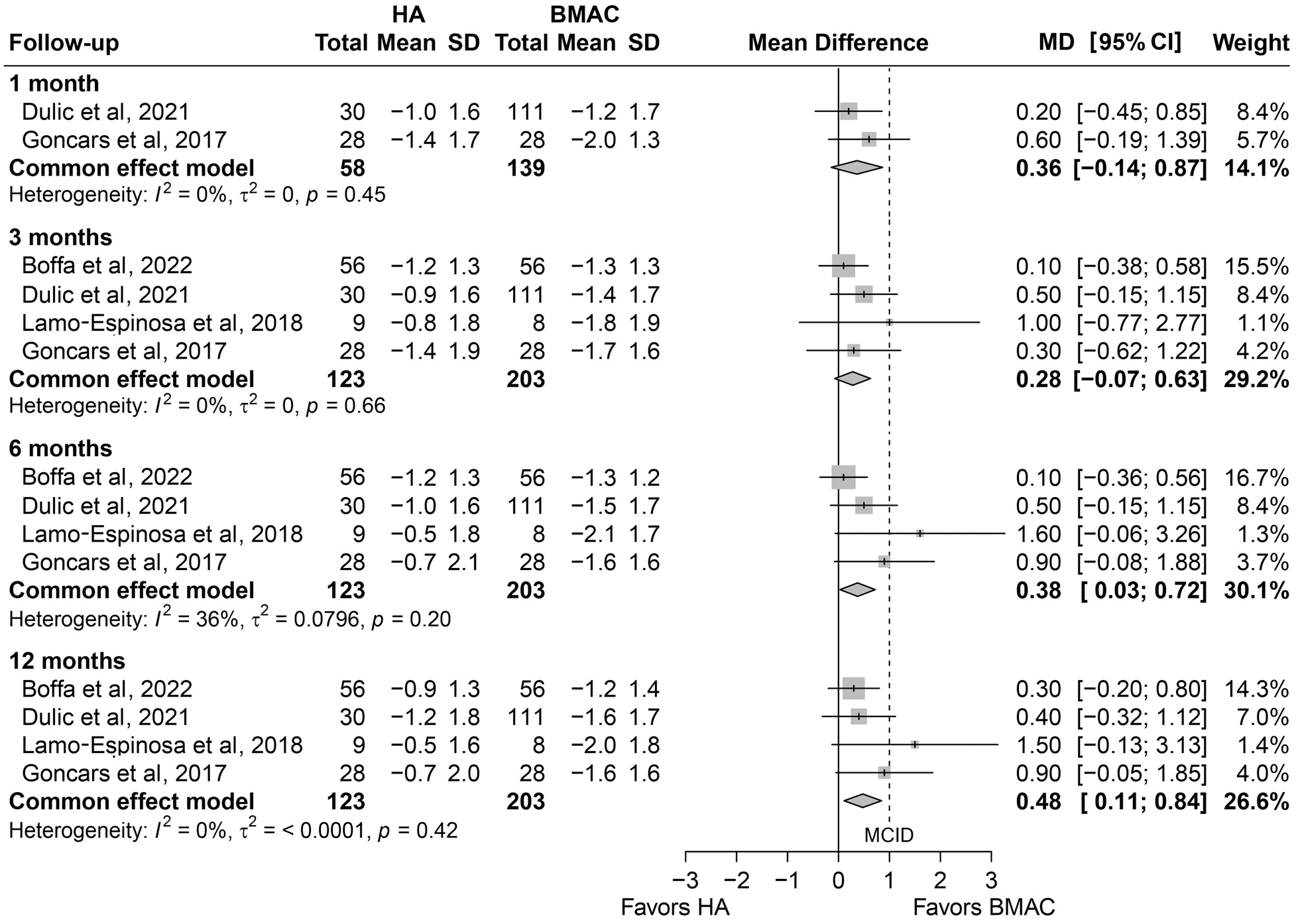
Forest plot showing the results of the meta-analysis of clinical scores representing pain (VAS pain, KOOS Pain) at each follow-up time point. Each score was standardized to pain scales based on the reported MCIDs for VAS pain and KOOS Pain. BMAC, bone marrow aspirate concentrate; HA, hyaluronic acid; KOOS, Knee injury and Osteoarthritis Outcome Score; MCID, minimal clinically important difference; MD, mean difference; VAS, visual analog scale.
Regarding the results of the meta-analysis of function scores, no significant differences were observed between BMAC and HA at 3 months (MD, 0.3; 95% CI, –0.59 to 1.19; P = .554), 6 months (MD, 0.17; 95% CI, –0.93 to 1.28; P = .753), or 12 months of follow-up (MD, 0.35; 95% CI, –0.5 to 1.2; P = .406) (Figure 4). In studies reporting results beyond 12 months, Boffa et al 9 reported no significant difference in IKDC subjective scores at 24 months. Lamo-Espinosa et al 32 reported WOMAC scores at 48 months favoring low-dose BMAC of 10 × 106 cultured autologous bone marrow–derived MSCs over HA with a statistically significant difference, but no significant difference was observed between the high-dose BMAC of 100 × 106 cultured MSCs versus HA.

Forest plot illustrating the meta-analysis results of clinical scores representing function (WOMAC, IKDC subjective form) at each follow-up time point. Each score was standardized to function scales based on the reported MCIDs for the WOMAC and the IKDC subjective form. BMAC, bone marrow aspirate concentrate; HA, hyaluronic acid; IKDC, International Knee Documentation Committee; MCID, minimal clinically important difference; MD, mean difference; WOMAC, Western Ontario and McMaster Universities Osteoarthritis Index.
BMAC Versus PRP
The results of comparison between BMAC and PRP were reported based on 3 studies.3,4,18 Anz et al 4 reported IKDC and WOMAC scores up to 24 months, demonstrating that both BMAC and PRP led to significantly improved scores, which plateaued at 3 months and were sustained for 24 months after injection. However, no statistically significant differences were seen between BMAC and PRP. Dulic et al 18 reported significant differences between baseline scores and those after 12 months for WOMAC, KOOS, KOOS Pain, and IKDC scores in both BMAC and PRP groups. At the 12-month follow-up, BMAC demonstrated better clinical scores for KOOS compared with PRP. However, no significant differences were found in the WOMAC and IKDC scores between the 2 groups. Clinical scores showed an initial improvement compared with baseline at the 1-month follow-up, which was maintained without significant differences beyond the 1-month time point in both groups.
BMAC Versus Other Intra-articular Injections
Mautner et al 37 compared BMAC to other intra-articular injections, including autologous adipose SVF, allogenic human umbilical cord tissue–derived mesenchymal stromal cells (UCT), and corticosteroid injection (CSI). VAS pain and KOOS Pain scores showed significant improvement 1 month after injection for all treatment modalities, and this effect was sustained up to the 12-month follow-up. No significant differences were observed between the various treatment methods. Shapiro et al 45 found that knee pain remained significantly decreased from baseline at the 12-month follow-up, with no apparent difference between BMAC and placebo saline injection. Shapiro et al also presented magnetic resonance imaging (MRI) results, stating that T2-weighted quantitative MRI mapping showed no significant changes as a result of treatment and failed to demonstrate regenerative benefits with a single BMAC injection.
Adverse Events
Mautner et al 37 reported no serious adverse events associated with the procedure. Adverse events with significant differences between the cohorts included postprocedural contusion (SVF 38.6% vs BMAC 12.2% vs UCT/CSI 0%; P < .0001) and postprocedural hematoma (BMAC 2.9% vs SVF 12.4%; P = .02). Boffa et al 9 reported no severe adverse events in either the BMAC or HA group. Four knees (7.1%) in the BMAC group and 3 knees (5.4%) in the HA group had significant pain or swelling after the injection procedure, without requiring any specific intervention or hospitalization. Lamo-Espinosa et al 32 and Goncars et al 25 reported no serious adverse events or complications resulting from their procedures or treatments during the follow-up period. The iliac crest puncture was painless, and no complications were observed at the donor sites. Overall, no serious adverse events or adverse events significantly associated with BMAC compared with other treatments were reported.
Cell Counts and Clinical Effects
The relationship between cell count and clinical effects was investigated in 2 studies.25,32 Goncars et al 25 reported a mean final yield of mononuclear cell extraction ranging from 38.64 to 33.7 × 10⁶ cells. Patients in the therapy group were categorized based on the injected cell count. The subgroup with a cell count higher than the mean demonstrated greater improvement than the subgroup with a cell count lower than the mean. However, statistically significant changes were observed only at the 12-month follow-up. Lamo-Espinosa et al 32 compared clinical effects between groups receiving either 10 × 106 or 100 × 106 autologous bone marrow-derived MSCs and found no clinical differences between the groups. The authors concluded with a question regarding the necessity of a high dose of cells for optimal outcomes.
Discussion
This systematic review aimed to assess the clinical efficacy of BMAC injections compared with other injection treatments for OA and included 8 RCTs with a total of 937 patients. The key finding of this study was a significant preference for BMAC over HA in terms of pain improvement, particularly beyond the 6-month mark; however, this difference was within the MCID. Regarding functional scores, no significant differences were observed between BMAC and HA. When comparing BMAC to other intra-articular injection options, including PRP, we found that the improvement in clinical scores observed from 1 month postinjection persisted for at least 12 months. However, the differences between treatment approaches were not distinctly evident.
All studies included in this review were Level 1 RCTs. As depicted in Figure 2, showing a summary of the overall risk of bias, almost all studies included in this review presented an unclear to high risk of bias in areas such as allocation concealment and blinding of participants and personnel. Among the signaling questions used to evaluate the risk of bias, one question checks whether participants were aware of their assigned intervention during the trial. None of the studies included in this review reported the use of a sham procedure during the BMAC harvest process, which was reflected in the risk-of-bias assessment. This is one of the most significant biases observed, despite our focus on Level 1 evidence studies, and should be taken into consideration when interpreting the results.
Moreover, for the meta-analysis of function scores, substantial heterogeneity was observed (I2 = 63%; τ2 = 0.6; P = .07). This meta-analysis included a limited number of studies, and the integration of various scores representing patient function based on the MCID criterion may be a contributing factor. Therefore, caution is warranted in interpreting the conclusions drawn from the pooled analysis conducted with this data.
Belk et al 6 reported in their systematic review that patients undergoing knee OA treatment with PRP or BMAC could anticipate improved clinical outcomes compared with those receiving HA. Keeling et al 30 similarly reported in their systematic review that BMAC injection led to enhanced patient-reported outcomes in patients with knee OA at short to midterm follow-up. BMAC did not demonstrate clinical superiority compared with other biologic therapies commonly used in OA treatment. Given that these results are based on a comparison of the final follow-up data with the baseline data, they align contextually with the findings of this study.
BMAC contains various growth factors that have been proposed to aid in the regenerative chondrogenesis process, along with an increased number of platelets and white blood cells.15,23 The study by Shapiro et al, 45 included in this systematic review, conducted T2-weighted quantitative MRI mapping at baseline and 6 months after BMAC or saline injection to determine whether chondrogenesis occurred. At 6 months, no significant changes in MRI T2-weighted values were observed compared with baseline for either BMAC-treated or saline-injected knees. At present, there is no clinical evidence from these studies that BMAC induces chondrogenesis.
In the 2022 updated American Academy of Orthopaedic Surgeons clinical practice guideline for the management of OA of the knee, 12 the content regarding HA and PRP among the injection treatments included in this review was presented. Both treatments were downgraded compared with previous evaluations, with HA receiving a moderate strength of recommendation and thereby not recommended for routine use in the treatment of symptomatic OA of the knee. PRP was given a limited strength of recommendation. The decision for HA was based on the current evidence not identifying the subset of patients who would benefit from HA, which could explain the observed inconsistency in the evidence. In this regard, BMAC, which has not shown a significant clinical difference compared with HA or PRP, may be challenging to recommend for routine clinical practice in patients with OA. However, as mentioned earlier, whereas HA showed early improvement with a significant decline after 12 months, the outcomes from BMAC remained stable for up to 24 months, suggesting more lasting results. Establishing appropriate indications for BMAC could play a crucial role in determining its potential recommendation for clinical practice in the future.
Regarding the establishment of appropriate indications, studies included in this review discussed the relevance of the patients’ K-L grades of OA. Anz et al 3 reported that their study involved patients with K-L grade 1 and excluded those with K-L grade 4, indicating that the effectiveness of either technique for severe OA cannot be concluded. Goncars et al 25 noted that when comparing the levels of clinical improvement between groups with K-L grades 2 and 3 OA, no statistically significant differences were observed in either group. Mautner et al, 37 who included patients with K-L grades 2, 3, and 4, stated that the K-L grade was not a dependable predictor of treatment success. Boffa et al 9 showed that in terms of KOOS Sports/Recreation and KOOS Quality of Life subscores, patients with K-L grades 1 and 2 demonstrated more significant symptom improvement compared with those who had K-L grades 3 and 4. Although the nature of a meta-analysis limits access to raw data, preventing the performance of subgroup analyses, this highlights the need for further research to determine appropriate indications, which appears to be a crucial topic for future investigation.
The majority of studies included in this review reported results comparing BMAC with other injectable treatments. Only Shapiro et al 45 used saline as a placebo to compare the therapeutic effects with BMAC, finding that BMAC did not demonstrate superiority in terms of symptom improvement compared with placebo. However, as seen in the meta-analysis by Previtali et al, 44 a symptom improvement exceeding the MCID was observed in 52% of patients even with placebo injections. In Shapiro et al's study, 45 to eliminate the need for a sham BMAC harvest procedure, research was conducted using different injectables in each knee, which was assessed to have a low risk of bias in that domain. Therefore, when interpreting the results of this study, it is crucial to evaluate the efficacy of BMAC injections while considering the inherent effects of the placebo.
Cell counts and their correlation with clinical effects have been continually discussed in all fields using BMAC as a therapeutic agent. However, no clear evidence of this association is currently available. Jo et al 29 presented their study findings on the correlation between cell count and clinical improvement. The study by Goncars et al, 25 included in the current review, indicated that the group with a higher than mean MSC count had better improvement compared with the group with a lower than mean cell count. This difference was statistically significant only at the 12-month follow-up point. However, in patients receiving the highest cell count doses (150 million cells), the degree of symptom improvement was not significantly pronounced. Lamo-Espinosa et al 32 showed no clinical differences between the groups receiving different cell counts of 10 × 106 versus 100 × 106. The relationship between cell count and clinical efficacy showed mixed results. Given the differences in analytic methods used in each study reporting the results, consistent analytic methods should be used in future studies to reach a consensus.
According to the studies included in this review, no serious adverse events and no adverse events significantly associated with BMAC compared with other treatments were reported. Lamo-Espinosa et al 32 and Goncars et al 25 reported that no complications were observed at the donor sites. Therefore, when considering the clinical effects mentioned earlier, BMAC injection can be considered a safe and effective technique for improving symptoms in patients with OA.
In situations where resources are limited, determining the optimal treatment requires considering not only the efficacy of the treatment itself but also its cost-effectiveness. Although HA injections are covered by most insurance companies, PRP and BMAC are not currently covered. In 2019, the cost of a PRP injection in the United States averaged $714. BMAC costs approximately 4 times more on average than PRP, which represents a significant financial consideration for many patients. 42 As mentioned earlier, although BMAC itself can be considered a safe and effective technique for improving symptoms, given these cost considerations and the fact that clinical differences with other intra-articular injection treatments are within the MCID, it is currently believed that BMAC injection may not replace other treatments.
Strengths and Limitations
As mentioned earlier, this review contextually aligns with the findings of systematic reviews on similar topics by Belk et al 6 and Keeling et al. 30 As an update to these studies, the current review presents several enhancements. The review by Keeling et al, which includes studies from level of evidence 1 to 4, is a Level 4 systematic review. In contrast, we included only studies with Level 1 evidence in an effort to minimize the risk of bias. Compared with the study by Belk et al, the current review also covered the comparison between BMAC and PRP, thus serving as an update on the current knowledge regarding the use of BMAC. The study by Vega et al 48 on allogenic BMAC injection, which was included in previous reviews, was not included in the current review. Indeed, their study expressed concerns regarding host immune rejection and the clinical efficacy difference between allogenic and autologous bone marrow–derived cells. Consequently, given our aim of synthesizing outcomes solely on autologous BMAC, we did not include that study. Additionally, by performing a subgroup analysis based on follow-up duration in the comparison between BMAC and HA, our study suggests the potential for a more enduring effect of BMAC, which can be considered a strength of this research.
This review has several limitations. First, in the process of aggregating data for meta-analysis, we noted an insufficient number of studies using the same clinical score. Therefore, we integrated and standardized the clinical scores using the MCID. Second, the follow-up time varied, ranging from 12 to 48 months. Data beyond the 12-month follow-up period are relatively scarce. Third, there may have been some level of heterogeneity between the studies in the meta-analysis of functional scores. To address this issue, we used a random-effects model to combine the results. Fourth, few studies evaluated MSC cell counts, leading to limited reports on their effects. Fifth, only 1 study included a placebo treatment with a saline injection. Sixth, intra-articular injection techniques and strategies were not consistent across all studies.
Conclusion
According to our results, BMAC injection demonstrated effectiveness in providing pain relief and functional improvement in patients with knee OA. When BMAC was compared with other intra-articular injection options, distinct differences surpassing the MCID were not evident. Further research is deemed necessary to investigate the role of BMAC in the treatment of knee OA.
Footnotes
Appendix
Final revision submitted April 18, 2024; accepted May 2, 2024.
The authors declared that they have no conflicts of interest in the authorship and publication of this contribution. AOSSM checks author disclosures against the Open Payments Database (OPD). AOSSM has not conducted an independent investigation on the OPD and disclaims any liability or responsibility relating thereto.
