




Abstract
Background:
Short-term, self-reported changes in symptom severity for musculoskeletal pain disorders may be more strongly associated with long-term prognoses than baseline patient characteristics, because such changes describe a trajectory and not a state.
Purpose:
To investigate whether short-term improvement in self-reported symptom severity is associated with long-term recovery among adolescents with nontraumatic knee pain (patellofemoral pain [PFP] or Osgood-Schlatter disease [OSD]).
Study Design:
Cohort study; Level of evidence, 3.
Methods:
The authors evaluated data from 2 prospective clinical trials that included adolescents aged 10 to 14 years with either PFP (n = 151) or OSD (n = 51). Both groups underwent a self-management rehabilitation program including activity modification, education, and exercise. The primary outcome was a 7-point global rating of change (GROC) scale (from “much improved” to “much worse”); participants were considered to have improved symptoms if they reported being “much improved” or “improved.” Outcomes were collected after 4 and 52 weeks. To investigate whether participants who improved according to GROC scores after 4 weeks were more likely to improve after 52 weeks compared with those who had not improved after 4 weeks, the authors calculated the relative risk (RR) of being improved.
Results:
Among participants with PFP, reporting an improvement after 4 weeks increased the likelihood of an improvement after 52 weeks (RR = 1.26; 95% CI, 1.06-1.50; P = .008); among those with OSD, reporting an improvement after 4 weeks did not increase the likelihood of an improvement after 52 weeks (RR = 1.06; 95% CI, 0.88-1.28; P = .545). Among participants with PFP who did not improve after 4 weeks, 73% reported improvement after 52 weeks, whereas among participants with OSD who did not improve after 4 weeks, 89% reported improvement after 52 weeks.
Conclusion:
Self-reported improvement after 4 weeks of treatment was associated with better outcomes after 52 weeks among adolescents with PFP. This association was present only among adolescents with PFP, as almost all adolescents with OSD improved after 52 weeks, regardless of short-term results. Importantly, even among adolescents reporting no improvement after 4 weeks, a large proportion reported improvement after 52 weeks. This highlights the importance of following the rehabilitation program regardless of the short-term response.
Prognostic factors have been investigated to help predict the outcomes or determine the specific treatment effects of several musculoskeletal pain disorders.1,2,4,5 Most often, this has involved the collection of baseline characteristics (eg, sex or age) or patient-related factors describing symptom severity (eg, pain intensity, symptom duration, number of pain sites).2,4,5 Some studies showed a low to moderate association between baseline factors and outcomes, whereas others failed to document an association. This makes it difficult to predict how an individual will respond to treatment.2-5
A systematic review published in 2020 posited that instead of focusing on patient-related factors to estimate prognosis related to musculoskeletal issues, researchers should explore whether short-term self-reported changes are more closely associated with prognosis. 9 Rather than identifying nonmodifiable characteristics, short-term changes in symptom severity may describe a trajectory that may or may not be predictive of long-term recovery. Thus, nonmodifiable characteristics in adolescents with patellofemoral pain (PFP) may not be predictive of the short- or long-term outcomes. 6
In the current study, we used data from 2 recently published clinical studies by our author group6,7 that included adolescents with common nontraumatic knee pain conditions (PFP 6 and Osgood-Schlatter disease 7 [OSD]) and that used the same study and intervention design, making it possible to pool the studies. The aim of the current study was to investigate whether short-term improvement in self-reported symptom severity is associated with long-term recovery among adolescents with either PFP or OSD.
Methods
Study Design
This study used data from 2 previously published clinical studies including adolescents with PFP 6 (ClinicalTrials. gov identifier NCT02402673) or OSD 7 (NCT02799394). Both studies received ethics committee approval.
Participants
Adolescents aged 10 to 14 years were recruited between 2015 and 2017 via local schools and social media using a questionnaire. Those who reported knee pain were invited to a clinical examination by 1 of 2 experienced physical therapists. Depending on their diagnosis based on the clinical examination, adolescents were enrolled in either the study on PFP 6 or the study on OSD. 7 The inclusion criteria for adolescents with PFP were (1) insidious onset of anterior or retropatellar knee pain for 6 weeks and provoked by at least 2 of the following positions or functions: prolonged sitting or kneeling, squatting, running, hopping, or stair walking; (2) tenderness on palpation of the patella or pain with stepping down or double-leg squatting; and (3) worst pain experienced during the previous week reported as 30 mm on a 100-mm visual analog scale. Exclusion criteria included (1) currently being treated for PFP; (2) age <10 or >14 years; (3) previous knee surgery; (4) a diagnosis of other knee conditions (eg, OSD, patellofemoral instability); or (5) concomitant injury or pain from the hip or lumbar spine. The inclusion criteria for adolescents with OSD were (1) pain localized at the tibial tuberosity that increased with palpation and (2) pain on resisted isometric knee extension. Exclusion criteria were (1) knee effusion; (2) patellar instability; (3) Sinding-Larsson-Johansson syndrome; and (4) concomitant injury or pain in the hip, lumbar spine, or other structures of the knee (ie, tendinopathy, previous knee surgery, or PFP).
Interventions
The interventions in both studies included 4 visits with a physical therapist over 12 weeks. Parents were required to attend all visits. In both studies, interventions were divided into blocks that included specific educational components, physical modalities to increase knee loading gradually, and specific tools to manage load and monitor pain. Block 1 (0-4 weeks) included a temporary reduction in sports participation; advice on refraining from pain-aggravating activities; and simple, home-based, low-load exercises consisting of 10 sets of 30-second isometric knee extensions every day and 3 sets of 10 double-limb bridges to be performed every other day. During block 2 (and also block 3 in the study on PFP), the exercises progressed from nonweightbearing to weightbearing lower limb exercises, and the advice given focused on slow progression toward a return to sport. Throughout the interventions, participants used an activity ladder to support their exercise and activity progression, and training compliance was monitored using training diaries.6,7
Primary Outcome: Global Rating of Change
At the 4-week and 52-week follow-ups, participants completed a 7-point global rating of change (GROC) scale to assess their self-reported improvement. Responses ranged from “much improved” (1 point) to “much worse” (7 points); if participants rated their current knee pain compared with baseline as either “much improved” or “improved,” they were dichotomized as improved.
Secondary Outcomes
Numeric Rating Scale
Worst pain during the previous 24 hours and worst pain during the previous week were measured on a numeric rating scale (NRS). Participants were asked to rate their pain from 0 (“no pain”) to 10 (“worst pain imaginable”) at baseline and at the 4-week and 52-week follow-ups.
Knee injury and Osteoarthritis Outcome Score
Participants completed the Knee injury and Osteoarthritis Outcome Score (KOOS) to assess their self-reported knee status and associated problems. The KOOS consists of 5 subscales (Pain, Symptoms, Activities of Daily Living, Sport/Recreation [Sport/Rec], and Quality of Life) and has previously been used for young adolescents with knee pain. 8 The outcome was collected at baseline and during the 4-week and 52-week follow-ups. We included only the KOOS Pain and KOOS Sport/Rec subscales for this study, as these are the domains adolescents find the most relevant, in our experience.
Data Analysis
We reported baseline characteristics using descriptive statistics (mean ± standard deviation) separately according to the diagnosis group (PFP vs OSD) and subgroup according to self-reported GROC status after 4 weeks (dichotomized into improved vs not-improved groups). To investigate whether participants who were improved after 4 weeks were more likely also to be improved after 52 weeks compared with those who were not improved after 4 weeks, we calculated the relative risk (RR) of being improved and the absolute risk difference for the PFP and OSD groups separately. As a secondary analysis, we repeated this analysis after pooling both diagnoses.
Unpaired t tests were used to explore whether there was a between-group difference at 52 weeks in KOOS Pain and KOOS Sport/Rec and worst pain according to NRS during the previous 24 hours and worst pain during the previous week or whether there was a between-group difference in change from baseline to the 52-week follow-up in those outcomes.
Results
Included were 202 participants overall: 151 participants in the PFP group and 51 participants in the OSD group. A total of 194 (96.0%) participants attended the 4-week follow-up (145 [96.0%] participants with PFP and 49 [96.1%] participants with OSD), and 155 (76.7%) participants attended the 52-week follow-up (113 [74.8%] participants with PFP and by 42 [82.4%] participants with OSD. The baseline characteristics are presented in Table 1.
Baseline Characteristics According to Group and Subgroup a

Data are presented as median [IQR] for non-normally distributed data and mean ± SD for normally distributed data. BMI, body mass index; GROC, global rating of change; IQR, interquartile range; NA, not available; OSD, Osgood-Schlatter disease; PFP, patellofemoral pain.
Data are presented as χ2 with P value or mean difference (95% CI) with P value.
Primary Analyses
Among the participants with PFP, reporting an improvement after 4 weeks significantly increased the RR of an improvement after 52 weeks (RR = 1.26; 95% CI, 1.06-1.50; P = .008), with an absolute risk difference of 19%. Among those in the PFP group who improved after 4 weeks, 46 of 50 participants reported an improvement after 52 weeks, and 46 of the 63 participants who did not improve after 4 weeks reported an improvement after 52 weeks. Among participants with OSD, reporting an improvement after 4 weeks did not increase the likelihood of an improvement after 52 weeks (RR = 1.06; 95% CI, 0.88-1.28; P = .545), with an absolute risk difference of 5%. Among those who improved after 4 weeks, 15 of 16 participants reported an improvement after 52 weeks; among those who did not improve after 4 weeks, 23 of 26 participants reported an improvement after 52 weeks.
Participants with PFP who reported improvement after 4 weeks had significantly lower NRS pain scores for the previous week (P = .041) as well as superior scores on the KOOS Pain (P = .043) and KOOS Sport/Rec (P = .010) after 52 weeks, whereas participants with OSD had significantly lower NRS pain scores for the previous 24 hours and previous week (P = .001 for both) and superior scores for KOOS Pain (P = .003) and KOOS Sport/Rec (P = .006). No between-group differences were seen in the change in scores from baseline to the 52-week follow-up for NRS pain, KOOS Pain, and KOOS Sport/Rec, regardless of the diagnosis (Table 2 and Figure 1).
Comparisons of NRS Pain and KOOS Between the Improved and Not-Improved Groups a
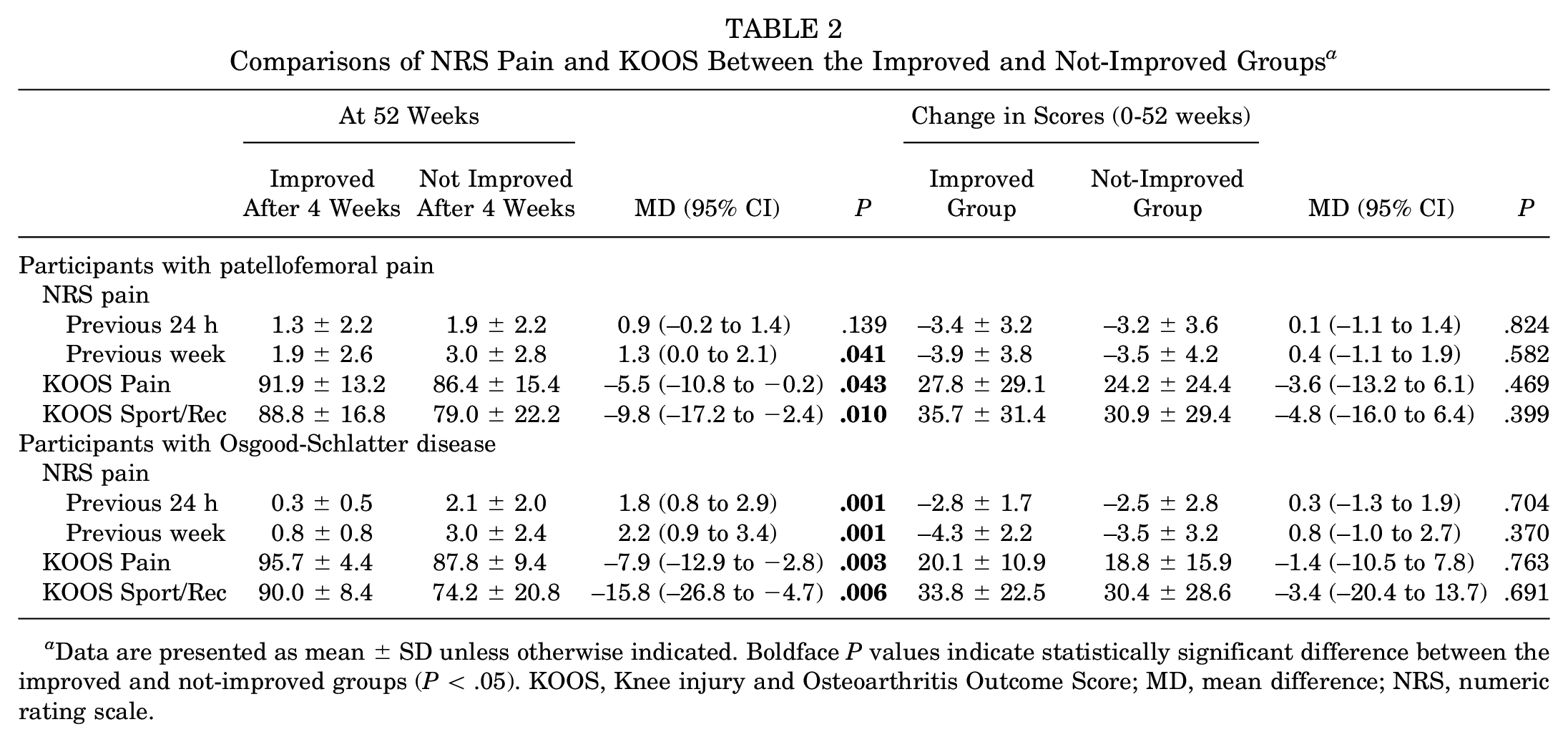
Data are presented as mean ± SD unless otherwise indicated. Boldface P values indicate statistically significant difference between the improved and not-improved groups (P < .05). KOOS, Knee injury and Osteoarthritis Outcome Score; MD, mean difference; NRS, numeric rating scale.

Mean Knee injury and Osteoarthritis Outcome Score (KOOS) Pain subscale values at 0, 4, and 52 weeks among participants who were improved or not improved after 4 weeks according to the global rating of change scale. OSD, Osgood-Schlatter disease; PFP, patellofemoral pain.
Pooled Analysis
Among participants who were improved after 4 weeks according to the GROC score (n = 78/194; 40%), 92% (n = 61/66) reported an improvement after 52 weeks. Further, among participants who did not report an improvement after 4 weeks (n = 116/194; 60%), 78% (n = 69/89) reported an improvement after 52 weeks. Reporting an improvement after 4 weeks significantly increased the likelihood of an improvement after 52 weeks (RR = 1.19; 95% CI, 1.05-1.36; P = .009) with an absolute risk difference of 14%.
Discussion
In this analysis of 2 previously published clinical studies by our author group,6,7 we demonstrated that self-reported short-term improvement was associated with better long-term improvement among adolescents with PFP (RR = 1.26; 95% CI, 1.06-1.50; P = .008) but not adolescents with OSD, as all OSD patients improved in the long-term regardless of the short-term results. However, a large proportion of those not initially reporting an improvement still experienced an improvement after 52 weeks.
Prognostic Factors Versus Short-term Changes
Historically, the collection of demographic characteristics (eg, sex or age) or factors describing the patient's condition (eg, pain intensity, symptom duration, number of pain sites) has been the point of focus for predicting patient outcomes.2,4,5 In an exploratory analysis of prognostic factors among adolescents with PFP, we evaluated the baseline characteristics associated with short-term (4-week) and long-term (52-week) outcomes and found that none of these characteristics were associated with the outcomes. 6 In the current study, we used the same cohort and discovered that the short-term changes were indeed associated with outcomes after 52 weeks in adolescents with PFP. This indicates that looking at changes over time may be used to predict outcomes and potentially superior to baseline prognostic factors among adolescents with PFP but not OSD.
Holden et al 3 explored prognostic factors in 1300 adolescents with knee pain. They included adolescents with a wide range of pain duration ranging from 3 weeks up to most of their lives. This individual participant data meta-analysis demonstrated that pain duration (years) was associated with an increase in pain and decreased function of 2 points on KOOS subscales per additional year of symptoms. 3 This finding may be clinically relevant for an adolescent presenting with 4 to 5 years of pain compared with those with recent onset (weeks/months) of pain. The majority of the candidate prognostic factors were not associated with outcomes, and only pain frequency and Health-Related Quality of Life (HRQoL) on the EuroQol 5-Dimension demonstrated a relevant association with outcomes after 12 months. The measures in the Holden et al study were reported on a continuous scale, which makes it difficult to directly compare the magnitude of association with this study. However, future investigators may wish to test whether measures of the trajectory (eg, using the GROC) can be used in combination with baseline characteristics such as pain frequency and HRQoL to predict long-term prognosis at an individual level.
Similar Long-term Changes Despite Differences in Short-term Improvement
In the individual participant data meta-analysis by Holden et al, 3 one of the findings was that adolescents who experienced the worst symptoms at baseline were less likely to experience long-term improvement. Although we found that those who experienced an improvement after 4 weeks had superior scores for NRS pain, KOOS Pain, and KOOS Sport/Rec after 52 weeks, we did not find a difference in the change scores from 0 to 52 weeks. This indicates that regardless of symptom severity at baseline, adolescents in these 2 trials had similar improvements over time. Still, given that adolescents are initially more affected by their condition, they will also experience worse symptoms in the long term compared with less affected individuals when the change scores are the same. This highlights why it is of utmost importance to adjust between-group comparisons in longitudinal studies for any baseline differences. Not adjusting could lead to faulty conclusions based on long-term results. 11 Our results may also add to knowledge regarding the usefulness of using the GROC at different follow-up periods over time. Despite the similar change scores, participants who were improved according to the GROC after 4 weeks were also more likely to be improved after 52 weeks. This could indicate that the GROC is also a measure of a current state rather than just a change over time, even though participants who respond to the GROC are asked to rate their state compared with before treatment, thus indicating a change. Had the GROC solely been a measure of change, we would not have found any between-group difference after 52 weeks.
Clinical Implications
Clinicians may confidently advise their patients to continue to adhere to the prescribed treatment if they experience an improvement within the first 4 weeks. Although adolescents do not experience an initial short-term improvement, the majority will improve in the longer term. Therefore, these results suggest that it may not be necessary to adjust the treatment approach based on the 4-week result. This study provides clinicians with data to support their adolescent patients and their parents about the likely trajectory and keep them engaged in the management plan. The original 2 studies on which the current study builds were based on a similar treatment approach consisting of activity modification combined with exercises and patient education.6,7 It is unknown whether these results would be replicated in other management strategies. The subgroup analysis revealed that short-term improvement was associated with long-term improvement only among participants with PFP and not among those with OSD. The majority of adolescents with OSD improved, regardless of their short-term results. However, these results should be interpreted with care, as only 51 adolescents with OSD were included in this subgroup analysis.
Limitations
One of the limitations of our study was the use of the GROC scale. Despite its common use, its validity in measuring functional change over time has been questioned. 10 Furthermore, the GROC has a potential recall bias, as respondents are asked if they feel improved compared with before treatment. This is more likely to affect long-term outcomes at 1 year compared with the 4-week outcomes. In addition, the cohort of adolescents with OSD was small, and future investigators may wish to test this association in a larger sample.
Conclusion
Self-reported improvement after 4 weeks of treatment was associated with better outcomes after 52 weeks among adolescents with PFP. This association was strongest among adolescents with PFP, as most adolescents with OSD improved regardless of short-term results. Importantly, even among adolescents reporting no improvement after 4 weeks, a large proportion reported improvement after 52 weeks. This highlights the importance of following the rehabilitation program regardless of the short-term response.
Footnotes
Final revision submitted February 22, 2024; accepted April 1, 2024.
The authors have declared that there are no conflicts of interest in the authorship and publication of this contribution. AOSSM checks author disclosures against the Open Payments Database (OPD). AOSSM has not conducted an independent investigation on the OPD and disclaims any liability or responsibility relating thereto.
Ethical approval for this study was obtained from Ethics Committee of the North Denmark Region (ref No. N-2014-0100).