




Abstract
Background:
Increases in peak shoulder distraction force and peak elbow valgus torque may influence throwing-arm pain and injury risk in youth pitchers.
Purpose/Hypothesis:
The purpose of this study was to determine whether shoulder distraction force and elbow valgus torque while accounting for anthropometrics and pitch velocity can predict the presence of pain in youth baseball pitchers. It was hypothesized that throwing-arm pain could be predicted using the concept of biomechanical efficiency, where a pitcher who is less efficient (having higher force or torque with the same pitch velocity) is more likely to experience pain.
Study Design:
Descriptive laboratory study.
Methods:
A total of 38 youth baseball pitchers (mean age, 13.3 ± 1.7 years) were divided into a pain group and pain-free group based on presence of throwing-arm pain as reported on a health history questionnaire. Each pitcher threw 3 maximal-effort fastballs to a catcher at regulation distance, and kinematics were measured using an electromagnetic motion-capture system (minimum 100 Hz). Height and weight as well as mean peak shoulder distraction force, peak elbow valgus torque, and pitch velocity across the 3 trials were evaluated. Logistic regression analyses determined whether shoulder distraction force or elbow valgus torque could predict the presence of throwing-arm pain when holding anthropometrics (body weight for shoulder distraction force; body weight and height for elbow valgus torque) and pitch velocity constant.
Results:
Shoulder distraction force significantly predicted the presence of throwing-arm pain after accounting for body weight and pitch velocity (χ2 = 9.49; P = .023). Specifically, for every 1-N increase in peak shoulder distraction force while holding body weight and pitch velocity constant, there was a 0.6% increased likelihood of experiencing throwing-arm pain. Elbow valgus torque could not predict the presence of pain when holding body weight, height, and pitch velocity constant.
Conclusion:
The models demonstrated that increases in peak shoulder distraction forces when holding pitch velocity and body weight constant increased a youth baseball pitcher's likelihood of experiencing throwing-arm pain. The study results support the concept of the biomechanical efficiency framework by offering evidence that maintaining pitch velocity with a lower joint load led to a lower likelihood of pain.
Clinical Relevance:
Results suggest that practicing efficient movement strategies can decrease the likelihood of experiencing throwing-arm pain while maintaining performance.
Throwing-arm pain is frequently reported among youth baseball players,26,27,37,39 with severe shoulder and elbow injuries prevalent at all levels of the sport.8,12,25 The incidence of youth throwing-arm injuries continues to increase at unprecedented rates, and the injury risk increases with age and competition level.8,9,11,35,36,38 Although increased pitch velocity is one of the most desired pitch performance metrics, it is also associated with increased injury susceptibility.1,10,33 To generate high pitch velocities, the shoulder and elbow experience sizable kinetics related to an increased likelihood of injury.6,7,18,24 While limiting shoulder force and elbow torque may be beneficial for injury prevention, increasing these kinetics is also linked to increased fastball velocity.2,7,28,31,45 Therefore, it is important to identify pitchers who optimize the tradeoff of limiting throwing-arm kinetics with increased pitch velocity.
The term biomechanical efficiency emerged to describe an optimized pitch delivery for injury mitigation while enhancing performance.13,15 Crotin and colleagues 13 defined biomechanical efficiency as the ratio of pitch velocity (m/s) and normalized elbow valgus torque (% body weight × height). While the current epidemic of elbow injuries provides justification for starting at the elbow, coining the term biomechanical efficiency to describe pitch velocity per unit of normalized elbow torque does not fully encapsulate an attempt to quantify a pitching delivery that optimizes pitch velocity while limiting injury risk (in the way of decreased kinetics at specific joints). For example, efficiency regarding the relationship between shoulder torque and pitch velocity has been presented in previous research.15,21,22 Prior research has also described the relationship between shoulder forces and pitching-related pain in youth baseball pitchers.24,30 Additionally, research suggests a positive relationship between shoulder distraction force and fastball pitch velocity.29,31,43,44 Because of the known relationship between shoulder distraction force, throwing-arm pain, and pitch velocity, the concept of biomechanical efficiency (joint forces or torques after accounting for anthropometrics and pitch velocity) should be expanded upon to include shoulder distraction force when considering the intersection of a baseball pitch that both optimizes performance and decreases injury risk.
Though numerous components (energy flow, segmental sequencing, etc) may influence the overall biomechanical efficiency of a baseball pitch, shoulder force and elbow torque are paramount when determining biomechanical efficiency of baseball pitching as they relate to the presence of pain and injury susceptibility.6,7,18,24 To our knowledge, there has yet to be an examination into the relationship between the efficiency of shoulder and elbow kinetics and pain prevalence in youth baseball pitchers. The findings would be of considerable importance to youth baseball pitchers, coaches, and clinicians to further understand if pitchers in pain are inducing more stress on their upper extremity without the benefit of increased pitch velocity.
In this study, we examined 2 components of biomechanical efficiency—shoulder distraction force and elbow valgus torque—as they relate to pitch velocity. The primary aim of this study was to investigate whether the presence of throwing-arm pain in youth baseball pitchers could be predicted using the concepts of biomechanical efficiency related to pitch velocity and kinetic demand on the throwing arm. We hypothesized that the presence of throwing-arm pain could be predicted using the concepts of biomechanical efficiency, where a less efficient (ie, higher force or torque with the same pitch velocity) pitcher is more likely to experience pain.
Methods
Participants
For this study, the records of male baseball pitchers with a playing level ranging from Little League to high school were retrospectively reviewed from a database of nearly 300 baseball pitchers from the previous 10 years of biomechanical evaluations. The current study included athletes from 2013 to 2023, and the final analysis was performed in December 2023. Inclusion criteria were as follows: (1) active on the team roster, (2) a primary or secondary position of pitcher, (3) being injury-free (defined as being free from a musculoskeletal injury diagnosed by a licensed medical professional that would prevent the athlete from practicing or competing) for the past 6 months, (4) no surgical history over the past 6 months, and (5) high school–aged or younger. All study protocols were approved by the university's institutional review board. Prior to testing, all procedures were thoroughly explained, and parental consent and participant assent were obtained.
Participants completed a health history questionnaire with the assistance of a legal guardian before data collection procedures. Participants answered, “Do you currently experience any pain/discomfort in your upper extremity, specifically your throwing side?” Grouping criteria was formed based on the “yes/no” response. Those who reported “yes” were prompted to select the location of throwing-arm pain and were considered for inclusion in the pain group.
A total of 19 pitchers met the inclusion criteria for the pain group. Of the participants who answered “no,” 19 pitchers who were matched to the pain group based on age, height, and body weight at the time of data collection were included in the pain-free group. The pitchers in the pain and pain-free groups did not significantly differ in age, height, or body weight (Table 1). Table 2 includes the location and onset of pain for the pitchers in the pain group.
Characteristics of the Study Cohort a

Data are reported as mean ± SD unless otherwise indicated.
Descriptors of Throwing-Arm Pain for the Pain Group (n = 19)

The total number of pitchers and percentages exceed 19 and 100%, respectively, as some pitchers reported multiple pain locations and onsets.
Variables of Interest
The variables of interest for this study included elbow valgus torque (defined as the torque about the elbow that causes a lateral compression and medial gapping) and shoulder distraction force (defined as the force of the shoulder about the longitudinal axis of the humerus directed away from the torso)17,18 of the throwing arm.
Data Collection
Kinematic data were collected using an electromagnetic tracking system (trakSTAR; Ascension Technologies) with a sampling frequency at a minimum of 100 Hz4,34 and synchronized with The Motion Monitor software (Innovative Sports Training). All raw position data were independently filtered with a fourth-order Butterworth filter at a cutoff frequency of 13.4 Hz.16,32,42 All kinetic variables were calculated using inverse dynamic methods within the biomechanical analysis software and were smoothed using a best-fit spline model within the biomechanical analysis software. 46 Data collection procedures and sensor placement for the electromagnetic tracking system (Figure 1) were consistent with previous literature, which includes research evaluating shoulder kinematics and kinetics in baseball pitching.5,16,32,41

Posterior view of sensor locations for right-handed pitchers. Left-handed pitchers had sensors 14 and 1 on their left hand and right foot, respectively.
After sensor attachment and digitization, each participant was allotted unlimited time for an individual throwing warm-up and familiarization with the testing protocol. All pitches were thrown off a synthetic-turf pitching mound using a regulation-sized baseball, to a catcher at the regulation distance based on age and current competitive throwing distance to home plate (11-12 years: 15.24 m; 13-14 years: 16.46 m; 14-18 years: 18.44 m). Pitch velocity was captured using a sport-specific radar gun (Stalker Pro Series; Applied Concepts) that was capturing to the nearest mile per hour, then converted to meters per second. Three fastballs pitched for a strike were used for data analysis, and the kinetic data were averaged across the 3 trials for analysis.
Statistical Analysis
Customized MATLAB (Version R2022a; The MathWorks) codes were used for data extraction. Peak shoulder distraction force and elbow valgus torque were identified, and pitch velocity was synchronized with each trial. Statistical analysis was performed using Jamovi Version 2.3 (The Jamovi Project) with an alpha level for all statistical tests set a priori to P < .05.
The presence of pain was binomially regressed on body weight (in newtons [N]) and fastball velocity (in m/s) as a covariate model. Shoulder distraction force (in N) was then added to determine the influence of distraction force on the presence of pain above and beyond the effects of body weight and fastball velocity. An analogous procedure was performed for elbow valgus torque, with the addition of height (in m) to the covariate model (Table 3). We chose this model comparison approach to isolate the predictive value of our kinetic variables on pain status after accounting for anthropometrics and pitch velocity rather than the currently used normalized kinetics divided by pitch velocity due to the inherent limitations of ratio metrics.3,14,40 A separate regression was run for peak shoulder distraction force and peak elbow valgus torque.
Summary of Variables Included in Each Model, Where the Predicted Outcome Is Throwing-Arm Pain

Body weight is in newtons (N); pitch velocity is in m/s; peak elbow valgus torque is in N·m; peak shoulder distraction force is in N.
Results
Group-level descriptive statistics for peak elbow valgus torque, peak shoulder distraction force, and pitch velocity are listed in Table 4.
Throwing-Arm Kinetics and Pitch Velocity by Group a

Data are presented as mean ± SD.
The overall model evaluations for each model are provided in Table 5. The combination of body weight, height, and pitch velocity did not significantly predict pain group membership (χ2 = 3.56; P = .313). The addition of peak elbow valgus torque (valgus torque model) did not significantly improve the model (Δχ2 = 0.85; P = .357), and the overall model including body weight, height, pitch velocity, and peak elbow valgus torque could not significantly predict pain (χ2 = 4.14; P = .353).
Results of Overall Model Evaluation for All Models a

Boldface P value indicates statistical significance (P < .05).
Shown are raw P values for each model; they do not depict model change.
The combination of body weight and pitch velocity was not significant in predicting pain (χ2 = 3.19; P = .203). However, when adding shoulder distraction force, the model reached significance (χ2 = 9.49; P = .023), with a significant improvement over body weight and pitch velocity (Δχ2 = 6.3; P = .012). Specifically, for every 1-N increase in shoulder distraction force, while holding body weight and pitch velocity constant, a pitcher increased his likelihood of experiencing throwing-arm pain by 0.6%. The model that included body weight, pitch velocity, and peak shoulder distraction force correctly predicted pain 65.8% of the time (specificity = 0.684; sensitivity = 0.632). Logistic regression analysis results for the shoulder distraction model are reported in Table 6.
Logistic Regression Analysis Results for the Shoulder Distraction Model a

Boldface P values indicate statistical significance (P < .05).
Discussion
In this study, we found that the distraction force model (body weight + pitch velocity + peak shoulder distraction force) was able to significantly predict the presence of throwing-arm pain (χ2 = 9.49; df = 3; P = .023). Further, the structure of the model revealed that shoulder distraction force was able to predict the presence of pain after accounting for pitch velocity and body weight (Δχ2 = 6.3; P = .012), suggesting that the concept of biomechanical efficiency applies to the shoulder when discussing musculoskeletal health.
The primary aim of the current study was to determine if the presence of throwing-arm pain in youth baseball pitchers could be predicted using the concept of biomechanical efficiency, which included kinetics of the throwing arm (elbow valgus torque and shoulder distraction force), pitch velocity, and anthropometric measures (body weight for shoulder distraction force; body weight and height for elbow valgus torque). The findings of this study partially supported our hypothesis, where peak shoulder distraction force significantly predicted throwing-arm pain after accounting for body weight and pitch velocity. While holding body weight and pitch velocity constant, a pitcher with greater shoulder distraction force was found to have a higher likelihood of experiencing throwing-arm pain. These 2 clinical aspects are crucial, as they build on the work of Nebel and colleagues, 30 who determined that youth baseball pitchers with throwing-arm pain experienced higher shoulder distraction forces independent of pitch velocity. The findings of the current study further suggest that pitchers experiencing throwing-arm pain are not as efficient in using their increased shoulder distraction force to generate higher pitch velocities.
The results of the shoulder distraction model revealed that shoulder distraction force and body weight were significant predictors of throwing-arm pain. Specifically, for every 1-N increase in weight, the likelihood of experiencing pain decreased by 1.2% when holding all other variables constant. This suggests that if a pitcher were to maintain one's body weight while pitching at the same velocity and decrease the stress about the shoulder, the likelihood of pain would decrease. Additionally, for every 1-N increase in shoulder distraction force, there was a 0.6% increase in experiencing pain if all other variables were held constant. While the 0.6% increase per 1 N of distraction force may seem minute in nature, there was high variability in the amount of distraction force experienced in throws, as seen in the standard deviation of both groups being over 200 N. Therefore, our data suggest that baseball pitchers who are less biomechanically efficient with their shoulder distraction force during a pitch are at a higher likelihood of experiencing throwing-arm pain.
Results of follow-up analysis revealed that neither body weight nor pitch velocity, nor their combination, could significantly predict pain. It was not until shoulder distraction force was introduced as a predictor that the model became significant. Therefore, changes in shoulder distraction forces may be a common driver of predicting throwing-arm pain. Further, including pitch velocity and weight increased the strength of prediction for the model compared with shoulder distraction force being modeled alone. These findings support the theory of efficiency within a baseball pitch, where a lower shoulder distraction force results in a lower likelihood of pain in the throwing arm while pitch velocity and body weight are held constant. This is an important finding that intersects both performance optimization and injury prevention.
Although shoulder distraction force efficiency was significantly related to throwing-arm pain, elbow valgus torque efficiency did not. This was surprising since prior research has suggested that both pitch velocity and elbow valgus torque influence throwing-arm injury susceptibility.1,10,26,27,33,37,39 While the findings are unexpected, a potential explanation is the age range of the participants. Youth players are not as coordinated in their movement patterns as college or professional players. 20 With discrepancies seen in both pitch velocity and elbow valgus torque between ages and levels of play, 20 it can be postulated that the relationship between kinetics and pitch velocity is also likely to fluctuate throughout development, which could have affected the findings of the current study. Prior research suggests susceptibility to throwing-arm pain and injury increases as pitchers age and mature.8,9,11,35,36,38 Factoring in pitch velocity and anthropometric data (body weight and height) did not show significance when investigating the relationship between elbow valgus torque and pain in youth baseball pitching; however, further analysis among other competition levels may provide additional insight into performance optimization and injury prevention.
Although the findings of the current study provide valuable insight, future investigations should examine the influence of other kinematic, kinetic, and energy parameters on efficiency metrics in baseball pitching. Crotin et al 13 reported that numerable discrete kinematics influence biomechanical efficiency of elbow valgus torque in professional and collegiate baseball pitchers; however, an investigation into the kinematics influencing efficiency in youth pitching has yet to be performed. Further, studies have shown that kinematic parameters are related to shoulder distraction forces,29,31,43,44 but the influence of specific kinematics on the efficiency of shoulder distraction force has yet to be identified. Additionally, a longitudinal study is needed to determine the biomechanics of pitchers who develop throwing-arm pain. This will allow for further investigation into whether there is a change in the intrapitcher efficiency when pain occurs. These future research directions will allow for a more holistic understanding of optimizing performance while minimizing the injury risk associated with baseball pitching.
Limitations
A few study limitations should be noted. First, the study included only 19 pitchers who reported pain across multiple locations of the throwing arm. Therefore, we advise caution when drawing broad conclusions beyond this specific demographic of youth baseball pitchers with throwing-arm pain. Further, a limitation of researching pitching mechanics related to pain is the inherent small sample size. The current study was a retrospective analysis, which precluded the possibility of conducting an a priori power analysis for sample size estimation, resulting in 2 groups of 19 athletes, some of whom had data collected at 100 Hz. While collecting at 100 Hz is a limitation, as baseball pitching is traditionally collected at higher frame rates, prior literature supports the use of the electromagnetic tracking systems for baseball throwing at lower frame rates. 23 Additionally, as there was some overlap between commonly used age ranges (youth and high school) in this study, the findings may not be generalizable beyond those outside these age ranges. Pitching mechanics have been found to vary between the youth and more advanced competition levels. 19 For transparency of the large range of ages, Table 7 contains the kinetics and pitch velocities of the pain and pain-free groups stratified according to pitchers who were high school–aged (14-18 years) and those who were younger (11-13 years). Because of the limited sample sizes in each of these specified groups, further investigation is needed into all levels of baseball pitchers, and vigilance should be used when assessing players using efficiency metrics.
Throwing-Arm Kinetics and Pitch Velocity Stratified by Age Group a
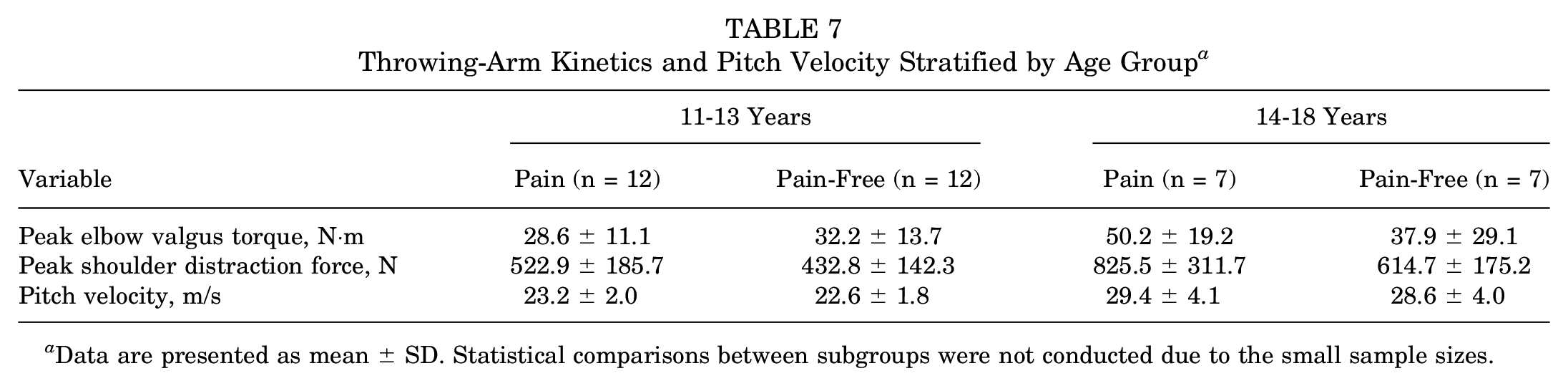
Data are presented as mean ± SD. Statistical comparisons between subgroups were not conducted due to the small sample sizes.
Finally, the subjectivity of pain is a limitation to the current study. Each person experiences pain differently and adapts throwing mechanics at different rates; therefore, the results of this study may be unique to the sample used. However, pain is often a precursor to injury, and we believe that while the presence of pain is going to be subjective and differs from person to person, the pain experience may lead to altered mechanics and further injury risk.
Conclusion
Our models demonstrated that increases in peak shoulder distraction forces when holding pitch velocity and body weight constant increase a youth baseball pitcher's likelihood of experiencing throwing-arm pain, which supported our hypothesis that youth baseball pitchers who experience throwing-arm pain would be less efficient in their use of the forces they are experiencing. This suggests that as the shoulder distraction force increases and pitch velocity remains constant, the likelihood of a pitcher's experiencing throwing-arm pain also increases. Future research should investigate what kinematics may influence shoulder distraction force efficiency and throwing-arm pain in youth baseball pitchers.
Footnotes
Final revision submitted February 23, 2024; accepted March 18, 2024.
The authors declared that there are no conflicts of interest in the authorship and publication of this contribution. AOSSM checks author disclosures against the Open Payments Database (OPD). AOSSM has not conducted an independent investigation on the OPD and disclaims any liability or responsibility relating thereto.
Ethical approval for this study was obtained from Auburn University (ref No. 18-121 EP 1803).
