




Abstract
Background:
Anterior cruciate ligament reconstruction (ACLR) is highly recommended in patients with ACL deficiency who must perform at a high physical level. A combination of functional and psychological outcome measures is necessary to provide a comprehensive evaluation of functional status after successful return to sport after ACLR.
Purpose:
To identify factors associated with higher functional outcomes among soccer players who had returned to full sports participation after ACLR.
Study Design:
Cohort study; Level of evidence, 3.
Methods:
A total of 168 out of 231 patients who underwent primary unilateral arthroscopic anatomic single-bundle ACLR were available at follow-up. Postoperatively, knee function, generic health outcomes, and psychological impact were assessed using the International Knee Documentation Committee (IKDC), the Knee injury and Osteoarthritis Outcome Score (KOOS), the Lysholm Knee Scoring Scale, the 12-item Short Form Health Survey (SF-12), and the ACL–Return to Sport after Injury scale.
Results:
After a mean follow-up of 35.5 ± 22.6 months, 85% of soccer players returned to performance. Midfielder position was associated with a better SF-12 Physical Component Summary (PCS) score (P = .013), IKDC (P = .003), total KOOS (P < .001), KOOS Symptoms (P = .004), KOOS Pain (P = .029), KOOS Activities of Daily Living (ADL) (P = .044), KOOS Sport and Recreation (Sport/Rec) (P = .001), KOOS Quality of Life (QoL) (P < .001), and Lysholm score (P = .008). Playing only on natural grass was associated with lower SF-12 PCS scores (P = .003), total KOOS (P = .001), and KOOS Sport/Rec (P = .011). Playing only on artificial turf was associated with lower Lysholm score (P = .018) and total KOOS (P = .014). The contact mechanism was associated with higher IKDC (P = .044) and KOOS QoL (P = .048), and injury affecting the dominant limb was associated with lower SF-12 Mental Component Summary scores (P = .012). Playing at a nonprofessional level was associated with lower total KOOS (P = .028), KOOS Symptoms (P = .002), KOOS ADL (P = .033), and KOOS Sport/Rec (P = .016).
Conclusion:
Professional soccer players and the midfielder position are associated with better functional scores upon returning to the sport. A history of noncontact ACL injury and playing on a single type of surface are associated with lower functional outcomes upon returning to the sport. Lower mental health scores can be expected after injury of the dominant limb.
Keywords
Pivoting sports such as soccer are considered high-risk activities for anterior cruciate ligament (ACL) injuries21,25 because of the high axial and torsional loads applied to the knee joint during sport-specific tasks 19 and contact with an opponent. Soccer is the most played sport in the world 11 and the ACL injury rate is 0.4 to 0.6 per soccer team every season. 16 The burden of ACL injury is particularly relevant since players lose ≥6 months of play on average. Currently, ACL reconstruction (ACLR) is highly recommended in patients who must perform at a high physical level. 32
One important goal for ACLR is to quickly return to sports (RTS), and it is considered a continuum: return to participation, RTS, and return to performance. 30 The RTS continuum was developed to support the sports medicine team in RTS decision making. During return to participation, the athlete may participate in some training, but he or she is not ready to RTS. RTS happens when the athlete has returned to competition, though one has not reached one's desired level of performance. In the last phase, return to performance, the athletes’ performance capabilities have returned to or exceeded the preinjury level.
Even if most players can return to soccer after ACLR, time-loss injuries that result in long periods without training or competing are considered major adverse events for the career of a soccer player.20,41 Kiliç et al 27 found that athletes who sustain severe musculoskeletal time-loss injuries are likely to develop subsequent symptoms of mental disorder, such as distress, anxiety, and depression, emphasizing the need for an interdisciplinary medical approach. Therefore, a combination of functional and psychological outcome measures is likely necessary to provide a comprehensive evaluation of functional status after RTS after ACLR. 15 Previous studies4,40 have found that the key factors that increase the possibility of RTS with return to performance after ACLR include younger age, male sex, playing an elite sport, and a positive psychological response. However, little knowledge of successful RTS after ACLR exists with regard to factors such as playing position, surface, and mechanism of injury in soccer.
The aim of this study was to investigate sport level, playing position and surface, mechanism of injury, and type of graft to identify factors associated with greater functional outcomes among soccer players who had returned to full sports participation after anatomic single-bundle ACLR. The return-to-performance rate was also investigated.
Methods
The study protocol was approved by the local ethics committee (institutional review board approval was obtained from University of Molise), and the research was conducted in compliance with the Declaration of Helsinki.
A retrospective multicenter study with prospective data collection was undertaken on 231 patients who underwent primary unilateral arthroscopic anatomic single-bundle ACLR between October 2017 and September 2022 at the following institutions: Mater Domini University Hospital of Catanzaro, Villa del Sole Clinic of Catanzaro, and Casa di Cura Villa Betania of Rome in Italy.
Patient Involvement Statement
Eligibility criteria were as follows: (1) >16 years old at the time of surgery, (2) ACLR using semitendinosus and gracilis tendon (ST-G) autograft, bone–patellar tendon–bone (BPTB) autograft, or synthetic graft, (3) played soccer at least once a week in training or in a match before the ACL injury, (4) return to full participation in soccer after ACLR, and (5) the capability to communicate with health care professionals and give valid informed consent. Soccer players who underwent bilateral ACLR, revision surgery, multiligament injuries, concomitant meniscal repair procedures, and fractures of the knee at any time as well as patients showing severe knee osteoarthritis (Kellgren-Lawrence grades 3 and 4) were excluded. The diagnosis was based on clinical and radiological evaluation of the knee (plain radiographs and magnetic resonance imaging). A total of 176 patients met the study criteria. Signed informed consent was provided by each patient who was made aware of all aspects of the study. 37 Demographic data, including age, sex, mechanism of injury (contact or noncontact), graft type (doubled ST-G, BPTB, or synthetic), dominant limb (defined as the preferred kicking limb), level of play (professional or nonprofessional), playing position (goalkeeper, defender, midfielder, forward), and playing surface (natural grass and artificial turf), were collected from medical records and then recollected at follow-up.
Surgical Technique
All ACLRs were performed by 3 surgeons (O.G., R.S, S.C.) with high levels of experience in knee arthroscopy. For the tibial tunnel, the aimer was adjusted to the 45° to 55° position to ensure adequate tibial tunnel length. Femoral tunnel drilling was performed via the anteromedial portal technique with the knee flexed to 120°. The ST-G were harvested for a 4-strand graft aiming for a minimum size of 8 mm. For BPTB autografts, a standard harvest was performed using the middle third of the tendon for a 10 mm–wide graft.
In all ACLR procedures, a cortical suspension device was used for femoral fixation. A bioabsorbable interference screw was used for tibial fixation while the graft was tensioned at 30° of knee flexion.
Postoperative Rehabilitation
Postoperatively, all patients underwent a common rehabilitation protocol regardless of the type of graft used. Patients walked with elbow crutches bearing weight as tolerated, and the range of motion was limited to 90° for 1 week. After 1 week, patients began range of motion therapy. After nearly full range of motion was achieved, patients started strength training, with an emphasis on closed kinetic chain exercises. The preservation of quadriceps function in the early postoperative stage of rehabilitation after ACLR was emphasized with an early initiation of isometric quadriceps setting exercises. Activities that prepared the individual for progression to full weightbearing and ambulation, improved balance and postural control, and achieved normal gait were allowed after 4 weeks. Weightbearing strengthening activities were initiated and progressed after 6 weeks. Strengthening exercises through the full range of motion and activities to enhance neuromuscular control were also continued to ensure full recovery and maintenance of strength and dynamic stability. Rehabilitation progressed from functional activities to sports-specific training. With the knee stable at Lachman and pivot-shift tests; when the quadriceps index was ≥85%; and strength, proprioception, and endurance for functional progression were satisfied, the patients began full-effort sprinting, cutting, and plyometric activities. RTS was permitted no earlier than 6 months after surgery.
Patient-Reported Outcome Measures
At follow-up, each patient was functionally and psychologically evaluated in person by a trained researcher (K.C.). Measures of knee function were assessed using the International Knee Documentation Committee subjective knee form (IKDC), the Knee injury and Osteoarthritis Outcome Score (KOOS), and the Lysholm Knee Scoring Scale.
The IKDC 24 is an 18-item instrument. Possible scores range from 0 to 100, where 100 means no limitation with daily or sporting activities and the absence of symptoms.
The KOOS 34 contains 42 questions organized into 5 subscales: (1) Pain frequency and severity during functional activities; (2) Symptoms such as the severity of knee stiffness and the presence of swelling, grinding or clicking, catching, and range of motion restriction; (3) Activities of Daily Living (ADL) functions experienced with difficulty; (4) Sport and Recreation (Sport/Rec) activities carried out with difficulty; and (5) Quality of Life (QoL) as it relates to the knee. Possible scores range from 0 to 100, where 100 means no knee problems.
The Lysholm scale 39 is an 8-item questionnaire. The total score ranges from 0 to 100, where 100 means no symptoms or disability.
The 12-item Short Form Health Survey (SF-12) 44 is a 12-item questionnaire used to assess generic health outcomes from the patient's perspective. Two summary scales (the Physical Component Summary [PCS] and the Mental Component Summary [MCS]) can be computed with scores ranging from 0% to 100%, with higher scores indicating better QoL.
The psychological impact was assessed using the ACL–Return to Sport after Injury scale developed and validated by Webster and Feller 43 and Webster et al 45 in relation to 3 elements that have been correlated with the RTS in the literature: emotions, confidence in one's performance, and the evaluation of risk. The total score was calculated by adding the values of the 12 responses and then dividing by 100 to obtain a percentage. High scores corresponded to a positive psychological response.
Statistical Analysis
The mean, standard deviation, and range were noted for the continuous variables, and counts were noted for the categorical variables. All data were collected, measured, and reported with 1 decimal accuracy. The distribution of the numeric samples was assessed with the Kolmogorov-Smirnov normality test. Based on this preliminary analysis, parametric tests were adopted. Correlations between outcome scales with pairwise correlation coefficients were evaluated; the correlation was considered to be strong (r > 0.5), medium (0.5 > r > 0.3), or small (0.3 > r > 0.1). 9 In the current study, the return-to-performance rate was calculated as the percentage of players with ACLR who returned to soccer training and match at their previous level of play. 42 An analysis of variance model was used in the univariate analysis to test if outcomes significantly changed among the categories of the variables. The variables that were noted to be significant after univariate analysis were included in the multivariate linear regression analysis model to test possible outcome predictors. The following variables were considered predictors: body mass index (continuous), playing position (categorical), dominant limb (categorical), playing surface (categorical), level of sport (categorical), graft type (categorical), and mechanism of injury (categorical). All the models were adjusted for age (continuous), sex (categorical), and follow-up (continuous). The regression equation for multiple regression analysis is as follows:

Y = dependent variable
®= constant/intercept
X = independent variable
©= random error term
Stata statistical software (Release 16; StataCorp) and GraphPad Prism (Version 7.0; GraphPad Software Inc) were used for the database construction and statistical analysis. Confidence intervals were set at 95%, and P < .05 was considered significant. 31
Results
Of the 176 patients who met inclusion criteria, 8 were lost at follow-up, leaving 168 patients available for the final evaluation. The characteristics of the study population are summarized in Table 1.
Baseline Characteristics of Included Patients a

ACL, anterior cruciate ligament; BMI, body mass index; BPTB, bone–patellar tendon–bone; ST-G, semitendinosus and gracilis.
There were 132 (78.6%) men, and the mean age at surgery was 26.3 ± 8.2 years (range, 16-52 years). Professional soccer players numbered 52 (31.0% of the cohort), and the dominant limb was involved in 78.6% of cases. The types of grafts used for ACLR were ST-G, BPTB, and synthetic in 79.2%, 16.1%, and 4.8% of cases, respectively. Overall, 85% of patients returned to their previous level of play. No differences in terms of playing position and playing surface emerged between data collected from medical records and those recollected at follow-up.
Clinical Outcomes
Clinical outcomes after a mean follow-up period of 35.5 ± 22.6 months are shown in Table 2.
Clinical Outcomes of Study Population a

ACL-RSI, Anterior Cruciate Ligament–Return to Sport after Injury; ADL, Activities of Daily Living; IKDC, International Knee Documentation Committee subjective knee form; KOOS, Knee injury and Osteoarthritis Outcome Score; Max, maximum; MCS, Mental Component Score; Min, minimum; PCS, Physical Component Score; QoL, Quality of Life; Sport/Rec, Sport and Recreation; SF-12, 12-item Short Form Health Survey.
At the correlation analysis, the correlation was positive and strong between Lysholm and KOOS (r = 0.826; P < .001), KOOS and IKDC (r = 0.802; P < .001), Lysholm and IKDC (r = 0.691; P < .001), SF-12 PCS and IKDC (r = 0.615; P < .001) and KOOS and SF-12 PCS (r = 0.610; P < .001). The correlation was medium and positive between Lysholm scores and SF-12 PCS scores (r = 0.462; P < .001) and small and positive between IKDC scores and SF-12 MSC scores (r = 0.295; P < .001) and between KOOS scores and SF-12 MSC scores (r = 0.238; P = .002) (Supplemental Table S1, available separately).
Tables 3 and 4 show the univariate analysis among outcome measures and the categories of the variables.
Univariate Analysis a
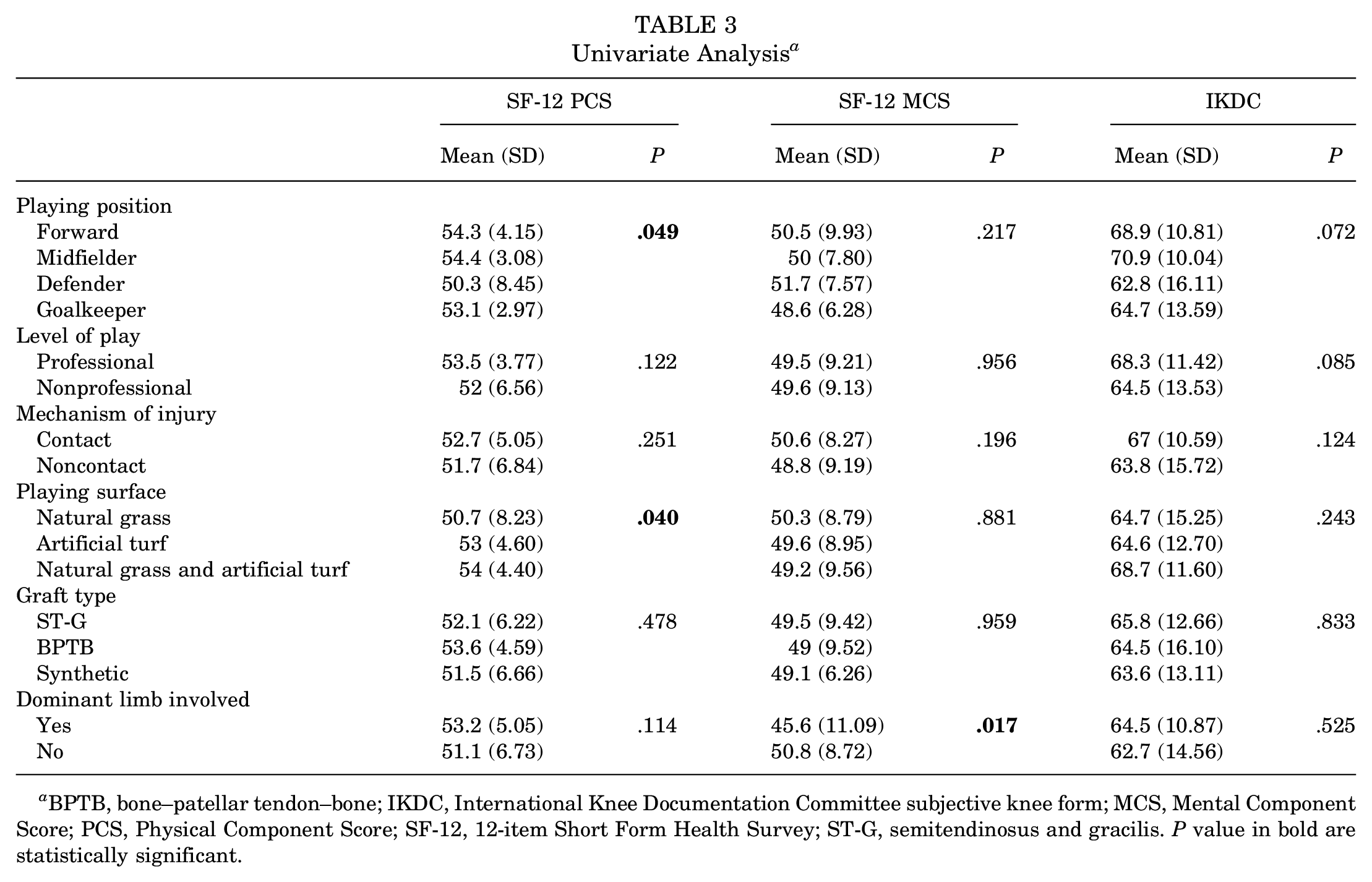
BPTB, bone–patellar tendon–bone; IKDC, International Knee Documentation Committee subjective knee form; MCS, Mental Component Score; PCS, Physical Component Score; SF-12, 12-item Short Form Health Survey; ST-G, semitendinosus and gracilis. P value in bold are statistically significant.
Univariate Analysis a
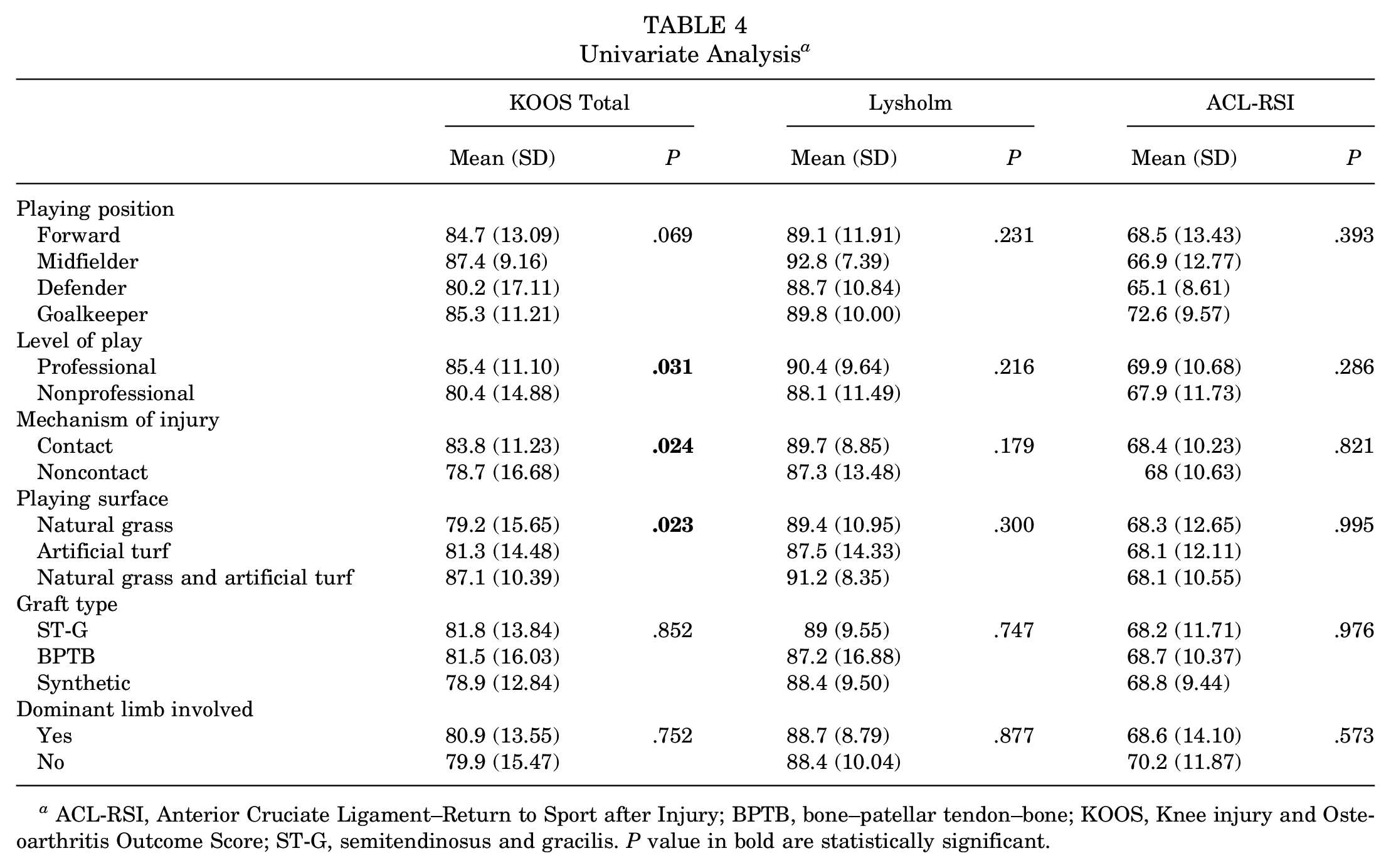
ACL-RSI, Anterior Cruciate Ligament–Return to Sport after Injury; BPTB, bone–patellar tendon–bone; KOOS, Knee injury and Osteoarthritis Outcome Score; ST-G, semitendinosus and gracilis. P value in bold are statistically significant.
Midfielders reported a greater SF-12 PCS score (54.4 ± 3.1) compared with other positions (P = .049). A greater postoperative KOOS was detected in professional compared with nonprofessional soccer players (85.4 ± 11.1 vs 80.4 ± 14.9, respectively; P = .031) and in players with a history of contact ACL injury compared with those with noncontact injury (83.8 ± 11.2 vs 78.8 ± 16.7, respectively; P = .024). Athletes playing soccer on both natural grass and artificial turf showed higher KOOS (87.1 ± 10.4 vs 81.3 ± 14.5 vs 79.2 ± 15.7, respectively; P = .023) and SF-12 PCS scores (54 ± 4.4 vs 53 ± 4.6 vs 50.7 ± 8.2, respectively; P = .04) when compared with athletes playing on artificial turf or natural grass alone or both. Players who underwent ACLR on the dominant limb reported lower SF-12 MCS scores than players in whom the nondominant limb was involved (45.6 ± 11.1 vs 50.8 ± 8.7, respectively; P = .017).
Regression Analysis
The multivariate regression analysis demonstrated that midfielder position was associated with better SF-12 PCS score (β = 4.9; 95% CI, 1.05-8.72; P = .013), IKDC (β = 13.2; 95% CI, 4.57-21.84; P = .003), total KOOS (β = 16.35; 95% CI, 7.59-25.12; P < .001), KOOS Symptoms (β = 14.4; CI 4.7-24.04; P = .004), KOOS Pain (β = 8.52; 95% CI, 0.91-16.13; P = .029), KOOS ADL (β = 9.6; 95% CI, 0.27-18.94; P = .044), KOOS Sport/Rec (β = 25.43; 95% CI, 10.59-40.27; P = .001), KOOS QoL (β = 27.62; 95% CI, 13.84-41.41; P < .001), and Lysholm score (β = 9.4; 95% CI, 2.52-16.36; P = .008).
Nonprofessional players were associated with lower total KOOS (β = −5.7; 95% CI, –10.76 to 0.62; P = .028), KOOS Symptoms (β = −7.8; 95% CI, –12.73 to 2.82; P = .002), KOOS ADL (β = −5.2; 95% CI, –9.92 to 0.41; P = .033), and KOOS Sport/Rec (β = −9.9; 95% CI, –17.9 to 1.83; P = .016).
The habit of playing only on natural grass was associated with lower SF-12 PCS scores (β = −4.5; 95% CI, –7.36 to 1.55; P = .003), total KOOS (β = −11.3; 95% CI, –18.03 to 4.57; P = .001), and KOOS Sport/Rec (β = −14.3; 95% CI, –25.19 to 3.3; P = .011). Playing only on artificial turf was associated with lower Lysholm scores (β = −5.6; 95% CI, –10.23 to 0.97; P = .018) and total KOOS (β = −7.1; 95% CI, –12.72 to 1.46; P = .014).
ACL injury due to contact mechanism was associated with higher IKDC (β = 4.4; 95% CI, 0.12 to 8.73; P = .044) and KOOS QoL (β = 7.4; 95% CI, 0.07 to 14.73; P = .048), and ACL injury affecting the dominant limb predicted lower SF-12 MCS (β = −6.1; 95% CI, –10.9 to 1.38; P = .012).
Discussion
In the current study, high patient functional and psychological scores were reported a mean of 3 years after anatomic single-bundle ACLR. Overall, 85% of patients returned to performance at their previous level of play. Professional soccer players and the midfielder position reported better functional scores upon returning to the sport. The habit of playing soccer on both natural grass and artificial turf was associated with higher functional scores than those of athletes playing on just one of the surfaces. ACL injury due to a noncontact mechanism was associated with lower functionality and QoL. Injuries affecting the dominant limb were associated with lower SF-12 MCS.
Returning to sports after ACLR is a difficult and complex process that depends on both medical and nonmedical factors. 10 RTS is both a measure of the success of the surgical procedure and a measure of patient satisfaction. 30 In the current study, 85% of soccer players returned to performance at their preinjury level of play, and this finding is consistent with previously published rates. 22 Waldén et al 41 investigated ACL injuries in male professional soccer players and found that 88% of patients were still playing soccer 3 years after the RTS, but 65% played at the same level and 23% played at a lower level. Moreover, it should be considered that nearly 1 out of every 5 athletes who undergo ACLR do not return to playing the sport, which remains below the expectations of patients undergoing ACLR and their clinicians.7,17
In the current cohort, anatomic single-bundle ACLR using an autograft was performed in 95% of cases, mean values around 80% of the maximum achievable value were obtained for all functional outcomes evaluated, and mean values from 50% to 70% were obtained for the outcomes relating to mental health and psychological well-being. Interestingly, Sepulveda et al 35 reported that among the most influential factors associated with ACLR outcomes and RTS are graft choice and anatomic position; the authors found that an anatomic tunnel position, along with appropriate autograft tensioning, ensures optimal graft isometry and function.
Level of Play
We found that playing soccer on a professional level was associated with better functional scores upon returning to the sport. A combination of factors, including superior athletic skill, 1 levels of physical fitness 29 and knee proprioception, 28 ready access to high-quality health care, 26 and greater financial incentives to play, might help to explain why professional soccer players reported higher functional scores than nonprofessional athletes.
Playing Position
The risk of developing an ACL injury and the capability to RTS itself seem to vary with playing position as well. Previous literature suggested that pressing is one of the most common injury mechanisms.8,21 In a pressing situation, the player typically makes a sidestep cut to reach the ball or to tackle an opponent. Other authors 12 reported that pressing tactics and a high-speed style of play have important correlations with ACL injury mechanisms. An analysis of performance suggested that different play positional roles require unique technical, physiological, and tactical demands from the players. For instance, defenders are more frequently engaged in pressing and aerial duels than midfielders, and forward players cover significantly greater distances while sprinting than midfielders. These unique technical and physiological demands predispose players to a greater risk of concussion among defenders and strain among forward players due to the eccentric overload of the musculotendinous junction that has been found to emerge when sprinting 11 ; however, no agreement regarding the correlation between position and injury risk exists in the literature. Overall, these aspects of the style of play and injury mechanisms could explain why, in the present study, the midfielder position was associated with better functional scores when returning to the sport.
Playing Surface
It was observed that the habit of playing soccer on both natural grass and artificial turf was associated with higher functional scores than those of athletes playing on just 1 surface. Biomechanical studies have generally supported increased frictional forces on artificial turf, but clinical studies have demonstrated inconclusive results. 14 Eisenstein et al 14 investigated the RTS rate after ACLR in the National Football League and reported no significant association with playing surface. Dragoo et al 13 supported the use of modern third-generation artificial turf as a safe and appropriate alternative to natural grass playing surfaces. Conversely, Andersson et al 3 reported a negative overall impression, poorer ball control, and greater physical effort among athletes playing on artificial turf than natural grass. However, natural grass surfaces are inherently variable due to several factors, such as soil type and grass root density. In addition, natural grass might not be as well maintained in training fields compared with match fields, where more attention is likely to be paid to keeping the fields in good condition for the competing athletes. 23 The response to physical wear and environmental exposures were also identified in the current literature as variables influencing the performance of playing surfaces. 46 In the current study, practicing on both artificial turf and natural grass could have had positive implications on neuromuscular aspects in soccer players, including proprioception, muscle activation, and interarticular coordination, with greater dynamic knee stability. 38
Mechanism of Injury
In addition, it was found that ACL injury due to a noncontact mechanism was associated with lower functionality and QoL among athletes who returned to full sports participation. Noncontact ACL tears were considered injuries after nonphysical contact with other players; the most common mechanism includes a deceleration task with high knee internal extension torque combined with dynamic valgus rotation with the body weight shifted over the injured leg and the plantar surface of the foot fixed flat on the playing surface. Noncontact ACL injuries in soccer players have a multifactorial etiology, 5 and risk factors include knee joint laxity, narrow intercondylar notch width, and decreased proprioception. It should be considered that the prevention of noncontact ACL injuries through modification of anatomic risk factors seems to have limited potential for intervention. 2 These risk factors are often not managed during ACLR surgery and therefore persist postoperatively, conditioning the optimal RTS.
Limb Dominance
In the current study, ACL injury affecting the dominant limb was associated with lower SF-12 MCS among athletes who have returned to full sports participation. The difference in SF-12 MCS values (5.2) between the players with ACL injury affecting the dominant limb and those with injury of the nondominant limb was greater than the minimal clinically important difference after ACLR. 33 The MCS component is a determinant of disability, and the demonstration of the value of treatment at a global level is also becoming more of a requirement from many policy makers. 36 When data from the current study were compared with the general population, >88% of our cohort scored in the mean or above mean range for both the PCS and the MCS scores of the SF-12. The effect of limb dominance on ACL injuries and biomechanics is controversial, and there is limited literature on this topic. Boo et al 6 reported that 92.9% of patients with a nondominant limb injury and 87.2% with a dominant limb injury had returned to their preinjury sport 1 year after ACLR. The authors also found that limb dominance does not have a significant impact on patient-reported functional outcome scores, which is consistent with our results.
Limitations and Strengths
There are several limitations to our study. Given the retrospective nature of the design of this study, potential bias cannot be excluded. Since we only evaluated athletes who returned to sports, we cannot comment on whether the differences we noted would be predictive of successful return to sport. Also, while we observed some differences in scores based on position, level of participation, and playing surface, we cannot determine causation. Also, the use of different types of grafts may represent a weakness of the study. We were unable to control for confounding factors, such as shoe type, field conditions, type of artificial turf field, and training and match exposures. Further studies should explore this topic and assess any possible confounding factors that may not be captured. The study design adhered to the consensus statement on injury definitions and data collection procedures in studies on soccer injuries. 18 This multicentric study consisted of patients who underwent ACLR by different surgeons; therefore, the risk of selection bias should also be considered in our cohort. The comprehensive evaluation of patients by validated tools recommended by the consensus criteria for defining successful outcomes after ACLR 30 and the rigorous collection of ACL injury data, as well as the sample size and follow-up time, which was comparable with the largest and longest series available on multiparametric evaluation of RTS in soccer represent considerable strengths of the present study.
Conclusion
After anatomic single-bundle ACLR, 85% of soccer players can expect to return to performance at their preinjury level. Professional soccer players and the midfielder position are associated with better functional scores upon returning to the sport. A history of noncontact ACL injury and playing on a single type of surface are associated with lower functional outcomes when returning to the sport. Postoperatively, lower mental health scores can be expected after injury to the dominant limb. This information may assist in guiding the expectations of soccer players and clinicians as well as in improving outcomes in these subgroups.
Supplemental Material
sj-pdf-1-ojs-10.1177_23259671241275663 – Supplemental material for Factors Associated With a Successful Return to Performance After Anterior Cruciate Ligament Reconstruction: A Multiparametric Evaluation in Soccer Players
Supplemental material, sj-pdf-1-ojs-10.1177_23259671241275663 for Factors Associated With a Successful Return to Performance After Anterior Cruciate Ligament Reconstruction: A Multiparametric Evaluation in Soccer Players by Michele Mercurio, Simone Cerciello, Katia Corona, Germano Guerra, Roberto Simonetta, Filippo Familiari, Olimpio Galasso and Giorgio Gasparini in Orthopaedic Journal of Sports Medicine
Footnotes
Final revision submitted March 6, 2024; accepted April 1, 2024.
The authors declared that they have no conflicts of interest in the authorship and publication of this contribution. AOSSM checks author disclosures against the Open Payments Database (OPD). AOSSM has not conducted an independent investigation on the OPD and disclaims any liability or responsibility relating thereto.
Ethical approval for this study was obtained from Università Degli Studi del Molise (No. 23/2022).

References
Supplementary Material
Please find the following supplemental material available below.
For Open Access articles published under a Creative Commons License, all supplemental material carries the same license as the article it is associated with.
For non-Open Access articles published, all supplemental material carries a non-exclusive license, and permission requests for re-use of supplemental material or any part of supplemental material shall be sent directly to the copyright owner as specified in the copyright notice associated with the article.
