




Abstract
Background:
Anterior cruciate ligament (ACL) injury in youth can lead to expensive treatment, lengthy rehabilitation, and long-term impairment. Injuries to the ACL are more common in adolescents who participate in organized sports.
Purpose:
To examine whether there is an association between age, physical activity patterns, pubertal timing (Tanner stage), or body mass index (obesity/overweight status) and the risk of developing an ACL injury in youth.
Study Design:
Cohort study; Level of evidence, 2.
Methods:
Data from the Growing Up Today Study (GUTS), a prospective cohort study of youth throughout the United States, were used in this study. From 1996 to 2003, questionnaires were sent to GUTS participants every 12 to 18 months to assess a variety of self-reported factors; in a related 2004 questionnaire, ACL tears and other diagnoses among the participants were reported. Cox proportional hazard models were run to determine the sex-specific association of activity patterns and pubertal timing with risk of developing an ACL tear.
Results:
A total of 4519 boys and 5622 girls (age: 9-15 years) were included, with 2.4% and 2.0% sustaining an ACL injury, respectively. Age was found to be a significant risk factor for ACL injury in both sexes (male: hazard ratio [HR] = 1.30 [95% CI, 1.14-1.48]; female: HR = 1.23 [95% CI, 1.10-1.38]). Mean hours per week engaged in vigorous activity was also predictive of a higher risk of ACL injury (male: HR = 1.04 [95% CI, 1.01-1.08]; female: HR = 1.10 [95% CI, 1.07-1.14]). The sports that were the most predictive of injury were running, basketball, soccer, and cheerleading/gymnastics in girls and running, football, and karate/martial arts in boys. Additionally, in boys, overweight/obese status was found to be a significant predictor of ACL injury (HR = 2.61 [95% CI, 1.60-4.26]). Furthermore, among 9- to 13-year-old girls, advanced Tanner stage was a strong predictor of injury risk (HR = 2.43 [95% CI, 1.10-5.36]).
Conclusion:
Age, time engaged in vigorous activity, overweight/obese status, and advanced Tanner stage were associated with an increased risk of ACL injury in young adults and adolescents. Further research with follow-up data will help complement this study and continue to highlight the risk factors associated with ACL reconstruction in adolescents and young adults.
While participation in organized sports has multiple positive benefits for youth athletes, including improved cardiometabolic and mental health and lower mortality rates, increased activity is invariably associated with increased risk for injury. ¶ The US Centers for Disease Control and Prevention recommends that children and adolescents aged 6 to 17 years should engage in 60 minutes or more of moderate to vigorous intensity physical activity each day, yet less than one-quarter (24%) of children in the United States are meeting this guideline.57,58 While many youth do not spend sufficient time being physically active, it has been found that up to 55% of children aged 6 to 17 years have participated in sports or have taken sports lessons after school or on the weekends during the 12 months when reviewing young athlete activity in multiple studies.15,56 Especially with the increased rate of sports specialization, acute and overuse injuries have become more prevalent and pose long-term health consequences in youth athletes.4,9,21,23,34,35,38
It is generally agreed that the number of hours spent in deliberate training and practice positively correlates with level of achievement in both team sports and individual sports and might confer benefits in terms of securing college scholarships or entry to elite collegiate, national, Olympic, or professional teams.4,5,13,23 The AOSSM defines sports specialization as engaging in a sport for ≥8 months per year (approximately 3 seasons per year) at the exclusion of other sports. 34 Currently, there is no evidence to support that specializing leads to success in a sport at an elite level.23,31,34,44 It is increasingly suggested that this intense level of practice during early childhood and the exclusion of other sports should be delayed until late adolescence to optimize success while minimizing injury, burnout, and psychological stress.4,12,13,21,23,31,34,44
While relatively uncommon in the general population, injuries to the anterior cruciate ligament (ACL) of the knee have been shown to be more frequent in adolescents who participate in organized sports. 46 Compared with adolescents who do not play sports, male and female adolescents who participate in organized sports have a 2- to 4-fold and 2- to 11-fold increased risk of ACL injury, respectively, depending on the time spent in each sport per week.20,24,32,46,52 Relatively few longitudinal population-based studies have examined modifiable risk factors for ACL injury in adolescents and young adults, including examining the nature of the sport (high pivoting vs not) and the impact of the hours per week engaged in activity on injury risk.
Not only has increased sports participation and specialization been associated with an increased risk for ACL injury, but female sex in general is a well-known contributor to increased injury risk.42,47 Several equivocal theories have been proposed to explain the difference in ACL injury rate between male and female patients. Some investigations have focused on the anatomic risk factors and neuromuscular control imbalances that may occur in women following the onset of maturation. The adolescent growth spurt is associated with rapid changes in height, body composition, Q-angle (girls), and hormone levels—specifically estrogen levels—which have been associated with increased ligament laxity.33,37,55,56,59,61 The mean pubertal takeoff age and peak height velocity reached differs between boys and girls, with boys hitting a mean takeoff age at 11 years and girls at 9 and peak height occuring at a mean age of 13.5 years in boys and 11.5 in girls. Girls begin puberty at an earlier age while boys gain a larger mass of lean muscle. 55
In addition to activity levels, sex, and pubertal timing, weight status can also affect risk of injury during maturation due to increased load on the knee joint and ligaments.14,33,53 With overweight and obesity prevalence rising in all age groups among children aged 2 to 19 years, a large proportion of youth could be at an increased risk of injury; thus, the topic deserves more attention. 51
The goal of our investigation was to examine how pubertal timing, activity patterns, and weight status are related to the risk of developing an ACL injury in youth.
Methods
Overview
For this study, we used data from the Growing Up Today Study (GUTS; https://gutsweb.org), which was established by recruiting the children of registered nurses participating in the Nurses’ Health Study II (NHS II; https://nurseshealthstudy.org) in 1996. Nurses who reported having ≥1 child between the ages of 9 and 14 years were asked for consent for their children to be invited to participate in the GUTS. Invitations and baseline questionnaires were sent to 13,261 girls and 13,504 boys, of whom approximately 68% of the girls (n = 9039) and 58% of the boys (n = 7843) returned questionnaires in 1996, thereby assenting to participate in the study. The GUTS project, including the analyses with data from GUTS participants and their mothers in NHS II, was approved by the Human Research Committee at Brigham and Women's Hospital. Additional details about the GUTS and the NHS II have been previously reported.22,52
Outcome Measures
From the fall of 1996 through 2003, questionnaires were sent to GUTS participants every 12 to 18 months to assess a variety of factors. Self-reported weight and height were submitted on all questionnaires. Body mass index (BMI) was calculated from the self-reported weight and height information. Children were classified as overweight or obese per the cutoffs of the International Obesity Task Force, 15 which are age- and sex-specific and provide comparability in assessing overweight and obesity from adolescence to adulthood. Female participants were asked whether their menstrual periods had started. Those who marked “yes” were asked the age at which their period began (age at menarche). Tanner stage of pubic hair development, as reported using validated pictograms, was used as an indicator of pubertal status in both boys and girls, along with age of menarche as an alternative measure of pubertal timing in girls. Both variables have been assessed repeatedly in the GUTS. The missing indicator method was used with the following variables: weight status, age at menarche, and Tanner stage.
Physical activity was reported on the 1996, 1997, 1998, 1999, and 2001 questionnaires. Mean number of hours per week engaged in a specific sport was computed as the mean hours in that activity in the summer, fall, winter, and spring. The data from these surveys were used to create the following variables: hours per week of vigorous activity, hours per week engaging in sports that involved pivoting (divided into possible-pivoting and high-pivoting sports), and hours per week of moderate and vigorous activity. Possible-pivoting sports included skateboarding, skating, cheerleading/gymnastics, volleyball, and martial arts; high-pivoting sports included basketball, hockey/lacrosse, soccer, and tennis. Hours per week of vigorous activity were computed as the sum of mean hours per week engaged in any of the following sports: basketball, dance/aerobics, hockey/lacrosse, running, swimming, skating, soccer, tennis, football (boys only), cheerleading/gymnastics, volleyball, and martial arts. Participants with a reported 0 to 40 hours per week of activity who were missing values for hours per week of vigorous activity or degree of pivoting had those values set to zero.
ACL Tear Outcomes
In the GUTS, there are 2 ACL tear outcomes: an incident ACL tear reported by a participant's mother in 2004 and an incident ACL tear reported by aparticipant. On the 2004 questionnaire, mothers were asked if a doctor had ever diagnosed their child with tendinitis, patellofemoral syndrome, a stress fracture, or an ACL tear. If the mother indicated that her child had received the diagnosis, she was asked to report the age at diagnosis, whether the injury was sports related, and the time off from playing sports (no time off, <1 month, 1-2 months, or ≥3 months). GUTS participants were considered for our study if their mothers reported they were diagnosed with an ACL tear at an age older than when they entered the GUTS cohort in 1996. Children who were the same age at diagnosis and entry into GUTS were considered to be prevalent to this case group but were not included in any analysis.
Study Sample
GUTS participants who completed ≥1 questionnaire between 1996 and 2003 and had their mother complete the 2004 questionnaire reporting an ACL tear in or before 2004 were included in the current study (n = 4969 boys and 5767 girls). Of these participants, we excluded those who reported ACL tears in 1996 or earlier (4 boys and 6 girls) or who were missing weight information (2 boys, 1 girl), Tanner stage (294 boys and 133 girls), or activity or who reported an activity outlier, such as reporting more hours played per week than possible (150 boys and 5 girls) in all years. After the exclusions, 4519 male and 5622 female participants remained for analysis. Participants included in the analysis were aged between 9 and 15 years at the time of their baseline questionnaires in 1997. Table 1 summarizes the participant characteristics at baseline according to sex.
Characteristics at Baseline (1997) Among the Included GUTS Participants a
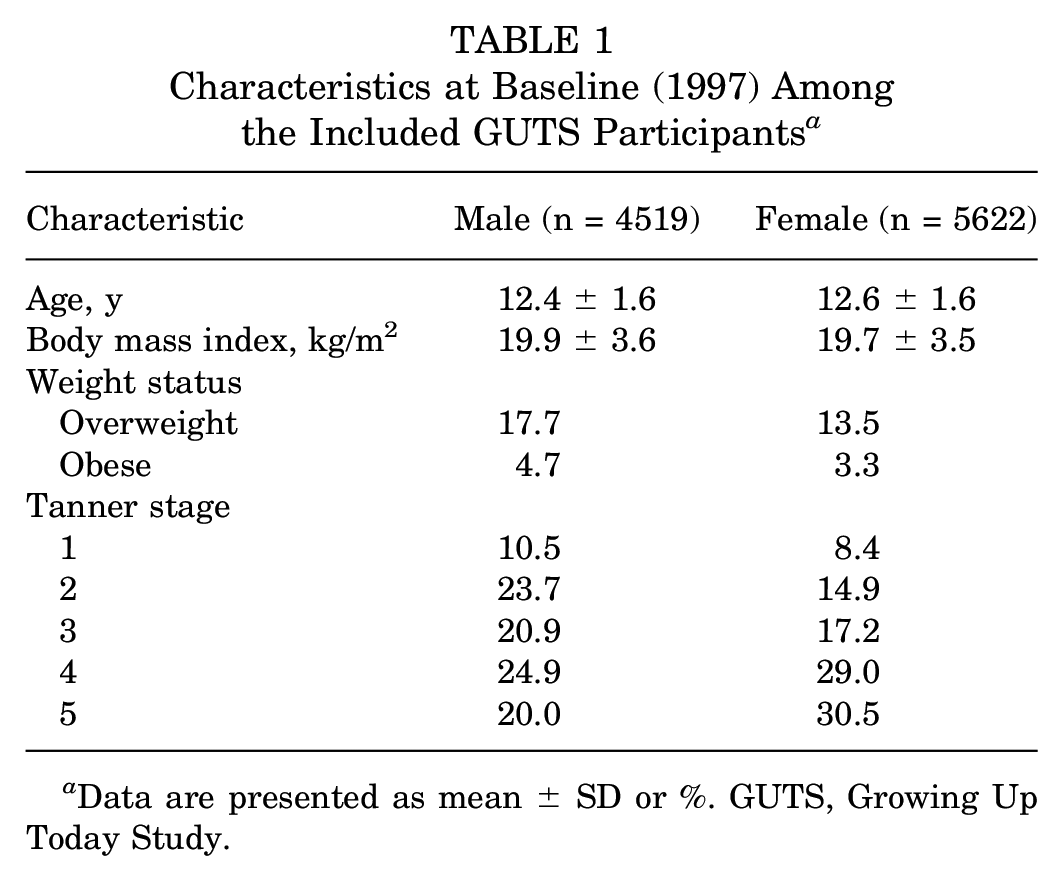
Data are presented as mean ± SD or %. GUTS, Growing Up Today Study.
Statistical Analysis
Cox proportional hazard models were run to determine the sex-specific association of activity patterns and pubertal timing with the risk of developing an ACL tear. Participants were censored after their first ACL tear or at end of follow-up, whichever came first. Potential confounders that were adjusted in the analysis included age and weight status (overweight or obese vs underweight or healthy weight). Predictors were time-varying covariates. Hazard ratios (HRs) and their 95% CIs were calculated, with significant predictors considered those in which the 95% CI did not include 1. All analyses were conducted using SAS statistical software (Version 9.4; SAS Institute).
Results
Between 1997 and 2003, approximately 2.4% (n = 107) of the 4519 male participants and 2.0% (n = 110) of the 5622 female participants sustained an ACL injury as reported by their mothers in the 2004 questionnaire. Risk of ACL injury was found to increase with age in both sexes (male: HR = 1.30 [95% CI, 1.14-1.48]; female: HR = 1.23 [95% CI, 1.10-1.38]) (Table 2). Tanner stage was not predictive of ACL injury risk among boys or girls; however, among the girls, earlier pubertal development was associated with an increased risk of ACL injury. Among 9- to 13-year-old girls, Tanner stage was a strong predictor of risk (HR = 2.43 [95% CI, 1.10-5.36]). At later ages, when all the girls had reached a late Tanner stage, developmental stage was not associated with this risk.
Predictors of Developing an ACL Tear Among Adolescent and Young Adults From the GUTS a

Data are reported as hazard ratio (95% CI) from Cox proportional hazard models. Dashes indicate areas not applicable. ACL, anterior cruciate ligament; GUTS, Growing Up Today Study.
Adjusted for age and weight status (overweight or obese vs underweight or healthy weight).
Weight status was unrelated to risk of ACL injury among the female participants, whereas their male counterparts who were overweight or obese were 2 times more likely to tear their ACL than those who were of healthy weight (HR = 2.61 [95% CI, 1.60-4.26]) (Table 2). Risk of ACL injury increased with hours per week engaged in vigorous activity (male: HR = 1.04 [95% CI, 1.01-1.08]; female: HR = 1.10 [95% CI, 1.07-1.14]). The association among female participants was driven by sports involving pivoting. Among the girls, involvement in high-pivoting sports was predictive of a greater risk for ACL injury in the next 1 to 2 years (HR = 1.15 [95% CI, 1.09-1.21]). This association was not observed in the boys (HR = 1.01 [95% CI, 0.96-1.08]).
Risk of ACL injury varied by sport (Table 3). Among both girls and boys, hours per week engaged in running was predictive of higher risk of ACL injury. For girls, hours per week engaged in basketball, soccer, volleyball, and cheerleading or gymnastics was predictive of increased risk for ACL injury, while among boys, hours per week engaged in football and karate/martial arts was predictive of increased risk for ACL tears.
Association Between Hours per Week Engaged in Specific Sports and Risk of ACL Tear Among Adolescents and Young Adults From the GUTS a
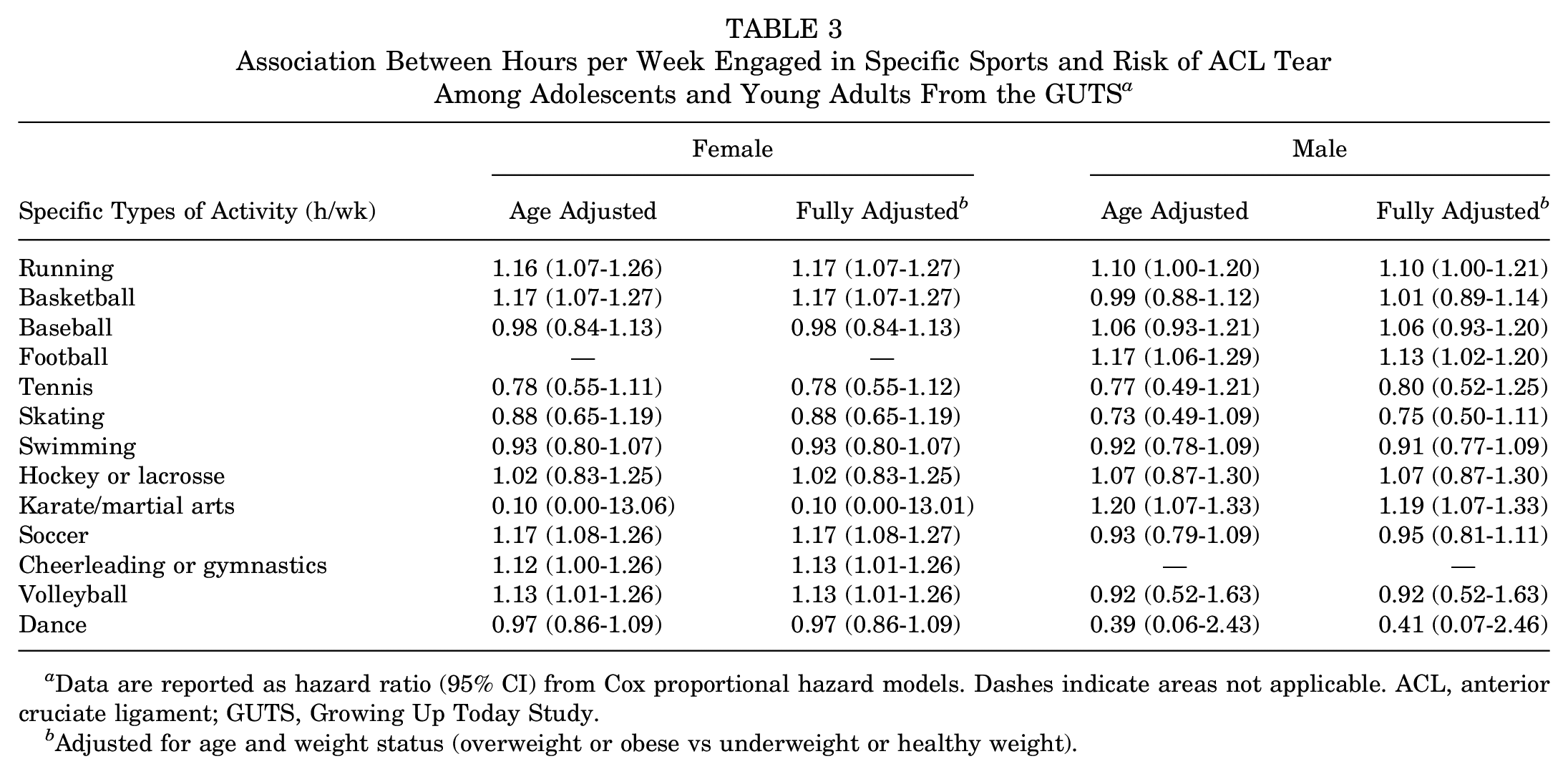
Data are reported as hazard ratio (95% CI) from Cox proportional hazard models. Dashes indicate areas not applicable. ACL, anterior cruciate ligament; GUTS, Growing Up Today Study.
Adjusted for age and weight status (overweight or obese vs underweight or healthy weight).
Discussion
Using unique prospective data, the study findings indicated an increased risk of ACL injury in young adults and adolescents with respect to older age (male: HR = 1.30 [95% CI, 1.14-1.48]; female: HR = 1.23 [95% CI, 1.10-1.38]), more hours per week engaged in vigorous activity (male: HR = 1.04 [95% CI, 1.01-1.08]; female: HR = 1.10 [95% CI, 1.07-1.14]), overweight/obesity status in boys (HR = 2.61 [95% CI, 1.60-4.26]), and advanced Tanner stage in girls aged 9 to 13 years (HR = 2.43 [95% CI, 1.10-5.36]).
A majority of ACL injuries occur via a noncontact mechanism, often in sports that require movements including pivoting, cutting, sudden changes in direction and deceleration, and landing in or near full extension. Pivoting sports such as soccer and basketball, which require such maneuvers, place anterior translational forces on the tibia in combination with the knee valgus and varus as well as internal rotation movements leading to an increased load on the ACL and increased risk of injury.39,43 The findings of this study are consistent with previous reports that athletes of high-pivoting sports and female sex are at increased risk for ACL injury. Specifically, we found that the top 3 sports that placed female adolescents at increased risk were basketball, soccer, and cheerleading or gymnastics, which is consistent with research from Ekstrand et al, 20 Stracciolini et al, 53 and Bram et al. 11 Further, a report on youth athletes in soccer showed that girls aged 15 to 18 years who played soccer were found to have a 5.4-fold increased risk of ACL injury compared with boys. 6 Similarly, in another study examining sex-based differences in ACL injury risk by activity, the female-to-male incidence rate ratio was 3.01 (95% CI, 1.19-7.63) for basketball, 4.96 (95% CI, 1.80-13.67) in gymnastics, and 1.27 (95% CI, 0.40-4.05) for soccer. 43 Most of the sports recognized as being high risk have events in which athletes are placed in a noncontact mechanism of injury with sudden deceleration and landing and pivoting maneuvers that are repeatedly performed.1,8,63 Similarly, football and karate/martial arts both involve cutting movements that place athletes at increased risk,11,23,26,41,43 as found with the male participants in our study. Running was also found to pose an increased risk for ACL injury in our study, and while the mechanism for injury is unclear, it may be attributed to risk during a concurrent activity that involves running or fall risk.
There is ample evidence that playing soccer, basketball, and football increases the likelihood of ACL injury14,18,19,26,43; thus, emphasis on injury prevention strategies is needed to help young athletes minimize their risk while playing these sports. In a systematic review and meta-analysis of 8 high-quality randomized controlled trials, Huang et al 30 investigated the efficacy of ACL injury prevention programs (IPPs). The authors found that athletes participating in IPPs experienced a 53% reduction in ACL incidence rate compared with athletes who did not. 30 A common trend among these IPPs was the incorporation of agility, strengthening, and plyometric exercises with focus on proper landing techniques. 30 Several studies have found prophylactic IPPs to be effective in significantly reducing incidence of not only ACL tears but also knee injuries overall.4,25,26,49 IPPs are proven to be beneficial and should therefore be recommended to adolescents with risk factors for ACL injury.
Girls have an earlier pubertal onset than boys, presenting both hormonal and anatomic changes that are well-documented in the literature.28,29,34,48,55,62 Boys have a relatively later and longer puberty than their female counterparts, during which they gain lean muscle mass, which can serve as a protective factor against ACL injury.33,37,45 It has been shown that girls have increased joint laxity after the onset of puberty compared with their male counterparts. 48 One explanation for this is decreased neuromuscular control of the knee in girls during puberty compared with boys. This leads to a greater total medial motion of the knees and an increased lower-extremity valgus angle. 45 Wild et al 60 demonstrated that among girls aged 10 to 13 years in Tanner stage 2, those undergoing their adolescent growth spurt displayed changes in the strategy with which they controlled their lower limbs to land after a horizontal leap movement, which has the potential to increase the risk of ACL injury. Previous studies have suggested that the peak ACL injury risk occurs around the period of pubertal growth spurts, which is 12 to 14 years in girls and 14 to 16 years in boys.34,53,55 Our data showed that advanced Tanner stage was a strong predictor of injury risk among girls in the older age group (9-13 years). At older ages, there is limited variability in Tanner stage of development; thus, one might not expect to observe an association between Tanner stage and risk of ACL tear once girls reach full maturation.
Recent literature has focused on the timing of the menstrual cycle as it might pertain to ACL injury risk. Increased estrogen levels during the menstrual cycle have been correlated with increased ligamentous laxity.3,16,27,40 It has been suggested that the menstrual cycle may have significant effect on ACL injury risk, with recent findings supporting an increased risk of noncontact ACL injury surrounding the preovulatory (first half) phase of the menstrual cycle.2,29,40 Further research has examined the potential benefits of oral contraceptives on stabilizing fluctuations in cyclic female sex hormones, with literature suggesting that oral contraceptives may provide a protective effect against ACL injury.16,29,41 Such research has focused on female patients outside of the adolescent age range but is an important topic of conversation, especially for youth athletes looking to continue long-term sports participation and female collegiate athletes minimizing their risk for ACL injury.16,29,41 Further research is warranted to explain the several unanswered questions in association with the potential confounders regarding pubertal hormonal changes in girls and boys, menstrual status, oral contraceptive use, and ACL injury risk, but they are beyond the scope of the data in this study.
Previous studies investigating ACL injuries in adolescents have not been able to separate an age effect from one driven by pubertal development. For example, Bloom et al 7 reported that in girls and boys in the pubertal stage (ages 12 to 16 years) there was a higher incidence of ACL injury reported in girls compared with their male counterparts. However, Stracciolini et al, 53 in a study that included 206 ACL tears among children aged 5 to 17 years, noted that the proportion of ACL injuries to total injuries was similar for boys and girls aged 13 to 17 years. A limitation and explanation for inconsistency across previous investigations is that age was used as a measure of pubertal timing. Age may be a suboptimal proxy measure of pubertal development due to variation within and between sexes on pubertal timing and maturation. It is suggested that when reporting on adolescent and young adult injuries, Tanner stage and age of menarche be used as further indicators of maturation rather than solely the use of age to distinguish the potential effect of pubertal timing on injury risk.34,55 In our study, we were able to utilize both Tanner stage and age as indicators of pubertal development and found both showed increased ACL injury risk, with the timing coinciding with pubertal development.
Few previous studies have focused solely on the relationship between BMI and ACL injury. In a study of 859 military recruits, Uhorchak et al 56 found that women with a BMI or body weight >1 SD above the mean were at a 3.5 or 3.2 times greater risk of ACL injury, respectively. Additionally, Stracciolini et al 53 in their study found BMI to be strongly associated with ACL injury (likelihood ratio test, 6.81) independent of sex, age, or sport. However, we found weight status to be a strong predictor of injury only in male patients. Our results corroborate the association between BMI and ACL tears, though it remains unclear whether this relationship is sex dependent.
Our findings highlight both the intrinsic and the extrinsic risks associated with ACL tears. Involvement in certain sports, hours spent participating in vigorous activity, and weight status are modifiable risk factors for injury. These risk factors should be communicated to adolescents, parents, coaches, athletic trainers, and providers. Targeting this population early with recommendations for IPPs, a healthy diet, and activity modifications can help promote a safe and active lifestyle into adulthood.43,53
Limitations and Strengths
GUTS data were collected via a self-report; therefore, there is likely to be some measurement error. Tanner staging, while validated in some studies, has also been shown to be inconsistent in self-reporting for some methods. 17 A few limitations exist due to the age of the data collection. Today, adolescents are increasingly specializing in a single sport, which may have affected the injury data in the present study. Current trends show that increased specialization leads to increased risk of injury, suggesting that hours of vigorous activity and sports played may be important variables to examine going forward. As previously noted, peak pubertal growth spurt for boys is 14 to 16 years, with this study including boys up to the age of 17 years. While we hoped to have included the peak risk age for all male participants in this study, some may have been missed. The size of this sample was large and included youth throughout the United States. Given that we used a population-based sample, the results should be generalizable to a wide variety of youth. However, our sample was mostly White (>90%), and therefore it is unknown whether our results are generalizable to people of other ethnicities/races.
Because previous ACL injury is a predictor of future ACL injury or contralateral ACL injury, our focus on initial injury is an important strength, ensuring that results are not confounded by injury history. However, the term “ACL tear” used in the 2004 questionnaire and in the GUTS yearly questionnaires does not determine if the tear was partial or complete and severe enough to require surgical intervention. These terms may have been misinterpreted by the questionnaire participants.
Conclusion
Although being physically active has many mental and physical health benefits, adolescents with a high volume of vigorous activity were found to have a higher likelihood of sustaining an ACL injury. Among female participants, engaging in sports involving pivoting and early pubertal development was found to be a strong predictor of an ACL injury. Among male participants, overweight or obese status or those involved in football or martial arts were found to be at an increased risk for ACL injury. Involvement in IPPs is an effective way to mediate the risk that comes with participating in high-risk sports. Understanding and addressing modifiable predictors for ACL injury early on is important in reducing risk and decreasing the potential need for costly ACL reconstructive surgery in youth. Further research with follow-up data will help complement this study and continue to highlight the risk factors associated with ACL injury in adolescents and young adults.
Footnotes
Acknowledgements
The authors thank the thousands of participants in the GUTS and their mothers for completing multiple surveys, and the Channing Division of Network Medicine, Department of Medicine, Brigham and Women's Hospital, for the use of the data.
Final revision submitted January 7, 2024; accepted February 23, 2024.
One or more of the authors has declared the following potential conflict of interest or source of funding: Data collection was supported by research grants from the US National Institutes of Health (grant numbers MH087786, DK59570, DK46200, HL68041, HD049889, DA033974, HD066963, OH0098003, and U01 HL145386). B.D.O. has received consulting fees from DePuy/Medical Device Business Services, Vericel, CONMED, Miach, and MTF Biologics; royalties from CONMED; and honoraria from Vericel; has stock/stock options in Vivorte; and is a paid associate editor for The American Journal of Sports Medicine. M.S.K. has received education payments from Kairos Surgical, consulting fees from OrthoPediatrics and Ossur, and royalties from OrthoPediatrics, Ossur, Elsevier, and Wolters Kluwer. AOSSM checks author disclosures against the Open Payments Database (OPD). AOSSM has not conducted an independent investigation on the OPD and disclaims any liability or responsibility relating thereto.
Ethical approval for this study was obtained from Brigham and Women's Hospital (ref No. 1999P002104).
