




Abstract
Background:
Compromise of the acetabular labrum can lead to pain and loss of critical intra-articular fluid pressure. Revision labral preservation poses unique challenges due to adhesions and compromised tissue quality.
Purpose/Hypothesis:
The purpose of the study was to evaluate patient-reported outcome (PRO) measures (PROMs) in patients undergoing revision hip arthroscopy with either labral reconstruction or labral repair after primary hip arthroscopy for labral tear. It was hypothesized that both procedures would lead to improved PROs.
Study Design:
Systematic review; Level of evidence, 4.
Methods:
A systematic review of the literature was conducted with the following keywords: (revision) AND (hip OR femoroacetabular impingement) AND (arthroscop*) AND (reconstruction OR repair) in PubMed, Cochrane, and Scopus in August 2023 using the PRISMA (Preferred Reporting Items for Systematic Reviews and Meta-Analyses) criteria, yielding 2002 initial records. Only studies comparing PROMs between revision labral reconstruction or revision labral repair after primary hip arthroscopy for labral tear were included. Background article information was recorded, including article title, author, study design, level of evidence, patient demographics, radiographic information, intraoperative data, PROMs, psychometric thresholds, and secondary surgeries. Secondary surgery in our study was defined as any open or arthroscopic hip surgery secondary to the initial revision surgery. Forest plots were created for pre- and postoperative outcomes present in ≥3 studies. Heterogeneity was calculated using I2 values.
Results:
Four studies, including 215 revision labral reconstructions and 115 revision labral repairs of the hips, were included in this systematic review. All studies were level 3 evidence, and study periods ranged between 2009 and 2019. Mean follow-up for the reconstruction and repair groups ranged from 26.3 to 36.6 months and 30.7 to 56.4 months, respectively. The mean age for the reconstruction and repair groups varied between 27 to 34.6 years and 27.5 to 30 years, respectively. Mean postoperative modified Harris Hip Scores for the reconstruction and repair cohorts ranged from 72.0 to 81.2 and 70.8 to 84.1, respectively (I2 = 0%). Mean visual analog scale for pain scores for the reconstruction and repair cohorts ranged from 3 to 3.5 and 2.3 to 3.9 (I2 = 33%). Overall secondary surgery rates ranged from 10.0% to 26.7% in the labral reconstruction cohort, compared with 10.0% to 50.0% in the labral repair cohort. One study reported superior outcomes in the revision labral repair group, with 3 studies finding no statistically significant difference in outcomes between the groups.
Conclusion:
Our systematic review showed that patients undergoing revision hip arthroscopy with labral reconstruction demonstrated significant improvement in postoperative outcome measures. Postoperative outcomes were similar to those of a benchmark control group of patients undergoing revision hip arthroscopy and labral repair. Labral reconstruction in the revision setting appears to be an effective treatment in clinically indicated patients.
The acetabular labrum encircles the hip joint, provides joint stability, distributes load across the joint, and maintains a tight seal to retain synovial fluid.5,13,26 In patients with mechanical disruption such as femoroacetabular impingement, the labrum can degenerate over time, causing pain, disability, and arthritis if left untreated.1,2,12 While the damaged labrum can be debrided, labral preservation is preferred due to better restoration of the labral suction seal.5,16,23 Several options exist for labral preservation, including labral repair and reconstruction.1,20 If the native labral tissue has sufficient quality, the torn native labrum can be reattached to the acetabular rim through a labral repair. 1 If the labrum is severely damaged, or the tissue quality is insufficient to repair, graft tissue can be used to reconstruct a new labrum. 20 In patients with labral tears, both labral repair and reconstruction have been shown to provide significant pain relief, restore mobility, and allow patients to return to activities of daily living. 22 Despite the successful postoperative outcomes of labral restoration, revision hip arthroscopy poses unique challenges due to adhesions and compromised tissue quality.17,19
Maldonado et al 11 previously compared labral repair and reconstruction outcomes in a systematic review and found improved patient-reported outcome (PRO) measures (PROMs) in both groups with no statistically significant differences. Recent studies have described favorable outcomes after both of these surgeries, even in the revision setting.3,10,15,27 However, no studies have provided composite data synthesizing these results.
The purpose of this study was to provide a systematic review of the present literature and to compare PROMs in patients undergoing revision hip arthroscopy with either labral reconstruction or labral repair after primary hip arthroscopy for labral tear. It was hypothesized that both patients undergoing labral repair and those having labral reconstruction would experience statistically significant improvement in PROMs and high rates of survivorship from total hip arthroplasty (THA).
Methods
Literature Search and Screening
A systematic review of the literature was conducted with the following keywords: (revision) AND (hip OR femoroacetabular impingement) AND (arthroscop*) AND (reconstruction OR repair) in PubMed, Cochrane, and Scopus in August 2023 using the PRISMA (Preferred Reporting Items for Systematic Reviews and Meta-Analyses) criteria (Table 1). Two authors (N.P. and T.K.) used the Covidence (Veritas Health Innovation; www.covidence.org) screening software to screen and review the title and abstract of each study in the search. Afterward, a full-text review of all studies that passed the initial title and abstract screen was performed by the same 2 authors. If consensus was not reached between both authors regarding the inclusion of an article at either stage, a third author (S.S.) reviewed articles for inclusion. Only studies with level of evidence 1 to 4 comparing preoperative and postoperative PROMs between revision labral reconstruction or revision labral repair were included after primary hip arthroscopy for labral tear. Biomechanical studies, case reports, technique articles, opinion pieces, abstracts, book chapters, review articles, and articles not written in English were excluded from this study (Table 2).
Article Searches in PubMed, Cochrane, and Scopus

Study Characteristics a

LOE, level of evidence; MINORS, methodological index for non-randomized studies.
Data Extraction
Background article information was recorded, including article title, author, study design, publication date, level of evidence, number of hips studied, patient demographics, radiographic information (lateral center-edge angle, alpha angle, Tönnis osteoarthritis grade), concomitant procedures, type of labral reconstruction, labral reconstruction graft type, PROMs, clinical benefit, and secondary surgeries.4,14,28 Secondary surgery in our study was defined as any open or arthroscopic hip surgery, including THA, secondary to the initial revision surgery. Survivorship was defined as nonconversion to THA. Extracted data were recorded via Microsoft Excel (Microsoft Office 2011; Microsoft). All data were extracted by 2 independent authors (S.P. and K.K.), who are a MD student and BS student, respectively, and reviewed for conflicts by a third author (S.S.).
Quality Assessment
Two authors (N.P. and T.K.) graded all articles using the methodological index for non-randomized studies criteria. 25 Conflicts in article scoring were resolved by a third author (S.S.).
Statistical Analysis
Statistical significance was defined as P < .05. Forest plots were created for pre- and postoperative outcomes present in ≥3 studies. A random-effects model was chosen to calculate standardized mean difference to provide a more conservative and generalizable estimate of the treatment effects, taking into account potential heterogeneity among the included studies. Heterogeneity was calculated using I2 values; I2 values of 30%, 50%, and 75% were defined as the upper limits of moderate, substantial, and considerable heterogeneity, respectively. 9 Forest plots and I2 values were generated using RevMan (Version 5.4; Cochrane).
Results
Literature Identification
The search inquiry on PubMed, Cochrane, and Scopus resulted in 2002 articles. After identifying and removing 250 duplicate articles, 1752 underwent title and abstract screening. Thirteen articles underwent full-text review to determine eligibility for inclusion, and 4 articles3,10,15,27 were included in the final review (Figure 1).

PRISMA (Preferred Reporting Items for Systematic Reviews and Meta-Analyses) flowchart of search and screening strategy. PROM, patient-reported outcome measure.
Study Characteristics and Demographics
Information on each of the 4 studies’ characteristics, such as publication year, study period, and level of evidence were recorded in Table 2. Demographic information, such as the number of hips, age, sex, mean follow-up time, and the number of previous surgeries, is recorded in Table 3. All studies were level 3 evidence, and study periods ranged between 2009 27 and 2019. 10 A total of 190 revision labral reconstruction and 114 revision labral repair hips were included in this systematic review. The mean follow-up time for the reconstruction and repair groups ranged from 26.3 10 to 36.6 months 15 and 24.8 3 to 56.4 27 months, respectively. The mean age for the reconstruction and repair groups varied between 27.0 15 and 34.6 27 years and 27.5 15 and 30 3 years, respectively. For the 2 studies that reported the number of previous surgeries, the reconstruction group had a higher mean number of previous surgeries, although this difference was not significant. Given that both studies by Perets et al 15 and Jimenez et al 10 were performed at the same center at overlapping study periods, we included both in this systematic review but chose to exclude Perets et al from the quantitative analysis due to its shorter study period and smaller cohort of patients.
Demographics a
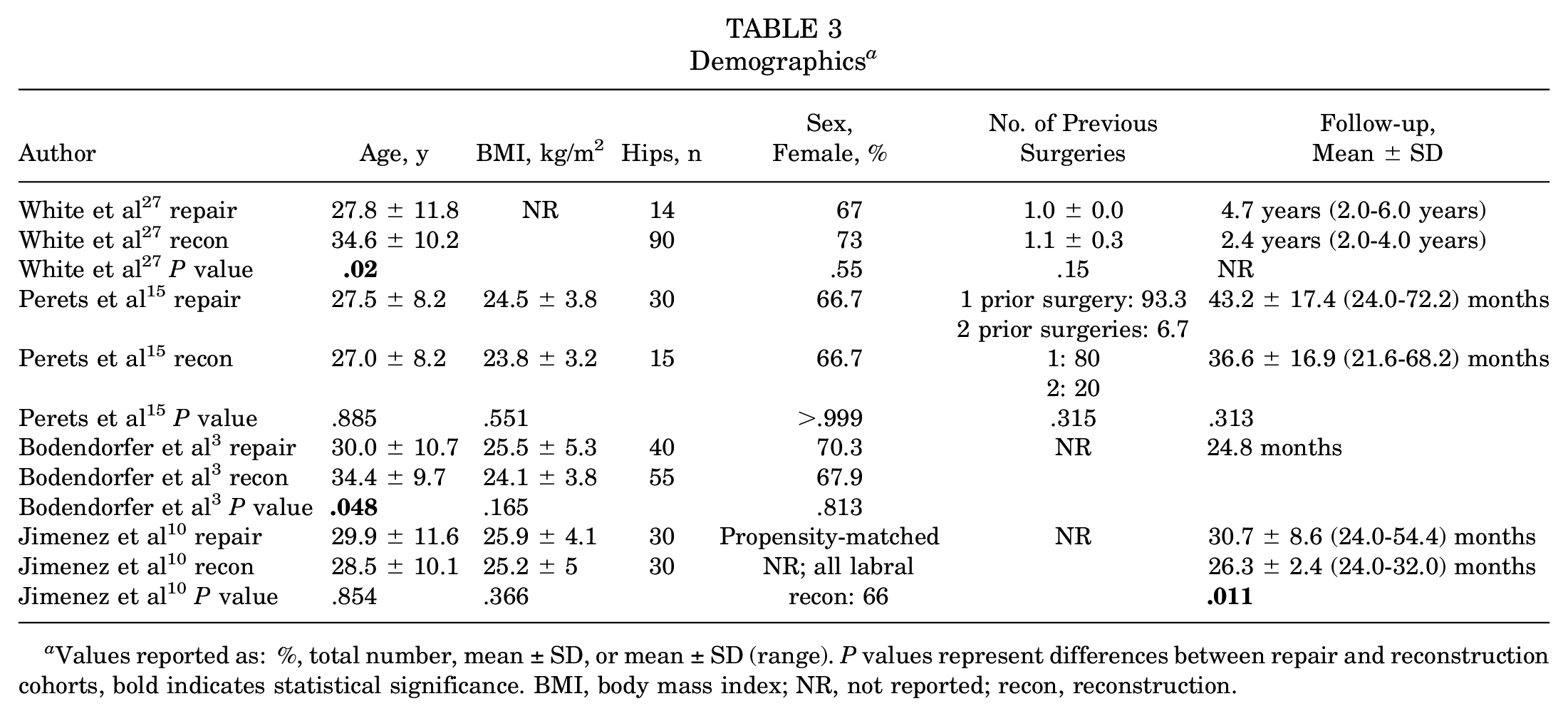
Values reported as: %, total number, mean ± SD, or mean ± SD (range). P values represent differences between repair and reconstruction cohorts, bold indicates statistical significance. BMI, body mass index; NR, not reported; recon, reconstruction.
Radiographic and intraoperative findings, such as mean lateral center-edge angle and Tönnis Grade scores, are recorded in Table 4. Surgical indications, concomitant procedures, and reconstruction details are recorded in Table 5. Irreparable labra,3,10,27 calcified labra,3,10,15 and nonviable tissue10,15 were some of the most common surgical indications for reconstruction. Three studies included both circumferential labral reconstruction and segmental labral reconstruction3,10,15 and 1 study only included circumferential labral reconstruction. 27 Three studies10,15,27 specified graft types, which included iliotibial band allograft, 27 gracilis tendon autograft, 15 and semitendinosus allograft. 15
Preoperative Radiographic and Intraoperative Findings a
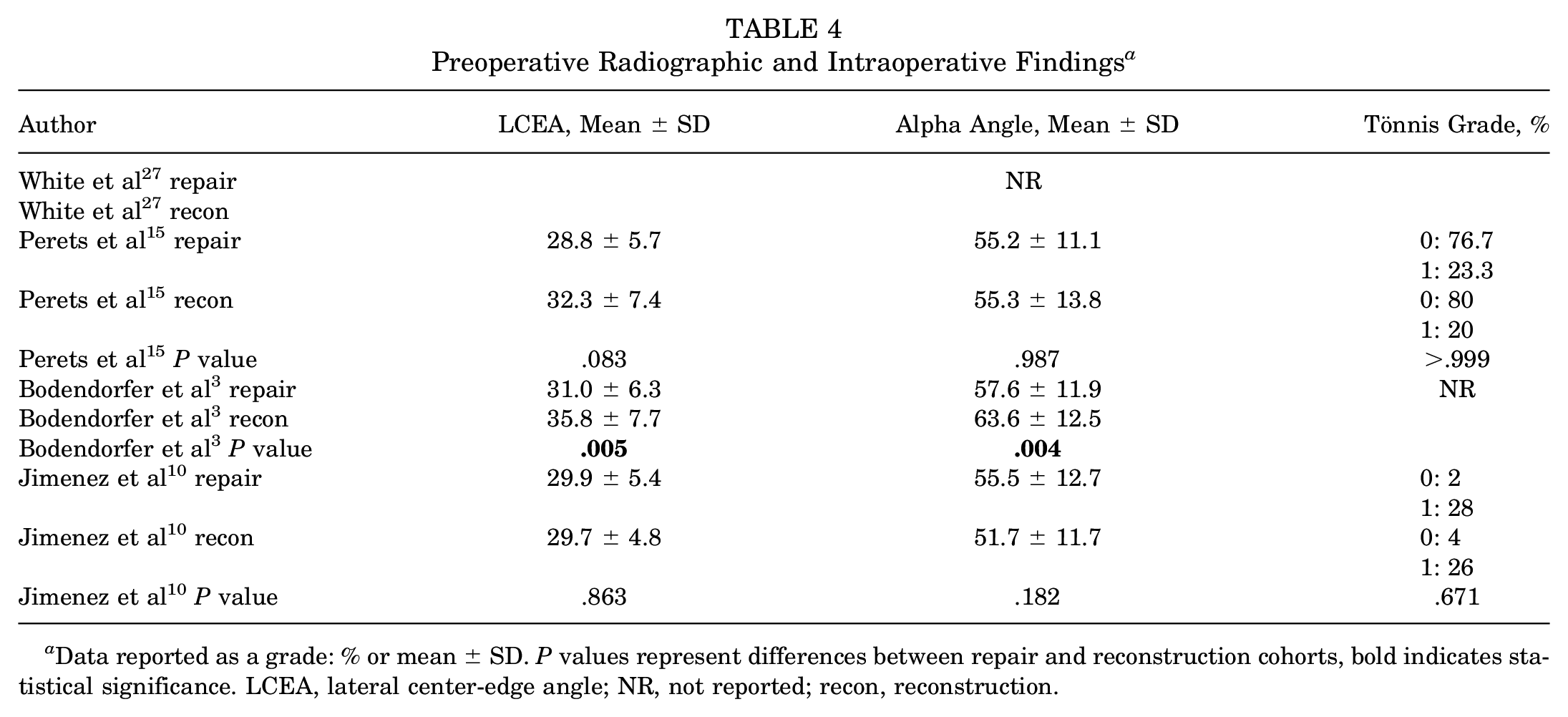
Data reported as a grade: % or mean ± SD. P values represent differences between repair and reconstruction cohorts, bold indicates statistical significance. LCEA, lateral center-edge angle; NR, not reported; recon, reconstruction.
Indications, Concomitant Procedures, and Reconstruction Type a

Values are reported as (%). P values represent differences between repair and reconstruction cohorts, bold indicates statistical significance. CLR, circumferential labral reconstruction; FAI, femoroacetabular impingement; GT, gracilis tendon; HO, heterotopic ossification; ITB, iliotibial band; LT, ligamentum teres; MRI, magnetic resonance imaging; NR, not reported; PT, posterior tibialis; Recon, reconstruction; SLR, segmental labral reconstruction; ST, semitendinosus.
Patient-Reported Outcome Measures
All 4 studies recorded PROMs. The modified Harris Hip Score (mHHS) and visual analog scale (VAS) for pain were recorded in all studies,3,10,15,27 the Hip Outcome Score–Sport-Specific Subscale (HOS-SSS) was recorded in 3 studies,3,10,15 the Nonarthritic Hip Score (NAHS) in 2 studies,10,15 and the Hip Outcome Score–Activities of Daily Living was recorded in 1 study. 3 Two studies10,15 reported statistical significance between preoperative and postoperative PROMs, and both studies found significant increases in mHHS, NAHS, VAS, and HOS-SSS for both the repair and the reconstruction cohorts. All 4 studies reported there were no statistically significant intergroup differences in PROM improvement between the repair and reconstruction groups. Pre- and postoperative PROMs, as well as improvement in scores, are recorded in Table 6. Mean preoperative mHHS totals for the repair and reconstruction cohorts ranged from 54.8 3 to 59.3 15 and 49.3 27 to 58.9, 3 respectively, while postoperative mHHS for repair and reconstruction were 70.8 3 to 84.115,27 and 72.0 15 to 81.2 27 respectively (I2 = 0%). Mean postoperative VAS for pain scores for the reconstruction and repair cohorts ranged from 3.0 27 to 3.5 15 and 2.3 27 to 3.9 3 , respectively (I2 = 33%).
Preoperative and Latest Follow-up Patient-Reported Outcome Measures a
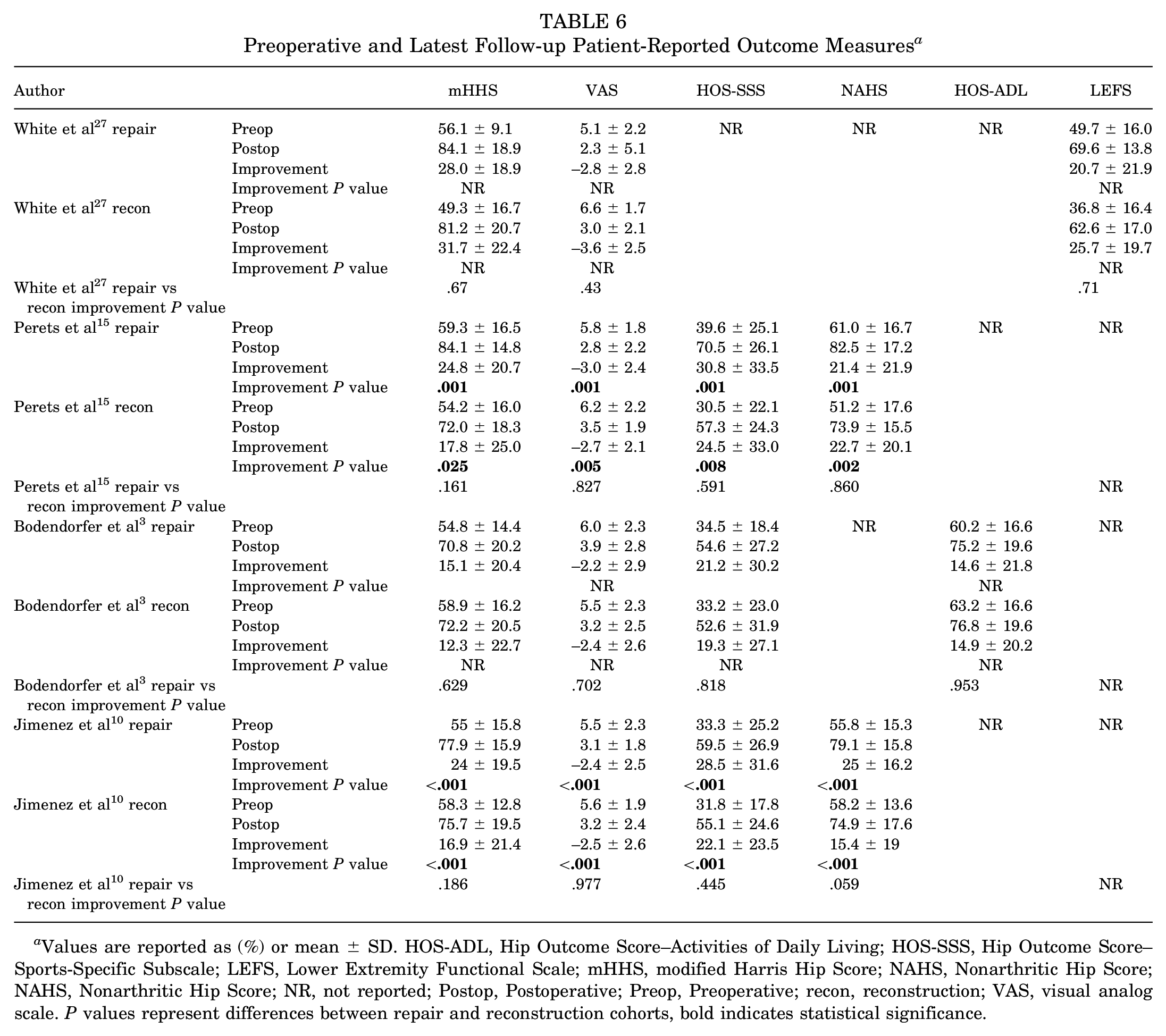
Values are reported as (%) or mean ± SD. HOS-ADL, Hip Outcome Score–Activities of Daily Living; HOS-SSS, Hip Outcome Score–Sports-Specific Subscale; LEFS, Lower Extremity Functional Scale; mHHS, modified Harris Hip Score; NAHS, Nonarthritic Hip Score; NAHS, Nonarthritic Hip Score; NR, not reported; Postop, Postoperative; Preop, Preoperative; recon, reconstruction; VAS, visual analog scale. P values represent differences between repair and reconstruction cohorts, bold indicates statistical significance.
Clinical benefit was recorded using minimal clinically important differences (MCIDs) in 3 studies,3,10,15 and Patient Acceptable Symptom State achievement rates were reported in 2 studies.3,15 In both the repair10,15 and the reconstruction3,10 groups, 2 out of 3 studies reported >70% of patients reaching the MCID threshold in ≥1 PROM.10,15 No study found statistically significant differences in MCID or Patient Acceptable Symptom State achievement rates between the repair and reconstruction groups. Clinical benefit achievement rates are reported in Table 7.
Achievement Rates of Clinical Benefit a

Values are reported as percentages. HOS-ADL, Hip Outcome Score–Activities of Daily Living; HOS-SSS, Hip Outcome Score–Sports-Specific Subscale; MCID, minimal clinically important difference; mHHS, modified Harris Hip Score; NAHS, Nonarthritic Hip Score; NR, not reported; PASS, Patient Acceptable Symptom State; recon, reconstruction; VAS, visual analog scale.
Figures 2 and 3 display forest plots and I2 statistics of mHHS and VAS for pain. I2 was 0% for mHHS and 33% for VAS for pain.

Forest plot of postoperative modified Harris Hip Score. IV, inverse variance; Std., standardized.

Forest plot of postoperative visual analog scale for pain. IV, inverse variance; Std., standardized.
Revision Hip Arthroscopy and Survivorship Rates
All 4 studies reported data regarding secondary surgeries to the initial revision surgery. Two studies10,15 reported rates of secondary hip arthroscopy, which ranged between 6.7% 15 and 13.3% 10 in the repair group and 6.7% 10 and 20% 15 in the reconstruction group. Perets et al 15 reported a mean time to secondary hip arthroscopy, which was 11.5 months for repair and 16.5 months for reconstruction. Rates of survivorship from conversion to THA were reported in 3 studies3,10,15 and ranged between 0% 3 and 3.3%10,15 in the repair cohort and 0% 3 and 6.7% 15 in the reconstruction cohort. Overall secondary surgery rates were reported in 3 studies10,15,27 and ranged between 10% 15 and 50% 27 in the labral repair group and 10% 10 and 26.7% 15 in the reconstruction group. White et al 27 reported time to secondary surgery, which was 17.0 and 23.6 months for the repair and reconstruction groups, respectively. Secondary surgery data are summarized in Table 8.
Summary of Survivorship Rates a

Values are reported as mean (range), mean ± SD (range), n, or n (percentage) NA, not applicable; NR, not reported; recon, reconstruction; THA, total hip arthroplasty. P values represent differences between repair and reconstruction cohorts, bold indicates statistical significance.
Discussion
The main finding of this review was that both labral repair and labral reconstruction groups experienced significant improvements in PROMs after undergoing revision hip arthroscopy after primary hip arthroscopy for labral tear. While labral reconstruction was performed in cases of more degenerative or complex labral pathology, no studies found significant differences in postoperative PROMs between these 2 groups. Rates of secondary surgery after revision surgery and rates of achieving psychometric threshold were also similar between revision labral reconstruction and revision labral repair.
Revision hip arthroscopy is challenging, often complicated by adhesions, deteriorated tissue, and altered anatomy.17,19,21 Similarly, prior literature has documented that patients who underwent revision arthroscopy reported equal or worse PROMs compared with those who underwent primary hip arthroscopy. 24 In the current review, mean postoperative mHHS scores ranged from 70.8 3 and 84.115,27 for the repair group and 72.0 15 and 81.2 27 for the reconstruction group. In comparison, Maldonado et al 11 found mean postoperative mHHS scores ranging from 84.1 to 93.0 for the repair group and 72.0 to 95.0 in the reconstruction group in a systematic review comparing labral repair and reconstruction in both the primary and the revision settings. Although the prognosis for patients undergoing revision hip arthroscopy is often less favorable compared with those undergoing primary hip arthroscopy, it is essential to note that patients still experience significant improvements in outcome. This study concurs with previous studies demonstrating that both labral repair and labral reconstruction improve patient satisfaction, restore function, and alleviate pain.
Generally, the reoperation rate in revision hip arthroscopy has been shown to be greater compared with primary procedures. A systematic review by Harris et al 8 of 6134 patients after hip arthroscopy found a reoperation rate of 6.3% and conversion to THA rate of 2.9%. Revision procedures are inherently more complex due to scar tissue formation, calcification, and the presence of prior surgical implants.17,19 In addition, patients with previous hip surgeries may have more significant labral tissue degeneration and/or cartilage injury compared with the primary setting. 21 In this review, secondary surgery rate ranged from 10% 15 to 50% 27 in the repair group and 10% 10 to 26.7% 15 in the reconstruction cohort. Within this, revision arthroscopy rates ranged from 6.7% 15 to 13.3% 10 in the repair group and 6.7% 10 to 20% 15 in the reconstruction group, although it was only reported in 2 studies. THA conversion rates ranged from 0% 3 to 3.3%10,15 in labral repair group at a mean follow-up 30.7 to 56.4 months and 0% 3 to 6.7% 15 in labral reconstruction group at a mean follow-up 26.3 to 36.6 months.
A source of heterogeneity in the labral reconstruction cohorts included in this study is graft type (autograft vs allograft), and donor tissue (ie, tensor fascia lata vs tibialis anterior). Graft selection for labral reconstruction is multifactorial and dependent on surgeon preference, patient-specific characteristics, graft availability, and cost. 20 While autografts reduce costs inherent with allograft sourcing, they introduce significant donor-site morbidity and may prolong surgical time to allow for harvest and preparation. On the other hand, using an allograft eliminates the risk of donor-site morbidity and may reduce surgical time. 7 Common allograft choices include the tensor fascia lata, tibialis anterior, and tibialis posterior.8,20 Rahl et al 18 found no difference in survivorship or PROs between patients who received labral reconstruction with an autograft or allograft. On the other hand, a more recent cohort study of 205 hips with minimum 2-year follow-up found that labral augmentation or reconstruction with autografts had a significantly lower revision rate than with allografts but no difference in conversion to THA. 6 In the patients evaluated in the included studies, iliotibial band allograft, gracilis tendon autograft, semitendinosus allograft, and posterior tibialis tendon allograft were most frequently used for reconstruction, but the data were insufficient to compare outcomes by graft type. Further research is warranted to better define the optimal graft source, preparation, reconstruction technique, and indication.
Finally, the studies included in this review varied widely in terms of their indications for labral reconstruction. White et al 27 initially had criteria of labral tissue >8 mm or <2 to 3 mm or irreparable labral tear for their study but then moved to performing reconstructions for all revision labral treatment. All studies used subjective terms such as “irreparable labrum/labral tear,”10,27 “nonviable tissue,”10,15 or “complex/extensive tearing” 3 as an indication for reconstruction. However, these terms lack standardized, objective definitions and instead rely on subjective intraoperative assessments that vary between surgeons. This lack of clarity highlights the need for reproducible criteria to guide the decision making of when labral reconstruction is indicated.
Limitations
One limitation of this study was that the indications for labral repair and reconstruction are different, so PROMs should be interpreted in the context that patients with labral reconstruction may be able to achieve similar PROMs despite worse labral conditions, not that one procedure is inherently better or worse. Another limitation of this study was that all studies were level 3 evidence, preventing us from pooling data to garner meaningful conclusions from standardized mean differences. Also, the total number of included studies was small, so there was a greater chance of type 2 error. Furthermore, the study periods varied among studies, which may have confounded results, as techniques for labral treatment have significantly improved over time. The final limitation to this study was that 2 of the studies were performed at the same institution, so there may have been an overlap in patients. The included studies were performed at centers and with surgeons with a distinct level of expertise in hip arthroscopy, which limits generalizability to surgeons who do not routinely perform hip arthroscopy. However, this issue was addressed by only including 1 of the studies in the standardized mean difference calculations. More studies are needed, especially prospective randomized trials, to fully understand the outcomes of revision labral repair and reconstruction.
Conclusion
Our systematic review showed that patients undergoing revision hip arthroscopy with labral reconstruction demonstrated significant improvement in postoperative outcome measures. Postoperative outcomes were similar to those of a benchmark control group of patients undergoing revision hip arthroscopy and labral repair. Labral reconstruction in the revision setting appears to be an effective treatment in clinically indicated patients.
Footnotes
Final revision submitted January 29, 2024; accepted March 4, 2024.
One or more of the authors has declared the following potential conflict of interest or source of funding: A.E.J. has received grants from Arthrex and Gotham Surgical Solutions & Devices; education payments from Arthrex, Polaris Technology Solutions, and Medwest Associates; and hospitality payments from Abbott Laboratories. AOSSM checks author disclosures against the Open Payments Database (OPD). AOSSM has not conducted an independent investigation on the OPD and disclaims any liability or responsibility relating thereto.
