




Abstract
Background:
It has been argued that the use of artificial turf football fields in the National Football League (NFL) increases player injury risk compared with natural grass surfaces.
Purpose/Hypothesis:
The purpose of this study was to quantify the rate of lower extremity injuries occurring in NFL players on artificial turf compared with natural grass surfaces and characterize the time missed due to injury and proportion of injuries requiring surgery. It was hypothesized that lower extremity injuries requiring surgical intervention would occur at a higher rate on artificial turf than on natural grass.
Study Design:
Descriptive epidemiology study.
Methods:
Lower extremity injury data for the 2021 and 2022 NFL seasons were obtained using publicly available records. Data collected included injury type, player position, player age, playing surface, weeks missed due to injury, and whether the patient underwent season-ending or minor surgery. Multivariable logistic regression was performed to determine the risk of season-ending surgery according to playing surface.
Results:
When combining injuries for the 2021 and 2022 seasons (N = 718 injuries), the incidence rate of lower extremity injury was 1.22 injuries/game for natural grass and 1.42 injuries/game for artificial turf. The odds of a season-ending surgery were found to be significantly higher on artificial turf compared with natural grass (odds ratio = 1.60; 95% CI, 1.28-1.99; P < .05), while additional variables, including weather, age, position, week of injury occurrence, and history of prior injury, did not influence the odds of season-ending surgery.
Conclusion:
The 2021 and 2022 NFL seasons of our analysis demonstrated a higher incidence rate of injuries on artificial turf surfaces compared with natural grass surfaces. In addition, the odds of injury requiring season-ending surgery were found to be significantly higher on artificial turf compared with natural grass.
As the emphasis on player safety in the National Football League (NFL) has increased in recent years, numerous risk factors for injury have been closely scrutinized for their roles in placing players at increased risk. One such factor, the use of artificial turf as a playing surface, has become a controversial topic, with many current and former players stating that football fields that use artificial turf place players at higher risk for injury, while alternative sources have suggested there is no significant injury rate between artificial and natural grass surfaces.12-14,21,23,24
Artificial playing fields have been utilized in the NFL for the past 5 decades, with the first installed in the Houston Astrodome in 1966. 19 Overtime, these artificial fields have transformed from carpet-like asphalt bases to the current use of permeable elastomeric layers of recycled rubber, polyurethane, and mineral aggregate. 23 Recently, designers of these fields have transitioned into using infill surfaces, a mat consisting of long polyethylene fibers with spaces between the fibers that are filled with rubber particles or sand. 4 By the start of the 2005 NFL season, all NFL stadiums with artificial playing fields had installed infill surfaces in place of the older generation artificial surfaces. 4
With the popularity of artificial turf football fields, there has been discordance regarding player safety, especially at the professional level. Previous studies that have assessed injuries on collegiate and professional playing fields have found statistically significantly higher rates of injuries on artificial surfaces in comparison with those on natural grass.4,18,21,23 Among these studies, there was variability in the consistency of study design and statistical significance, prompting future studies to assess the rate of injuries on artificial turf playing surfaces.7,15
The purpose of this study was to quantify the rate of lower extremity injuries occurring in NFL players on artificial turf compared with natural grass surfaces and characterize the time missed due to injury and proportion of injuries requiring surgery. We hypothesized that lower extremity injuries requiring surgical intervention would occur at a higher rate on artificial turf than on natural grass.
Methods
Lower extremity injury data for the 2021 and 2022 NFL seasons were obtained using publicly available records from the internet (www.ESPN.com, www.NFL.com).16,17 The databases on ESPN provided in-game injury information regarding NFL players from the season. As we were unable to obtain information regarding injuries in practice, we focused on in-game injuries that were reported on the ESPN game summaries. All reported lower extremity injuries during the regular and playoff seasons were analyzed. Upper extremity, head, and back injuries were excluded. Preseason data were also excluded due to the unavailability of injuries reported on the ESPN game summaries. Data collected included injury type, player position and age, playing surface, weeks missed due to injury, and whether the patient underwent minor surgery or major (season-ending) surgery.
Statistical analysis was performed using R Software (Rlabs). Descriptive statistics, including percentages and counts for categorical and ordinal data and means with interquartile ranges for continuous data, were used to summarize data. The injury incidence was calculated for the 2021 and 2022 seasons by calculating the ratio of the number of injuries that occurred on grass and artificial turf and the number of games played on the respective surfaces. Additionally, injuries were stratified into 4 categories according to the number of games missed: 0, 1-2, 3-6, or >6. Multivariable logistic regression was performed to determine the influence of playing surface on the risk of major surgery. P < .05 was considered statistically significant.
Results
A total of 718 lower extremity injuries were included in the analysis, 327 injuries (45.54%) in 2021 and 391 injuries (54.46%) in 2022. A demographic summary of these injuries by position, age, field, and history of previous injury is displayed in Table 1. Within the NFL as of the end of the 2022 season, there were 16 stadiums surfaced with natural grass and 13 stadiums with artificial turf (Table 2).
Summary of Lower Extremity Injury Data Collected (N = 718 Injuries) a

Data are reported as No. of injuries unless otherwise indicated.
Players without designated positions on team (special teams, practice squad etc.).
Summary of Stadiums in the NFL According to Field Surface a
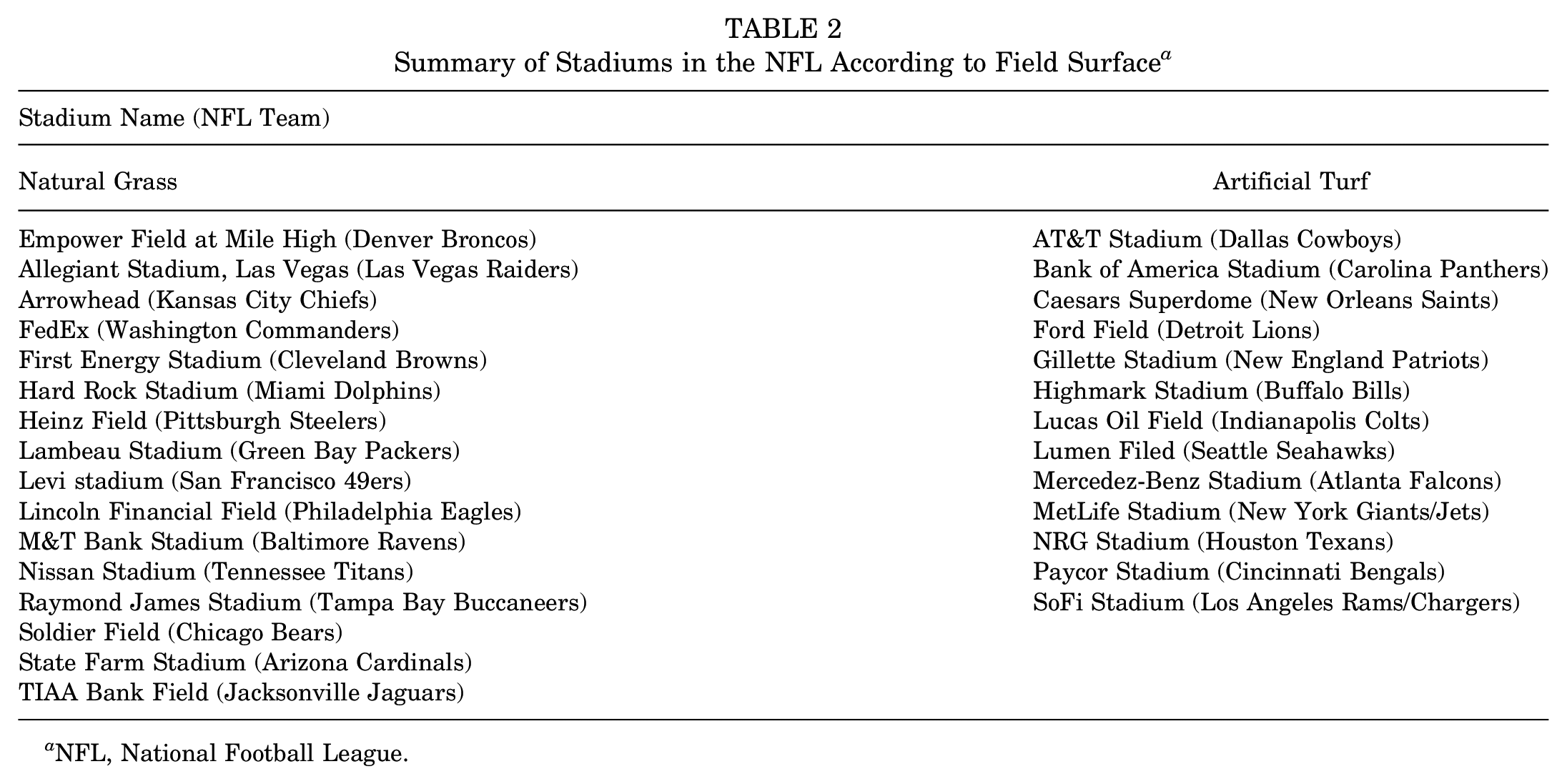
NFL, National Football League.
To account for injury severity, we documented the subsequent weeks of gameplay missed after an injury. The incidence of these injuries by severity is shown in Table 3 and Figure 1. The overall incidence rate of lower extremity injuries for the combined 2021 and 2022 seasons was 1.22 injuries/game for natural grass and 1.42 injuries/game for artificial turf.
Injuries Within the 2021 and 2022 NFL Seasons Stratified by Amount of Time Missed a

Data are reported as No. NFL, National Football League.
Data reported as number of surgeries on natural grass vs artificial turf, and their corresponding incidence rates.

Injuries on artificial turf versus natural grass during the 2021 and 2022 National Football League seasons.
In total, there were 50 players injured on natural grass who required lower extremity surgery and 83 players injured on artificial turf who required lower extremity surgeries. The most common surgeries after a lower extremity on grass were anterior cruciate ligament (ACL) reconstruction (n = 17), Achilles repair (n = 9), and ankle or syndesmosis open reduction and internal fixation (n = 7). The most common surgeries after a lower extremity on artificial turf were ACL reconstruction (n = 30), Achilles repair (n = 12), and patellar open reduction and internal fixation or patellar tendon repair (n = 8) (Table 4).
Summary of Lower Extremities Surgeries Performed in the 2021 and 2022 NFL Seasons a

Data are reported as No. Dashes indicate data not reported. ACL, anterior cruciate ligament; MCL, medial collateral ligament; ORIF, open reduction and internal fixation.
Bivariate modeling showed that the history of previous injury as well as field type influenced the risk of surgery. In the multivariate model, the odds of season-ending surgery were significantly higher on artificial turf compared with grass (odds ratio = 1.60; 95% CI, 1.28-1.99; P < .05). Weather, age, position, week, and history of previous injury were not significant influences on the odds of season-ending surgery.
Discussion
The study findings indicated that NFL players were at a higher incidence of developing lower extremity injuries on artificial turf compared with natural grass. On top of this, the odds of a more serious injury requiring season-ending surgery were found to be significantly higher on artificial turf compared with natural grass. The findings from our study contribute to the ongoing discussion of injury differences while playing on artificial turf surfaces versus natural grass, with the hope of prioritizing player safety.
Despite significant advancements in equipment, a growing emphasis on player safety, and the progress made in treatments, the persisting rate of injuries in the NFL has sparked ongoing debates regarding the safety of playing on artificial turf fields. Previous studies have demonstrated an increase in injury risk in artificial turf versus natural grass surfaces.12-14,21,23,24 However, there has been no recent assessment of the differences. The purpose of this study was to compare the injury rates in the NFL for artificial turf and natural grass over the 2 seasons of 2021 and 2022.
Players in the NFL and the NFL Players Association have voiced concerns regarding the safety of artificial turf fields.2-20 However, there has been substantial pushback from several NFL owners and the league itself. Concerns from players throughout the professional league have warranted studies on the differences in injury rates between artificial turf and natural grass playing fields. Our results are similar to a previous study, as we found that artificial turf is a serious risk factor for increasing lower extremity injury. 9 Moreover, a study that looked at injury rates from 2000 to 2009 in the NFL similarly found a 22% increase in both knee and ankle injuries on FieldTurf in comparison with natural grass. 4 Our findings align closely with the results of both studies, revealing a notable trend: over the past 3 years, there has been a substantial surge (20%) in lower extremity injuries on FieldTurf in comparison with those sustained on natural grass. 3 It is thought that the increasingly integrated use of analytics and higher reporting of in-game injuries has led to this increase, despite advancements in player equipment. 9
Additionally, a recent systematic review analyzed 53 articles across football, soccer, and other sports. Of the included articles, 32 compared injury rates on artificial turf and natural grass, and >37.5% (since over 12) reported a higher overall injury rate on artificial turf. Of the 32 articles, 3 (9.4%) reported a higher overall injury rate on natural grass. 3 However, it was interesting to note that all 3 of those studies utilized ad hoc cohort selection and were supported by funding from the artificial turf industry.10-12 Our findings corroborate previous studies and underscore the importance of addressing injury risks on artificial turf fields.
While these injuries are severely affecting players in the NFL, the injuries associated with playing on artificial turf fields extend to the collegiate and high school levels, further emphasizing the increased injury risk. In a separate study, 2460 knee injuries sustained over the course of 10 National Collegiate Athletic Association (NCAA) seasons were examined by Loughran et al. 8 They came to the conclusion that using artificial turf increases the chance of sustaining certain knee ligament ailments. According to their research, posterior cruciate ligament tears were substantially more common during competitions played on artificial turf than on natural grass. During competitions on artificial turf as opposed to natural grass, lower NCAA divisions (II and III) were found to have greater rates of ACL injuries. 8
Interestingly, in our data analysis, we found a significantly higher number of extensor mechanism injuries and a very high number of ACL injuries in artificial turf fields versus natural grass fields.
There are several technical and clinical indications that can be drawn from our findings. First, it is important to continually evolve synthetic turf to maintain its desirable traits but also emphasize player safety. Its increased use in recent years warrants further evaluation to protect players from season-ending injuries that could significantly alter their future. The altering of the future can start at a young age, as studies have found that high school athletes are 58% more likely to sustain injuries on artificial turf than on natural grass. 22 Not only does this negatively affect their future health but it also affects their ability to go into professional sports in the future.
The capacity of natural grass and artificial turf to develop divots and release the cleat at loading magnitudes and rates generated during elite sports competition has been demonstrated by biomechanical testing of various football cleats on a range of athletic surfaces.5,6 Artificial turf is known to have less absorption of force for the player’s knee and ankle, which increases the risk of injury.5,6,9 The lesser ability of artificial turf to release a cleat puts more strain on a player’s extremities through greater force and increased torque.5,6,9 On the other hand, natural grass has been shown to often release the cleat before reaching an injurious load.1,5,6,9 As a result, it is crucial that its design takes into account the type of surface that will be utilized with it as well as the precise mechanics of how its cleat pattern will interface with synthetic surfaces.
Limitations
Our study has several limitations. Due to the use of public records to collect data in this study, it is possible that the method of data collection did not capture all sustained injuries, providing an underestimate of the incidence of lower extremity injuries. We understand this may limit the validity of our results; however, we still believe this method captures the general trend in injuries between the 2 fields. Moreover, while we tried to control for confounding factors such as weather, age, and history of a prior injury, we are unable to account for personal factors such as player preference or league-specific factors that may influence the decision to proceed with surgery. To the best of our knowledge, this is the first study that has evaluated NFL injury differences in the past 3 years. We hope this information provides players, coaches, and teams with pertinent information to promote player safety.
Conclusion
Our study showed that NFL athletes were more likely to get injured on artificial surfaces and that artificial turf dramatically increased the likelihood of sustaining a serious injury requiring surgery. These findings support prior research highlighting the necessity of putting player safety first and reducing danger on pitches with artificial turf. For players, coaches, and teams to make decisions about playing surfaces, the study offers useful information regarding playing safety.
Footnotes
Final revision submitted November 18, 2023; accepted February 12, 2024.
One or more of the authors has declared the following potential conflict of interest or source of funding: N.K.P. has received education payments from Evolution Surgical. B.T.F. has received education payments from Evolution Surgical. AOSSM checks author disclosures against the Open Payments Database (OPD). AOSSM has not conducted an independent investigation on the OPD and disclaims any liability or responsibility relating thereto.
Ethical approval was not sought for the present study.
References
Supplementary Material
Please find the following supplemental material available below.
For Open Access articles published under a Creative Commons License, all supplemental material carries the same license as the article it is associated with.
For non-Open Access articles published, all supplemental material carries a non-exclusive license, and permission requests for re-use of supplemental material or any part of supplemental material shall be sent directly to the copyright owner as specified in the copyright notice associated with the article.
