




Abstract
Background:
The consumer availability and automated response functions of chat generator pretrained transformer (ChatGPT-4), a large language model, poise this application to be utilized for patient health queries and may have a role in serving as an adjunct to minimize administrative and clinical burden.
Purpose:
To evaluate the ability of ChatGPT-4 to respond to patient inquiries concerning ulnar collateral ligament (UCL) injuries and compare these results with the performance of Google.
Study Design:
Cross-sectional study.
Methods:
Google Web Search was used as a benchmark, as it is the most widely used search engine worldwide and the only search engine that generates frequently asked questions (FAQs) when prompted with a query, allowing comparisons through a systematic approach. The query “ulnar collateral ligament reconstruction” was entered into Google, and the top 10 FAQs, answers, and their sources were recorded. ChatGPT-4 was prompted to perform a Google search of FAQs with the same query and to record the sources of answers for comparison. This process was again replicated to obtain 10 new questions requiring numeric instead of open-ended responses. Finally, responses were graded independently for clinical accuracy (grade 0 = inaccurate, grade 1 = somewhat accurate, grade 2 = accurate) by 2 fellowship-trained sports medicine surgeons (D.W.A, J.S.D.) blinded to the search engine and answer source.
Results:
ChatGPT-4 used a greater proportion of academic sources than Google to provide answers to the top 10 FAQs, although this was not statistically significant (90% vs 50%; P = .14). In terms of question overlap, 40% of the most common questions on Google and ChatGPT-4 were the same. When comparing FAQs with numeric responses, 20% of answers were completely overlapping, 30% demonstrated partial overlap, and the remaining 50% did not demonstrate any overlap. All sources used by ChatGPT-4 to answer these FAQs were academic, while only 20% of sources used by Google were academic (P = .0007). The remaining Google sources included social media (40%), medical practices (20%), single-surgeon websites (10%), and commercial websites (10%). The mean (± standard deviation) accuracy for answers given by ChatGPT-4 was significantly greater compared with Google for the top 10 FAQs (1.9 ± 0.2 vs 1.2 ± 0.6; P = .001) and top 10 questions with numeric answers (1.8 ± 0.4 vs 1 ± 0.8; P = .013).
Conclusion:
ChatGPT-4 is capable of providing responses with clinically relevant content concerning UCL injuries and reconstruction. ChatGPT-4 utilized a greater proportion of academic websites to provide responses to FAQs representative of patient inquiries compared with Google Web Search and provided significantly more accurate answers. Moving forward, ChatGPT has the potential to be used as a clinical adjunct when answering queries about UCL injuries and reconstruction, but further validation is warranted before integrated or autonomous use in clinical settings.
It is estimated that 70% to 90% of Americans search for health information online, with the vast majority of patients doing so before seeing a physician. 7 Data suggest that patients directly act on this information, and inaccurate or misleading information may lead to patient harm.22,23 Therefore, it is critical as a medical community to understand what patients are seeing online, both to be informed when patients present to the office and to ensure quality control and initiate efforts to improve online information when needed. 32 As a result, considerable attention has been devoted to understanding what forums patients use to obtain health-related information and the quality of information provided by these resources.
Recently, there has been a dramatic advancement in the consumer availability of generative artificial intelligence (AI) large language models (LLMs) capable of responding to language commands and returning information based on pattern recognition and reinforcement learning. 15 In particular, these models have been popularized as open-source chatbots, such as chat generator pretrained transformer (GPT), with research suggesting ChatGPT (Open AI) is the fastest-growing consumer application in history. 10 The unsupervised and automated functions of ChatGPT are poised to provide information concerning a diverse range of subject matter, including health information. Recent studies have evaluated ChatGPT's performance on the United States Medical Licensing Examination, 9 compared its ability to post answers to an online health forum to human physicians, 1 and discussed its implications with respect to academic integrity.16,19,26 More recently, several investigations have tested the ability of ChatGPT to triage and answer questions about various medical conditions.8,28 However, there is a paucity of data on musculoskeletal conditions to date, which represents a substantial proportion of the health care burden nationally and globally.2,24,31 Therefore, understanding its capabilities in this domain is clinically relevant.
Given the potential impact that an automated chatbot could confer on reducing administrative and clinical burden should it prove valid and accurate, the aim of the present study was to evaluate the ability of ChatGPT-4 to respond to patient inquiries concerning ulnar collateral ligament (UCL) injuries and compare these results with the performance of Google. We hypothesized that there would be no significant differences in the ability to compile answers to patients’ frequently asked questions (FAQs) or in the accuracy of answers compared with Google.
Methods
Search Engines and Rationale
This study did not examine human subjects; thus, it was exempt from institutional review board approval. This study evaluated the performance of ChatGPT-4 to deliver online health information with respect to simulated patient queries pertaining to both qualitative and quantitative information relating to UCL injuries. ChatGPT-4 is an AI-derived LLM that generates realistic human responses through a chatbot function. It is trained through supervised and reinforcement learning to optimize the accuracy, breadth, and relevance of responses to text prompts utilizing billions of modeling parameters and primarily information obtained from contemporary internet resources. 15
UCL injuries were chosen as the ideal test case to understand how ChatGPT-4 may respond to patient queries and serve as a clinical adjunct for several reasons. First, rehabilitation protocols are graded, variable, and specific and require prolonged recovery periods in some cases.14,17 Therefore, accurate information and expeditious treatment can be of great importance. Second, these injuries may be treated conservatively or operatively depending on several injury-related and patient-related factors.3,6 Therefore, information pertaining to this decision may be highly searched. Similarly, there are multiple operative treatment options (ie, reconstruction versus repair), and 1 particular surgery is not necessarily appropriate for all patients (ie, in contrast to total joint arthroplasty for osteoarthritis). Finally, these injuries typically impact a young population familiar with new technologies who, therefore, may be early adopters of ChatGPT.
Google was chosen as the control case, as it is the most widely used search engine worldwide and the only search engine that generates FAQs when prompted with a query. 29 FAQs were specifically selected for investigation for the following reasons: (1) these are the questions that are the most commonly asked and, hence, of greatest interest to patients; (2) their use allows for objective assessment without bias from the authors in question generation; and (3) their use provides a systematic and reproducible method of question generation to compare between Google and ChatGPT-4.
Patient-replicated Query
A freshly installed browser was employed to minimize potential bias from previous search history, cookies, or cache. The first analysis was performed to identify the top FAQs on UCL injuries and reconstruction on Google and compare the relevance of the top questions as purported by ChatGPT-4 using Google as the historical gold standard. On May 5, 2023, Google Web Search was first searched for the query “ulnar collateral ligament reconstruction.” The top 10 FAQs, answers, and their sources were recorded. FAQs were excluded if they were not relevant to UCL injuries of the elbow or if they represented a duplicate question. ChatGPT-4 was then queried as the experimental arm with the command “Perform a Google Search with the search term ‘ulnar collateral ligament reconstruction’ and record the most popular questions related to this search term,” in accordance with previously validated methods. 5 These additional 10 questions, answers, and their associated sources were also recorded for comparison. Concordance between the most commonly asked questions, as purported by Google and ChatGPT-4, was assessed. Question subjects—including cost, evaluation of surgery, indications and management, longevity, risks and complications, specific activities, technical details, and timeline of recovery using a modification of the Rothwell criteria, in accordance with previous methods 13 —were then assessed. Finally, we evaluated answers for the sources from which they were derived (ie, academic, commercial, group medical practice, single-surgeon practice, and social media) (Table 1).
Modified Rothwell Criteria for Classification of Online Sources 13
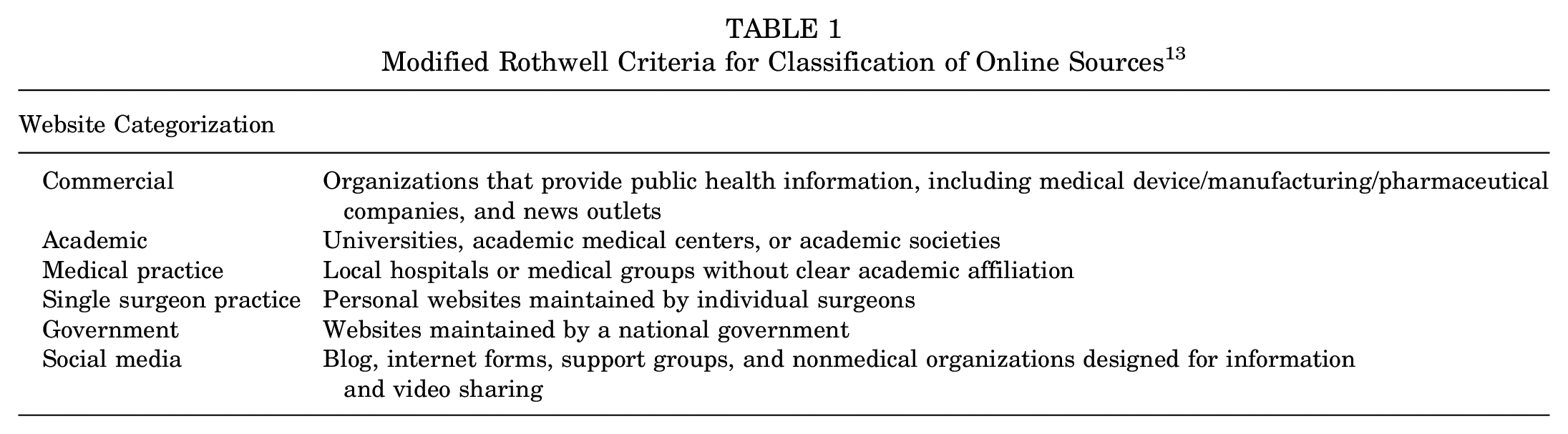
A second independent search, after clearing all browsing history and memory, was then performed for 10 additional FAQs with answers necessitating a discrete, numeric value. By limiting the analysis to the most common questions with discrete answers, an objective comparison between search engines could be performed. For the numerical questions, answers were compared between Google and ChatGPT-4 for concordance, with answers rated as complete overlap, partial overlap (ie, if ranges provided), or completely discordant (or no overlap). All categorization was performed by the same 2 independent authors (A.Z.L., M.M.), with a third author called upon in the event of a discrepancy (K.N.K.).
Expert Comparison for Ground Truth Accuracy
Answers were assessed for accuracy based on the clinical judgment of 2 fellowship-trained sports medicine surgeons who have been in practice for >15 years and specialize in shoulder and elbow injuries (D.W.A., J.S.D.). Furthermore, these 2 surgeons assessed the accuracy and the clinical relevance of the top 10 general FAQs (Supplemental Table S1). Both graders were blinded to whether the answer was from Google or ChatGPT-4 and the source of information used to answer the question. The accuracy of each answer was rated on a 3-point response scale as inaccurate (0 points), somewhat accurate (1 point), or accurate (2 points). The clinical relevance of the top 10 FAQs was also graded on a 3-point scale as little to no clinical relevance (0 points), some clinical relevance (1 point), or very clinically relevant (2 points).
Statistical Analysis
Descripted statistics were computed and presented as frequencies with percentages. Comparisons of categorical data were made with chi-square test or Fisher exact test, as appropriate. Comparisons of continuous data were performed with Student t test. Statistical analyses were performed using Microsoft Excel (Microsoft) and GraphPad Prism Version 9.5.1 (GraphPad Software), with statistical significance being defined by using a P < .05 threshold in all circumstances.
Results
Most Common Patient Queries for Google and ChatGPT-4
The top 10 FAQs concerning UCL injuries on both Google and ChatGPT-4 are presented in Table 2. Overall, question overlap was observed for 4/10 (40%) of the questions elicited by the respected queries. The most common questions for Google were related to evaluation of surgery (2/10, 20%), indications and management (2/10, 20%), and specific activities (2/10, 20%), while the most common questions for ChatGPT-4 were related to indications and management (3/10, 30%) and technical details (3/10, 30%; Figure 1). The 4 overlapping questions were related to 1 each (1/10, 10%) of technical details, timeline of recovery, evaluation of surgery, and longevity. Answers to these questions and their sources can be found in Supplemental Table S1. When graded by 2 experts blinded to search engine and answer source, the mean (± standard deviation) accuracy/correctness of answers given by ChatGPT-4 and Google were 1.9 ± 0.2 and 1.2 ± 0.6, respectively, representing a statistically significant difference in favor of ChatGPT-4 (P = .001).
Top 10 Open-Ended Internet FAQs for UCL Reconstruction per Google and ChatGPT-4 a
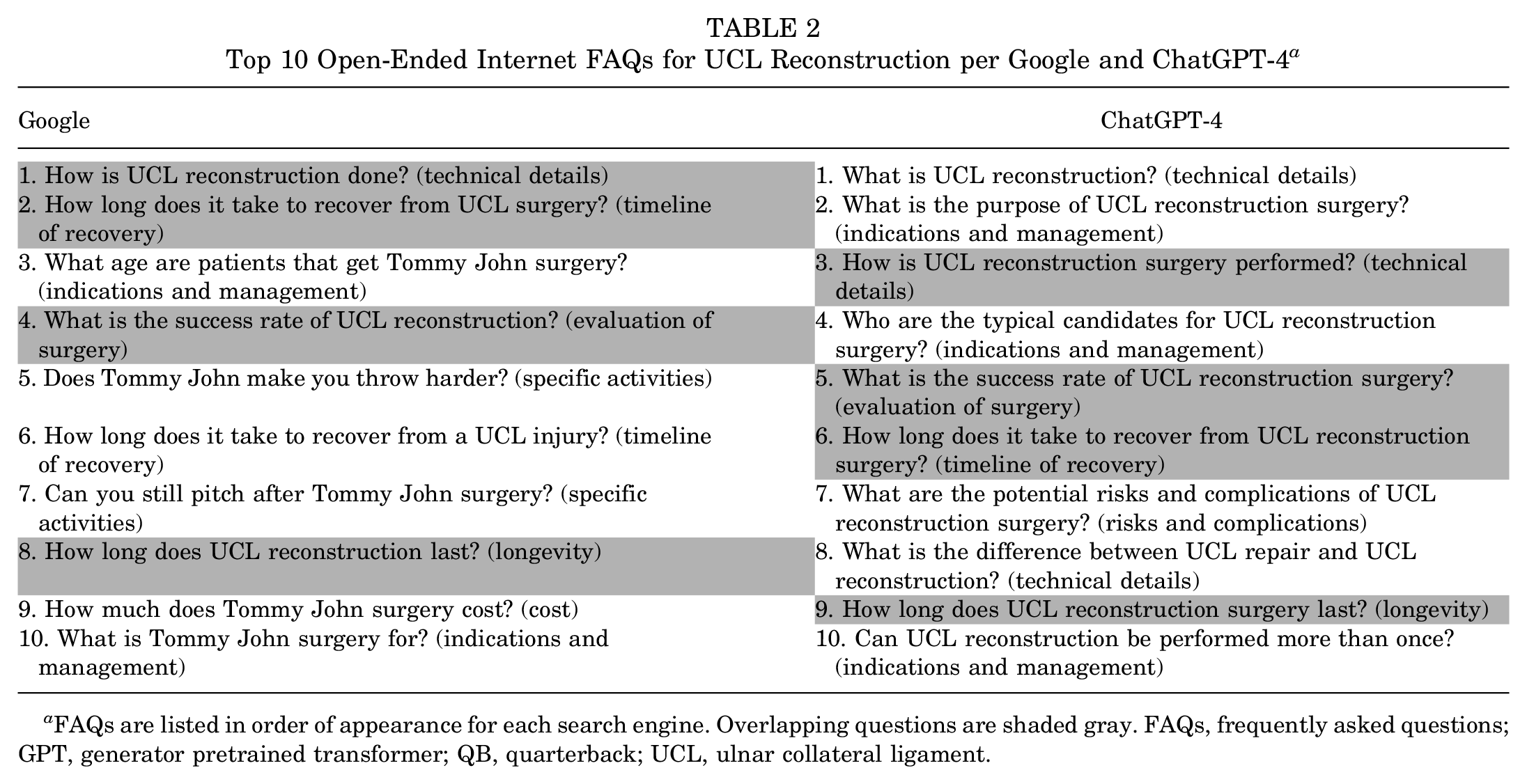

FAQs are listed in order of appearance for each search engine. Overlapping questions are shaded gray. FAQs, frequently asked questions; GPT, generator pretrained transformer; QB, quarterback; UCL, ulnar collateral ligament.

Question type for the 10 most commonly encountered questions relating to ulnar collateral ligament reconstruction for Google and ChatGPT-4. GPT, generator pretrained transformer.
In analyzing the source of answers to the 10 most common FAQs on the respective platforms, the sources utilized for Google answers to the top 10 FAQs were 50% academic, with the remaining 50% being answered from medical practices (3/10, 30%) and social media (2/10, 20%) (Figure 2). In contrast, the sources used by ChatGPT-4 were 90% academic, with the remaining FAQs being answered using a commercial source; however, although ChatGPT-4 used a greater proportion of academic resources, this difference failed to reach statistical significance (P = .14).

Sources of answers to the 10 most common questions for Google and ChatGPT-4. GPT, generator pretrained transformer.
Most Common Patient Queries With Numeric Answers
The 10 most commonly asked numerical questions, with the respective answers from both Google and ChatGPT-4, are listed in Table 3. The most common question types were related to the timeline of recovery (2/10, 20%), indications and management (2/10, 20%), and specific activities (2/10, 20%). Overall, only 2 of 10 (20%) answers were the same, 3 of 10 (30%) demonstrated partial overlap, and 5 of 10 (50%) were completely discordant (Figure 3). All sources used by ChatGPT-4 to answer these FAQs were academic, while only 20% of sources used by Google were academic (P = .0007; Figure 4). The remaining Google sources included social media (40%), medical practices (20%), single-surgeon websites (10%), and commercial websites (10%).
Top 10 Questions and Answers (Sources) Comparison of Search Engines for Numerical Questions for UCL Reconstruction a


Answers with complete overlap are shaded green, answers with partial overlap are shaded yellow, and answers with no overlap are shaded red. Expert grading scale: grade 0, inaccurate; grade 1, somewhat accurate; and grade 2: accurate. UCL, ulnar collateral ligament.

Overlap in answers to the 10 most common questions with numerical answers between Google and ChatGPT-4. GPT, generator pretrained transformer.

Sources of answers to the 10 most common questions with numerical answers between Google and ChatGPT-4. GPT, generator pretrained transformer.
When comparing the answers to these questions based on a blinded assessment by the 2 experts, the mean accuracy/correctness of answers was 1.8 ± 0.4 for answers provided by ChatGPT-4 versus 1 ± 0.82 for answers provided by Google, representing a statistically significant difference in favor of ChatGPT-4 (P = .013). Furthermore, there were no answers graded as inaccurate by ChatGPT-4, whereas Google had 3 answers graded as inaccurate. Across all 20 answers to both qualitative and quantitative questions, 16 of 20 (80%) were accurate for ChatGPT-4 compared with 5 of 20 (25%) for Google (P = .0005). When considering the clinical relevance of answers to FAQs, the mean clinical relevance score was 1.8 ± 4.2 for ChatGPT-4 versus 1.6 ± 0.7 for Google, which was not statistically different (P = .44). Only Google provided a FAQ graded as little to no clinical relevance, while all FAQs provided by ChatGPT-4 were graded as having some clinical relevance or being very clinically relevant.
Discussion
The main findings of the present study were as follows: (1) ChatGPT-4 provided a comprehensive range of clinically relevant questions and answers across various topics related to UCL injuries using primarily academic resources; (2) queries yielded relatively little (40%) content overlap between Google and ChatGPT-4 in terms of the most FAQs; (3) ChatGPT-4 used a greater proportion of academic resources to answer questions compared with Google; and (4) ChatGPT-4 provided answers that were significantly more accurate compared with Google based on grading by a blinded expert. These results have several implications for both sports medicine patients and physicians.
As the adoption of ChatGPT-4 continues to grow at a breakneck pace, 10 more sports medicine patients are likely to turn to this service for online health information. The current results demonstrate that patients with UCL injuries using ChatGPT-4 are more likely to obtain information from academic sources compared with patients using Google. These findings are encouraging, as patients are likely to receive information that is both more accurate and less biased from academic sources compared with other sources (eg, commercial, social media, etc), which were frequently present in the Google results. In addition, an anecdotal analysis of the sources for the ChatGPT-4 answers demonstrated information was consistently derived from a mix of both reputable institutions, such as the American Academy of Orthopaedic Surgeons and the Mayo Clinic, as well as the primary medical literature, while Google used information from reputable sources in only few circumstances. This is also a positive finding, as it suggests ChatGPT-4 may source all available information for the most relevant answer, as opposed to deriving most of its answers from a single or few sources, which could also induce bias, even if from an academic resource.
In line with these expectations, and perhaps most importantly, we found that ChatGPT-4 answers were significantly more accurate than Google Web Search answers when assessed by 2 blinded fellowship-trained sports medicine surgeons. Moreover, no answers from ChatCPT-4 were judged to be completely inaccurate, compared with 3 answers from Google, while 16 of 20 (80%) answers were completely accurate for ChatGPT-4 compared with only 5 of 20 (25%) from Google. The high accuracy of ChatGPT-generated answers is consistent with and expands upon what has been observed in other fields. For instance, Samaan et al 25 assessed the accuracy of ChatGPT for answering questions pertaining to bariatric surgery where responses were graded by board-certified bariatric surgeons. The authors reported that ChatGPT provided comprehensive and accurate answers to 86.8% of the questions but did not compare the performance to current gold standard sources of information such as Google. In the cancer literature, 11 the accuracy of answers given by ChatGPT has been reported to exceed 95%. Taken together, the findings from the present study suggest that information on UCL injuries and reconstruction that patients obtain online from ChatGPT-4 is from high-quality sources and unlikely to be worse than when obtained from Google. Should patients inquire to search for more information about their condition online, physicians may choose to direct them to ChatGPT-4 as opposed to traditional search engines such as Google. However, future studies are necessary to continue to validate the accuracy and reliability of the information provided by ChatGPT-4 across a range of conditions.
Interestingly, there was relatively little overlap in the most commonly asked questions between Google and ChatGPT-4. The purpose of this analysis was to systematically analyze the relevance of FAQs generated by ChatGPT-4, compared with the most frequently used search engine in the world. 1 If Google is assumed to be the gold standard of relevant questions, then 1 interpretation of this finding could be that when nonspecifically prompted, ChatGPT-4 may not return the most common questions patients have. This finding could be due to the relative recency of ChatGPT-4 as a platform, and ongoing calibration through additional searches may observe results becoming more concordant over time. On the other hand, it is possible that the most commonly asked questions from Google over decades no longer represent the most common questions about UCL injuries and reconstruction that patients have today, and, as such, the ChatGPT-4 results could be more relevant and contemporary. In either event, patients can always ask ChatGPT-4 the specific questions they have, and when asked the same questions in the current study, ChatGPT-4 was more likely to respond with academically sourced and accurate answers.
The present study builds on previous work in other fields, suggesting that ChatGPT-4 may be an improved and reliable patient resource. Pertaining to musculoskeletal conditions, Dubin et al 5 prompted ChatGPT-3 with 10 questions on total knee arthroplasty and total hip arthroplasty and utilized Google Web Search to assess the utility of ChatGPT in total joint arthroplasty. They reported that ChatGPT provided a heterogeneous range of questions and answers compared with Google, with a high proportion of responses being informed by PubMed, which is in accordance with the finding in this study that ChatGPT has a predilection for using academic resources. Ayers et al 1 recently demonstrated that ChatGPT responded to patient questions on an online medical forum with significantly greater quality and empathy compared with verified physicians. On the other hand, ChatGPT has failed to exhibit the higher-level thinking required to pass the Fellowship of the Royal College of Surgeons (Trauma & Orthopaedics) examination, scoring only 35.8% (30% lower than the Fellowship of the Royal College of Surgeons pass rate) 4 and only in the 40th percentile for the Orthopaedic In-Training Examination. 20 Thus, while ChatGPT continues to improve and is likely to be an increasingly valuable clinical adjunct moving forward, it is far from a panacea that can replace clinical judgment. Therefore, expectations for its ability to answer medical questions should be measured. Regardless, with all the attention surrounding this technology, it is going to become increasingly common for sports medicine physicians to encounter patients who have obtained information from ChatGPT; therefore, it is critical for clinicians to be aware of this resource and the quality of information it provides. LLMs such as ChatGPT may eventually play an increasing role in other aspects of clinical practice besides serving as an information resource, with emerging literature demonstrating the potential to decrease administrative burden, 18 respond to patient inbox messages that are received, and effectively triage patients.18,30 With increased validity and confidence in responses and information, ChatGPT may be incorporated into medical records and either send real-time responses or draft responses for providers to review, edit, and send, and screening systems could be implemented before new appointment bookings to ensure patients are seen by the appropriate provider (ie, new sports medicine patients with operative conditions routed to a sports medicine surgeon and those with nonoperative conditions routed to nonoperative sports medicine physicians). Although results from the present study are promising, continued validation and refinement of the ChatGPT-4 and its subsequent versions will be imperative before clinical use.
Limitations
Although this study has many strengths, including its novelty and systematic design to allow for objective comparison between Google and ChatGPT-4, it is not without limitations. First, both Google and ChatGPT-4 are dynamic resources that evolve over time. As such, the current results may not always hold in the future. Second, the study is limited to UCL injuries and reconstruction, and the results may not be generalizable to other conditions. Although previous literature concerning the use of ChatGPT has also restricted its search to a single topic involving a limited number of questions, continued research into the efficacy of ChatGPT as a source of online health information is likely to be beneficial. Third, the performance of a limited number of questions was assessed, which does not represent all possible questions or concerns a patient may have about this topic. However, previous literature has demonstrated samples of questions as low as 6 to provide a valid and representative sample of what patients may ask, 27 while other studies have reported on a more limited number of questions than investigated in the present study to demonstrate appropriate performance and reproducibility.5,12,21 Fourth, although some statistically significant differences were observed between ChatGPT-4 and Google (ie, the mean medical accuracy of answers to general FAQs; Supplemental Table S1), it is unclear whether these differences are clinically significant. Fifth, patients may combine information from multiple resources (ie, both Google and ChatGPT-4), which was not assessed in this study. Last, although a methodological strength of this study is utilizing a new browser and erasing history with each iterative search, it is also a limitation because it may ultimately affect the generalizability of results as others may not achieve similar results if they do not refresh their browsers.
Conclusion
ChatGPT-4 is capable of providing responses with clinically relevant content concerning UCL injuries and reconstruction. ChatGPT-4 utilized a significantly greater proportion of academic websites to provide responses to FAQs representative of patient inquiries compared with Google Web Search and provided significantly more accurate answers. Moving forward, ChatGPT can potentially be used as a clinical adjunct when answering queries about UCL injuries and reconstruction, but further validation is warranted before integrated or autonomous use in clinical settings.
Supplemental Material
sj-pdf-1-ojs-10.1177_23259671241257516 – Supplemental material for Understanding How ChatGPT May Become a Clinical Administrative Tool Through an Investigation on the Ability to Answer Common Patient Questions Concerning Ulnar Collateral Ligament Injuries
Supplemental material, sj-pdf-1-ojs-10.1177_23259671241257516 for Understanding How ChatGPT May Become a Clinical Administrative Tool Through an Investigation on the Ability to Answer Common Patient Questions Concerning Ulnar Collateral Ligament Injuries by Nathan H. Varady, Amy Z. Lu, Michael Mazzucco, Joshua S. Dines, David W. Altchek, Riley J. Williams and Kyle N. Kunze in Orthopaedic Journal of Sports Medicine
Footnotes
Final revision submitted November 14, 2023; accepted January 10, 2024.
One or more of the authors has declared the following potential conflict of interest or source of funding: J.S.D. has received consulting fees from Arthrex and Trice Medical; royalties or license payments from Linvatec; nonconsulting fees from Arthrex; education payments from Gotham Surgical Solutions & Devices; and hospitality payments from Horizon Pharma. D.W.A. has received royalties or license payments from Stryker and hospitality payments from Arthrex. R.J.W. has received royalties or license payments from Arthrex; acquisitions from Smith+Nephew; nonconsulting fees from Arthrex; consulting fees from Arthrex; and hospitality payments from Joint Restoration Foundation. AOSSM checks author disclosures against the Open Payments Database (OPD). AOSSM has not conducted an independent investigation on the OPD and disclaims any liability or responsibility relating thereto.
Ethical approval was not sought for the present study.
Supplemental Material
Supplemental Material for this article is available at https://journals.sagepub.com/doi/full/10.1177/23259671241257516#supplementary-materials
References
Supplementary Material
Please find the following supplemental material available below.
For Open Access articles published under a Creative Commons License, all supplemental material carries the same license as the article it is associated with.
For non-Open Access articles published, all supplemental material carries a non-exclusive license, and permission requests for re-use of supplemental material or any part of supplemental material shall be sent directly to the copyright owner as specified in the copyright notice associated with the article.
