




Abstract
Background:
As information on the meniscus accumulates in PubMed, it is possible to evaluate the trends in research on the topic over time.
Purpose:
To evaluate the major trends in meniscus-related publications in PubMed from the earliest publication to the present day.
Study Design:
Cross-sectional study.
Methods:
PubMed was searched on January 3, 2023, using the search strategy “menisc *”[All Fields] AND (“knee”[MeSH Terms] OR “knee”[All Fields] OR “knee joint”[MeSH Terms] OR (“knee”[All Fields] AND “joint”[All Fields]) OR “knee joint”[All Fields]) AND 1900/01/01:2022/12/31[Date - Publication]. This retrieved 15,569 human and animal studies. We determined the top 10 meniscus-related publications in terms of overall citations and citations per year, as well as the top 10 authors, journals, countries, and institutions of cited publications on the meniscus. In addition, we performed word-cloud analyses based on meniscus-related terms from different periods (before 1981, before 2000, after 2005, and in the past 5 years [2018-2022]), including the year of first appearance and the number of publications featured.
Results:
Since the first recorded publication on the meniscus in 1928, there was a steady growth in the number of articles until 2005, when there was an upsurge in publications from 254 in 2005 to 955 in 2022. Noyes was the author with the most citations (n = 3314), and a 2006 study by Caplan and Dennis had the most citations per year (n = 125). Arthroscopy published the most articles on the meniscus with 1118, whereas the Journal of Cellular Biochemistry had the most citations per article with 125.69. The most published countries and institutes were the United States and the Hospital for Special Surgery, respectively. Word-cloud analysis of article titles showed that “meniscectomy” had become less prominent, and “root,”“ramp,”“transplantation,” and “slope” had become more prominent.
Conclusion:
There has been an upsurge in publications on the meniscus since 2005, with word-cloud analysis indicating shifting interests in meniscus-related research.
Keywords
The method for treating meniscus-related issues was fundamentally altered 60 years ago when it was discovered that removing the meniscus from the knee joint—at the time, thought to be the only method for treating sports-related injuries—caused articular cartilage to deteriorate and the sluggish onset of arthritis. 13 Partial meniscectomy was proposed as a substitute for total meniscectomy in 1982, 14 and the first documented case of a meniscus transplant was reported in 1989. 23 These studies, which served as a turning point in our knowledge of the anatomy and purpose of the knee meniscus, sparked a plethora of subsequent studies looking at various therapeutic modalities. Keeping the tissue intact wherever possible is the current standard of care for meniscus-related lesions.12,24,26,36 In cases of severe or complete traumatic lesions, however, the inability of surgeons to reconstruct the tissue—both morphologically and functionally—continues to pose difficulties. 17 The inability to stop osteoarthritis (OA) from progressing at the same time provides a similar incentive to look for novel therapeutic approaches.32,34 PubMed is an important source of literature searches among orthopaedic surgeons. It has been more than 20 years since it was rolled out for public use, and it has gained popularity ever since. The meniscus is one of the oldest structures in the knee to be studied and treated surgically. 16 As information on this structure accumulates and is cited in PubMed, trends in interest in a particular topic may vary from time to time. 18
This study aimed to look at the major trends involving publications on the meniscus on PubMed from the earliest publication to the present day.
Methods
PubMed was searched on January 3, 2023, using the following search strategy: “menisc*”[All Fields] AND (“knee”[MeSH Terms] OR “knee”[All Fields] OR “knee joint”[MeSH Terms] OR (“knee”[All Fields] AND “joint” [All Fields]) OR “knee joint”[All Fields]) AND 1900/01/01:2022/12/31[Date - Publication]. This search retrieved 15,569 human and animal studies.
We recorded trends in the publication of meniscus studies and analyzed the top 10 studies in terms of overall citations and citations per year (calculated as the number of citations divided by the number of years since publication). The online PubMed by Year tool 33 was used to compare the yearly number of publications on the meniscus per 100,000 PubMed publications. Publications were also analyzed in terms of study type (eg, systematic review, randomized controlled trial [RCT], or case report), which was obtained by using filters in the PubMed search output. We also evaluated the top 10 authors, journals, countries, and institutions of cited publications on the meniscus.
Most of the analysis was performed using the output from PubMed (overall citations, citations per year, top authors, top journals). However, we used the Scopus database for information on the top 10 countries and institutions publishing on the meniscus, as this information is not provided in PubMed. We are aware that the 2 databases are not the same since Scopus includes more journals than PubMed, but the trends appear to be similar in both databases.
In addition, word-cloud analyses was performed based on author names and on terms related to the meniscus from different periods (before 1981, before 2000, after 2005, and during the past 5 years [2018-2022]), the year of first appearance, and the number of publications. Data mining was performed using Orange software (Mac version 3.32.0; https://orangedatamining.com) from the titles of all articles.
Results
Trends in Publications on the Meniscus
The first recorded publication on the meniscus in PubMed was by Pandalai in the Indian Medical Gazette in 1928. 28 It was about a cyst of the meniscus in the knee. The next study was published by Charnley in 1945. 8 The number of publications crossed 100 in 1982 and 200 in 1993. However, it took only 16 years to increase from 300 to over 900 publications per year. There was a steady growth in the number of publications until 2005, when there was an upsurge in publications from 254 in 2005 to 955 in 2022; this was almost a fourfold increase. A graph of publications per year is shown in Figure 1. A 2-order polynomial trend line was added to the chart to indicate the increasing trend in the number of publications.

Numbers of publications per year (blue line) with trend line (black curve). An upsurge in publications beginning in 2005 can be seen. The blue dots indicate the number of publications each year.
Information on number of meniscus-related citations was only available from 1980, as represented in Figure 2 along with the number of publications. A threefold increase in the number of citations was seen from 1990 to 2006, from 5264 to more than 16,000. The number of citations in the most recent 5 to 7 years was lower, as expected, as it takes time for citations to accumulate for any article.

Numbers of citations and publications on the meniscus per year.
Figure 3 shows the yearly trend in number of meniscus-related publications compared with all PubMed publications (estimated as a proportion of 100,000 publications in PubMed) since 1945. There was a steady increase in the proportion of attention garnered by meniscus articles, from a low of 8 per 100,000 in 1951 to 65 per 100,000 in 2015.

Number of meniscus-related publications per year compared with all PubMed publications since 1945 (shown as number of publications per 100,000).
Top 10 Cited Publications
Table 1 lists the top 10 cited studies on the meniscus. The most-cited article, a 2006 study by Caplan and Dennis, 7 collected 2011 citations, and the 10th most-cited article collected 698 citations. Most articles in this list were not specific to the meniscus. Since meniscus pathologies are frequently involved with other structures such as the anterior cruciate ligament (ACL) and articular cartilage, these were also pulled in the search for meniscus studies.
Top 10 Most-Cited Publications on the Meniscus on PubMed

Top 10 Authors and Journals Publishing on the Meniscus
Overall, there were 390 first authors and 1294 journals that published articles on the meniscus. The top 10 authors by citations per year are shown in Figure 4A. Caplan and Dennis, 7 with their 2006 article in the Journal of Cellular Biochemistry, topped the list with 125.69 citations per year. Arthroscopy topped the journals list in terms of the number of meniscus studies published overall, with 1118 studies (Figure 4B) followed by Knee Surgery, Sports Traumatology, Arthroscopy (KSSTA; n = 1044) and American Journal of Sports Medicine (AJSM; n = 955). When arranged by overall number of citations, AJSM topped the list (n = 55,898), followed by Arthroscopy and KSSTA (Figure 4C). The top 3 journals accounted for 31% of all citations on this topic, with AJSM alone accounting for 15%. Although the number of citations was high for AJSM relative to the number of studies published (n = 947), the number of meniscus studies published was higher for Arthroscopy (n = 1118) and KSSTA (n = 1044). When sorted according to the number of citations per year, the Journal of Cellular Biochemistry was the leader (n = 125.69) followed by AJSM and Nature Reviews Rheumatology (Figure 4D).

(A) Top 10 authors by citations per year. (B) Top 10 journals by number of overall publications. (C) Top 10 journals by overall citations and publications. (D) Top 10 journals by citations per year. Am J Sports Med = American Journal of Sports Medicine; Clin Orthop Relat Res = Clinical Orthopaedics and Related Research; J Bone Joint Surg Am = The Journal of Bone and Joint Surgery; J Orthop Res = Journal of Orthopaedic Research; J Knee Surg = The Journal of Knee Surgery; Orthop J Sports Med = Orthopaedic Journal of Sports Medicine; Arthritis Rheum = Arthritis and Rheumatism; J Bone Joint Surg Br = The Bone and Joint Journal (previously The Journal of Bone and Joint Surgery: British Volume); J Cell Biochem = Journal of Cellular Biochemistry; Nat Rev Rheumatol = Nature Reviews Rheumatology; J Anat = Journal of Anatomy; N Engl J Med = The New England Journal of Medicine; PLoS Med = PLoS Medicine; Stem Cell Res Ther = Stem Cells Research and Therapy.
We list the top 10 first authors by overall number of citations and publications in Figure 5. According to overall number of citations, the top 3 authors were Noyes, Englund, and Lohmander. These 3 authors accounted for 2.6% of all citations.
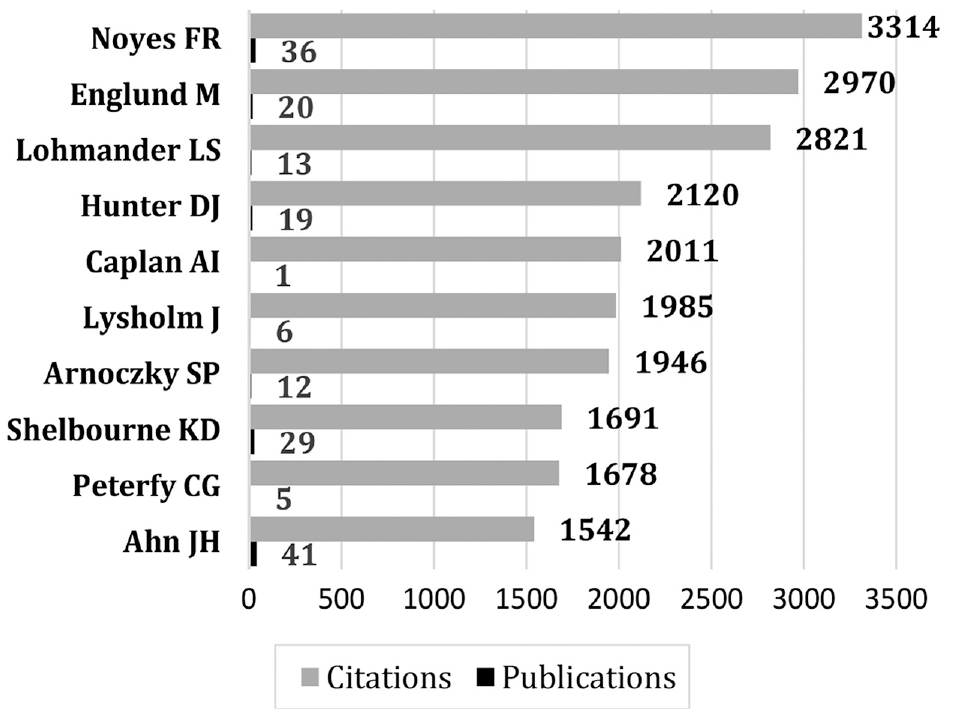
Top 10 first authors by overall citations, with number of publications.
Types of Studies on the Meniscus
We looked at the number of different study types as shown in PubMed and analyzed their yearly numbers (Figure 6). This classification was given by PubMed to only 4582 studies out of 15,157 from 1966 to 2022. Overall, the publications consisted of systematic reviews (n = 329), meta-analyses (n = 122), RCTs (n = 331), clinical trials (n = 517), reviews (n = 1580), case reports (n = 1235), and others (n = 468).

Publications on the meniscus through time according to study type. All study types showed an upward trend, more so with reviews and systematic reviews.
Systematic reviews and meta-analyses started in 1997 with single-digit publications until 2010. There has been a steady increase in systematic reviews and meta-analyses since 2011, ending with 62 and 19, respectively, in 2022. RCTs and clinical trials started in 1966 but were irregular with single-digit publications until 1993 for clinical trials and 2004 for RCTs. Their numbers were at a maximum of 20 for RCTs in 2022 and 27 for clinical trials in 2013. Reviews were the maximum number of publications, with the first publication in 1964, having single-digit publication numbers until 1987 to a maximum of 104 in 2022.
The information on countries and institutions publishing on meniscus is available in Appendix Figure A1. The most published country was the United States (US), followed by Germany and Japan, and the most published institutions on this topic were the Hospital of Special Surgery, followed by Harvard Medical School and the University of California at San Fransisco.
Word-Cloud Analysis
Author Names
The top 5 authors (in any position) along with the number of publications included Guermazi (n = 152), LaPrade (n = 151), Englund (n = 116), Okazaki (n = 106), and Furumatsu (n = 105). Figure 7 shows the word cloud that was created with all the names of the authors.
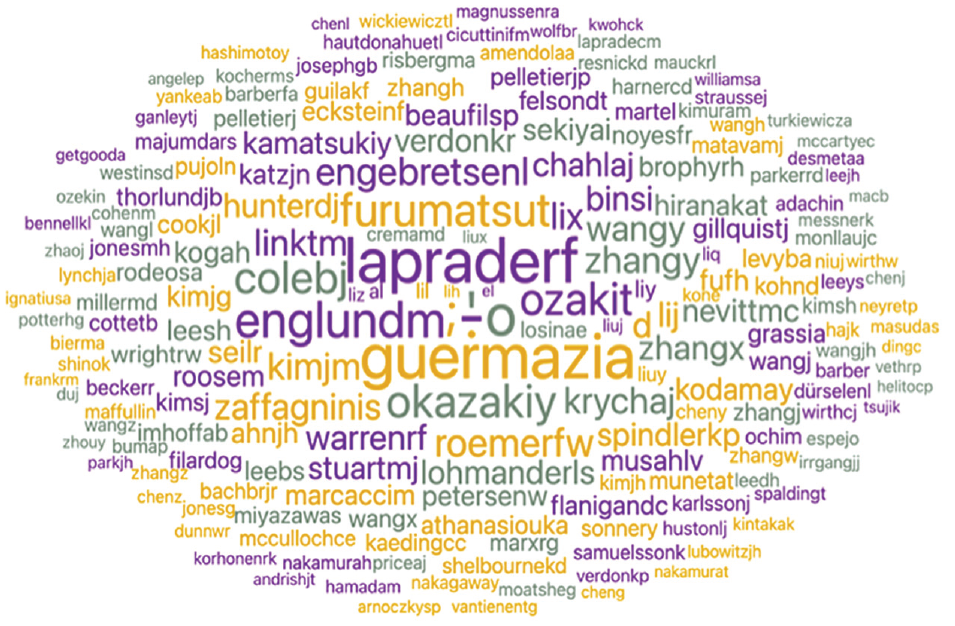
Word cloud of author names.
Keywords in Titles
We created separate word clouds based on the titles of articles before 1981, before 2005, and after 2005 (Figure 8) to see if there were differences, as there had been a significant upsurge in the number of publications on the meniscus since 2005. Before 1981, the words “meniscectomy,”“arthrography,”“contrast,”“diagnosis,” and “clinical” were more prominent, and “arthroscopy” was less prominent in titles. After 2005, “tears,”“repair,”“root,”“transplantation,”“systematic,”“medial,”“imaging,” and “MRI” were more prominent than in the word cloud before 2005. Before 2000, “arthroscopy,”“imaging,”“magnetic resonance,”“cruciate,” and “study” were prominent, and “meniscectomy” was still prominent. There was more emphasis on diagnosis before 2000.
However, in the past 5 years, “meniscectomy” has become less prominent. “Root,”“repair,” and “tear” have become more prominent, and “allograft,”“osteoarthritis,”“cruciate,” and “reconstruction” have also become more prominent. “Medial” and “posterior” are more prominent, possibly indicating more work on the medial meniscus and posterior root tears. “Ramp,”“extrusion,” and “transplantation” have also appeared. “Discoid” is less prominent, and “slope” has appeared, indicating recently work on these fronts concerning the meniscus.

Word cloud of keywords in titles during different periods: before 1981, before 2000, after 2005, and in the most recent 5 years (2018-2022).
Although absolute numbers of occurrences of these terms are available, we do not think they are comparable between the periods we have studied since there is a significant difference in the number of publications between these study periods. Table 2 lists the first appearance and frequency of appearance of commonly associated terms with meniscus. These data are arranged in chronological order to give a sense of the evolution of terms related to the meniscus. The terms that appear later in the timeline may, in general, be expected to be less frequent.
Terms Related to the Meniscus and Their First Appearance in Titles

Discussion
The findings of our study revealed a steady growth in the number of publications regarding the meniscus from 1945 to 2005, with an upsurge in publications after 2005. AJSM published the most studies on the meniscus (n = 55,898), and the 2006 study by Caplan and Dennis 7 had the highest number of overall citations (n = 2011) as well as citations per year (n = 125.69).
The number of publications on the meniscus from 1928 to 2022 in PubMed was 15,569. In comparison, there were 19,060 articles on the ACL published from 1948 to 2019, 20 5087 articles on the posterior cruciate ligament published from 1915 to 2019, 19 and 2362 articles on articular cartilage published from 2009 to 2018. 37 There were 41,149 articles published on all the branches of arthroscopy from 1955 to 2019. 20 It appears that the studies on the meniscus are second only to those on the ACL in the field of arthroscopy and sports medicine. Articles on the meniscus have been published since 1928, before those on the ACL and arthroscopy. Publications on arthroscopy started to appear in 1955, and the term “arthroscopy” in the titles of meniscus articles started in 1970.
In 2022, Alomar et al 2 identified the top 10 most-cited papers in meniscus research and concurrent knee issues and analyzed their characteristics. The authors found that most of the research concerning the meniscus relates to the importance of meniscus preservation, the link between meniscus injuries and concomitant ACL and chondral injuries, and its role in long-term OA. 2 Western countries have contributed the most to the most-cited evidence concerning the meniscus. Meniscus repair and transplantation techniques have recently gained importance and need further research to qualify for the most-cited evidence 2 . Similarly, Brown et al, 6 in their bibliometric analysis, noted that in the meniscus literature there is a strong predominance of therapeutic studies, studies generated and published within the US, and studies focused on topics of arthroscopic repair or removal. Overwhelmingly, the included articles were published before 2010, affirming the criticism that bibliometric analysis favors older articles. 6 In February 2023, Kunze et al 21 identified and described the 50 most-cited articles in meniscus research over 80 years to capture a wide range of influential articles. The top 50 most-cited articles were published between 1941 and 2014 and were collectively cited 13,152 times. The median number of total citations per article was 203.5, whereas the median citation rate was 9.6 citations per year. 21 The majority of articles were clinical outcome studies (56%). 21
Top Authors, Institutions, Countries, and Journals
In 2022, Chen et al 9 performed the first comprehensive analysis of the knowledge structure of knee OA and the meniscus across 2 decades and identified emerging research trends from a bibliometric perspective. A total of 3,218 articles were retrieved. Guermazi was identified as the author who had contributed the most to the field and Osteoarthritis and Cartilage was identified as the most productive research journal. 9 The US was found to be the global leader in the field and the center for international cooperation, with less international collaboration occurring in Eastern Asia. Boston University was the most prolific institution. 9
Yang et al 40 investigated the publication conditions of stem cell therapy for meniscal regeneration and visualized the research trends and frontiers. A total of 354 publications were collected and analyzed. The US contributed the largest number of publications (34.104%). Tokyo Medical Dental University contributed the largest number of publications (n = 34) among all full-time institutions. The journal Stem Cell Research Therapy published the largest number of studies on stem cells for meniscal regeneration (n = 17). 40 Sekiya contributed the majority of publications in this field (n = 31), whereas Horie was the most frequently cited author (n = 166). The chief keywords were (n = 1) tissue engineering, (n = 2) articular cartilage, (n = 3) ACL, (n = 4) regenerative medicine, and (n = 5) scaffold. 40 This indicates that the current research hotspot has been transformed from basic surgical research to tissue engineering. 40
Bibliometrics
The bibliometric techniques help quantitative evaluation of publications and are best recognized for their efforts to gauge the significance of scientific research by using several indicators, such as the impact factor and the H-index. 3 Reviewers and policymakers are increasingly using these indicators to evaluate the research impact because these are more objective than a peer review. 3 There may be confusion over how bibliometric indicators function, which causes assessors to use them incorrectly. The most typical error is probably to gauge the significance of an article published in a journal by its impact factor, which is not truly correct, as only a smaller percentage (10-30%) of the papers published in a journal receive the majority of the citations (“skewed publications”) that a journal receives to establish its impact factor.30,31
Comparing the values of typical bibliometric metrics across disciplines, such as the impact factor or an author's H-index, is another error, as huge disparities in the number of citations exist among various subject fields. 3 A third frequent error made by assessors is failing to account for time. Not only do citations take time to build up but they also keep building up over time. Studies have indicated that for bibliometric indicators to be trustworthy, manuscripts must have accumulated enough citations for at least 2 to 3 years after publication. 1 This implies that at least 2 years should have passed since the publication of the most current studies included in any institutional evaluation using bibliometric markers. 38
Recent Trends in Meniscus Surgery
As recently as 2012, the consensus was that “partial meniscectomy is managed for the majority of other types of meniscal tears that are degenerative, significantly traumatized, and/or located in an avascular area of the meniscus” and that “as a result of biologic issues and technical limitations, repair of the meniscus is indicated for unstable, peripheral vertical tears”. 5 However, more forms of meniscus rips can now be repaired because of recent advances in technology and a deeper understanding of tear patterns. Currently, older patients and more complicated tear patterns have been included in the indications for meniscus repair. 39 This is reflected in the changes seen in our word-cloud findings.
Recent articles have analyzed the surgical technique and clinical outcome of meniscus transplantation. Although a meniscectomy is a successful surgery, some people experience early postmeniscectomy knee pain. This is because the knee is typically susceptible to OA changes over time. 4 When conservative treatments fail, these patients have a variety of surgical choices. One of these options is a meniscal allograft, although there may be some disadvantages, such as complete removal of the remaining healthy meniscal tissue, more difficult surgery, the need for bone tunnels for fixation, factors related to donor compatibility, and potential difficulties in graft procurement. 4 Concerns about disease transmission and immunological reactivity are also raised by the transplantation of live cells into an allograft. However, the outcomes are encouraging.
Recent trends in the meniscus appear to be on topics such as ramp lesions, meniscus root repair, and meniscus allograft transplantation. The keywords related to these terms were not prominent when the word clouds from the 2000s and before 1981 were compared, and “osteoarthritis” has also appeared more prominently in the word cloud in the past 5 years, indicating that research on OA is closely linked to the meniscus.
Meniscus repair has undergone significant advancements over the past 2 decades. If the repairs are biologically enhanced, success rates may be higher. Although trials using fibrin clots, platelet-rich plasma, and stem cells have shown encouraging results, further research is required to establish superiority. 39 In Europe and many other parts of the world, partial meniscus replacements are becoming popular. Synthetic complete meniscus replacements are the next stage in this progression. 39 The middle-aged patient with moderate arthritis who has postmeniscectomy pain in a knee but is too advanced for a meniscus transplant but too early for a partial knee arthroplasty may benefit from this to target 1 particularly problematic group. 4 A medial meniscus implant intended to replace a missing meniscus is soon to be used in the US. 27 The implant's objective is to restore load distribution across the knee joint, which should help prevent additional articular cartilage deterioration. An animal model has proven chondroprotective characteristics. 27
Limitations
There are several limitations to this study. The analysis was performed using terms from the titles only. This has the limitation that if a particular term is not included in the title, it will not be picked up in the analysis. Standardization of the titles of manuscripts, such as systematic reviews and RCTs, has been a recent stipulation and has not been uniformly followed by authors and publishers; hence, some data may be omitted. In addition, the articles analyzed also included articles from veterinary journals. We did not make any effort to separate veterinary publications since most of the basic sciences work on the meniscus was done on animals, and some of these articles may have been published in veterinary journals.
The classification of articles has been a recent development. The early articles published on this topic may not have been classified according to the current standards and, hence, may not have been included in the early articles. In addition, systematic reviews and meta-analyses were not performed in the early days and were recent developments.
We included most of the data for this bibliometric study from PubMed, and only limited data about the top 10 universities, countries, and types of publications were taken from Scopus. However, there is no single definitively superior database, and we chose 1 of the most widely used databases. Citations are a dynamic entity, and as such, our search and article reflect the picture of the day, and a search on a later date may produce a different set of articles or the citation number may vary. Finally, another limitation concerns the level of evidence and quality of articles; even though 1 paper is cited frequently, it could be a level 5 paper.
Conclusion
The results of this bibliometric analysis indicated that there has been a steady growth in the number of meniscus-related publications since the first study in 1928, with an upsurge of publications seen after 2005. According to overall number of citations, the top 3 first authors were Noyes, Englund, and Lohmander, and the top 3 journals were AJSM, Arthroscopy, and KSSTA.
Footnotes
Appendix
Final revision submitted August 8, 2023; accepted August 18, 2023.
One or more of the authors has declared the following potential conflict of interest or source of funding: Research support was received from the Italian Ministry of Health (Ricerca Corrente). AOSSM checks author disclosures against the Open Payments Database (OPD). AOSSM has not conducted an independent investigation on the OPD and disclaims any liability or responsibility relating thereto.
Ethical approval for this study was waived by IRCCS Ospedale Galeazzi–Sant’Ambrogio.