




Abstract
Background:
The Landing Error Scoring System (LESS) has been utilized on the field or in the clinic to identify patients with an increased risk for anterior cruciate ligament (ACL) injuries; however, its validity and efficacy have not been fully confirmed.
Purpose:
To assess the efficacy of the LESS in identifying the ACL injury risk by examining the correlation between the LESS score and motion patterns on 3-dimensional kinematic analysis.
Study Design:
Controlled laboratory study.
Methods:
The jump-landing motion was analyzed for 16 female basketball or badminton players who volunteered to participate in the study. All study participants were aged 19 or 20 years. The sequence of motion was evaluated with the LESS, while kinematic data were simultaneously acquired with a 3-dimensional motion analysis system utilizing the point cluster method. The correlation between the LESS score and knee kinematics was statistically analyzed.
Results:
When a LESS score ≥6 was defined to be a risk factor for ACL injuries, 7 of the 16 participants (43.8%) were found to exhibit risky motion patterns. Significant correlations were noted between the LESS score and knee valgus (r = 0.87; P < .0001) and internal tibial rotation (r = 0.57; P = .02) at landing. By contrast, a substantial variability was present in knee flexion, showing no correlation with the LESS score.
Conclusion:
Significant correlations were found between the LESS score and knee valgus and internal tibial rotation during a jump-landing task.
Clinical Relevance:
The LESS can be regarded as an effective measure to identify risky motion patterns that may increase the likelihood of ACL injuries.
Keywords
It is important to identify modifiable risk factors for an anterior cruciate ligament (ACL) injury. The majority of ACL injuries are reported to be sustained in a noncontact manner.6,13,22 Several studies have identified motion patterns that may increase the risk for noncontact ACL injuries.3,4,11,12,20 Hewett et al11,12 conducted epidemiological biomechanical studies based on the results of 3-dimensional (3D) kinematic and kinetic analyses during a jump-landing-rebounding task and reported motion patterns at risk for ACL injuries such as an increased knee valgus angle/moment and higher ground-reaction force. Subsequently, several studies utilizing 3D motion analysis have identified additional biomechanical factors that may increase the likelihood of future ACL injuries.3,20 However, the use of a motion analysis system takes substantial time and has a higher cost, limiting its applicability.
As a practical assessment of motion in clinical practice or on the field, the efficacy of 2-dimensional analysis of the jump-landing motion using video images has been examined and reported.17,18 Padua et al 20 proposed the Landing Error Scoring System (LESS) as a reliable screening test. The LESS quantitatively analyzes motion patterns on frontal- and sagittal-plane video images. Padua et al 19 also conducted a cohort study showing that a high LESS score was correlated with a greater risk for subsequent ACL injuries. In contrast, other studies have reported negative results on the efficacy and validity of the LESS.15,16,21
As for the validation of the LESS, there are some studies that have compared the results of the LESS to 3D motion analysis.9,10,20 In those studies, the kinematic results were used as the gold standard for assessing validity; however, motion analysis using surface markers/sensors can be associated with measurement errors caused by the movement of skin markers. To minimize errors in 3D motion analysis, Andriacchi et al 2 proposed the point cluster method, whose improved accuracy has been proven by in vivo accuracy testing.1,23
In this study, the jump-landing motion was evaluated by the LESS with simultaneous kinematic data acquisition using a 3D motion analysis system with the point cluster method. The purpose of this study was to assess the efficacy of the LESS in identifying the ACL injury risk by examining the correlation between the LESS score and motion patterns on 3D kinematic analysis. It was hypothesized that a higher LESS score during a jump-landing task would be correlated with faulty motion patterns at risk for ACL injuries.
Methods
Study Population
Healthy female basketball or badminton players belonging to teams at our college were selected as potential candidates. The concept and analytical protocol of the study were explained, and those who understood the study’s content and volunteered to participate in the study were subjected to testing. In total, 16 female athletes without a history of significant lower extremity injuries were selected as study participants. All participants were aged 19 or 20 years, with a mean age of 19.6 years. The protocol of this study was approved by the institutional review board of our college.
Analysis of Jump-Landing Motion
The jump-landing task followed the jump-landing motion described by Padua et al 20 (Figure 1). Participants jumped from a 30 cm–high box, landed with both feet onto a force platform placed at a distance of 50% of their height away from the box, and immediately rebounded for a maximum vertical jump. Measurements were performed after instructions on the task and practice jumps. Overall, 3 successful trials were subjected to an evaluation. 20

Jump-landing task for evaluation with the Landing Error Scoring System (LESS). The sequence of motion was recorded with 2 digital video cameras for the acquisition of (A) front and (B) side views.
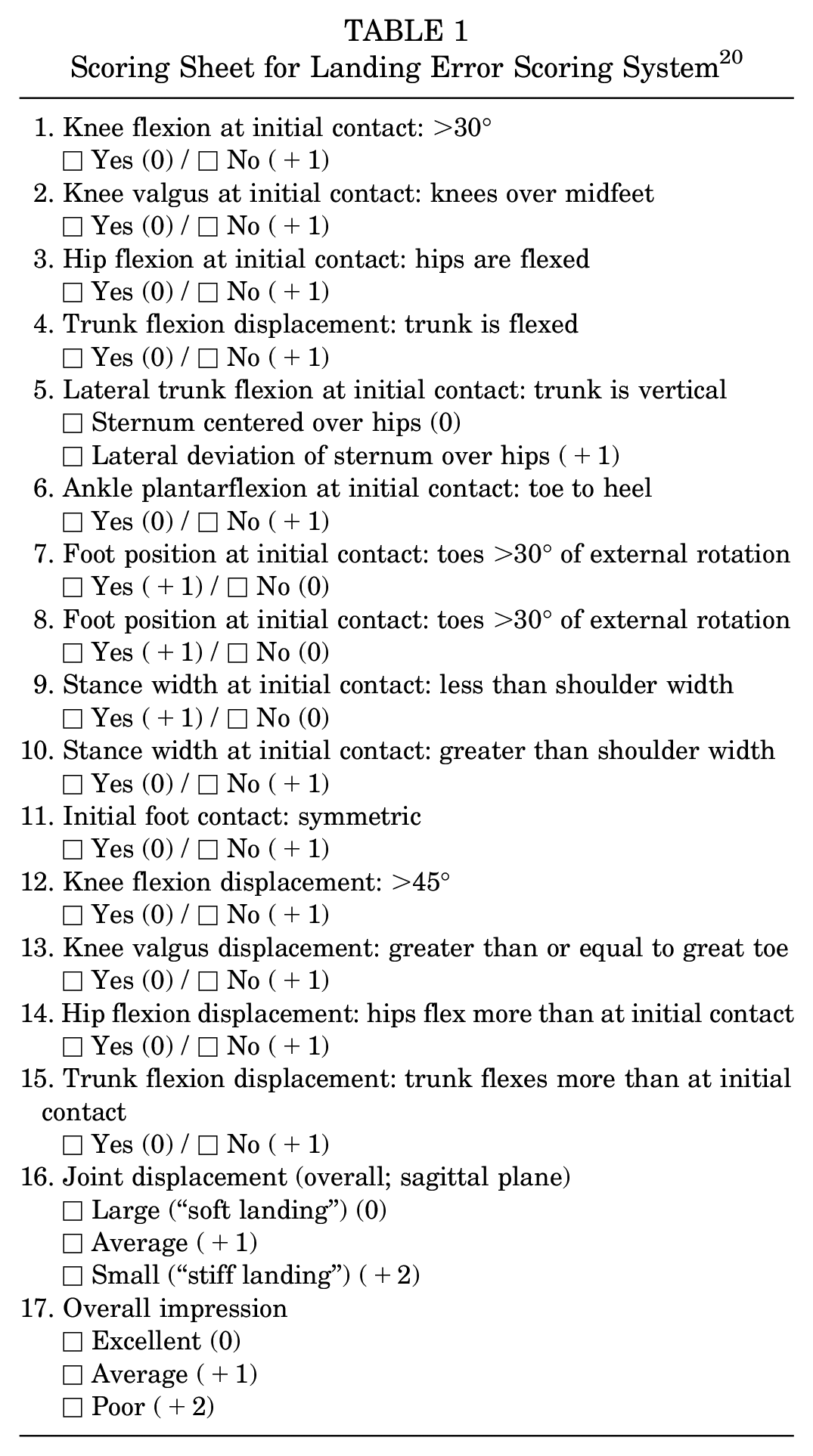
For the LESS, a jump-landing task was recorded with 2 digital video cameras for the acquisition of front and side views. Image analysis was performed using imaging processing software (ImageJ; United States National Institutes of Health). The jump-landing motion was scored using the LESS, as shown in Table 1. Positioning of the trunk and lower limbs at initial contact upon landing and subsequent changes until maximum knee flexion were assessed by simple scoring (0 or 1) for 17 items. To determine the interobserver and intraobserver reliabilities of the LESS in this study, 2 observers (T.M. and S.O.) independently conducted scoring, and 1 observer (T.M.) conducted repeat scoring with a 1-week time interval on video images of an initial 10 cases. Thereafter, the intraclass correlation coefficient was calculated for the assessment of reliability.
Scoring Sheet for Landing Error Scoring System 20
3D motion analysis was conducted using 8 infrared cameras (Vicon) and multiple reflective markers attached to the skin. Measurement errors induced by nonrigid body movement of the skin surface markers were reduced using the point cluster method described by Andriacchi et al 2 (Figure 2). Testing and analytical methods in the present study followed the procedures that were described in previous relevant articles.1,2 The parameters included for analysis were range of knee motion (angular displacement) on the sagittal, coronal, and axial planes (flexion/extension, valgus/varus, and internal/external rotation) during a jump-landing task between contact upon landing and maximum knee flexion at landing.
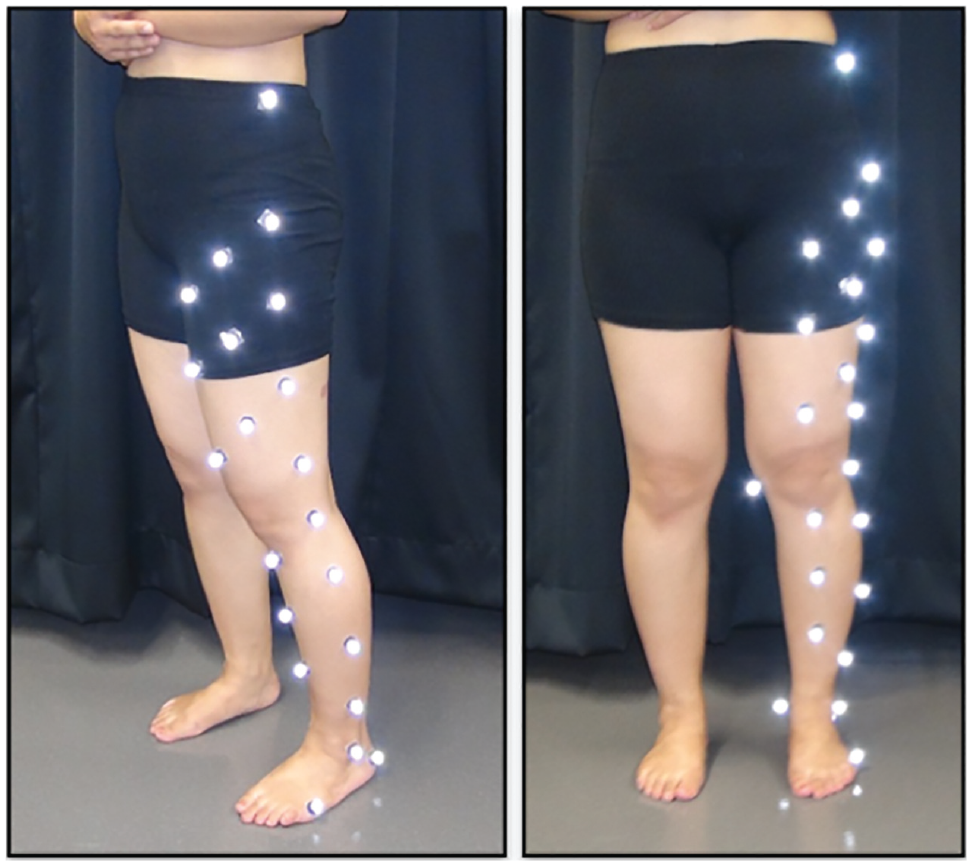
Multiple reflective markers attached to the skin for kinematic analysis using the point cluster method. 2
Statistical Analysis
The correlation between the LESS score and kinematic results was statistically analyzed using the Spearman correlation coefficient (r), with statistical significance set at P < .05. Statistical analysis was performed using SPSS software (Version 19; IBM).
To assess the statistical power of this study, post hoc power analysis was conducted with displacement of the knee valgus angle adopted as the primary outcome measure using corresponding software (G*Power [Version 3.1.9.6]; Heinrich Heine University Düsseldorf). Consequently, the statistical power was calculated to be 1 –β of 0.99 with an alpha of .05, showing adequate power for analysis of this specific outcome measure.
Results
LESS Score
The initial 10 cases showed interobserver and intraobserver intraclass correlation coefficients of 0.93 and 0.97, respectively, indicating excellent reliability of the LESS. Therefore, scoring by 1 observer (T.M.) was adopted and subjected to subsequent analysis. The LESS score of the participants averaged 5.69 (range, 2-8). When a LESS score ≥6 was defined to be a risk factor for ACL injuries, as indicated in the study by Padua et al, 19 7 of the 16 participants (43.8%) were found to exhibit risky motion patterns.
Relationship Between LESS Score and Kinematic Variables
On analysis of the correlation between the LESS score and kinematic variables, a higher LESS score was associated with increased knee valgus displacement during landing (r = 0.87; P < .0001) (Figure 3A). Regarding rotational motion of the knee, all participants experienced internal tibial rotation after toe contact, and there was a moderate correlation between internal tibial rotation displacement and the LESS score (r = 0.57; P = .02) (Figure 3B). By contrast, a substantial variability was present in knee flexion, and no significant relationship was detected between knee flexion displacement during landing and the LESS score (r = 0.27; P = .31) (Figure 3C).

Correlation between the Landing Error Scoring System (LESS) score and (A) displacement of the knee valgus angle (r = 0.87; P < .0001), (B) displacement of the internal tibial rotation angle (r = 0.57; P = .02), and (C) displacement of the knee flexion angle (r = 0.27; P = .31).
Discussion
In this study, the efficacy and validity of the LESS in identifying athletes at risk for ACL injuries were assessed using 3D motion analysis as a reference. Consequently, it was shown that the LESS score was significantly correlated with increased knee valgus and internal tibial rotation during a jump-landing task. These results indicate the efficacy and validity of the LESS in identifying the ACL injury risk.
The LESS was developed by Padua et al 20 as a clinical screening tool to detect faulty motion patterns associated with the risk for ACL injuries. Subsequently, these authors conducted a cohort study and confirmed the efficacy of this test. 19 On the other hand, several studies have reported contradictory results, and the significance of the LESS as a screening tool is still controversial.8,10,15,16,21
To assess the validity of the LESS, several studies have compared the results of the LESS and 3D motion analysis.9,20 Padua et al 20 reported that participants with a high (poor) LESS score demonstrated faulty motion patterns such as increased knee valgus and hip internal rotation and less knee and hip flexion during the jump-landing sequence. Myer et al 17 compared the results of a clinic-based assessment for the jump-landing motion using frontal- and sagittal-plane video images as well as 3D kinematic and kinetic data derived from motion analysis, showing a high correlation between the findings obtained from the 2 evaluation methods. Everard et al 9 reported that the LESS score had a significant correlation with most kinematic variables derived from 3D kinematic analysis. In the present study, the point cluster method developed by Andriacchi et al 2 was employed in 3D motion analysis, enabling a more accurate assessment for knee kinematics. 23 The statistical analyses in this study showed that a high LESS score was associated with increased knee valgus and internal tibial rotation during landing, which corresponds to the findings of previous studies.9,20
Previous biomechanical and image analysis studies have shown that knee valgus is a principal factor contributing to noncontact ACL injuries.3,7 Koga et al 14 analyzed ACL injury video images in female athletes and showed that valgus loading was a contributing factor while internal tibial rotation was coupled with valgus motion. Bates et al4,5 reported the results of cadaveric biomechanical studies using robotics, showing that isolated abduction and combined abduction and internal rotation produced a significant increase in ACL strain. The present study showed a strong correlation between knee valgus and the LESS score as well as a moderate correlation between internal tibial rotation and the LESS score. Because these 2 motion patterns have been shown to be associated with ACL injuries, the study results indicate the efficacy of the LESS in identifying patients with an increased risk for ACL injuries.
Limitations
There are some limitations to this study. First, the sample size (n = 16) is too small, although participants’ demographic characteristics and activity levels were fairly uniform. Second, only the knee motion was subjected to analysis, while the kinematics of other parts in the lower extremities and trunk was not evaluated. Third, kinetic data were not available, which precluded the evaluation of force and moment during the motion.
Conclusion
Significant correlations were present between the LESS score and knee valgus and internal tibial rotation during a jump-landing task. Therefore, the LESS can be regarded as an effective measure to identify risky motion patterns that may increase the likelihood of ACL injuries.
Footnotes
Final revision submitted May 16, 2023; accepted June 2, 2023.
The authors have declared that there are no conflicts of interest in the authorship and publication of this contribution. AOSSM checks author disclosures against the Open Payments Database (OPD). AOSSM has not conducted an independent investigation on the OPD and disclaims any liability or responsibility relating thereto.
Ethical approval for this study was obtained from Hyogo Medical University (No. 13010-2).