




Abstract
Background:
Social media has the potential to play a substantial role in the decision-making of patients when choosing a physician for care.
Purpose:
The purpose of this study was to determine whether an association exists between physician social media activity and patient satisfaction ratings on physician review websites (PRWs) as well as number of reviews. It was hypothesized that there would be a significant association between physician social media utilization and patient satisfaction ratings.
Study Design:
Cross-sectional study.
Methods:
The American Orthopaedic Society for Sports Medicine database was queried for the complete membership list. The online media profile and level of activity of the members were evaluated, and an online media presence score was calculated. The surgeons with the approximately top 10% of online media presence scores were compiled to assess the relationship between social media usage (Twitter, Instagram, YouTube, and Facebook) and patient satisfaction ratings on the Google Reviews, Healthgrades, and Vitals PRWs. Bivariate analysis was performed to compare demographic variables and level of online presence.
Results:
A total of 325 surgeons were included in the analysis. The most common platform used was Facebook (88.3%). There was no significant relationship between active social media use and overall ratings on any of the PRWs. Active Twitter use was associated with a greater number of ratings on all review websites, a greater number of comments on Google Reviews and Healthgrades, and shorter patient-reported clinic wait times on Healthgrades. Active Instagram use was associated with a greater number of comments on Vitals. No relationships were observed for YouTube or Facebook.
Conclusion:
For the included sports medicine surgeons who were most active on social media, no significant relationships were found between social media use and overall ratings on PRWs. Of all the platforms assessed, active use of Twitter was the only significant predictor of more reviews on PRWs. Thus, when deciding which form of social media engagement to prioritize in building one's practice, Twitter may serve as a relatively low-demand, high-reward option.
In recent years, the use of social media has grown and evolved to become a powerful utility for the physician-patient relationship. 17 According to the Pew Research Center, from 2005 to 2021 the adoption and use of at least 1 type of social media platform by adults in the United States (US) increased dramatically from 5% to 72%. 23 Increased online interphysician and physician-to-patient interactions could hold value, especially when considering the potential for the dissemination of information through interactive platforms such as Facebook, Twitter, and Instagram. 1 Moreover, social media has proven useful in patient recruitment, patient and surgeon education, and professional networking. 13 Among other surgical specialties, such as plastic surgery, social media has outpaced traditional advertising, as surgeons with large follower counts and social media influence have shown greater popularity across search engine platforms as compared with those surgeons with strong academic pedigrees.7,9
Social media has had an impact on many facets of health care, including orthopaedic surgery. With a significant elective surgical volume in orthopaedic surgery, it can be important to utilize social networking platforms for patient recruitment, managing patient expectations, and educating patients on specific diagnoses and resultant prognoses. 3 Building a presence on social media can provide an online extension of the physician and assist with practice building. 16 Further, patient satisfaction is a commonly used metric for orthopaedic surgeons when evaluating the patient-physician relationship, performing self-assessments, and completing accreditation requirements, such as The Joint Commission. 27
Understanding the relationship between social media and patient satisfaction could reveal the importance of social media presence for an orthopaedic surgeon's practice. Physician review websites (PRWs) are being utilized by patients to research other patients’ experiences and feedback before scheduling an initial clinic visit. 26 Although not a validated measure of clinical competency, PRWs have become increasingly popular among patients seeking care.2,3,26 Sama et al 25 looked at a small subset of sports medicine surgeons and found that social media use correlated with higher overall physician ratings on PRWs such as Google Reviews (https://business.google.com/reviews), Healthgrades (https://www.healthgrades.com), and Vitals (https://www.vitals.com). However, there are still limited data on who the most active sports medicine surgeons on social media are in the US and whether there is an association with their ratings on PRWs.
The purpose of this study was to determine the association between physician social media activity among the most active members of the American Orthopaedic Society for Sports Medicine (AOSSM) and patient satisfaction ratings on PRWs. We hypothesized that there would be a significant association between physician social media utilization and patient satisfaction ratings for surgeons who are active predominantly on Twitter and Instagram, based on the experience of these platforms highlighting patient sentiment on a variety of sports medicine-related procedures.10,21,29
Methods
The study protocol was considered exempt from institutional review board approval. The AOSSM membership database was queried on June 24, 2021, producing a list of 3334 members. Nonorthopaedic surgeons (physiatry, anesthesia, etc), surgeons practicing outside the US, and surgeons still in training (residents, fellows) were excluded from the study.
Surgeon Characteristics
Demographic variables were collected for each surgeon including region of the country, number of years since fellowship, practice type, and sex. If they did not complete a fellowship, the number of years since finishing residency was recorded. Practice location was stratified based on the 4 general US regions: Northeast, Midwest, South, and West. Level of experience was categorized as ≤4, 5 to 14, 15 to 24, or ≥25 years in practice.
A Google search was performed similarly for all surgeons as follows: [first name] + [last name] + [medical degree], with medical degree being either a doctor of medicine or doctor of osteopathic medicine. The first 20 results from the Google search were screened to identify the surgeon's website/practice and to locate a picture to assist the rest of the search. This process was based on a similar protocol previously described by Lander et al 19 and Narain et al. 22 Private practice physicians were surgeons in a group practice, solo practitioner practice, a hybrid academic/private practice group (“privademic”), or hospital employed. Academic practice physicians were surgeons employed by a university, with or without an associated professorship as their main designation. Surgeons who were currently in active-duty military service were labeled as military practice physicians. Based on surgeons’ indication on their AOSSM profile, the highest level of sports event coverage at any time in their career (current or past) was also recorded (from professional to college, high school, and recreational/youth).
Social Media Data
Social media analysis was performed for all included surgeons using a similar search protocol previously described by Lander et al 19 and Narain et al. 22 A similar Google search was performed for all surgeons, as follows: [first name] + [last name] + [medical degree] + [platform of interest]. A summated online presence score was calculated from 0 to 13 based on the presence of each of the following (1 point each): practice group website, personal website, active links on personal website, ResearchGate profile, LinkedIn profile, Twitter profile, active Twitter profile, Instagram profile, active Instagram profile, YouTube profile, active YouTube profile, Facebook profile, active Facebook profile. An active Twitter, Instagram, YouTube, or Facebook account was defined as having content posted within the previous 6 months, as similarly reported by Narain et al. 22
PRW Data
The surgeons in the approximately top 10% in terms of activity on social media were compiled to assess the relationship between Twitter, Instagram, YouTube, and Facebook usage and PRWs. Activity level on social media was determined based on the summated online presence score. The PRWs for the 325 (10%) most active surgeons based on summated online presence score on social media included Google Reviews, Healthgrades, and Vitals, as adapted from McCormick et al. 20
On Google Reviews, [first name + last name + medical degree] of each surgeon was entered and confirmed from the previous demographic information already collected. The total number of ratings, average rating (out of a possible 5 stars), and number of comments were recorded for each surgeon. On Healthgrades, the total number of ratings, average rating (out of a possible 5 stars), total number of comments, and presence of a personalized biography was determined for each surgeon. From Vitals, the total number of ratings, average rating (out of a possible 5 stars), total number of comments, and patient-reported clinic wait times (minutes) was recorded for each surgeon.
In addition, we determined whether the physician had received a Castle Connolly award (regional or national) from the Castle Connolly website (https://www.castleconnolly.com/). A Castle Connolly award is a merit-based award whereby physicians are nominated by their colleagues and awarded by a physician-led research team, considering these physicians “top doctors” in their specialty.
Statistical Analysis
Statistical analysis and generation of figures were performed using IBM SPSS Statistics for Macintosh (Version 28.0, IBM Corp) and Microsoft Excel (Version 16.5, Microsoft Corp). Binary logistic regression was used to compare dichotomous categorical variables. This included presence of a biography and regional/national Castle Connolly award winners. Negative binomial logistic regression with log-link function was used to compare numerical variables. This included number of ratings/comments, rating, and wait time. Models were used to generate an odds ratio (OR) and related 95% confidence interval (CI). An omnibus test was utilized to determine whether the model created had an improved fit relative to the null model with no predictors (P < .05).
Results
Surgeon Characteristics
A total of 2870 persons were queried from the AOSSM database after exclusion criteria were applied. An online social media presence score was calculated, and only the most active approximately 10% of AOSSM members based on summated online presence score were included in further analyses. The average social media score among included surgeons was 8.9 out of 13 (range, 7-13). A total of 325 surgeons were included in the final analysis. The characteristics of these surgeons are presented in Table 1. The majority of these surgeons were male (89.8%; n = 292) and worked in a private practice setting (70.8%; n = 230). Among this cohort, the largest percentage of surgeons practiced in the southern US (29.8%; n = 97), were between 5 and 14 years into practice (47.4%; n = 154) and covered professional sports currently or at some point in their career (64.3%; n = 209).
Characteristics of the Surgeons Included in the Study (N = 325) a
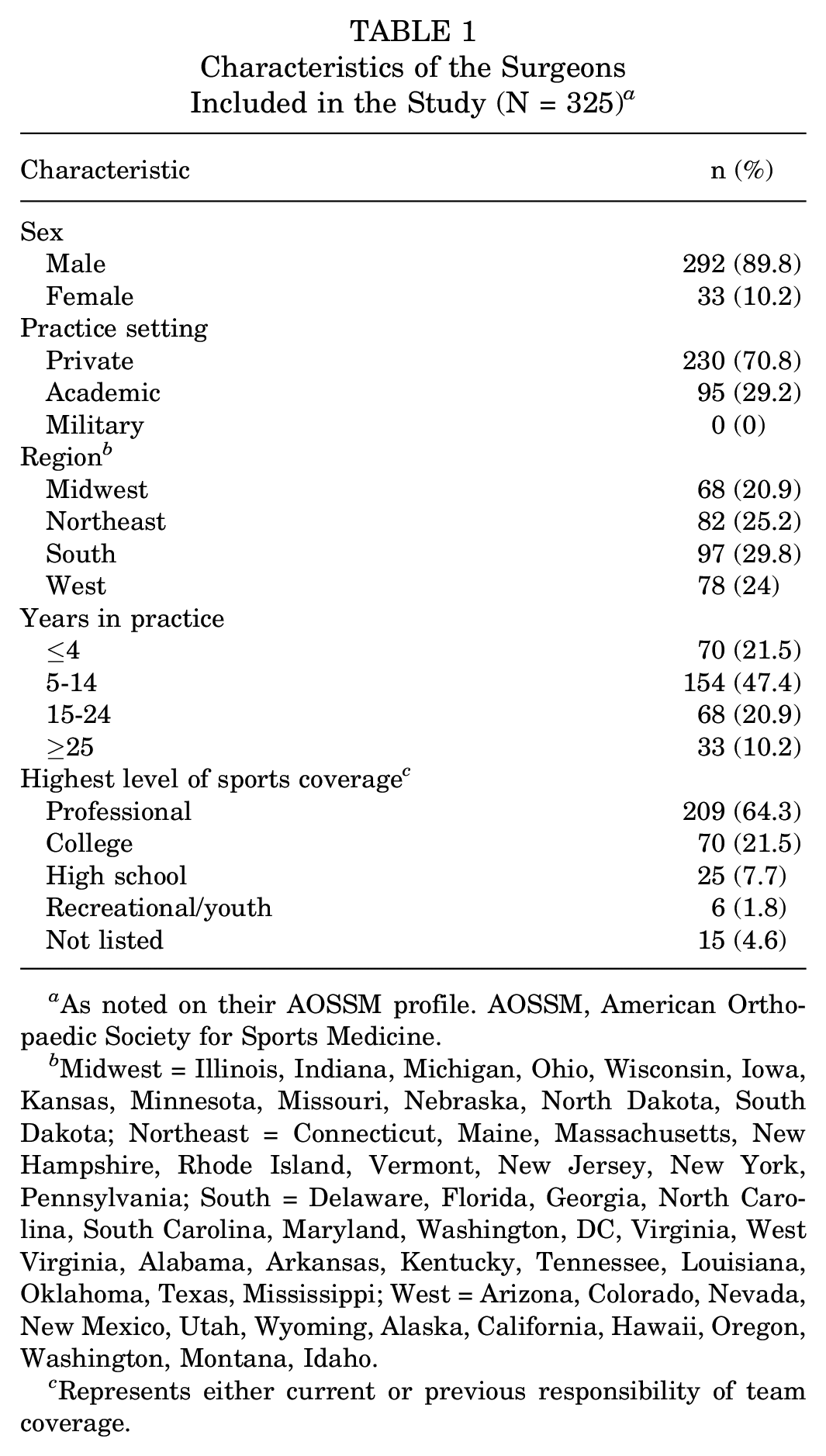
As noted on their AOSSM profile. AOSSM, American Orthopaedic Society for Sports Medicine.
Midwest = Illinois, Indiana, Michigan, Ohio, Wisconsin, Iowa, Kansas, Minnesota, Missouri, Nebraska, North Dakota, South Dakota; Northeast = Connecticut, Maine, Massachusetts, New Hampshire, Rhode Island, Vermont, New Jersey, New York, Pennsylvania; South = Delaware, Florida, Georgia, North Carolina, South Carolina, Maryland, Washington, DC, Virginia, West Virginia, Alabama, Arkansas, Kentucky, Tennessee, Louisiana, Oklahoma, Texas, Mississippi; West = Arizona, Colorado, Nevada, New Mexico, Utah, Wyoming, Alaska, California, Hawaii, Oregon, Washington, Montana, Idaho.
Represents either current or previous responsibility of team coverage.
Use of Social Media
The distribution of online social media platform presence and relative activity level for the most active 325 sports medicine surgeons are presented in Figure 1. A total of 260 surgeons (80%) had a professional Twitter account and 174 (53.5%) actively used Twitter within 6 months before the time of analysis. A total of 209 surgeons (64.3%) utilized a professional Instagram account. Only 147 of the 325 surgeons actively utilized Instagram within the previous 6 months (45.2%). Across the remaining major platforms, 223 (68.6%) had a professional YouTube account, with only 57 (17.5%) actively using YouTube in the previous 6 months, and 287 surgeons (88.3%) had professional Facebook accounts, with 244 (75.1%) surgeons actively using Facebook in the previous 6 months.
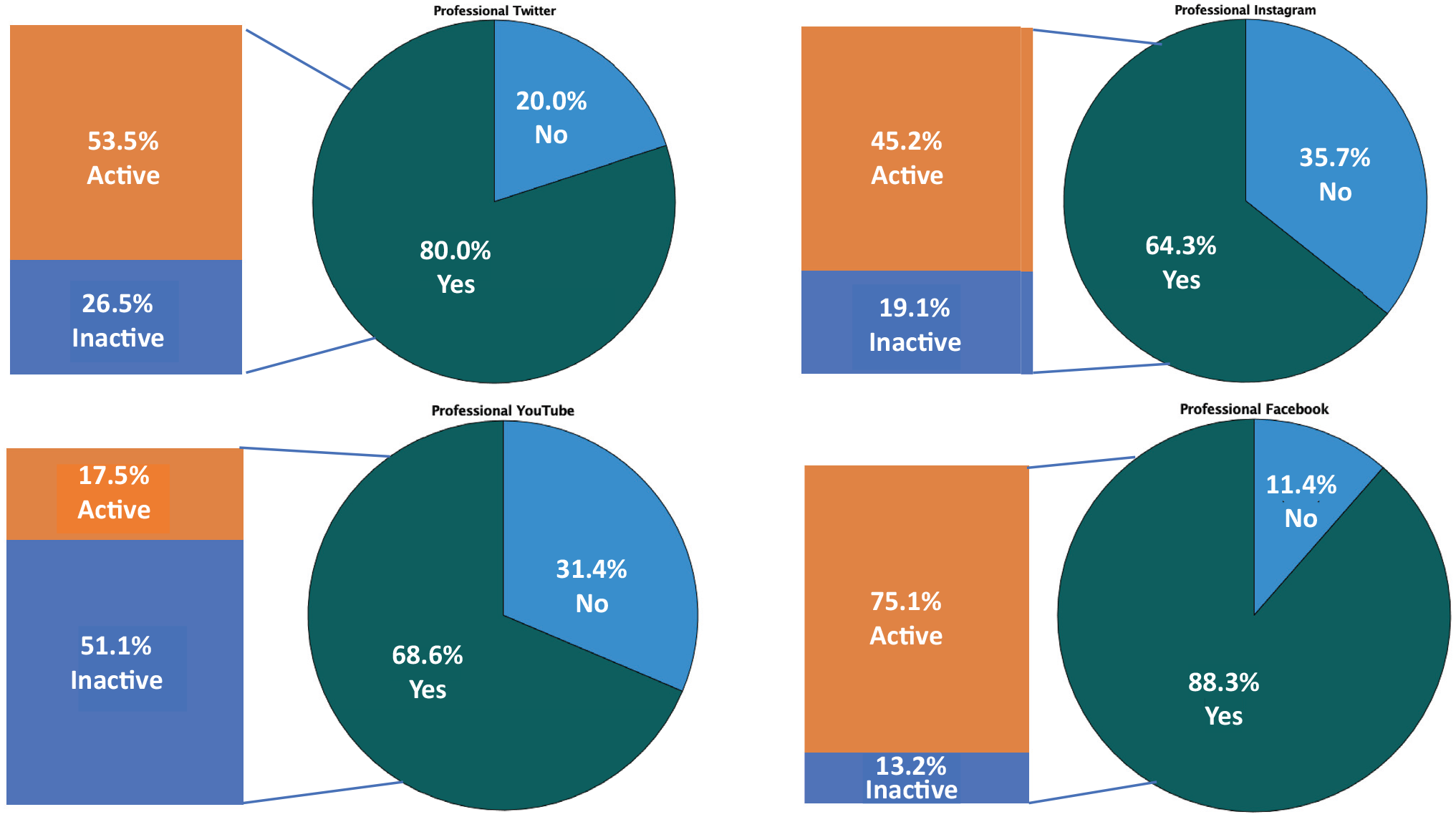
Pie charts modeling the distribution of presence and activity level for Twitter, YouTube, Instagram, and Facebook, where an active account is defined as usage within the previous 6 months.
Effects of Social Media on Ratings
The relationship between Twitter activity and patient ratings are outlined in detail in Table 2. There was no association between active Twitter use and overall ratings on any of the PRWs. When examining the relationship between active Twitter accounts and Google Reviews ratings, there was an increased likelihood of having a larger number of ratings (OR, 1.307 [95% CI, 1.004-1.701]; P = .046) and number of comments (OR, 1.496 [95% CI, 1.142-1.959]; P = .003) when surgeons had an active Twitter account. On Healthgrades, there was a significant association between Twitter activity and the number of ratings (OR, 1.414 [95% CI, 1.121-1.784]; P = .003) and number of comments (OR, 1.436 [95% CI, 1.103-1.869]; P = .007). When considering Vitals, Twitter activity led to an increased likelihood of having a larger number of ratings (OR, 1.287 [95% CI, 1.012-1.637]; P = .04. Of note, patients associated surgeons who had active Twitter accounts with shorter average clinic wait time (OR, 0.864 [95% CI, 0.766-0.975]; P = .018).
Association Between Active Twitter Account and PRW Variables a
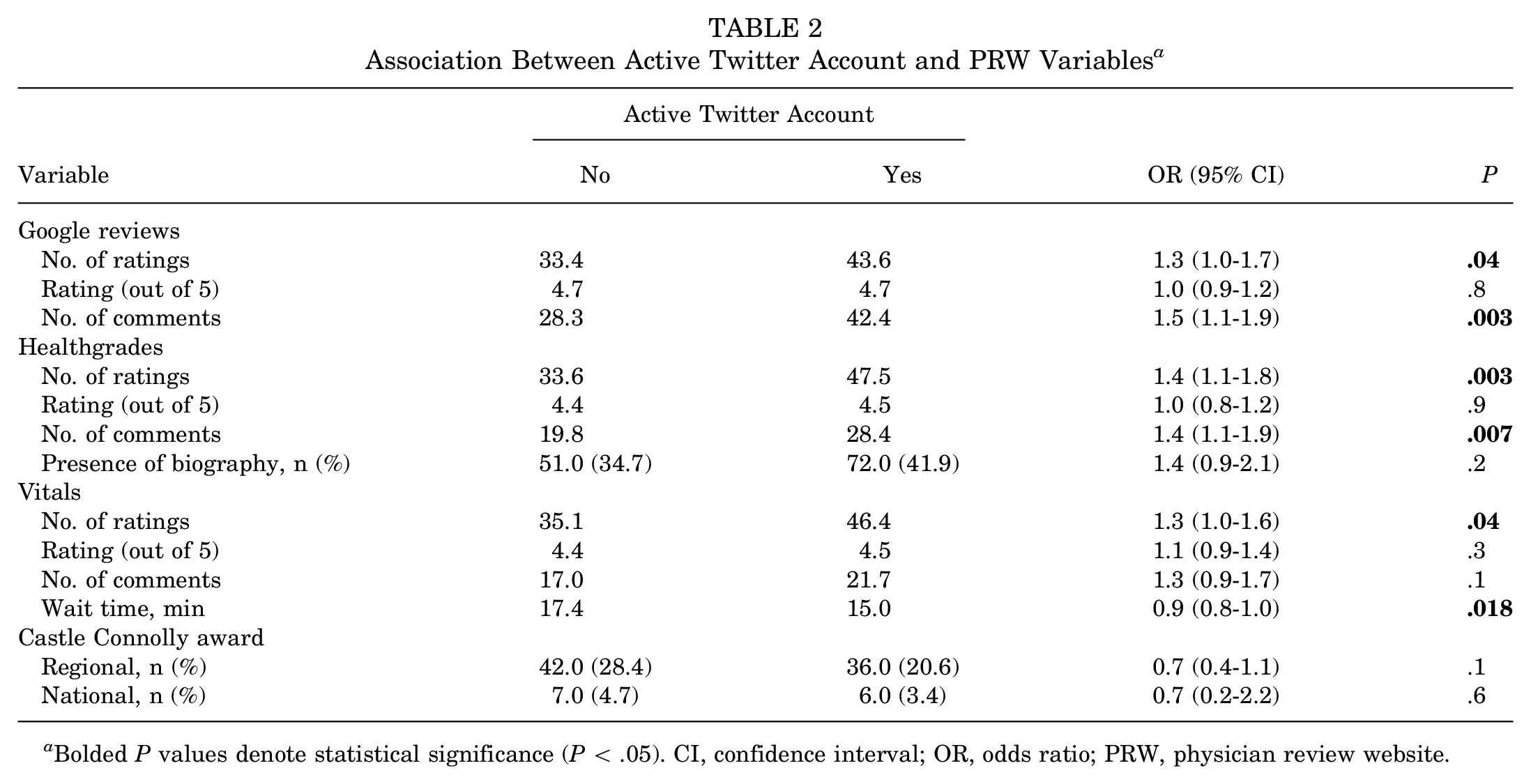
Bolded P values denote statistical significance (P < .05). CI, confidence interval; OR, odds ratio; PRW, physician review website.
The relationships between active Instagram accounts and patient ratings are outlined in Table 3. There was no association between active Instagram use and overall ratings on any of the PRWs. There was no significant relationship between Instagram activity and Google Reviews or Healthgrades ratings. This was true for all 3 outcomes: number of ratings (P≥ .49), overall rating (P ≥ .634), and number of comments (P ≥ .091). There was, however, a significant relationship between Instagram activity and the number of comments on Vitals (OR, 1.359 [95% CI, 1.017-1.790]; P = .038).
Relationship Between Active Instagram Account and PRW Variables a

Bolded P value denotes statistical significance (P < .05). CI, confidence interval; OR, odds ratio; PRW, physician review website.
The relationships between active YouTube or Facebook accounts and patient ratings are outlined in Table 4 and Table 5, respectively. There was no significant relationship between YouTube or Facebook activity and any of the evaluated outcomes, suggesting they do not play a major role in physician reviews.
Relationship Between Active YouTube Account and PRW Variables a

CI, confidence interval; OR, odds ratio; PRW, physician review website.
Relationship Between Active Facebook Account and PRW Variables a

CI, confidence interval; OR, odds ratio; PRW, physician review website.
Discussion
The principal finding of this study was that there was no significant relationship between active social media use and overall ratings on any of the PRWs. However, active Twitter use was significantly associated with (1) a greater number of ratings on all PRWs assessed, (2) a greater number of comments on Google Reviews and Healthgrades, and (3) shorter patient-reported wait times in clinic. While active Instagram use was associated with a significantly greater number of comments on Vitals, there were no other statistically significant findings. No relationships were observed for active YouTube or Facebook use and PRW outcomes.
In this study, there was no significant relationship between active social media use on any platform with overall ratings on any PRW nor were there any significant associations between active social media use and Castle Connolly regional or national awards. While initial studies on the role of social media for spine surgeons in Florida and Texas, respectively, also found no association between use of Facebook, Twitter, or Instagram with higher overall ratings,4,5 a follow-up study of New York spine surgeons found that having any form of social media was significantly associated with higher scores on PRWs. Of note, having an Instagram account was associated with higher scores on all websites, whereas Facebook use was associated with higher Healthgrades ratings only. These latter findings are similar to those of Sama et al, 25 who also saw a significant trend toward higher physician ratings on all websites for sports medicine physicians in Florida with any form of social media presence. Their study included LinkedIn, a professional networking platform not assessed in the current study, and did not include YouTube, all of which may have produced disparate results from the present study. McCormick et al 20 also saw higher ratings on PRWs, in addition to number of ratings and comments for shoulder and elbow surgeons who had professional social media accounts. This variability in findings may be attributable to differences in subspecialty, geographics, or even heterogeneous study designs. It is possible that the results from our current study differ from other reported studies on PRWs as we assessed only the top 10% of AOSSM members who were most active on social media and thus represent a niche cohort of surgeons. In addition, other factors may play a much more important role in attaining positive reviews on PRWs, including the amount of time spent with patients, associated clinic wait times, responsiveness to email/telephone calls, and surgical outcomes.
Moreover, our study assessed the 325 sports medicine surgeons in the US who are known to be most active on social media; it is possible that the presence of social media alone may not lead to higher ratings, but increased activity on these platforms may be more important for quantity of comments and ratings. Several parallels exist in online consumer choice as it relates to popularity bias for physicians. Hayes et al 11 assessed whether a larger sample size of online reviews could act as a proxy for product quality and found that when consumers could not explain why a difference existed in 2 similar products, the product with the larger sample size of reviews was chosen. Comparatively, when a factor for the difference in ratings could be explained, such as length of time a product was advertised online, the popularity bias was reduced drastically. Furthermore, Heck et al. 12 confirmed their hypothesis that consumers strive for a “coherence model,” where the combination of average review scores as well as number of reviews contributes to bias in selecting popular products. With regard to sports medicine surgeons and PRWs, the number of comments and not just the ratings may act as a proxy for popularity. This has important implications for patient recruitment and trust before patients decide to proceed with care. Hoang et al 14 demonstrated that of the 329 patients they surveyed at 5 multispecialty orthopaedic surgery groups, younger patients were found to believe the information they saw on PRWs as useful, sufficient, and unbiased for selecting a surgeon.
Of all platforms assessed, Twitter is the only one in which active use correlated with more comments and ratings on PRWs. The microblogging nature of Twitter allows physicians to quickly provide concise pieces of information (limited to 140 characters) pertaining to surgical techniques, new research, or even marketing information regarding their practice.8,15,28 They can further enhance the level of engagement of their posts by using hashtags, which allow their posts to be linked to other similar posts and thereby be more accessible to viewers. Moreover, the interactive element of Twitter - the ability to like, reply to, or retweet a post - may allow for increased engagement not only between physicians but also between physicians and past, current, or potential future patients. Instagram, however, usually requires viewers to have a membership on the platform to readily view its content. Thus, although the majority of the most active sports surgeons (64.3%) have a professional Instagram account, it is possible that their patient viewership could be limited due to difficulty finding or sharing their content. Furthermore, no significant findings were observed between active YouTube or Facebook use with PRW outcomes. Unlike Twitter, which is typified by short, ideally less effortful posts and reposts, YouTube inherently requires more effort to create and edit video content to attract viewership and many of the resources available are of low quality.18,24 This may explain why, although 68.6% of the most active sports surgeons had a professional YouTube account, only 17.5% were actually active on it. The interpretations from the current study must consider the relatively low percentage of “active” social media accounts and the ultimate impact on PRW outcomes.
As social media continues to become used widely and patients are similarly continuing to utilize internet searches to make medical decisions, it is increasingly relevant for sports medicine surgeons to consider how to integrate social media into their practice. Curry et al 3 saw that, of new orthopaedic patients who reported using social media platforms, 51.8% also did research to understand their health before seeing the provider and up to another 26% relied on PRWs before these visits. Younger patients tended to use social media more, as well as sports medicine patients, a cohort typically composed of younger orthopaedic patients. 3 As Sama et al 25 have already demonstrated that social media use for a small subset of sports surgeons was associated with higher overall physician ratings, these data on PRWs could impact perceptions of potential sports medicine patients. Moreover, patients who used social media were more likely to travel further distances for new patient consultations, as far as 120 to 180 miles (190-290 kilometers). 3 In regards to Twitter and Instagram, reviews of posts from patients and surgeons on ulnar collateral ligament reconstruction and hip arthroscopy have shown that the majority of posts from patients highlight positive experiences with diagnosis, treatment, and rehabilitation after these injuries.10,29 Thus, the impressions these surgeons make via their social media presence and PRWs could potentially influence younger, sports medicine patients to seek them out and to travel from further distances. Furthermore, a study on the quality of comments on PRWs for spine surgeons saw that more positive reviews were attributable to patient outcomes as well as surgeon likeability and perceptions of their character. 6 It found that 89.9% of online comments were related to surgeon outcomes and likeability. Thus, the ways in which sports medicine surgeons choose to “personalize” their social media platforms may lead to an enhanced number of positive reviews. This is pertinent, as it is known many patients use not only ratings but also the comments on these PRWs to make decisions on who will provide medical care.
Limitations
This study must be interpreted in the context of its limitations. Principally, the cross-sectional nature of the study design does not allow any causality to be established. We did not compare high social media activity surgeons with low activity social media surgeons, which may have masked some differences in the outcomes. Furthermore, the appraisal of social media “activity” as a binary assessment of social media activity in the last 6 months may underrepresent the importance of social media activity. It is also possible that the cohort that is frequently using social media platforms for information about their surgeon is not the same population that is leaving reviews on PRWs. The PRWs may also be influenced by paid marketing structures and/or advertisements of practices and therefore not truly reflective of organic practice appraisal. We also acknowledge that there is potential bias in persons who are deciding to leave comments or ratings on PRWs and may be influenced by good or bad patient experiences as well as the potential to be solicited by the surgeons themselves to fill out online reviews. Furthermore, the current study was not able to definitively determine whether increasing number of positive comments and ratings was associated with increases in new patient visits to the surgeons. Future studies are still needed to assess how surgeons choose to produce their social media content as well as who is managing their accounts. Moreover, it would be important to know how much surgeons or their affiliated hospitals or practices are spending on marketing toward social media and how much time in a day they personally are spending developing and releasing content. Having this information may provide more insight into the “personalized” nature of their social media platforms as well as the ease with which others may incorporate this into their own practices. Furthermore, future research into the new patient referrals and operative volume generated from patients who found providers via social media content could be beneficial to quantify the larger impact of these platforms.
Conclusion
For sports medicine surgeons most active on social media, no significant relationships were found between active social media use and overall ratings on PRWs. Of all the platforms assessed, active use of Twitter was the only significant predictor of more reviews on PRWs. Thus, when deciding which form of social media engagement to prioritize in building one's practice, Twitter may serve as a relatively low-demand, high-reward option.
Footnotes
Final revision submitted June 3, 2023; accepted June 7, 2023.
One or more of the authors has declared the following potential conflict of interest or source of funding: H.W.S. has received education payments from Medwest Associates and Smith & Nephew. O.A.O. has received education payments from Medwest Associates. J.C. has received education payments from Medwest Associates, Arthrex, and Smith & Nephew; consulting fees from Smith & Nephew, Vericel, Arthrex, DePuy Synthes Products, Conmed, Ossur, and Linvatec; nonconsulting fees from Smith & Nephew and Linvatec; hospitality payments from Stryker and Medical Device Business Services; and a grant from Arthrex. AOSSM checks author disclosures against the Open Payments Database (OPD). AOSSM has not conducted an independent investigation on the OPD and disclaims any liability or responsibility relating thereto.
Ethical approval was not sought for the present study.