



Abstract
Background:
Currently, most pitching instructors suggest a shorter arm path—the total distance the arm travels during pitching. Theoretically, this combination allows for better body segment sequencing, a more efficient energy transfer through the kinetic chain, and increased ball velocity, while limiting elbow varus torque.
Hypothesis:
Shorter arm paths would be associated with increased ball velocity and decreased elbow varus torque.
Study Design:
Descriptive laboratory study.
Methods:
A total of 182 professional pitchers threw 8 to 12 fastball pitches while evaluated by 3-dimensional motion capture (480 Hz). The arm path was calculated as the total distance the hand marker traveled during the pitch. The pitch was divided into early, late, and total arm paths. A linear regression model assessed the interpitcher relationship between arm path, elbow varus torque, and ball velocity. A linear mixed-effects model with random intercepts assessed intrapitcher relationships.
Results:
Interpitcher comparison showed that total arm path weakly correlated with greater elbow varus torque (P = .025). Strong correlations were found between ball velocity and early (R2 = 0.788; P < .001), late (R2 = 0.787; P = .024), and total arm paths (R2 = 0.792; P < .001). Strong positive intrapitcher correlations were found between elbow varus torque and early (R2 = 0.962; P < .001) and total arm path (R2 = 0.964; P < .001). For individual pitchers, there was a large variation in the early (30.1 ± 15.7 cm) and late (21.4 ± 12.1 cm) arm path. For every 30-cm (11.8-inch) increase in early arm path (the mean range for an individual pitcher), there was a 1.29-N (β = 0.0429) increase in elbow varus torque and a 0.354 m/s (0.79 mph) (β = 0.0118) increase in ball velocity.
Conclusion:
A shorter arm path correlated with decreased elbow varus torque and decreased ball velocity in intrapitcher comparisons. Determining the individual mechanics that decrease elbow varus torque may help coaches and trainers correct these patterns.
Clinical Significance:
A shorter arm path during the pitch can decrease elbow varus torque, which limits the load on the medial elbow but also has a detrimental effect on ball velocity. An improved understanding of the impact of shortening arm paths on stresses on the throwing arm may help minimize injury risk.
Keywords
Over the past 10 years, the rate of fastballs thrown over 95 mph during a game among Major League Baseball (MLB) pitchers has increased 38 from 12% to 22.1%. This steady climb in fastball velocity in professional pitchers has been accompanied by a rising prevalence of shoulder and elbow injuries.5,17,10 The act of throwing a fastball places the throwing arm at high kinetic loads and greater elbow varus torque24,32 and may place pitchers at risk of ulnar collateral ligament (UCL) injury. 7 Mechanics, such as increased horizontal abduction of the shoulder at foot contact (FC), increased maximum shoulder external rotation, and trunk lateral flexion at ball release (BR), have been related to both increased ball velocity26,36,37,43 and increased risk of injury.6,21,22,25,33,35,39
Arm path, or the total distance that the arm takes to get from the glove to BR, has become an increasingly discussed topic within the baseball community. 28 Arm path is a combination of wrist flexion/extension, forearm pronation/supination, elbow flexion/extension, shoulder external/internal rotation, and shoulder horizontal abduction/adduction movements throughout the entire pitch. Traditionally, pitchers have been taught to throw with a longer arm path during the first part of the pitching motion, which includes limiting elbow flexion and extending the throwing arm away from the body while delaying shoulder external rotation. Historically, it has been hypothesized that a shorter arm path would place increased stress on the throwing arm and could be harmful with more rapid acceleration and deceleration of the limb over a shorter trajectory. 31 However, there has recently been a change in philosophy for pitchers to shorten their arm path to decrease injury risk and optimize ball velocity. In one of the first discussions of the idea of a shorter arm path, Japanese instructor Katsuma Tezuka details this idea as an “elbow spiral.” 40 While no English versions of this book exist, DriveLine Baseball has translated it for internal use and reported that Tezuka advocates for shortening the arm during the arm-cocking phase and not allowing it to extend toward second base. 28 Pitching instructors anecdotally suggest that the shorter arm path allows for better sequencing of the trunk and throwing arm segments and more efficient transfer of energy through the kinetic chain. Theoretically, this combination ultimately produces increased ball velocity with decreased elbow varus torque experienced at the throwing arm. In recent years, there has been a trend toward a shorter arm path in MLB pitchers 28 ; however, no studies to date have investigated the influence of arm path on kinetics or ball velocity.
The purpose of this study was to investigate the relationship between the arm path of professional baseball pitchers and ball velocity and elbow varus torque. We hypothesized that shorter arm paths would be associated with increased ball velocity and decreased elbow varus torque.
Methods
This was a retrospective review of professional pitchers who were previously tested by Motus Global. Motus Global deidentified all data before distribution. The study protocol received institutional review board approval. A total of 320 professional pitchers (21.8 ± 2.18 years of age; 190.4 ± 5.6 cm; 95.2 ± 9.6 kg) who had previously undergone evaluations were included in this study. At the time of testing, the inclusion criteria were professional baseball pitchers on the Major League or Minor League roster (at any level) and had no serious injury (<2 weeks on the injured list) in the previous 6 months.
Demographic data were reported by each pitcher—including age, preferred throwing arm, experience level, and history of injury. Research staff measured and recorded the pitcher’s height and weight. Before pitching, 46 reflective markers were positioned on anatomic landmarks as previously described. 19 Positional coordinate data of the reflective markers were collected using an 8-camera Raptor-E motion analysis system (Motion Analysis Corporation) at 480 Hz. The global coordinate system was established based on International Society of Biomechanics standards: Y was vertically upward, X was from the pitching rubber toward home plate, and Z was the cross-product of X and Y. 44
After an unlimited warm-up period with the pitcher’s preferred routine, all fastballs were pitched with a game-like effort from a dirt mound to a catcher behind home plate at regulation distance (60 ft 6 inch [18.4 m]). Data for 8 to 12 fastballs were captured for each pitcher. Pitchers were allowed to pitch at their own pace and directed to aim for the middle of the strike zone. Ball velocity was measured with a radar gun behind the pitcher (Stalker Sports Radar).
All data processing was performed using custom MATLAB scripts (Version R2021b; Mathworks) as previously described.8,20 Data from the markers were filtered by a low-pass filter (fourth-order zero-lag Butterworth filter; 13.4-Hz cutoff frequency). 16 The pitch was divided into 3 time points: maximum knee height (MKH), FC, and BR (Figure 1). MKH was established as the frame where the lead knee reached maximum height in the Y-direction. FC was identified as the first frame when the lead toe or heel in the Y-axis reached the ground surface. BR was calculated as the instant 0.01 sec after the wrist joint center passed the elbow joint center in the positive X-direction.8,19,11 These time points were used to define the early arm path (MKH to FC), late arm path (FC to BR), and total arm path (MKH to BR). There is potential movement of the throwing arm before MKH and the arm continues to move after BR. However, these time points were chosen because they represent standardized time points and allowed for comparison between pitchers. The arm path was calculated as the total distance the hand marker moved measured in cm. Arm length was measured as the combined distance from the wrist joint center (defined by the medial and lateral wrist markers) to the elbow joint center (defined by the medial and lateral wrist markers) and then the elbow joint center to the acromion marker. Peak elbow varus torque was reported both as an absolute value and as a normalized value by pitcher’s body weight (%BW) and height (%BH).8,19,20

Identified phases of the pitch used to define arm path lengths: early arm path (MKH to FC), late arm path (FC to BR), and total arm path (MKH to BR). MKH, maximum knee height; FC, foot contact; BR, ball release.
To establish a distribution of pitches for analysis, pitchers who had a pitch velocity range <1.3 m/s (2.9 mph) were excluded (n = 93). Pitchers were also excluded if they had fewer than 3 recorded pitches (n = 45). To assess the relationship between the arm paths, elbow varus torque, and ball velocity among all pitchers, a simple linear regression model was used. This was conducted by using pitchers’ averages across all trials. To assess intrapitcher relationships, a linear mixed-effects model with random intercepts was used to analyze all pitches for each player. For all analyses, statistical significance was set at an alpha value of .05. Also, R2 < 0.3 indicated a weak correlation, 0.3 < R2 < 0.7 a moderate correlation, and R2 > 0.7 a strong correlation. All data analyses were performed using MATLAB with the Statistics and Machine Learning Toolbox.
Results
Of the 320 professional pitchers, 182 satisfied the inclusion and exclusion criteria, with a mean of 10.5 ± 2.5 pitches per pitcher. The mean ball velocity was 38.7 ± 1.5 m/s (86.6 ± 3.4 mph), with a mean ball velocity range of 36.2 to 43.7 m/s (81-93.7 mph). For individual pitchers, the mean range of ball velocities was 2.1 ± 0.7 m/s. The mean absolute elbow varus torque was 87 ± 15.0 N·m and the normalized elbow varus torque was 4.9% ± 0.7% BW×BH. The mean total arm path was 399.7 ± 28.9 cm, with a range of 306.9 to 486.8 cm. For individual pitchers, the mean arm path variation by throwing phase was 19.1 ± 12, 30.1 ± 15.7, and 21.4 ± 12.1 cm for total, early, and late paths, respectively. The mean arm length was 58.55 ± 3.99 cm, with a range of 46.16 to 70.77 cm.
Simple linear regressions for interpitcher analysis found weak R2 values (≤0.03) for all arm paths when compared with ball velocity and elbow varus torque, with only 2 comparisons showing significance (Table 1). No statistically significant associations were found with ball velocity. Early and total arm paths were the only significant paths that were weakly correlated with elbow varus torque (P = .020 and .025, respectively). When arm path was normalized by arm length to account for differences between pitchers, there were still no significant associations with elbow varus torque (Table 2).
Arm Path Versus Elbow Varus Torque and Ball Velocity in Professional Pitchers a
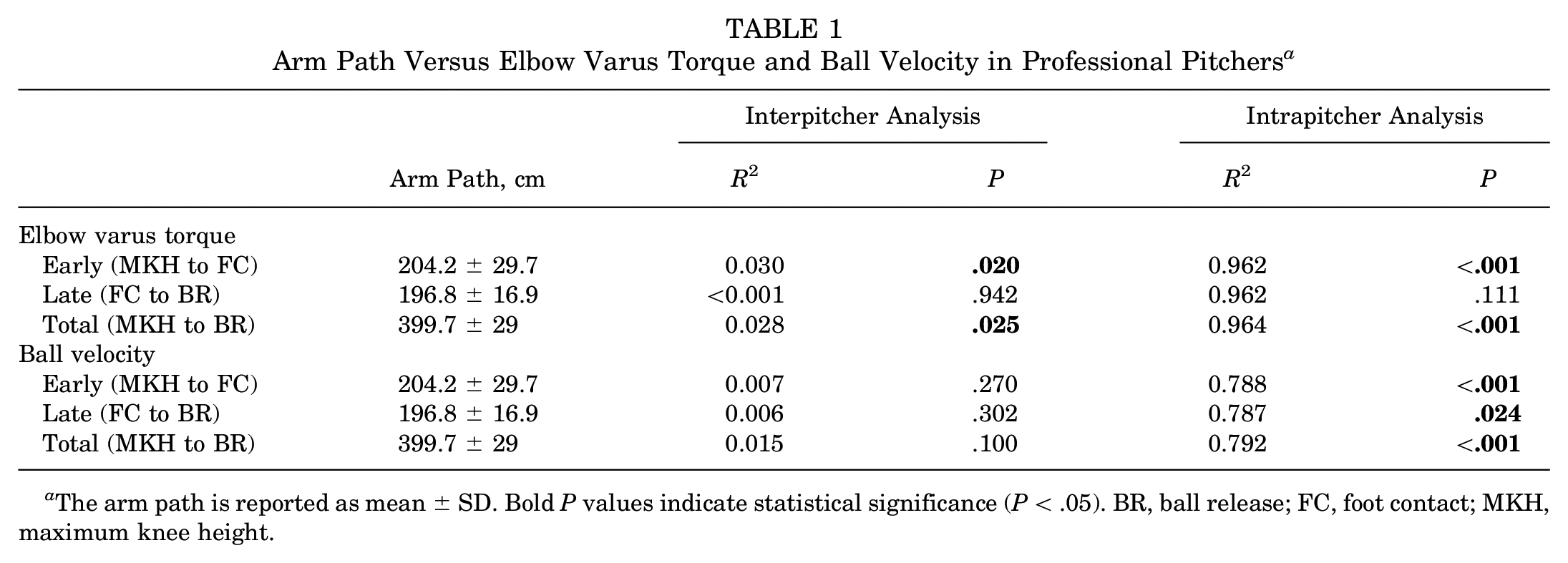
The arm path is reported as mean ± SD. Bold P values indicate statistical significance (P < .05). BR, ball release; FC, foot contact; MKH, maximum knee height.
Normalized Arm Path Versus Normalized Elbow Varus Torque in Professional Pitchers a

The arm path is reported as mean ± SD. BR, ball release; FC, foot contact; MKH, maximum knee height.
Normalized to the percentage of arm length.
A linear mixed-effects model with random intercepts was used for the intrapitcher analysis to compare the 3 arm paths with ball velocity and elbow varus torque. Strong correlations were found between ball velocity and early (R2 = 0.788; P < .001), late (R2 = 0.787; P = .024), total arm paths (R2 = 0.792; P < .001), and total arm path (R2 = 0.964; P < .001) (Table 1). For every 30 cm (11.8-inch) increase in early arm path (the mean range for an individual pitcher), there was a 0.35 m/s (0.79 mph) (ß = 0.0118) increase in ball velocity and a 1.29 N·m (β = 0.043) increase in elbow varus torque. Late arm path showed a nonsignificant correlation with elbow varus torque (R2 = 0.962; P = .111).
Discussion
In the present study, we aimed to investigate 2 primary hypotheses: (1) a shorter arm path would result in increased ball velocity, and (2) a shorter arm path would result in decreased elbow varus torque. Contrary to our hypothesis, we found that shorter arm paths were associated with lower ball velocity. The change in ball velocity was modest—a player pitching at the upper end of his early arm path range threw only approximately 0.75 mph faster than the lower end. Confirming our second hypothesis, a strong positive correlation was reported between early arm path and total arm path with elbow varus torque (R2 = 0.962-0.964) when using intrapitcher comparison. Modification of early arm path appears to be a potential avenue to decrease injury risk in pitchers to decrease elbow varus torque.
As this is the first study to investigate arm path, as well as investigate the continual movement of the throwing arm during a pitch, there are no direct comparisons with previous literature for our values. Biomechanical studies have investigated the pitching motion starting at the moment of FC, as it has been thought that the impact of movement before FC is negligible because FC is the first moment of energy transference between the ground and the body.12-14,21,42 However, in the time that occurs before FC, or the interval that we have defined as early arm path (from MKH to FC), there is substantial movement of the throwing arm. In the present study, 51% of the total arm path is represented by the distance traveled in the early arm path interval. Given the findings of the present study, it is paramount that any analysis of the throwing arm include motion starting from MKH, as this is over half of the total movement during the pitching motion.
Pitchers remove their hand from their glove to begin the arm motion with some combination of shoulder abduction, shoulder external rotation, elbow extension, and wrist flexion/extension, all beginning before FC. Intrapitcher analysis showed a 30-cm range in the early arm path between pitches. This variation represents a combination of shoulder, elbow, and wrist motion. When a pitcher was throwing at the higher end of this range (30 cm), there was a 1.29 N·m higher torque experienced at the elbow. Considering that the mean varus torque experienced with each throw is approximately 87 N·m, this represents a 1.5% increase in elbow varus torque. While this number seems insignificant with 1 pitch, it can significantly change workload over the course of a game, season, and lifetime. It is thought that elbow injuries are a result of repetitive microtrauma to the soft tissues, and thus, minimizing the accumulated damage is crucial in preventing injury. Previous research has shown that pitchers are more likely able to make adjustments in their pitching delivery in the early parts of the pitch (ie, early arm path), compared with later parts of the pitch where changes are more unlikely. 15 Identifying movement patterns that need to be adjusted in the early arm path can help guide coaches and clinicians to correct these patterns to decrease elbow varus torque and thus injury risk.
Previous research has linked individual components of the throwing motion with elbow varus torque starting at FC—specifically elbow flexion, shoulder horizontal abduction, shoulder rotation, shoulder abduction, and forearm pronation to elbow varus torque—although the impact of arm path is not well elucidated.3,41,42,34 Werner et al 41 reported that college pitchers who landed with less elbow extension and shoulder abduction had decreased elbow varus torque. In a separate study on professional pitchers, Werner et al 42 found that elbow varus torque was related to the amount of elbow flexion at peak torque, suggesting a more flexed elbow reduced the amount of torque experienced at the elbow. However, elbow flexion only accounted for 5% of the variance in elbow varus torque. Similarly, Aguinaldo and Chambers 3 evaluated a sample of college and professional pitchers and reported that elbow flexion at peak torque was protective against excess varus torque. Given the strong correlation between arm path and elbow varus torque within pitches for an individual player, it is important to identify possible modifications to a pitcher’s early arm path to reduce elbow varus torque and potential injury risk.
Our hypothesis that a shorter arm path would support more efficient movement and therefore result in higher ball velocities was not supported. An increase in early, late, and total arm paths was significantly and positively correlated with increased ball velocity within a pitcher. Our study reported that for every 30 cm increase in the early arm, the path was in ball velocity of 0.354 m/s (0.79 mph) (ß = 0.0118). Given the fact that increases in elbow varus torque and velocity have been shown to increase UCL risk, the early arm path appears to be an ideal target for pitching motion modification to prevent injury.
It has been speculated, although not established, that slight movement variability in pitching mechanics between throws can be protective for a pitcher, as this can lead to varying displacement of the pitching load on the tissues of the throwing arm. Conversely, large variability may cause disruptions in timing and lead to compensations, creating additional loads and theoretically increasing injury risk. 14 In the present study, there was a 30-cm (11.8-inch) range in the early arm path within individual pitchers, indicating a surprisingly large variation between pitches at the early part of each pitch. This variability is a combination of slight differences in shoulder, elbow, and wrist motions that, while seemingly insignificant when isolated to each joint, can compound when added together to yield wider variability in the early arm path. Conversely, variations in each segment or joint could cancel each other out and result in the same arm path but with very different pitching mechanics. Optimization of a given pitcher’s mechanics may not require a major overhaul but rather minor adjustments.
The pitch is a complex motion that requires large contributions from the legs, pelvis, and trunk where alterations in mechanics can influence elbow varus torque.3,4,42 Increased knee extension and pelvis rotation velocity increase the transfer of energy to the trunk and throwing arm, ultimately producing greater ball velocity.9,18,19,37 Additionally, the timing of the kinetic chain is crucial, and temporal variations have significant impacts on both torque and ball velocity.1,2,23,27,29,30 Professional pitchers with properly sequenced kinetic chains were reported to have faster ball velocity with no difference in elbow varus torque compared with pitchers with discordant kinetic chain sequencing. 23 In the present study, we did not investigate lower extremity, pelvis, and trunk kinematics or the timing of the transfer of energy to the throwing arm, which may be why we found no significant relationships when comparing across different pitchers’ arm path and elbow varus torque. Interpitcher comparison assumes that other variables are nonsignificant contributors to torque; however, there was a strong significant relationship within an individual pitcher, and there likely are significant variations in lower body kinematics that made interpitcher comparisons unreliable. It is possible that contributions from the lower body, kinetic chain, and height and weight have a significant influence on both ball velocity and elbow varus torque. Future research investigating these contributions on arm path and varus torque is warranted.
Limitations
This study has several limitations. First, only professional pitchers were used in this study, and the results may not be generalizable to pitchers participating in other levels of competition. Younger, less experienced pitchers are generally smaller with less strength, resulting in different throwing mechanics, which are generally not seen in professional pitchers. Moreover, potentially confounding variables related to handedness, lower extremity and trunk positional kinematics and prior injury or surgical history were not accounted for in our analyses and could influence the findings between pitchers. Data for each participant were captured once, with no longitudinal follow-up. Instruction on changing the arm path or the ability to train a different length arm path was not studied. While pitchers were instructed to pitch with game-like effort and pitched from the mound, this controlled setting was atypical from practice and competition. We acknowledge that the pitchers may have pitched with reduced effort and may not represent in game mechanics. Additionally, pitches were used regardless of whether it was a strike or a ball, and the arm path might have an impact on the pitcher’s command. Although these measures are known to influence a pitcher’s mechanics and ability to load the throwing arm, we did not evaluate pitchers’ shoulder range of motion or strength. Last, only fastballs were used in this analysis; therefore, the findings may not apply to other pitch types.
Conclusion
A shorter arm path was found to be a weak predictor of ball velocity and elbow varus torque experienced among professional pitchers. However, when controlling for an individual pitcher, early and total arm path was a strong predictor of both ball velocity and elbow varus torque, indicating the shorter the arm path the slower the ball velocity and lower the elbow varus torque. Additionally, within an individual pitcher, there was a large variation in the early arm path between pitches. It appears that minor changes in throwing arm mechanics account for a large change in arm path. Previous studies have linked increased ball velocity and elbow varus torque to increased UCL injury risk; therefore, early arm path appears to be an ideal target for pitch modification to prevent injury. Determining the individual mechanics that lead to decreased elbow varus torque may help coaches and trainers correct these patterns.
Footnotes
Final revision submitted May 11, 2023; accepted May 22, 2023.
One or more of the authors has declared the following potential conflict of interest or source of funding: M.R.C. has received hospitality payments from Encore Medical and Medical Device Business Services, and education payments from Medwest Associates. G.P.N. has received royalties from Anika Therapeutics, Stryker, Arthrosurface, and Wright Medical; consulting fees from Anika Therapeutics, AzurMeds, KCI USA, Stryker, Arthrosurface, and Wright Medical; nonconsulting fees from Arthrosurface and Wright Medical; and honoraria from Arthrosurface. N.N.V. has received consulting fees from Arthrex, Smith & Nephew, and Stryker; nonconsulting fees from Arthrex; royalties from Arthrex, Smith & Nephew, and Graymont Professional Products; and hospitality payments from Relievant Medsystems. G.E.G. has received consulting fees from AzurMeds, DePuy/Medical Device Business Services, Encore Medical, Wright Medical, and Bioventus; royalties from Encore Medical, Stryker, and Wright Medical; and honoraria from Wright Medical. AOSSM checks author disclosures against the Open Payments Database (OPD). AOSSM has not conducted an independent investigation on the OPD and disclaims any liability or responsibility relating thereto.
Ethical approval for this study was obtained from the Rush University Medical Center (ORA No. 20071504-IRB01-AM01).