



Abstract
Background:
There is a wide range of literature on patellar tendon injury, making it increasingly difficult to stay informed on the most influential studies in this field. It is essential to be familiar with the foundational articles of patellar tendon injury research to understand the current state of the literature and deliver high quality care.
Purpose:
To objectively identify the 50 most influential articles relating to patellar tendon injury and conduct a bibliometric analysis to identify key features of these articles.
Study Design:
Cross-sectional study.
Methods:
The Clarivate Analytics Web of Knowledge database was utilized to gather metrics on the 50 most cited articles on patellar tendon injury on June 27, 2022. The information extracted from each article included publication year, number of citations, author information, article type, level of evidence, country of origin, journal name, study focus, and industry influence.
Results:
The top 50 studies were cited a total of 8543 times and published between 1977 and 2015. The majority of articles were published after 2003, and the majority of citations were accrued after 2011. The most prevalent article types were cohort studies (n = 23), and the majority of studies were of evidence level 2 (n = 14) or 4 (n = 13). Australia and the United States (US) each published the most studies (n = 11). Only 4 (8%) studies focused on patellar tendon rupture, and 12 (24%) of the top 50 studies were associated with industry.
Conclusion:
The majority of the top 50 most influential articles in patellar tendon injury were published and accumulated citations in the past 10 to 20 years. Non-US countries, institutions, and journals published many of the top 50 studies, reflecting a global interest and commitment to research in this field. Patellar tendon rupture and surgical repair represents a minority of research in the top 50 studies and could be a point of growth in the future.
Patellar tendon injury spans a wide range of pathologies from tendinopathy to rupture. 37 Patellar tendon injury was originally defined in 1973 as jumper’s knee, a progressive pathology consisting of 4 stages: (1) pain only after activity; (2) pain before activity alleviated with warm-up, but reappearing after activity; (3) constant pain during an activity that hinders performance; and (4) rupture of the patellar tendon. 7 Since then, there has been extensive evolution in our understanding of patellar tendon injury, informed by a consistent growth of literature focused on patellar tendon pathology throughout the last several decades. 36,47
This evolution includes literature which defines at-risk populations, pathophysiology, biomechanics, diagnostics, and treatment of pathology. 36,47 For example, previous literature has demonstrated that patellar tendon injury is especially prevalent in jumping athletes such as basketball and volleyball players. 6,21,24,43 Specific risk factors within athletes include decreased joint range of motion, lower limb biomechanics, training surface, and shoe type. 35,43 As the understanding of risk factors has evolved, new interventions consisting of exercises, training, and biomechanical assessment have been developed in the hopes of reducing patellar tendon injury rates in athletes. 10,27 Multiple theories exist regarding the pathophysiology of patellar tendinopathy, including repetitive tendon overload, 19 degeneration, 23 and neovascularization. 3 This has led to an increase in basic science research hoping to identify the mechanic-biologic factors involved with patellar tendon injury. 42,50 Similarly, there is no consensus on the best treatment plan for patellar tendinopathy, as current treatments range from corticosteroids and cryotherapy to platelet-rich plasma (PRP) injection and surgery. 40
Despite this evolution in our understanding of patellar tendon injury, the ever-growing body of research on patellar tendon injury presents a challenge to clinicians seeking out the most important literature and makes it increasingly difficult to stay up to date with the most important studies on the subject. Bibliometric analysis is a well-established tool that objectively identifies the impact that a particular article or group of articles have on a specific topic. 13,15 Bibliometric analyses examining the most impactful articles have been conducted previously in the fields of cardiac surgery, neurosurgery, urology, and more. 22,31,32 Within orthopaedic surgery, bibliometric analyses have been conducted for shoulder arthroscopy, knee arthroscopy, pediatrics, spine, and more. 4,16,18,28,29,46 Agarwalla et al 1 performed a bibliometric analysis on the 50 most cited articles on patellar instability; however, none of their included articles focused on patellar tendon injury.
The purpose of this study was to identify the top 50 most frequently cited articles related to patellar tendon injury and analyze their key characteristics, including level of evidence, study design, country of origin, publication year, and several other factors.
Methods
This study was deemed exempt from institutional review board approval due to the use of publicly accessible data. Similar to the methodology described in other orthopaedic bibliometric analyses, data and metrics in this study were obtained using the Clarivate Analytics Web of Knowledge. 2,4,5,8,17,20,30,44 A literature search was conducted on June 27, 2022. The search was performed multiple times using varying Boolean queries to capture all iterations of patellar tendon injury research and maximize the largest number of total searches without restrictions on date, language, journal, or country of origin. The final search terms were: (Patella OR Patellar OR Patellar Tendon) AND (Rupture OR Repair OR Injury OR Surgery OR Surgical Repair OR Treatment OR Rehabilitation OR Reconstruction OR Tear Or Avulsion OR Instability OR Tendinopathy OR Tendinosis OR Tendinitis OR Pathology OR Dislocation OR Displacement). This query resulted in 10,952 results.
The 10,952 search results were organized in descending order based on total citations per article. Titles and abstracts of each article were reviewed through consensus by 2 authors (S.B. and V.G.) to evaluate the article’s relevance to patellar tendon injury. Articles were included if they discussed at least 1 of the following: risk factors, injury etiology, biomechanical mechanisms of injury, diagnosis, characteristics, histopathological analysis, management, treatment, surgical repair, surgical outcomes, complications of treatment, or epidemiological trends of any patellar tendon injury. In addition, patellar tendon injury had to be a keyword of the study. Articles with only peripheral mention of patellar tendon injury, articles that involved the patellar tendon as a graft for surgery of a different injury, and articles that studied the patellar tendon without any injury or complication were all excluded. If an article’s abstract was insufficient to determine the inclusion or exclusion of an article, the full manuscript was obtained and reviewed through consensus by 2 authors (S.B. and V.G.) to make an evaluation on inclusion or exclusion. The senior author (A.C.) was consulted for final evaluation if there was any remaining ambiguity.
A total of 50 articles met the inclusion criteria after evaluating the top 663 of the 10,952 search results. The full manuscripts were obtained and reviewed for each of these 50 articles to extract the following information: total citations, citations by year, publication year, first and senior author names, country of origin, institution of origin, publishing journal name, study type, study focus, injury type (tendinosis, tendinitis, rupture, etc), and any conflicts of interest. Country of origin and affiliated institution of the senior author were collected in addition to first author if they were not identical. Study designs were categorized into randomized controlled trial, cohort study, case series, review article, or expert opinion. A review article that did not employ a systematic query or review of the literature was deemed an expert opinion article. Study focus for each article was classified as one of the following: epidemiological, risk factors/injury etiology, injury findings/characteristics, treatment, or multiple of the 4 listed focuses. The level of evidence is a measure of an article’s relative risk of bias, and was evaluated for each article using the guidelines of The Journal of Bone and Joint Surgery. 48 Nonclinical studies had their methodology analyzed to best classify it within The Journal of Bone and Joint Surgery guidelines. Both the level of evidence and study type were determined by consensus between the first and second authors (S.B. and V.G.). The citation density was calculated for each article by dividing the total number of citations the article had accrued by the number of years since publication. 15 Clinical summaries were obtained through consensus by having 2 reviewers (S.B. and M.M.) extracting the main results and conclusions from each study’s abstract.
Results
The top 50 most cited articles relating to patellar tendon injury, with number of citations, citation density, and summary of clinical findings, are listed in Appendix Table A1. The oldest article was published in 1977, and the most recent was published in 2015. The vast majority were published after 1995 (45 of 50), and half of the top 50 were published from 2005 onward. The greatest number of articles published in a single year were 5 in both 2005 and 2006 (Figure 1). The top 50 articles accumulated a total of 8543 citations at the time of analysis and 8305 citations from 1978 to 2021. The majority of the citations accumulated from 2011 onward, totaling 5779 in the subsequent 11 years (Figure 2).
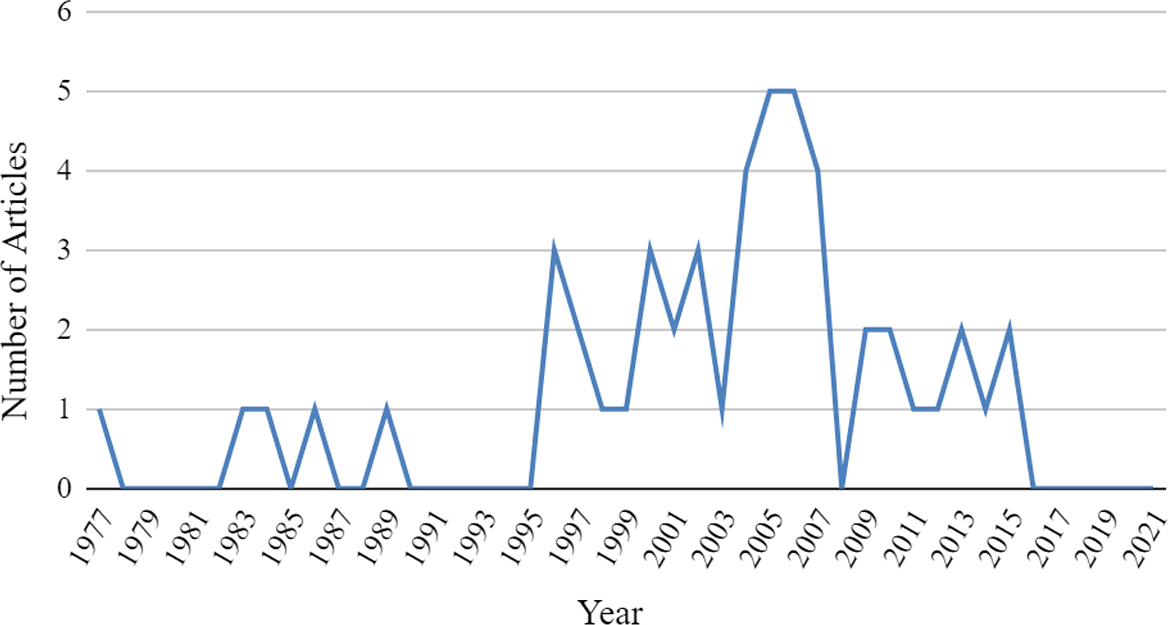
Number of top 50 most cited patellar tendon injury articles published per year.

Total number of citations accumulated by the top 50 most cited patellar tendon injury articles per year.
The mean number of citations per article was 170.9 (range, 110 to 561), and the median number of citations were 146.5. The oldest published article from 1977 ranked 41 of 50 with 132 citations and a citation density of 2.9. 49 The top 3 articles by citation densities had densities of 25.5, 23.9, and 22.2. 9,12,25 The bottom 3 citation densities were 2.9, 3.4, and 3.5. 14,34,49
The most published first and/or senior authors of the top 50 most cited patellar tendon injury articles were led by Håkan Alfredson, with 5. The top authors by number of citations in the top 50 were Karim Khan, Håkan Alfredson, and David Butler, with 765, 750, and 737, respectively. A total of 8 authors had 3 or more publications in the top 50 (Table 1).
Most Represented Authors Within the Most Cited Patellar Tendon Injury Articles

The included articles were published across 17 journals internationally. American Journal of Sports Medicine, British Journal of Sports Medicine, and Scandinavian Journal of Medicine and Science in Sports published the most articles in the top 50, with 12, 8, and 5, respectively (Table 2). These articles originated from 12 countries, with Australia and the United States (US) publishing 11 each. These were followed by Denmark, Italy, and Sweden, which had 5 each (Figure 3). The institutions publishing the most of these studies were Umeå University and University of Cincinnati, with 6 and 5, respectively. A total of 7 institutions published 3 or more of the publications in the top 50 (Table 3).
Publishing Journals of the Most Cited Patellar Tendon Injury Articles


Number of top 50 most cited patellar tendon injury articles by country of origin.
Affiliated Institutions of the Most Cited Patellar Tendon Injury Articles

The most common study type within the top 50 was cohort studies (n = 23), followed by case series (10), randomized controlled trials (9), review articles (4), and expert opinions (4). The most common level of evidence was level 2, with 14, followed by level 4, with 13 (Figure 4). The distribution of study focus was as follows: 30 focused on treatment, 8 on risk factors/injury etiology, 5 on injury findings/characteristics, and 3 on epidemiology; 4 studies had a focus involving multiple of these categories.
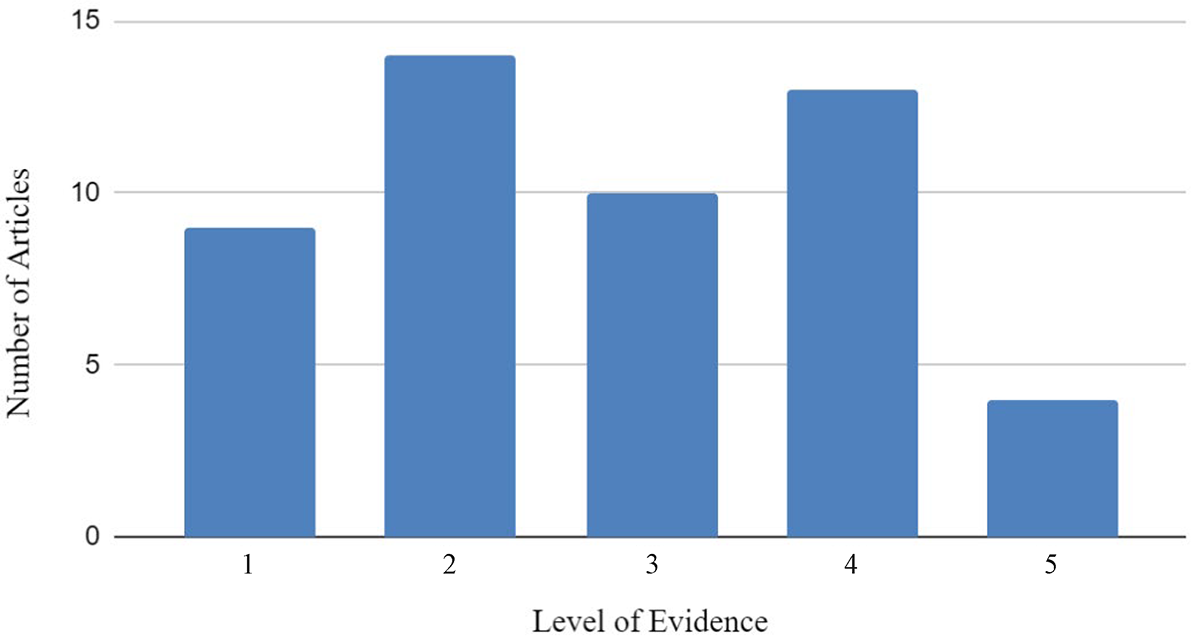
Number of top 50 most cited patellar tendon injury articles by level of evidence.
Of the top 50 studies, 40 were clinically based, whereas 10 had a histopathological approach involving animal models and/or basic science research. A total of 38 studies (76%) focused on some variation of patellar tendinosis while only 4 focused on patellar tendon ruptures. Of the 33 studies with relevant funding information disclosed, 8 (24%) received funding or were affiliated with industry.
The main clinical findings and takeaways are summarized in Appendix Table A1. A total of 11 studies (22%) found benefit from eccentric training as a treatment modality; 4 studies (8%) found positive outcomes in using PRP injections as another treatment. Other findings include relevant risk factors for patellar tendon injury, common histopathological findings of the injury, varying success with other treatment modalities, and more.
Discussion
This bibliometric analysis of the top 50 most commonly cited patellar tendon injury studies demonstrates that the majority were published after 2003, were cohort studies and case series, and level of evidence was primarily 2 and 4. Most of these studies originate from non-US countries, institutions, and journals. Many studies (60%) centered their analysis of patellar tendon injury on some variation of patellar tendinosis and emphasized research on treatment.
Despite the oldest of the top 50 articles being published in 1977, the majority of publications in the top 50 and citations accumulated by the top 50 articles have occurred in the past 11 to 18 years. While this suggests a more recent growth in research centering on patellar tendon injury, no article on the top 50 list was published after 2015, and the accumulation rate of citations is slowing. The combination of these factors suggests that, after experiencing heightened interest and growth in the first 2 decades after 2000, research in the field of patellar tendon injury is either stabilizing or stagnating. This contrasts with fields such as shoulder and knee arthroscopy, which are experiencing rapid growth as evidenced by both the abundance of recent articles and high citation accumulate rate. 28,29 As patellar tendon injury can be complicated to diagnose and treat, perhaps increased study could afford improved understanding of patellar tendon pathology, diagnosis, and current treatment modalities. 33,38 –40
Randomized controlled trials and studies with level 1 evidence were in the minority (9 of 50). This is likely explained by the distribution of only 30 articles focusing on treatment. As new treatments arise and become more prominent, there would be an expected increase in the proportion of randomized controlled trials.
In contrast to findings in other orthopaedic bibliometric analyses, non-US countries represent 78% of the originating countries for the top 50 patellar tendon injury articles. 4,17,20,26,28,29 This is supported by the prevalence of both non-US journals and non-US institutions among the journals and institutions publishing the most top 50 patellar tendon injury articles. This finding supports the notion that the conduction of leading research in the field of patellar tendon injury is an international endeavor, and practitioners would be wise to consult both US and non-US articles without limiting their scope.
The distribution of focus in aspects of patellar tendon research is also quite diverse. Many studies focusing on risk factors/injury etiology, injury findings/characteristics, and epidemiology rather than solely treatment suggest that the field is still exploring various aspects of patellar tendon pathology. Furthermore, patellar tendon rupture and surgical repair represents a small fraction of patellar tendon injury research. Though less common, the severity in clinical impact of this pathology warrants further representation. Lastly, the limited influence of industry in patellar tendon research could be explained by the limited use of technology and robotics in comparison with other orthopaedic fields such as arthroscopy and arthroplasty. However, the ongoing adoption of regenerative medicine in orthopaedics represents an avenue of growth for patellar tendon injury treatment. 11,41,45 Within these top 50 studies, many of them found positive benefits in today’s treatment mainstays such as eccentric load training and PRP therapies. As treatment modalities new to the market involving novel biologics, PRP, stem cells, and scaffolds become perfected, we postulate that patellar tendon research and industry involvement in this research will grow.
Limitations
There are several limitations to this study. First, while the search criteria used in this study were clearly defined, the term “jumper’s knee” was not included. This was done intentionally to widen the search focus to broad-scale patellar tendon injuries throughout the selection process and was remediated by the usage of broad and expansive search criteria, as well as the search function utilizing “topic” rather than “title.” This allows for any article that mentions any term in our broad search criteria to be flagged for selection and does not preclude any article that has a title of solely “jumper’s knee” from being included. Second, while the selection criteria used to narrow down the top 50 articles in patellar tendon injury were well defined and very comprehensive, they were nevertheless partially subjective in nature. In addition, citation accumulation is not a perfect measure of an article’s impact on a field. Articles with fewer citations but significant impact on the field may not have been included. Nonetheless, citation accumulation offers an objective metric that is well accepted and can be used to stratify literature with minimal subjectivity. Finally, the Web of Knowledge database was used for this analysis. While comprehensive, certain articles may have been excluded by either search criteria discrepancies or article citation tabulation inefficiencies.
Conclusion
The majority of the top 50 most influential articles in patellar tendon injury were published and accumulated citations in the past 11 to 18 years. Non-US countries, institutions, and journals published many of the top 50 studies, reflecting a global interest and commitment to research in this field. Patellar tendon rupture and surgical repair represents a minority of research in the top 50 studies and could be a point of growth in the future. This article serves as a reference to direct sports medicine practitioners to the 50 most influential studies relating to patellar tendon injury. We aim for these 50 studies and the analysis we provide to assist healthcare professionals in efficiently assessing consensus, trends, and needs within the field.
Footnotes
Final revision submitted February 20, 2023; accepted April 5, 2023.
One or more of the authors has declared the following potential conflict of interest or source of funding: J.M.H. has received education payments from ImpactOrtho. A.C. has received consulting fees from Zimmer Biomet. AOSSM checks author disclosures against the Open Payments Database (OPD). AOSSM has not conducted an independent investigation on the OPD and disclaims any liability or responsibility relating thereto.
Ethical approval was not sought for the present study.
APPENDIX
Top 50 Most Cited Patellar Tendon Injury Articles a

| Rank | Article | Citations, n (Citation Density) a | Summary of Clinical Findings |
|---|---|---|---|
| 1 | Coleman BD, Khan KM, Maffulli N, Cook JL, Wark JD. Studies of surgical outcome after patellar tendinopathy: clinical significance of methodological deficiencies and guidelines for future studies. Scand J Med Sci Sports. 2000;10(1):2-11. | 561 (25.5) | • There is a negative correlation between reported surgery success rate and methodology scores in 23 studies • Study methodology may influence reported surgical outcome |
| 2 | Awad HA, Butler DL, Boivin GP, et al. Autologous mesenchymal stem cell-mediated repair of tendon. Tissue Eng. 1999;5(3):267-277. | 461 (20.0) | Administering mesenchymal stem cells to a wound site can significantly improve its biomechanical properties within 4 weeks but produce no visible improvement in its microstructure |
| 3 | Awad HA, Boivin GP, Dressler MR, Smith FNL, Young RG, Butler DL. Repair of patellar tendon injuries using a cell-collagen composite. J Orthop Res. 2003;21(3):420-431. | 304 (16.0) | Surgically implanting tissue engineered mesenchymal stem cell-collagen composites significantly improve the biomechanical properties of tendon repair tissues |
| 4 | Khan KM, Bonar F, Desmond PM, et al. Patellar tendinosis (jumper’s knee): findings at histopathologic examination, US, and MR imaging. Victorian Institute of Sport Tendon Study Group. Radiology. 1996;200(3):821-827. | 288 (11.0) | • MRI and ultrasonography both revealed an abnormal zone at the proximal patellar tendon attachment • Histopathologic examination revealed mucoid degeneration in all tendons in patients |
| 5 | Kongsgaard M, Kovanen V, Aagaard P, et al. Corticosteroid injections, eccentric decline squat training and heavy slow resistance training in patellar tendinopathy. Scand J Med Sci Sports. 2009;19(6):790-802. | 246 (18.9) | • Corticosteroid injections have good short-term but poor long-term clinical effects • Heavy slow resistance training has good short-term and long-term clinical effects accompanied by pathology improvement and collagen turnover |
| 6 | Malliaras P, Barton CJ, Reeves ND, Langberg H. Achilles and patellar tendinopathy loading programmes: a systematic review comparing clinical outcomes and identifying potential mechanisms for effectiveness. Sports Med. 2013;43(4):267-286. | 215 (23.9) | • Clinicians should consider eccentric-concentric loading alongside or instead of eccentric loading for patellar tendinopathy treatment • Further good-quality studies comparing loading programs and evaluating clinical outcomes are needed |
| 7 | Kon E, Filardo G, Delcogliano M, et al. Platelet-rich plasma: new clinical application. A pilot study for treatment of jumper’s knee. Injury. 2009;40(6):598-603. | 209 (16.1) | • Patients recorded statistically significant improvements in all measured scores • This method may be safely used to treat jumper’s knee |
| 8 | Witvrouw E, Bellemans J, Lysens R, Danneels L, Cambier D. Intrinsic risk factors for the development of patellar tendinitis in an athletic population. A two-year prospective study. Am J Sports Med. 2001;29(2):190-195. | 192 (9.1) | • Lower flexibility of the quadriceps and hamstring muscles may contribute to patellar tendinitis in athletes • Screening and treating poor quadriceps and hamstring flexibility is a prevention option |
| 9 | Cook JL, Feller JA, Bonar SF, Khan KM. Abnormal tenocyte morphology is more prevalent than collagen disruption in asymptomatic athletes’ patellar tendons. J Orthop Res. 2004;22(2):334-338. | 189 (10.5) | • Tenocyte changes were found in all but one of the histologically abnormal tendons • Cellular changes must be present if there is an increase in ground substance, collagen, or vascular changes |
| 10 | Filardo G, Kon E, Della Villa S, Vincentelli F, Fornasari PM, Marcacci M. Use of platelet-rich plasma for the treatment of refractory jumper’s knee. Int Orthop. 2010;34(6):909-915. | 184 (15.3) | Statistically significant improvement in all scores was observed for patients with chronic refractory patellar tendinopathy receiving PRP treatment |
| 11 | Young MA, Cook JL, Purdam CR, Kiss ZS, Alfredson H. Eccentric decline squat protocol offers superior results at 12 months compared with traditional eccentric protocol for patellar tendinopathy in volleyball players. Br J Sports Med. 2005;39(2):102-105. | 180 (10.6) | • Both exercise protocols improved pain and sporting function in volleyball players over 12 months • The decline squat protocol may offer greater clinical gains during a rehabilitation program for patellar tendinopathy in athletes |
| 12 | Dragoo JL, Wasterlain AS, Braun HJ, Nead KT. Platelet-rich plasma as a treatment for patellar tendinopathy: a double-blind, randomized controlled trial. Am J Sports Med. 2014;42(3):610-618. | 178 (22.2) | Standardized eccentric exercise and ultrasound-guided PRP injection with dry needling accelerates recovery from patellar tendinopathy relative to either treatment alone, but apparent benefit of PRP dissipates over time |
| 13 | Zwerver J, Bredeweg SW, van den Akker-Scheek I. Prevalence of Jumper’s knee among nonelite athletes from different sports: a cross-sectional survey. Am J Sports Med. 2011;39(9):1984-1988. | 178 (16.9) | • Prevalence of jumper’s knee varies from 14.4% to 2.5% depending on sport • Jumper’s knee is almost twice as prevalent in male compared with female athletes • Possible risk factors are sport-specific loading characteristics, younger age, taller body stature, and higher body weight |
| 14 | Jonsson P, Alfredson H. Superior results with eccentric compared to concentric quadriceps training in patients with jumper’s knee: a prospective randomised study. Br J Sports Med. 2005;39(11):847-850. | 173 (10.9) | Eccentric quadriceps training on a decline board reduced pain in jumper’s knee while concentric training did not |
| 15 | Kettunen JA, Kvist M, Alanen E, Kujala UM. Long-term prognosis for jumper’s knee in male athletes. A prospective follow-up study. Am J Sports Med. 2002;30(5):689-692. | 171 (8.5) | At 15 year follow-up, jumper’s knee causes mild but long-lasting symptoms after an athletic career |
| 16 | Ferretti A. Epidemiology of jumper’s knee. Sports Med. 1986;3(4):289-295. | 168 (4.7) | Extrinsic factors are seemingly more important than intrinsic factors in the etiology of jumper’s knee |
| 17 | Chan BP, Fu S, Qin L, Lee K, Rolf CG, Chan K. Effects of basic fibroblast growth factor (bFGF) on early stages of tendon healing: a rat patellar tendon model. Acta Orthop Scand. 2000;71(5):513-518. | 163 (7.4) | Basic fibroblast growth factor administration demonstrated a dose-dependent increase in proliferating cells and type III collagen 7 days postinjury |
| 18 | Peers KHE, Lysens RJJ. Patellar tendinopathy in athletes: current diagnostic and therapeutic recommendations. Sports Med. 2005;35(1):71-87. | 157 (9.2) | Conservative therapy should be shifted from anti-inflammatory strategies towards a complete rehabilitation with eccentric tendon strengthening |
| 19 | Bahr R, Fossan B, Løken S, Engebretsen L. Surgical treatment compared with eccentric training for patellar tendinopathy (Jumper’s Knee). A randomized, controlled trial. J Bone Joint Surg Am. 2006;88(8):1689-1698. | 155 (9.7) | • Surgical treatment did not demonstrate an advantage compared with eccentric strength training • Eccentric training should be implemented for 12 weeks before open tenotomy is considered |
| 20 | Juncosa-Melvin N, Shearn JT, Boivin GP, et al. Effects of mechanical stimulation on the biomechanics and histology of stem cell-collagen sponge constructs for rabbit patellar tendon repair. Tissue Eng. 2006;12(8):2291-2300. | 155 (9.7) | Mechanical stimulation of stem cell-collagen sponge constructs can significantly improve tendon repair biomechanics |
| 21 | Cook JL, Khan KM, Harcourt PR, Grant M, Young DA, Bonar SF. A cross sectional study of 100 athletes with jumper’s knee managed conservatively and surgically. The Victorian Institute of Sport Tendon Study Group. Br J Sports Med. 1997;31(4):332-336. | 154 (6.2) | • 33% of athletes presenting to a sports medicine clinic with jumper’s knee were unable to return to sport for more than 6 months • 48% of athletes studied reported symptoms occurring before the age of 20 years |
| 22 | Rio E, Kidgell D, Purdam C, et al. Isometric exercise induces analgesia and reduces inhibition in patellar tendinopathy. Br J Sports Med. 2015;49(19):1277-1283. | 153 (21.9) | Isometric muscle contractions may be used to reduce pain in people with patellar tendinopathy without a reduction in muscle strength |
| 23 | Purdam CR, Jonsson P, Alfredson H, Lorentzon R, Cook JL, Khan KM. A pilot study of the eccentric decline squat in the management of painful chronic patellar tendinopathy. Br J Sports Med. 2004;38(4):395-397. | 153 (8.5) | • Eccentric squats on a decline board produced encouraging results for pain reduction and return to function • Eccentric exercise using single-leg squats was less effective than eccentric squats on a decline board |
| 24 | Fredberg U, Bolvig L. Significance of ultrasonographically detected asymptomatic tendinosis in the patellar and Achilles tendons of elite soccer players: a longitudinal study. Am J Sports Med. 2002;30(4):488-491. | 151 (7.5) | Athletes with abnormal sonographic findings in the patellar tendon before the start of their season were found to have a 17% risk of developing jumper’s knee during their athletic season |
| 25 | Ni M, Lui PPY, Rui YF, et al. Tendon-derived stem cells (TDSCs) promote tendon repair in a rat patellar tendon window defect model. J Orthop Res. 2012;30(4):613-619. | 148 (14.8) | Tendon-derived stem cells promoted earlier and better repair in a rat patellar tendon window defect model |
| 26 | Vetrano M, Castorina A, Vulpiani MC, Baldini R, Pavan A, Ferretti A. Platelet-rich plasma versus focused shock waves in the treatment of jumper’s knee in athletes. Am J Sports Med. 2013;41(4):795-803. | 145 (16.1) | Therapeutic PRP injections result in better midterm clinical outcomes when compared with extracorporeal shock wave therapy in athletes with jumper’s knee |
| 27 | Kongsgaard M, Qvortrup K, Larsen J, et al. Fibril morphology and tendon mechanical properties in patellar tendinopathy: effects of heavy slow resistance training. Am J Sports Med. 2010;38(4):749-756. | 141 (11.7) | • Fibril morphology is abnormal in tendinopathy, but the tendon mechanical properties are not • Heavy slow resistance training was associated with clinical improvements in patellar tendinopathy and associated with changes in fibril morphology |
| 28 | Alfredson H, Forsgren S, Thorsen K, Lorentzon R. In vivo microdialysis and immunohistochemical analyses of tendon tissue demonstrated high amounts of free glutamate and glutamate NMDAR1 receptors, but no signs of inflammation, in Jumper’s knee. J Orthop Res. 2001;19(5):881-886. | 141 (6.7) | Glutamate may be involved in painful jumper’s knee, and there is no evidence of chemical inflammation in this chronic condition |
| 29 | Chan BP, Chan KM, Maffulli N, Webb S, Lee KK. Effect of basic fibroblast growth factor. An in vitro study of tendon healing. Clin Orthop Relat Res. 1997;(342):239-247. | 141 (5.6) | Basic fibroblast growth factor can enhance wound closure and may be caused by cell proliferative response as opposed to chemotaxis |
| 30 | Malliaras P, Cook JL, Kent P. Reduced ankle dorsiflexion range may increase the risk of patellar tendon injury among volleyball players. J Sci Med Sport. 2006;9(4):304-309. | 140 (8.7) | Reduced ankle dorsiflexion range of motion may increase the risk of patellar tendinopathy due to a coupling between ankle dorsiflexion and eccentric contraction of the calf muscle for absorbing lower limb force when landing from a jump |
| 31 | Juncosa-Melvin N, Matlin KS, Holdcraft RW, Nirmalanandhan VS, Butler DL. Mechanical stimulation increases collagen type I and collagen type III gene expression of stem cell-collagen sponge constructs for patellar tendon repair. Tissue Eng. 2007;13(6):1219-1226. | 139 (9.3) | • Mechanical stimulation of cell-sponge constructs leads to similar increases in the expression of 2 structural genes • Mechanical stimulation results in linear stiffness and linear modulus |
| 32 | Juncosa-Melvin N, Boivin GP, Gooch C, et al. The effect of autologous mesenchymal stem cells on the biomechanics and histology of gel-collagen sponge constructs used for rabbit patellar tendon repair. Tissue Eng. 2006;12(2):369-379. | 139 (8.7) | • Introducing autogenous mesenchymal stem cells into a gel-collagen sponge composite leads to a significant improvement in tendon repair compared with using a gel-sponge composite alone • In vivo loading results indicate that the addition of stem cells enhances the effectiveness of the gel-collagen sponge composite in repairing tendons |
| 33 | Kelly DW, Carter VS, Jobe FW, Kerlan RK. Patellar and quadriceps tendon ruptures -jumper’s knee. Am J Sports Med. 1984;12(5):375-380. | 137 (3.6) | Repair of patellar tendon ruptures leads to excellent function if surgery is performed early and normal patellar tendon length is restored |
| 34 | James SLJ, Ali K, Pocock C, et al. Ultrasound guided dry needling and autologous blood injection for patellar tendinosis. Br J Sports Med. 2007;41(8):518-521; discussion 522. | 136 (9.1) | Dry needling and autologous blood injection using ultrasound guidance may be effective in treating patellar tendinosis |
| 35 | Fredberg U, Bolvig L, Pfeiffer-Jensen M, Clemmensen D, Jakobsen BW, Stengaard-Pedersen K. Ultrasonography as a tool for diagnosis, guidance of local steroid injection and, together with pressure algometry, monitoring of the treatment of athletes with chronic jumper’s knee and Achilles tendinitis: a randomized, double-blind, placebo-controlled study. Scand J Rheumatol. 2004;33(2):94-101. | 135 (7.5) | • Ultrasonography should be used for precise diagnosis and guidance for peritendinous injection of steroid in chronic Achilles and patella tendinitis • Ultrasonography and pressure algometry are recommended as objective methods for monitoring treatment effect • Ultrasonographically guided injection of long-acting steroid has a dramatic clinical effect but may result in relapse of symptoms within 6 months if combined with aggressive rehabilitation |
| 36 | Khan KM, Maffulli N, Coleman BD, Cook JL, Taunton JE. Patellar tendinopathy: some aspects of basic science and clinical management. Br J Sports Med. 1998;32(4):346-355. | 135 (5.6) | • Clinicians must inform patients that patellar tendinopathy is a degenerative condition caused by excessive load bearing, and diagnosis is made primarily through clinical assessment • Treatment options include correction of biomechanical problems, local physical modalities (eg, ice), and graduated strengthening exercises with a focus on eccentric training. Corticosteroid or aprotinin infiltration may also be used as an adjunct to other treatments |
| 37 | Lian O, Holen KJ, Engebretsen L, Bahr R. Relationship between symptoms of jumper’s knee and the ultrasound characteristics of the patellar tendon among high level male volleyball players. Scand J Med Sci Sports. 1996;6(5):291-296. | 135 (5.2) | • Ultrasonography has low specificity and sensitivity in evaluating patients with mild symptoms of jumper’s knee • The study suggests the inefficiency of ultrasonography in identifying mild cases of jumper’s knee |
| 38 | Alfredson H, Ohberg L. Neovascularisation in chronic painful patellar tendinosis -promising results after sclerosing neovessels outside the tendon challenge the need for surgery. Knee Surg Sports Traumatol Arthrosc. 2005;13(2):74-80. | 133 (7.8) | • Neovessels and accompanying nerves may contribute to chronic painful patellar tendons, suggesting a new target for treatment with sclerosing injections • Findings challenge previous theories and methods of surgical treatment for chronic painful patellar tendons, and future studies should consider these results in designing randomized controlled trials |
| 39 | Ferretti A, Ippolito E, Mariani P, Puddu G. Jumper’s knee. Am J Sports Med. 1983;11(2):58-62. | 133 (3.4) | • Histologic findings confirmed “jumper’s knee” as a pathology localized at the bone-tendon junction • Abnormalities observed: pseudocystic cavities, disappearance of the “blue line,” increased thickness of the insertional fibrocartilage, mineralization and ossification of fibrocartilage, abnormalities in patellar tendon (only in 1 patient with corticosteroid injection) |
| 40 | Zernicke RF, Garhammer J, Jobe FW. Human patellar-tendon rupture. J Bone Joint Surg Am. 1977;59(2):179-183. | 132 (2.9) | • Tendon maximum tensile stress is greater during dynamic loading (as in sports) than during static testing • Dynamic loading in sports leads to higher tendon maximum tensile stress than static testing |
| 41 | Cook JL, Khan KM, Kiss ZS, Griffiths L. Patellar tendinopathy in junior basketball players: a controlled clinical and ultrasonographic study of 268 patellar tendons in players aged 14-18 years. Scand J Med Sci Sports. 2000;10(4):216-220. | 131 (5.9) | Ultrasonographic tendon abnormality is present in 3 times as many cases as there are clinical symptoms in 14- to 18-year-old female basketball players |
| 42 | Richards DP, Ajemian SV, Wiley JP, Zernicke RF. Knee joint dynamics predict patellar tendinitis in elite volleyball players. Am J Sports Med. 1996;24(5):676-683. | 129 (5.0) | • External tibial torsional moment during takeoff (spike jump for right knee, block jump for left knee) is a significant predictor of tendinitis in volleyball players • Patellar tendon pain in these players is significantly related to high forces, high rates of loading, large tibial torsional moments, and deep knee flexion angles |
| 43 | Malliaras P, Cook J, Purdam C, Rio E. Patellar tendinopathy: clinical diagnosis, load management, and advice for challenging case presentations. J Orthop Sports Phys Ther. 2015;45(11):887-898. | 125 (17.9) | • Hallmark features of patellar tendinopathy include pain localized to the inferior pole of the patella and load-related pain that increases with the demand on the knee extensors • Diagnosis is clinical and requires a thorough examination to determine contributing factors. Management should focus on progressively developing load tolerance and addressing risk factors, and rehabilitation can be slow |
| 44 | Visnes H, Bahr R. The evolution of eccentric training as treatment for patellar tendinopathy (jumper’s knee): a critical review of exercise programmes. Br J Sports Med. 2007;41(4):217-223. | 124 (8.3) | • Eccentric training may have a positive effect based on most studies • Specific protocol recommendation is limited and further study is needed to determine the treatment program (including decline board, performed with discomfort, and athlete removal from sports activity) |
| 45 | Alfredson H. The chronic painful Achilles and patellar tendon: research on basic biology and treatment. Scand J Med Sci Sports. 2005;15(4):252-259. | 123 (7.2) | • Intratendinous microdialysis has shown normal prostaglandin E2 (PGE2) levels in chronic painful tendinosis and no upregulation of proinflammatory cytokines • Glutamate (a potent modulator of pain) was found to be present in human tendons with higher levels in chronic painful tendinosis compared with pain-free tendons • Eccentric calf-muscle training has shown promising results in decreasing pain and structurally improving tendons |
| 46 | Rand JA, Morrey BF, Bryan RS. Patellar tendon rupture after total knee arthroplasty. Clin Orthop Relat Res. 1989;(244):233-238. | 117 (3.5) | Patients with limited preoperative motion and those with limited surgical exposure are at high risk of patellar tendon rupture during TKA |
| 47 | Hoksrud A, Ohberg L, Alfredson H, Bahr R. Ultrasound-guided sclerosis of neovessels in painful chronic patellar tendinopathy: a randomized controlled trial. Am J Sports Med. 2006;34(11):1738-1746. | 116 (7.2) | Significant improvement in knee function and pain observed in patients with patellar tendinopathy after sclerosing injections with polidocanol |
| 48 | Maffulli N, Testa V, Capasso G, et al. Similar histopathological picture in males with Achilles and patellar tendinopathy. Med Sci Sports Exerc. 2004;36(9):1470-1475. | 111 (6.2) | • Tendinopathic Achilles and patellar tendons have similar histological characteristics • It is not possible to distinguish between the 2 tendons based on histological examination |
| 49 | Warden SJ, Kiss ZS, Malara FA, Ooi ABT, Cook JL, Crossley KM. Comparative accuracy of magnetic resonance imaging and ultrasonography in confirming clinically diagnosed patellar tendinopathy. Am J Sports Med. 2007;35(3):427-436. | 110 (7.3) | • Ultrasonography was more accurate than MRI in confirming patellar tendinopathy • The combination of GS-US and CD-US was the best for confirming clinically diagnosed patellar tendinopathy, with GS-US having the greatest sensitivity and CD-US indicating strong likelihood of symptoms |
| 50 | Crossett LS, Sinha RK, Sechriest VF, Rubash HE. Reconstruction of a ruptured patellar tendon with Achilles tendon allograft following total knee arthroplasty. J Bone Joint Surg Am. 2002;84(8):1354-1361. | 110 (5.5) | • Achilles allograft is a reliable reconstruction option for a ruptured patellar tendon after total knee arthroplasty • The technique may be particularly useful for patients with previous surgeries that have compromised the extensor mechanism, but further follow-up is needed to determine long-term durability |
a Citation density is the total number of citations divided by the number of years since publication. CD-US, color Doppler ultrasound; GS-US, gray scale ultrasound; MRI, magnetic resonance imaging; PRP, platelet-rich plasma; TKA, total knee arthroplasty.