



Abstract
Background:
Previous research has documented the proportion of “tall and fall” (TF) and “drop and drive” (DD) pitching styles among Major League Baseball (MLB) pitchers who underwent ulnar collateral ligament reconstruction (UCLR). The proportion of these 2 styles among all MLB pitchers remains unknown.
Purpose:
To determine the proportion of the TF and DD pitching styles in all rostered MLB pitchers during a single season as well as the proportion of TF and DD pitchers who sustained an upper extremity (UE) injury and those who underwent UCLR.
Study Design:
Cross-sectional study; Level of evidence, 3.
Methods:
Pitcher demographic characteristics from the 2019 MLB season and pitching information were obtained via open-access sources. Two-dimensional video analysis was used to categorize the included pitchers into TF and DD groups. Statistical comparisons and contrasts were made using 2-tailed t tests, chi-square tests, and Pearson correlation analyses as appropriate.
Results:
Of the 660 MLB rostered pitchers in 2019 (age, 27.39 ± 3.51 years; body mass index, 26.34 ± 2.47 kg/m2; fastball velocity, 150.49 ± 3.99 kph [93.51 ± 2.48 mph]), 412 (62.4%) pitchers used the TF style and 248 (37.6%) pitchers used the DD style. Significantly more UE injuries were seen in the TF group compared with the DD group (112 vs 38 injuries, respectively; P < .001). Twelve pitchers underwent UCLR (TF, 10; DD, 2), representing a 1.8% UCLR rate among all pitchers. This was a second surgery for 2 pitchers, both of whom used the TF pitching style. Significantly more pitchers in the TF group than the DD group had undergone UCLR before 2019 (135 vs 56 pitchers, respectively; P = .005).
Conclusion:
The results of the present study demonstrated a higher prevalence of both UE injury and prior UCLR in TF pitchers. Further research is needed to explore the potential association between pitching style and UE injury.
Keywords
There are 2 traditional pitching styles among Major League Baseball (MLB) pitchers, “tall and fall” (TF) and “drop and drive” (DD). These pitching styles were first described by Ryan et al 27 in 1991, then they were expanded to encompass positioning of the pelvis and the lead pitching knee at stride-foot contact (SFC) in 2021 by Chen et al. 7 It is believed that TF is more common among American pitchers and DD is more common among Japanese and Korean pitchers. 7,26,27 In the TF pitching style, the pelvis is higher than the drive-leg knee joint at SFC, resulting in the ball being released at a slightly vertical trajectory off the pitching mound. 3,26,27 The DD pitching style involves the drive-leg knee joint assuming a flexed position, which remains below or in line with the pelvis as the pitcher drives forward in a lunge-like position, resulting in a longer, faster stride motion toward home plate. 7,26 –28 Both pitching styles seek to maximize pitching velocity and throwing performance.
It is well known that pitching mechanics play a role in upper extremity (UE) injuries among baseball players. 1,2,6,7,9,11,15,16,21 –24 Specifically, the ulnar collateral ligament (UCL) is commonly injured in the throwing elbow. The UCL provides valgus stability during the act of throwing a baseball. 1,2,6,9 UCL injuries occur most often in baseball pitchers. Many pitchers often elect to undergo UCL reconstruction (UCLR) to salvage their pitching career. 5,12,25 The prevalence of UCLR among MLB pitchers has increased in the past 15 years. 8 In a recent study, 3 we demonstrated that a higher proportion of UCL-injured MLB pitchers who underwent UCLR from 2007 to 2017 used the TF pitching style compared with the DD style (72.6% vs 27.4%, respectively). Nonetheless, it is unknown what proportion of MLB pitchers use the TF and DD pitching styles and whether either of these pitching styles elicits a greater rate of UE injury or UCLR.
The main purpose of this study was to explore differences during a single season among rostered MLB pitchers who used the TF versus the DD pitching style. A secondary purpose was to explore UE injury and UCLR occurrence in these pitching groups. We hypothesized that there would be a higher rate of UE injury and previous career UCLR in the TF group compared with the DD group.
Methods
Participants and Data Sources
The study protocol was considered exempt from institutional review board approval. All MLB pitchers who were part of the active roster during the 2019 season were included in the study. Pitcher demographic characteristics (age, height, weight, body mass index [BMI], handedness, and pitching velocity) were obtained via Baseball Reference 19 and MLB 20 websites. The MLB Player Analysis Tommy John Surgery List 29 was utilized for MLB pitchers who sustained a UCLR during the 2019 season or at a previous point in their career. Other information, such as UE (shoulder or elbow) injury or surgery during 2019, MLB division and league, and pitching video, were obtained from open-source databases. 3,13,18,20,29 A UE injury was defined as one in which the pitcher was placed on the disabled list after sustaining an elbow or shoulder injury to their dominant throwing arm. 18,20
Determining Pitching Style
The procedural protocol used to distinguish the TF and DD pitching styles was adapted from our previous study. 3 The pitching style was assessed through the use of pitching videos attained from open media sources. Each video was collected from the 2019 athletic year. A 2-dimensional lateral orthogonal view was utilized to examine all pitchers. Two independent video recordings of a fastball being thrown were used per pitcher and were analyzed independently by 2 raters (M.F.B, a certified physician assistant, and G.H., a certified athletic trainer). The 2 raters used the same technology and criteria to assess all pitching videos. A third pitching video was assessed if there were any discrepancies between the raters.
The raters examined the kinematics of each pitch using Hudl technology to assess the drive-leg knee angle and pelvis position. 17 The video was paused at SFC, and the box tool was used to draw a box encasing the pelvic girdle, with the top of the box at the naval and the bottom of the box at the coccyx (Figure 1). The box tool was utilized to capture the position of the pitcher’s pelvis. 17 The arrow tool was then used to draw an arrow from the inferior corner of the box to the inferior pole of the patella. The arrow in combination with the box was used to determine the position of the pelvis in relation to the drive-leg knee. Then, the kinematic angle tool was used to generate an angle from the anterior superior iliac spine to the inferior pole of the patella and down through the medial malleolus. 17 The mean of the 2 drive-leg knee angles was then calculated.

Experimental setup and kinematic parameter measurements. (A, left and right) TF pitchers captured 140° to 180° of knee flexion. (B, left and right) DD pitchers captured 90° to 130° of knee flexion. (C) TF pitchers captured ∼130° to 140° of knee flexion, with the pelvis above the drive-leg knee level. (D) DD pitchers captured ∼130° to 140° of knee flexion, with the pelvis in line with the drive-leg knee level. The arrow tool (red) and the box tool (yellow) were used in combination to determine the position of the pelvis in relation to the drive-leg knee, while the angle tool (green) was used to generate knee flexion angle. DD, drop and drive; TF, tall and fall.
The pitching style was then determined based on the mean drive-leg knee angle and pelvis positioning. Pitchers whose drive-leg knee landed in an extended (140°-180°) position relative to the pelvis (pelvis above the knee) during SFC were designated TF (Figure 1A). 3 Pitchers whose drive-leg knee landed in a flexed (90°-130°) position relative to the pelvis (pelvis in line or below the knee) during SFC were designated DD (Figure 1B). 3 If the pitcher’s drive-leg knee kinematic angle fell between 130° and 140°, their pitching style was determined based on pelvis location (pelvis above [for TF] or in line/below [for DD] the lead knee) (Figure 1, C and D). 3
Statistical Analysis
Data were analyzed and reported using descriptive statistics where appropriate. Frequencies and percentages were used when reporting categorical variables, and means and standard deviations were used when reporting continuous variables. The 2-tailed independent-sample t test was used to assess 2 groups of normally distributed data, and the Wilcoxon rank-sum test was used for nonnormal distributions. Comparisons between the TF and DD groups were conducted using the chi-square test, the Fisher exact test when low cell counts were present, and Pearson correlation analyses. The significance level was set at P < .05. All data were analyzed using the Statistical Package for the Social Sciences 28 (IBM), and figures were compiled using GraphPad Prism.
Results
According to the online sources, there were 660 rostered MLB pitchers during the 2019 season (age, 27.39 ± 3.51 years; BMI, 26.34 ± 2.47 kg/m2; and throwing velocity, 150.49 ± 3.99 kph [93.51 ± 2.48 mph]). Of these pitchers, 412 (62.4%) used the TF pitching style and 248 (37.6%) used the DD pitching style. Demographic characteristics and pitching characteristics are shown in Table 1, and a breakdown of pitching styles according to the 6 MLB divisions and the 2 MLB leagues is represented in Figure 2. There were no significant differences between the TF and DD groups in the mean fastball velocity (P = .38) or pitcher BMI (P = .34), age (P = .38), or handedness (χ2 = 1.36; P = .25); however, there was a significant height difference (P = .02). The mean fastball velocity was not correlated with BMI (r = 0.04; P = .32). There were no significant differences between pitching groups according to MLB division (P = .48) or league (P = .30).
Demographic and Performance Variables by Pitching Style a

a Data are reported as mean ± SD or No. of pitchers. Bold P value indicates a statistically significant difference between groups (P < .05). BMI, body mass index; DD, drop and drive; TF, tall and fall.
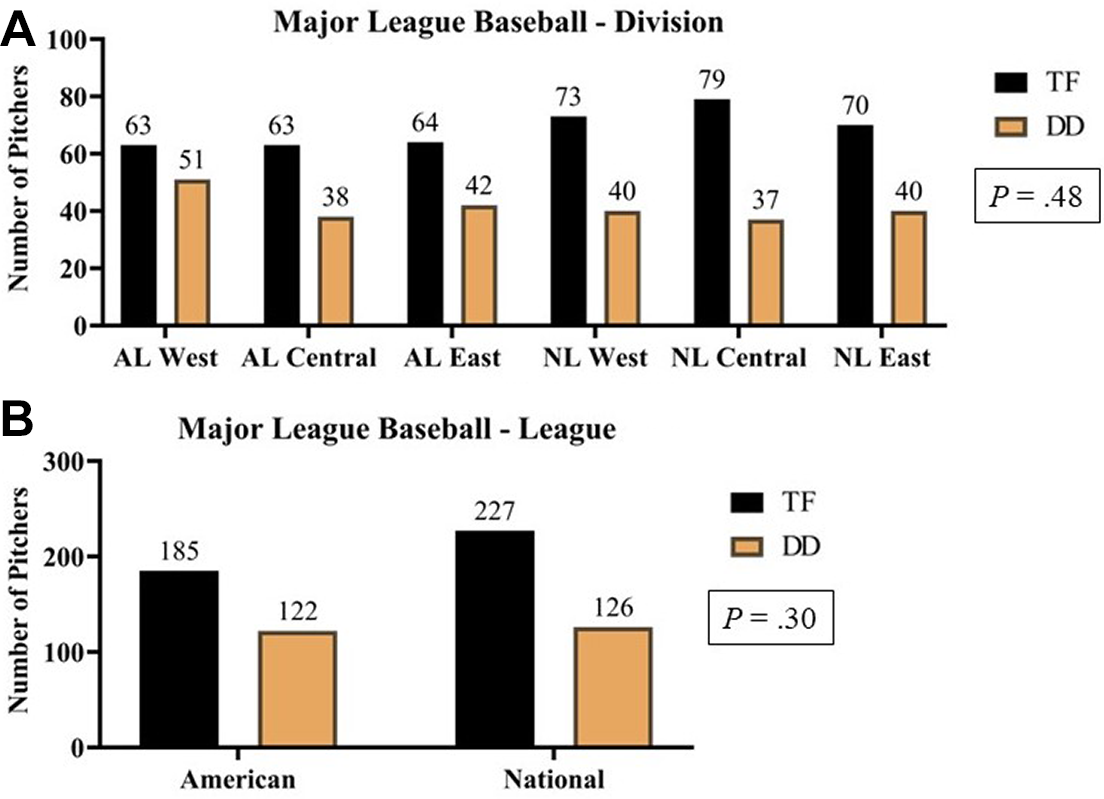
(A) Pitching style of 2019 rostered MLB pitchers by division. (B) Pitching style of 2019 rostered MLB pitchers by league. AL, American League; DD, drop and drive; NL, National League; TF, tall and fall.
Of the 660 pitchers, 150 sustained a UE injury during the 2019 season: 112 TF pitchers (27.2% of all TF pitchers) and 38 DD pitchers (15.3% of all DD pitchers); this difference was statistically significant (χ2 = 12.43; P < .001). Of these 150 pitchers, 14 (TF, 11; DD, 3) underwent UE-related surgery during the 2019 season (Figure 3A and Figure 4). Of pitchers who underwent surgery, 12 (TF, 10; DD, 2) had UCLR, representing a 1.8% UCLR rate during the 2019 MLB season (Figure 3A). This was a second surgery for 2 pitchers, both of whom used the TF pitching style. Before the 2019 season, 135 TF pitchers (32.8% of all TF pitchers) and 56 DD pitchers (22.6% of all DD pitchers) had previously undergone UCLR (Figure 3B and Figure 4); this difference between groups was statistically significant (χ2 = 7.81; P = .005). Table 2 shows the number of pitchers who sustained a UE injury during the 2019 season and those who underwent prior UCLR according to the 6 MLB divisions and 2 MLB leagues.
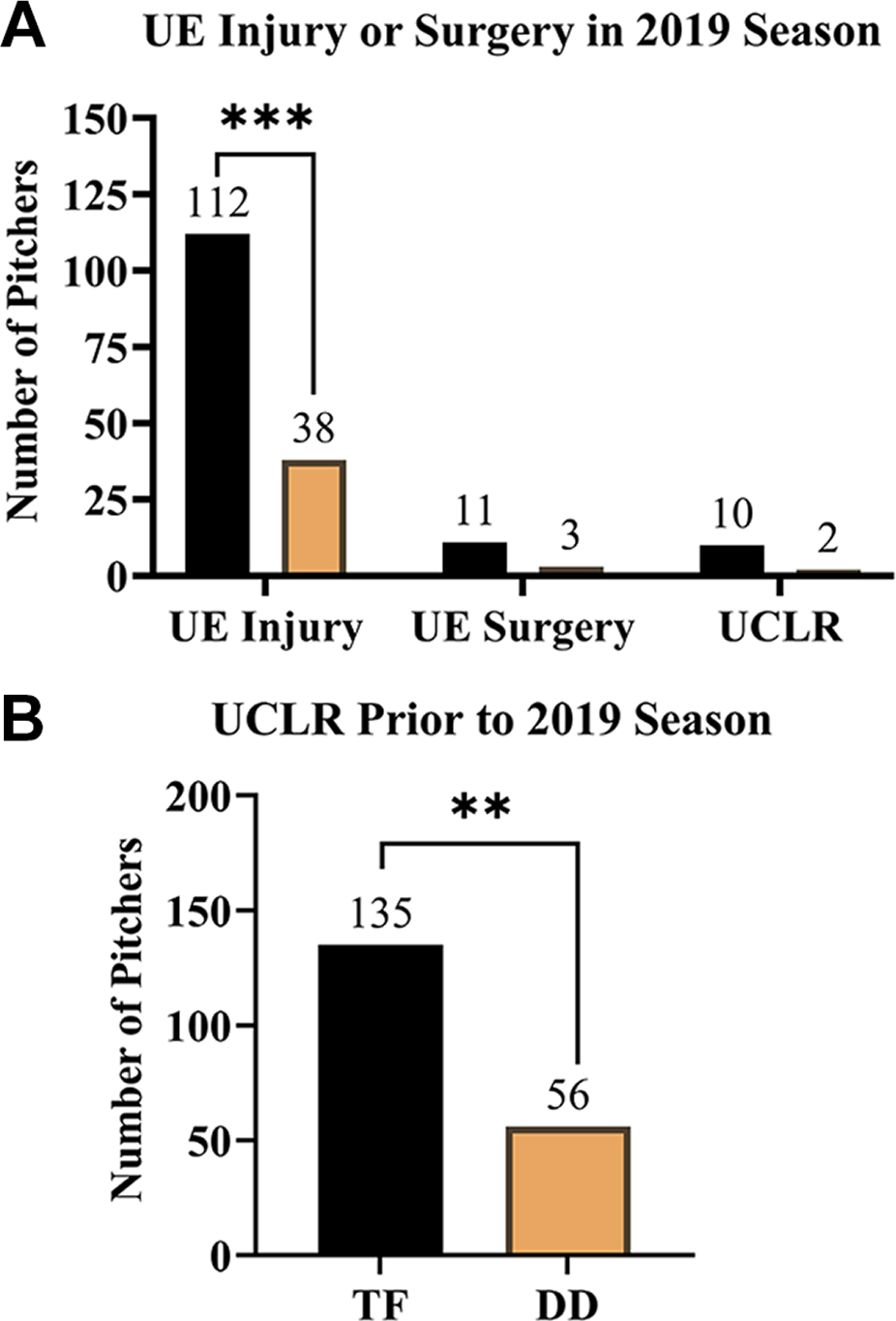
(A) Number of UE injuries and related surgeries in the 2019 MLB season by pitching style. (B) Number of UCLRs before the 2019 MLB season by pitching style. DD, drop and drive; MLB, Major League Baseball; TF, tall and fall; UCLR, ulnar collateral ligament reconstruction; UE, upper extremity. Significant differences between groups: **P < .01; ***P < .001.
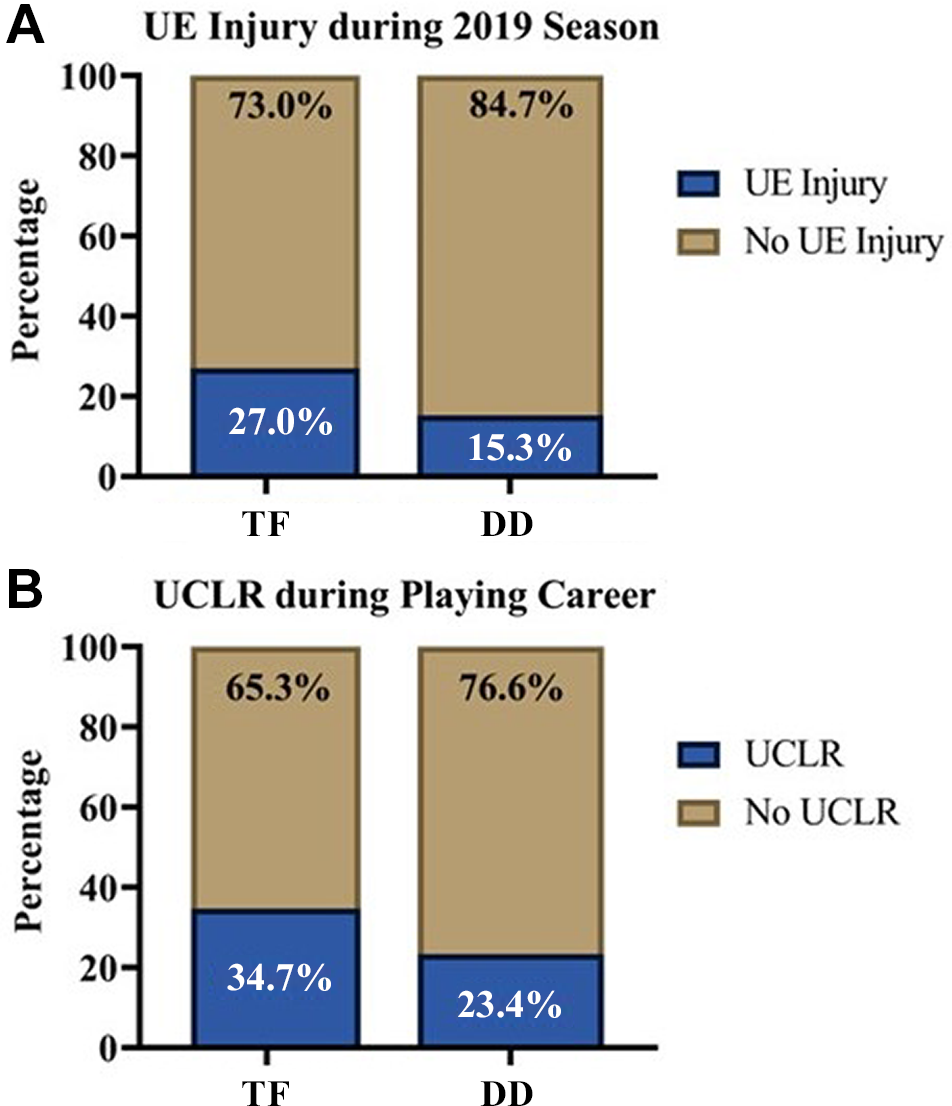
(A) Percentage of pitchers who sustained a UE injury during the 2019 MLB season by pitching style. (B) Percentage of pitchers who underwent UCLR during their playing career (2019 season and before) by pitching style. DD, drop and drive; MLB, Major League Baseball; TF, tall and fall; UCLR, ulnar collateral ligament reconstruction; UE, upper extremity.
UE Injury and Prior UCLR in MLB Division and League by Pitching Style a
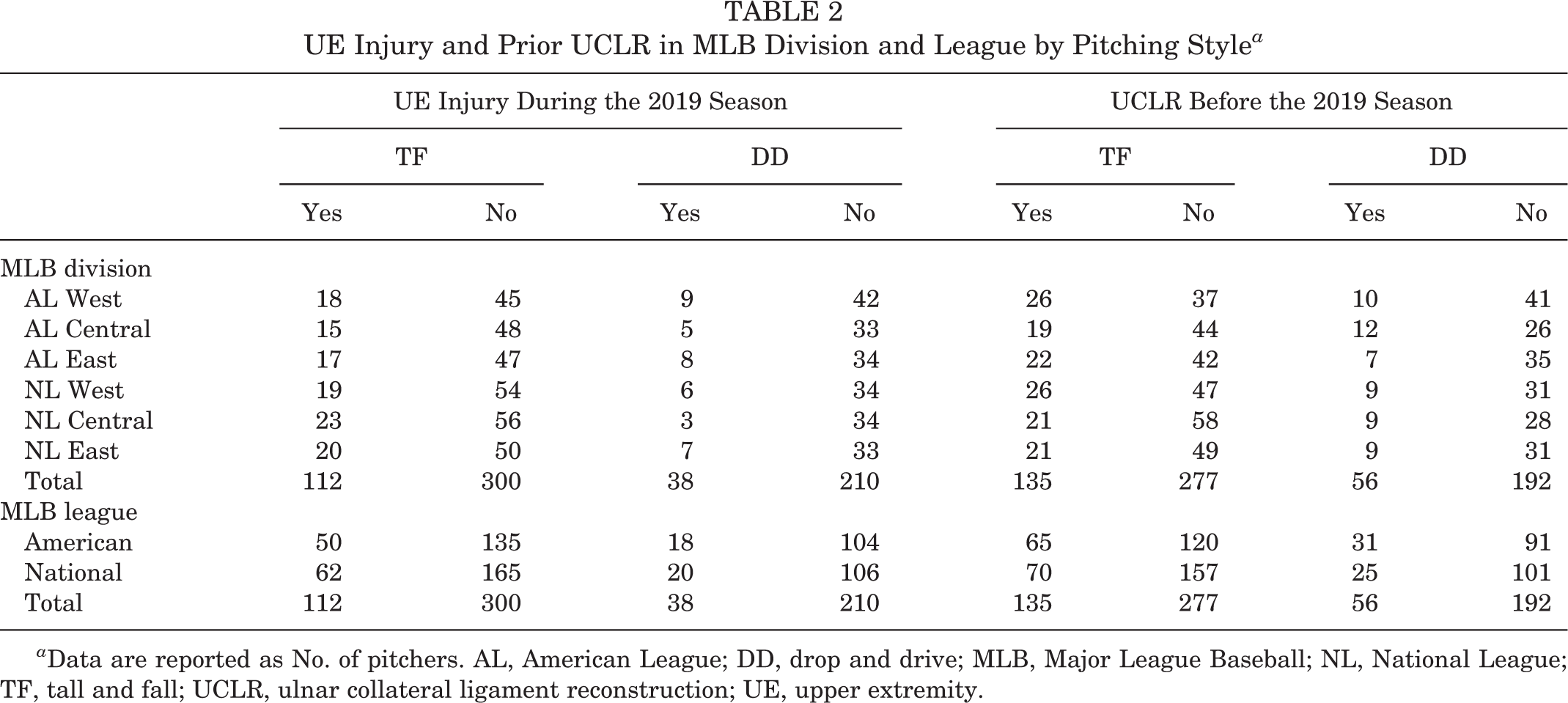
a Data are reported as No. of pitchers. AL, American League; DD, drop and drive; MLB, Major League Baseball; NL, National League; TF, tall and fall; UCLR, ulnar collateral ligament reconstruction; UE, upper extremity.
Discussion
In the present study, the mean fastball velocity (P = .38), BMI (P = .34), age (P = .38), and handedness (χ2 = 1.36; P = .25) were not significantly different between pitching styles. Significantly more UE injuries were seen in the TF group compared with the DD group (P < .001). In addition, significantly more pitchers in the TF group had undergone UCLR before 2019 (P = .005).
To our knowledge, this is the first study to assess the proportion of the TF and DD pitching styles among rostered MLB pitchers during a single season. This information provides the research community with the estimated usage of TF and DD pitching styles in the MLB. An increased number of MLB-rostered pitchers were found to utilize the TF pitching style compared with the DD pitching style. This is interesting considering our study findings. The increased injury occurrence, without differences in demographic characteristics (except height) and performance details, suggests that the biomechanical characteristics of the TF pitching style itself may account for the detected increase in UE injuries.
In a study comparing the biomechanical differences between American and Japanese professional baseball pitchers, Oi et al 22 found that American pitchers were more likely to exhibit an extended drive-leg knee angle that resulted in significantly higher elbow joint stress and elbow injury rates. Japanese pitchers utilized a more flexed drive-leg knee angle and exhibited greater shoulder stress and higher shoulder injury rates. 22 Dowling et al 10 also evaluated Japanese (n = 11) versus American (n = 11) collegiate pitchers and found that the American group landed with the drive-leg knee in an extended position, resulting in greater throwing arm peak kinetics versus the Japanese group. Whiteside et al 30 evaluated 104 MLB pitchers and demonstrated that those who had a less pronounced horizontal release location had a lower likelihood of UCLR. The results of these findings suggest that the drive-leg knee flexion angle may have significant implications on UE injury risk.
A 2022 study by Solomito et al 28 explored the relationship between the lead knee flexion angle throughout the pitching motion and elbow forces. Kinematic and kinetic data were collected using standard optoelectronic motion capture methods from 121 collegiate pitchers. Results indicated that the peak elbow varus torque decreased for every 10° increase in the knee flexion at the time of foot contact, at maximum external rotation of the glenohumeral joint, and at ball release. 28 As elbow varus torque is associated with increased UE injury risk, these results indicate that the greater knee flexion angle achieved by the DD pitching style may be protective. Those authors also found that the knee flexion angle at both maximum external rotation of the glenohumeral joint and ball release was significantly associated with peak ball velocity. For every 10° increase in knee flexion, there was a 0.2 m/s reduction in peak ball velocity. 28
Solomito et al 28 suggested that there may be a tradeoff between decreased ball speed and decreased joint moments with an increased knee flexion angle. That study evaluated collegiate baseball pitchers with a mean age of 20.1 ± 1.4 years and a pitching velocity of 72.2 ± 5.6 mph. In the present study, as well as in another recent publication from our group, 3 there were no differences in the mean fastball velocity of MLB pitchers using variable knee flexion angles. More work is needed to explore the relationship between the drive-leg knee flexion angle and both elbow forces and pitching velocity.
Increased elbow valgus torque is also known to correlate with increased UE injury rates in baseball pitchers. 2 The biomechanical differences between the TF and DD pitching styles may contribute to differences in elbow valgus torque. Recently, our group conducted a pilot study in which we assessed elbow valgus torque in 24 noninjured National Collegiate Athletic Association Division II and III pitchers using either the TF or DD pitching style. 4 After each pitcher threw 10 consecutive fastball pitches, we found that the elbow valgus torque was significantly greater in the TF group for pitch number 3 (62.7 ± 13.5 vs 52.9 ± 10.5 N·m; P = .05), pitch number 6 (64.3 ± 12.8 vs 49.9 ± 13.2 N·m; P = .01), pitch number 8 (63.5 ± 15.5 vs 51.3 ± 11.0 N·m; P = .03), and pitch number 9 (63 ± 9.6 vs 49.6 ± 15.7 N·m; P = .02). 4 These findings suggest that when the TF pitching style is utilized, greater elbow valgus torque may occur compared with that of the DD pitching style.
Limitations
The results of the present study should only be interpreted within the context of the following limitations. MLB data regarding individual training, playing experience, practice workloads, and individual pitching kinematics were not available for evaluation. Individual elbow kinematic forces, such as valgus torque, were not available for this retrospective study. We also could not determine whether a different pitching style had been used before the 2019 MLB season. Further, we were unable to break down pitching styles by pitcher position (starter, reliever, closer). Another limitation was that neither interrater nor intrarater reliability was assessed during the determination of pitching styles. Although pitching videos were carefully selected, small deviations in the angle at which the video was recorded may have influenced the rater assessment of the knee angle. The Hudl mobile application is supported in the literature 3,14 ; however, it is limited to 2-dimensional lateral orthogonal views. The usage of 3-dimensional motion-capture analysis to determine drive-leg knee kinematics in relation to the pelvis during SFC should be assessed in future studies.
Conclusion
The information in this study provides the research community with the estimated usage of TF and DD pitching styles in the MLB. We demonstrated that there was a higher prevalence of both UE injury and prior UCLR in TF pitchers. Further research is needed to explore the potential association between pitching style and UE injury.
Footnotes
Final revision submitted February 6, 2023; accepted March 9, 2023.
One or more of the authors has declared the following potential conflict of interest or source of funding: J.P.B. has received education payments from Fones Marketing Management; consulting fees from DJO; nonconsulting fees from Arthrex; and royalties from Arthrex. D.E.H. has received education payments from Arthrex. AOSSM checks author disclosures against the Open Payments Database (OPD). AOSSM has not conducted an independent investigation on the OPD and disclaims any liability or responsibility relating thereto.
Ethical approval for this study was waived by Baylor Scott & White Research Institute (ref No. 381518).