




Abstract
Background:
The anterior cruciate ligament (ACL) is commonly injured in elite-level female athletes, which usually requires ACL reconstruction (ACLR).
Purpose:
To analyze return to play (RTP) and changes in performance of players in the National Women’s Soccer League (NWSL) after ACLR.
Study Design:
Descriptive epidemiology study.
Methods:
NWSL players who sustained an ACL tear and underwent surgery between the 2013 and 2020 seasons were identified by multiple online resources. Players were classified as forwards, defenders, midfielders, and goalkeepers. RTP was assessed according to games played, games started, percentage of minutes played, plus/minus net per 90 minutes (a measure of a player’s contribution to their team’s performance while on the field), goals scored, and assists. A subanalysis was performed based on the median age at the time of the injury (≤24 vs ≥25 years). Nonparametric testing methods were used throughout the analysis.
Results:
A total of 30 NWSL athletes were included. Midfielders had the highest percentage of injuries (n = 11; 36.7%), followed by forwards (n = 10; 33.3%). Overall, 27 players returned to the NWSL at a median of 12.1 months (IQR, 10.9-14.3 months), constituting a 90.0% RTP rate. There was a significant decrease in the percentage of minutes played from 1 year before the injury to 1 year after the injury (median, 87.9% [IQR, 80.7%-90.6%] vs 25.1% [IQR, 16.3%-57.2%], respectively; P = .031). Forwards and midfielders had a significant decrease in the number of assists from 1 year before the injury to 1 year after the injury (median, 3.0 [IQR, 1.0-3.0] vs 0.0 [IQR, 0.0-1.0], respectively; P = .037) as well as the number of goals scored when averaging across 2 seasons before the injury to 2 seasons after the injury (median, 3.0 [IQR, 1.5-5.5] vs 1.0 [IQR, 0.5-3.5], respectively; P = .031). On subanalysis, older players started in significantly more games (median, 12.0 [IQR, 3.8-18.5] vs 3.0 [IQR, 0.5-6.0], respectively; P = .048) and had a higher percentage of minutes played (median, 63.0% [IQR, 18.8%-77.3%] vs 14.9% [IQR, 2.0%-21.2%], respectively; P = .046) at 1 year after the injury versus younger players.
Conclusion:
There was a 90.0% RTP rate after ACLR in the NWSL. Players who returned to the NWSL had a lower percentage of minutes played in their first year after RTP, with older players starting in more games and having a greater percentage of minutes played. Compared with preinjury performance, forwards and midfielders had a significant decrease in the number of assists at 1 year after the injury as well as the number of goals scored at 2 years after the injury.
Keywords
The anterior cruciate ligament (ACL) is a commonly injured ligament in athletes, usually requiring ACL reconstruction (ACLR). 5 For those participating in professional sports, this has the potential of affecting career length, performance, salary, and mental health. 17 Several studies have been performed on outcomes after ACLR 4,15,23 ; however, little is known about the return-to-play (RTP) and performance outcomes of elite-level female soccer players after ACLR.
A previous study of players in the Women’s National Basketball Association showed that only 69.5% of players returned to play after ACLR and that those who did had significantly decreased performance regarding games played, games started, minutes played, rebounds, assists, and blocks. 31 These findings can be because of a multitude of factors, including psychological in which players have a fear of reruptures, leading to a decrease in performance metrics. 22 It has been shown that women sustain ACL injuries at higher rates than men, with a 3.5 times and 2.8 times increased incidence in basketball and soccer, respectively. 11
To the best of our knowledge, there has not been a RTP and performance analysis after ACL tears in the National Women’s Soccer League (NWSL). The NWSL was established in 2013 and consisted of 12 teams in 2022. 18 The purpose of this study was to analyze the RTP rate and changes in performance of NWSL players after ACLR. We hypothesized that there would be a high RTP rate, but a decrease in performance in this cohort.
Methods
NWSL players for this study were identified by cross-referencing multiple online resources and articles, including official injury reports, press releases, game summaries, and online publications. 13,19,21,25,27 –29,33 This method has been utilized in previous studies. 6,12,14,16 Each documented case of an ACL tear was verified by a minimum of 2 separate sources. Included were players who experienced ACL tears and underwent surgery between the years 2013 and 2020. RTP was defined as any player who played at least 1 minute in at least 1 NWSL game after the injury. Excluded were players who sustained their injuries in non-NWSL games (ie, international friendlies [exhibition matches] and non-NWSL leagues) (Figure 1).
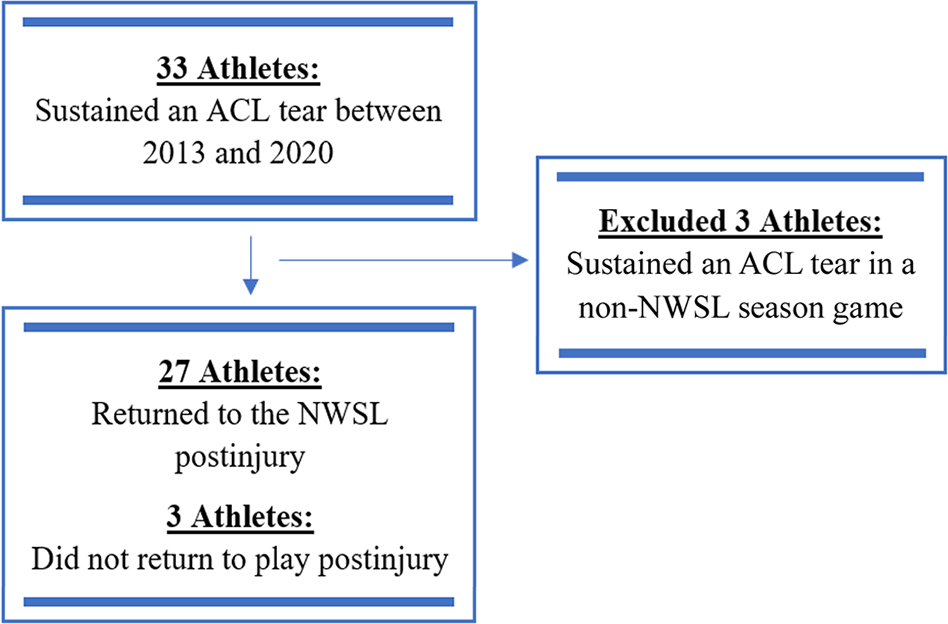
Flow chart demonstrating final cohort selection. ACL, anterior cruciate ligament; NWSL, National Women’s Soccer League.
Players were classified by position as forwards, defenders, midfielders, and goalkeepers. The FBref 7 database was used to collect the following data points: player position, number of seasons played, age at injury, RTP time, player draft round/position, games played, games started, percentage of minutes played, and plus/minus net per 90 minutes. Goals scored and assists were also collected for forwards and midfielders. The percentage of minutes played was defined as the percentage of a team’s total minutes in which the player was on the pitch. Plus/minus net per 90 minutes was the most complete data statistic found that can measure a player’s impact on the game; it measures the net goals per 90 minutes by the team while the player was on the pitch minus net goals allowed per 90 minutes by the team while the player was off the pitch. 7
Performance data were collected for 2 years before and 2 years after a player’s return from her ACL tear and surgery. Players who were injured in their rookie year were excluded from performance analysis, as they did not have preinjury data. Players served as their own internal control in this study. RTP time was determined by calculating the number of days between the injury date and the date of the first match appearance after the injury. In addition, 1 year after the injury was defined as the first year in which an athlete played after the injury year; this was determined by cross-referencing FBref match logs with the online resources previously described. For seasons played before and after the index year, all NWSL games were recorded.
All statistical data were collected up until the end of the 2021 season, which was the final complete season at the time of this study. COVID-19 significantly affected the 2020 season in which the Challenge Cup was introduced instead of a regular season. 9 As a result, player statistics were not analyzed for the 2020 year, other than participation, to maintain homogeneity between years. Player statistics were only recorded and analyzed for NWSL games.
Statistical Analysis
Descriptive statistics were tabulated for all measured outcomes according to players who returned to play and those who did not return. Categorical variables were summarized using frequencies and percentages. All continuous variables were analyzed for normality using histograms, boxplots, and the Shapiro-Wilk test. The homogeneity of variance was examined using boxplots and the Levene test. Because a majority of these outcomes significantly violated the assumption of normality (along with the desired retention of outliers), continuous variables were reported using medians and interquartile ranges (IQRs).
The primary outcome measures for player performance after RTP were plus/minus net per 90 minutes and percentage of minutes played. Secondary outcome measures included number of games played, number of games started each season, goals scored, and assists. For each of these performance variables, 2 sets of Wilcoxon signed-rank tests were performed: (1) comparing 1 season before to 1 season after the injury and (2) comparing 2 seasons before to 2 seasons after the injury. Additionally, for each of the performance variables, the Wilcoxon rank-sum test was used to compare players based on the median age at the time of the injury (≤24 vs ≥25 years). Because of small sample sizes, particularly in the group not returning to play, the Fisher exact test was used for comparisons of categorical variables.
Across all analyses, P <.05 was considered significant. All analyses were conducted in R 4.2.1 (R Foundation for Statistical Computing).
Results
A total of 30 NWSL athletes underwent ACLR between the 2013 and 2020 seasons and met inclusion criteria. Midfielders had the highest percentage of injuries (n = 11; 36.7%), followed by forwards (n = 10; 33.3%). Of the 30 injured players, 27 returned to the NWSL at 1 year after the injury, constituting a 90.0% RTP rate. The median RTP time was 12.1 months (IQR, 10.9-14.3 months). Of players who returned to play at 1 year after the injury, 23 experienced their injury during an in-season game, while 4 sustained their injury during the off-season/preseason. Overall, the majority of injuries (53.3%) were sustained on a grass playing field. The characteristics of players can be found in Table 1.
Characteristics of Players a

a Data are reported as median (interquartile range) or n (%). NWSL, National Women’s Soccer League.
At 2 years after the injury, 19 of 26 players (73.1%) remained in the NWSL. The 2-year RTP rate was calculated for players who were injured between the 2013 and 2019 seasons, as the most recent complete season was the 2021 season. A breakdown of RTP by position and postinjury year is shown in Table 2.
RTP at 1 and 2 Years After Injury a

a IQR, interquartile range; RTP, return to play.
b The 2-year rate only included players injured between the 2013 and 2019 seasons.
Performance After RTP
Player performance statistics for 1- and 2-year preinjury to postinjury comparisons are shown in Table 3.
Performance for 1 Year Before and After Injury (n = 27) and 2 Years Before and After Injury (n = 19) a

a Data are reported as median (interquartile range). Bolded P values indicate a statistically significant difference between groups (P < .05).
Percentage of Minutes Played
When comparing the percentage of minutes played at 1 year before the injury versus 1 year after the injury, there was a statistically significant drop in participation (median, 87.9% [IQR, 80.7%-90.6%] vs 25.1% [IQR, 16.3%-57.2%], respectively; P = .031). This was not seen when averaging across 2 seasons before the injury versus 2 seasons after the injury (median, 67.2% [IQR, 65.5%-80.6%] vs 40.6% [IQR, 17.2%-69.5%], respectively; P = .313).
Plus/Minus Net Per 90 Minutes
In terms of player performance, athletes had a median plus/minus net per 90 minutes of 0.2 (IQR, –0.1 to 0.3) before the injury compared to –0.3 (IQR, –0.4 to –0.1) after the injury, averaged across 2 seasons (P = .375). When comparing plus/minus net per 90 minutes at 1 year before the injury versus 1 year after the injury, players had a median of 1.0 (IQR, 0.3 to 1.6) versus –0.7 (IQR, –0.9 to 0.1), respectively (P = .094).
Games Played
Athletes played in a median of 20.5 (IQR, 20.0-22.0) games before the injury compared to 17.0 (IQR, 8.0-23.0) games after the injury, averaged across 2 seasons (P = .528). When comparing the number of games played at 1 year before the injury versus 1 year after the injury, players played in a median of 20.0 (IQR, 11.0-22.0) versus 13.5 (IQR, 10.0-19.0) games, respectively (P = .142).
Games Started
Athletes started in a median of 18.5 (IQR, 14.0-20.0) games before the injury compared to 8.5 (IQR, 3.0-21.0) games after the injury, averaged across 2 seasons (P = .205). When comparing the number of games started at 1 year before the injury versus 1 year after the injury, players started in a median of 16.5 (IQR, 9.5-19.3) versus 5.5 (IQR, 3.0-16.5) games, respectively (P = .075).
Goals Scored
Analyzing forwards and midfielders, there was a significant decrease in the number of goals scored from the preinjury to postinjury time frame (median, 3.0 [IQR, 1.5-5.5] vs 1.0 [IQR, 0.5-3.5], respectively; P = .031), averaged across 2 seasons. When comparing the number of goals scored at 1 year before the injury versus 1 year after the injury, players had a median of 3.0 (IQR, 0.0-5.0) versus 1.0 (IQR, 0.0-4.0), respectively (P = .121).
Assists
Analyzing forwards and midfielders, there was a significant decrease in the number of assists at 1 year before the injury versus 1 year after the injury (median, 3.0 [IQR, 1.0-3.0] vs 0.0 [IQR, 0.0-1.0], respectively; P = .037). This was not seen when averaging across 2 seasons before the injury and 2 seasons after the injury (median, 2.0 [IQR, 0.0-3.5] vs 0.0 [IQR, 0.0-0.3], respectively; P = .104).
Performance After RTP Between Younger and Older Players
The subanalysis based on player age (≤24 vs ≥25 years) indicated that older players started in significantly more games (median, 12.0 [IQR, 3.8-18.5] vs 3.0 [IQR, 0.5-6.0], respectively; P = .048) and had a higher percentage of minutes played (median, 63.0% [IQR, 18.8%-77.3%] vs 14.9% [IQR, 2.0%-21.2%], respectively; P = .046) at 1 year after the injury compared to younger players (Table 4).
Performance at 1 Year After Injury by Age a
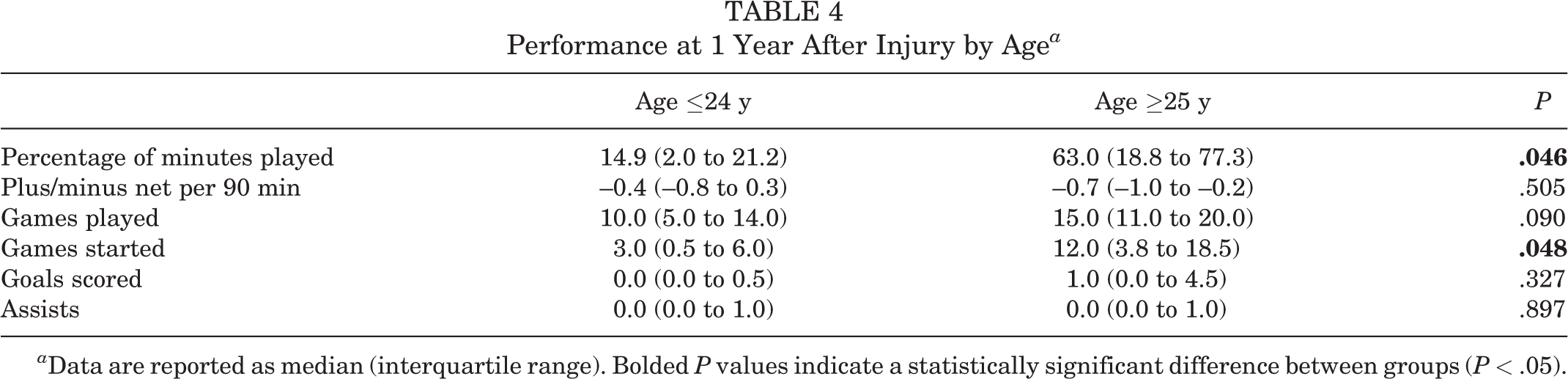
a Data are reported as median (interquartile range). Bolded P values indicate a statistically significant difference between groups (P < .05).
Discussion
The primary finding of this study was that 90.0% of NWSL players returned to play after ACLR between the years 2013 and 2020. The median RTP time was 12.1 months, and most injuries were experienced by midfielders. Comparing performance after ACLR to preinjury values, the only statistically significant drop in any measure was a reduction in the percentage of minutes played in the year after the injury. However, this was not seen when evaluating 2 years of postinjury data. Surprisingly, when older players returned to play, they started in more games and had a higher percentage of minutes played than their younger counterparts. The percentage of minutes played may be influenced by coaches decreasing an athlete’s playing time to mitigate repeat injuries. When assessing forwards and midfielders only, there was a significant decrease in the number of goals scored when averaged across 2 years after the injury compared to 2 years before the injury as well as a significant decrease in the number of assists at 1 year after the injury compared to 1 year before the injury.
Prior studies have analyzed the RTP rate after ACLR in male soccer players. Forsythe et al 8 found an 80.4% RTP rate (41/51) in the Union of European Football Associations (UEFA) between the years 1999 and 2019, with a mean RTP time of 7.1 ± 3.6 months. Athletes played in significantly fewer games and minutes after the injury, requiring 3 years to return to preinjury performance levels. 8 Our study revealed a different trend in the NWSL in which we found a longer RTP time (median, 12.1 months) but no significant difference in the number of games played.
Brophy et al 1 assessed RTP characteristics after ACLR in soccer athletes from the Multicenter Orthopaedic Outcomes Network (MOON) cohort. From a sample size of 55 male and 45 female participants, a multivariate analysis found that older athletes and female athletes were less likely to RTP (male: 76%; female: 67%). On univariate analysis, female athletes were more likely to undergo future ACL surgery (20.0% vs 5.5%, respectively). Graft choice (bone–patellar tendon–bone autograft vs hamstring tendon autograft) did not affect RTP. 1 This is not unexpected, as similar outcomes have been reported with both graft types. 3,24 We found a much higher RTP rate of 90.0% for our cohort, and this could be attributed to multiple factors, with one being that our players were professional athletes and have constant medical oversight and care while another being that because this is our cohort’s primary career, the players have a strong driving force to return. Also, with the advancements in clinical and surgical management made throughout the years, 2,32 treating ACL tears has evolved to where players are able to RTP with better outcomes.
Howard et al 10 studied the RTP rate after ACL tears in female National Collegiate Athletic Association (NCAA) Division I Southeastern Conference soccer players. Of 80 ACL tears, there was an 85% RTP rate. No significant differences in RTP rates were seen based on surgical factors, such as concomitant knee procedures, graft types, or graft fixation methods. Those with scholarships had a significantly higher RTP rate than those who did not (91% vs 46%, respectively). Our study is in line with theirs, as the slightly higher RTP rate that we found could be caused by our smaller sample size.
Szymski et al 26 analyzed the RTP characteristics of men’s professional (1st-3rd league), semiprofessional (4th-6th league), and amateur (7th league) athletes from the ACL Registry in German Football. After primary ACL ruptures, professional players had statistically faster RTP times (247 days) compared to semiprofessional (334 days) and amateur (376 days) players. Also, professional players were the only ones to have no significant difference in the number of minutes or games played at 2 years after the injury compared to before the injury. While that study analyzed male players, our study of female athletes had similar findings. There was a high RTP rate in the NWSL, and this may be attributed to the advanced level of medical support present at the professional level, thus influencing outcomes.
Beyond physical ability, the other major factor that has the potential to affect a player’s RTP is her psychological state of mind. Toale et al 30 examined the psychological factors that impact return to sport after ACLR, finding that the most common reason why athletes did not return to sport was a fear of reinjuries (28%), followed by a lack of confidence in their performance after returning (19%). Interestingly, only 10% reported residual knee pain as the reason for not returning. The ACL–Return to Sport after Injury (ACL-RSI) score was significantly lower at the time of the diagnosis (40.3 vs 49.3, respectively) and at 2 years after the injury (41.8 vs 78.7, respectively) in athletes who did not RTP compared to those who did. Nwachukwu et al 20 performed a systematic review on variables affecting return to sport after ACLR, finding that of players who did not RTP, 65% cited psychological reasons (fear of reinjuries, lack of confidence in the knee, and lack of interest/motivation) for not doing so. Both studies highlight the importance that psychological factors play in an athlete’s RTP. While physical therapy is a mainstay after ACLR, orthopaedic providers should also take the psychological impact of an injury into account to provide their patients with the best chance of recovery.
While this study analyzed the effect of ACLR on the future playing ability of NWSL players, further research could be directed toward a better understanding of variables that prolong injury and recovery times, such as the effects of grass versus turf fields. Also, studies can be performed to determine if there are any specific intrinsic qualities that a player’s position possesses, such as being a midfielder, that places her at an increased risk of injuries compared to other positions. These studies will likely be needed to be performed when there are a greater number of ACL tears in the NWSL to allow for appropriate analysis.
Limitations
This study was not without limitations. Players with ACL tears were identified through public resources, and as a result, players not reported in public databases would not have been included in this study. With injury details, surgery type, graft selection, and rehabilitation programs being unknown because of not having access to patient records, granular data interpretation was limited. The plus/minus net per 90 minutes variable used for performance analysis has not been validated. Some injury dates were within 1 week of the actual injury date if in the preseason, off-season, or practice because there was no exact date provided in online resources. RTP dates may be inexact for players who recovered during the off-season, as no games were played. With the small sample sizes for each position analyzed, definitive statistical significance was difficult to achieve because the study was underpowered. Not every player had a complete data set of values for each statistic measured. Some of these limitations were also present in an RTP analysis of National Football League players after ACLR. 17
Conclusion
Our study found a 90.0% RTP rate after ACLR in the NWSL. Athletes had a lower percentage of minutes played in the first season in which they returned, with older players starting more games and having a greater percentage of minutes played. Forwards and midfielders had a significant decrease in the number of goals scored averaged across 2 years after the injury compared to 2 years before the injury as well as a significant decrease in the number of assists at 1 year after the injury compared to 1 year before the injury.
Footnotes
Final revision submitted December 13, 2022; accepted January 27, 2023.
One or more of the authors has declared the following potential conflict of interest or source of funding: D.J. has received consulting fees from Xiros and Smith & Nephew, nonconsulting fees from Smith & Nephew, royalties from Smith & Nephew, and hospitality payments from Linvatec. A.V.S. has received grant support from Arthrex; education payments from Arthrex, Smith & Nephew, and Stryker; and nonconsulting fees from Smith & Nephew. AOSSM checks author disclosures against the Open Payments Database (OPD). AOSSM has not conducted an independent investigation on the OPD and disclaims any liability or responsibility relating thereto.
Ethical approval was not sought for the present study.