




Abstract
Background:
There is a dearth of information related to shoulder and elbow overuse injuries in Asian overhead youth athletes.
Purpose:
To determine the prevalence and severity of shoulder and elbow overuse injuries, as well as their associated factors, among competitive overhead youth athletes in Singapore.
Study Design:
Descriptive epidemiology study.
Methods:
Participants completed a survey consisting of 4 multiple-choice questions and 1 open-ended question. Data on sex, age, playing experience, and weekly training hours were also collected. Separate injury severity scores (range, 0-100, with higher scores indicating greater severity) for the shoulder and elbow were tabulated from the responses to the multiple-choice questions. The association between participant characteristics and presence of shoulder and elbow overuse injuries was determined using the chi-square test. Crude odds ratios (ORs) and 95% CIs were also calculated.
Results:
532 overhead youth athletes (age, 12-18 years) responded, of which 434 responses were included for analysis. Badminton, cricket, softball, swimming, and volleyball were some of the sports studied. The prevalence of shoulder and elbow overuse injuries was 31.3% and 9.2%, respectively. The respective severity scores were 30.4 ± 14.4 and 38.4 ± 22.4. Age was associated with the presence of both shoulder (P = .016) and elbow (P = .037) overuse injuries. Years of experience was associated with the presence of substantial elbow injuries (P = .049). Weekly training hours was associated with the presence of shoulder (P = .016) and substantial shoulder (P = .020) injuries. Being older (15-18 years) increased the odds of shoulder (OR, 1.65; 95% CI, 1.10-2.49) and elbow (OR, 2.04; 95% CI, 1.03-4.01) overuse injuries. Having >8 years of experience increased the odds of substantial shoulder (OR, 2.71; 95% CI, 1.01-7.29) and substantial elbow (OR, 3.92; 95% CI, 1.01-15.24) overuse injuries. Training >11 hours per week increased the odds of shoulder overuse injuries (OR, 2.64; 95% CI, 1.31-5.30).
Conclusion:
Shoulder overuse injuries were more prevalent, but elbow injuries tended to be of greater severity among competitive overhead youth athletes in Singapore. Coaches working with older and experienced youth athletes, especially those training >11 hours per week, should be cognizant of the risk of shoulder and elbow overuse injuries.
In overhead sports, the repetitive forceful use of the arm in an arc overhead can impose intense demands on the shoulder and elbow. 28 This leads to an increased risk for shoulder and elbow overuse injuries, particularly among overhead youth athletes who are characterized by musculoskeletal immaturity, unrefined motor skills, nonlinearity of growth, and the continuing practice of early sports specialization. 12
Previous studies have reported the prevalence of shoulder overuse injury to be 17% to 40% and the prevalence of nontraumatic elbow pain to be 28% in overhead youth athletes. 1,16,21 Interestingly, while shoulder pain has been described in sports such as handball, volleyball, and baseball, apparently the prevalence of elbow pain has only been described in youth baseball players. 19 Furthermore, the majority of existing reports on shoulder and elbow overuse injuries among overhead youth athletes are from Western populations such as Brazil, 11 the United States, 16,23 and Norway. 1 There is a dearth of such epidemiological evidence in Asian overhead youth athlete populations, including investigations on the factors associated with the presence of shoulder and elbow overuse injuries. 19 This is a concern, as context-specific epidemiological data are required to develop effective preventive measures with greater acceptance and adoption by end users. 8,13 This presents a need to investigate the prevalence of shoulder and elbow overuse injuries among Asian overhead youth athlete populations.
The primary aim of this research was to determine the prevalence and severity of shoulder and elbow overuse injuries among competitive overhead youth athletes across different overhead sports in Singapore, as a representative subset of the Asian youth sports context. The secondary aim was to determine the factors associated with the presence of shoulder and elbow overuse injuries. It was hypothesized that the rate of shoulder overuse injuries would be greater than that of elbow overuse injuries.
Methods
Study Design and Participants
This was a cross-sectional, descriptive epidemiological study investigating the prevalence of and factors associated with shoulder and elbow overuse injuries among competitive overhead youth athletes in Singapore. Participants were recruited through various youth sports clubs and training centers. The inclusion criteria were (1) youth athletes between 12 and 18 years of age, (2) participation in an overhead sport as the primary sport, and (3) training under a coach with the aim to compete in ≥1 tournament during the forthcoming season. Participants were excluded if they were (1) ≤11 years of age, (2) ≥19 years of age, (3) did not participate in an overhead sport or it was not their primary sport, and (4) participated for recreational purposes without the intention to compete and if (5) the injury description did not meet the criteria for an overuse injury.
An overhead sport was defined in this study as a sport that requires repetitive use of the upper arm and shoulder in an arc overhead, 3 to perform a forceful throwing or striking motion. The overhead sports included in this study were badminton, baseball, cricket, dragonboating (a team water sport with a racing crew of 18-20 paddlers), team handball, softball, swimming, tchoukball (a team sport similar to handball), tennis, volleyball, and water polo. A competitive athlete was defined in this study as one who trains with the aim of participating in a competition.
An online survey was distributed among 532 youth athletes from 11 overhead sports. After the removal of invalid responses (eg, did not meet inclusion criteria, had incomplete answers, or the reported injury was not overuse in nature), 434 valid responses each for shoulder (206 female, 228 male) and elbow (208 female, 226 male) overuse injuries were obtained and analyzed. Ethics approval for this study was received from our institution. As participants were minors, both parental consent and participant consent were obtained before recruitment.
Procedures
Data were collected using an online survey via the use of Google Forms. Participants responded to the survey through a link posted online on open-access social media platforms. Patient information on age, sex, primary sport, weekly training hours, and years of experience was collected.
Online Survey
The prevalence of shoulder and elbow overuse injuries was obtained using a survey based on the Oslo Sports Trauma Research Centre Overuse Injury Questionnaire (OSTRC-O2) 10 (see the Appendix). Participants answered 5 questions for each anatomic location based on their experiences during the previous 3-month period. Questions 1 to 4 were multiple-choice questions related to their sports participation, sports performance, modifications to training or competition, and presence of pain. Question 5 was an open-ended filter question asking participants to briefly describe their injury (if applicable).
Reporting of Overuse Injuries
Similar to the format of the OSTRC-O2, 10 question 1 of the survey, on participation ability, served as a gatekeeper question. If no reduction in participation ability was reported, no overuse injury was recorded and the survey for that particular anatomic area was deemed to be completed. An overuse injury was recorded if the participant reported a reduction in participation ability. 10 A substantial overuse injury was recorded if participants indicated that the injury affected their sports performance (question 2) and/or led to training or competition modifications (question 3) to a moderate/major extent (≥25% of the time). For verification purposes, all injury descriptions in the open-ended filter question (question 5) were screened by a trained sports medicine physician. Only injury descriptions that were deemed as meeting the criteria for an overuse injury were accepted and considered as an overuse injury. Injury descriptions that seemed nonoveruse in nature (eg, aggravation or recurrence) were filtered out. For instance, any injuries described as “I fell and injured my elbow,” “My injury got better and happened again,” or “I can recall how and when this injury happened” were not considered overuse injuries, and the participants were excluded from further analysis.
Severity Score
Questions 1 to 4 each represented a maximum score of 25, with responses a, b, c, and d in each question receiving 0, 8, 17, and 25 points, respectively. 10 The scores from each question were then summed to provide a severity score for each individual, with total scores of 0 indicating no severity (and therefore no overuse problem) and 100 indicating the maximum severity possible.
Statistical Analysis
Based on a previous pilot study of a 25% prevalence for shoulder overuse injuries among overhead youth volleyball athletes, with a 95% CI and 5% level of precision, the estimated sample size required was 288. To account for 20% invalid responses, a size of 350 was considered adequate.
The characteristics of the participants were recorded as absolute values and percentages and included sex (male vs female), age (12-14 vs 15-18 years), years of experience (1-4 vs 5-8 or >8 years), and weekly training hours (1-5 vs 6-11 or >11 hours). Group differences were analyzed using the chi-square test.
The prevalence of shoulder and elbow overuse injuries was calculated by dividing the number of participants who reported a shoulder or elbow overuse problem by the total number of participants. The prevalence of substantial shoulder and elbow overuse injuries was similarly calculated using the number of participants who reported a substantial shoulder or elbow overuse problem.
The mean severity score was calculated by summing the severity scores for all participants and dividing the sum by the number of participants who reported the presence of a shoulder or elbow overuse problem. Differences in severity scores between male and female participants were compared using the Mann-Whitney U test because of the presence of outliers.
The association between participant characteristics and the presence of overuse problems was analyzed by the chi-square test. Crude odds ratios (ORs) and 95% CIs were also determined. All statistical analyses were conducted with SPSS Version 28.0 (IBM Corp), and the threshold for significance was set at P < .05.
Results
Participant Characteristics
A total of 434 surveys were included in this analysis with a response rate of 81.6%. Female respondents were generally older (15-18 years) than male athletes (12-14 years) for both shoulder and elbow injuries (P < .001 for both). Female athletes also preferred softball and volleyball, whereas male athletes preferred cricket and swimming. A higher percentage of female athletes also trained ≥6 hours per week compared with male athletes. A summary of participant characteristics is presented in Table 1.
Participant Characteristics Stratified by Injury Location and Sex a

a Data are reported as n (%). Boldface P values indicate statistically significant differences between groups (P < .05).
Prevalence and Severity of Overuse Injuries
Based on a 3-month recall period, the number and prevalence of shoulder and elbow overuse injuries and substantial injuries according to participant characteristics are presented in Table 2.
Overuse and Substantial Overuse Injuries According to Participant Characteristics a
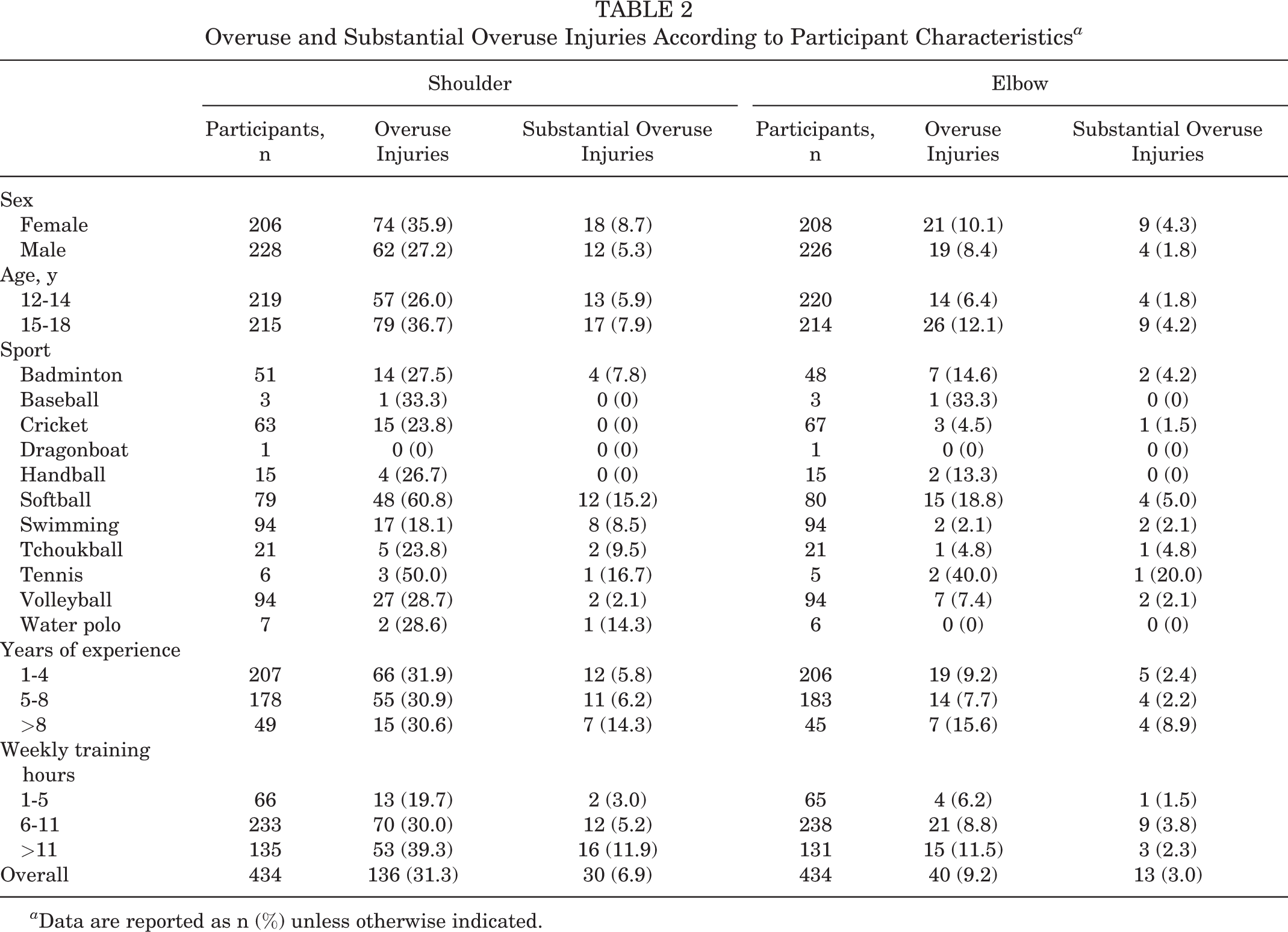
a Data are reported as n (%) unless otherwise indicated.
Shoulder Region
The overall prevalence rates of shoulder overuse injuries and substantial overuse injuries were 31.3% (female, 35.9%; male, 27.2%) and 6.9% (female, 8.7%; male, 5.3%), respectively. The overall mean severity score for shoulder overuse problems was 30.4 ± 14.4. Based on sex, female athletes had a mean severity score of 30.4 ± 14.7, while it was 30.5 ± 14.1 for male athletes (U = 2256; P = .868).
Elbow Region
The overall prevalence rates of elbow overuse injuries and substantial overuse injuries were 9.2% (female, 10.1%; male, 8.4%) and 3.0% (female, 4.3%; male, 1.8%), respectively. The overall mean severity score for elbow overuse injuries was 38.4 ± 22.4. Female and male athletes had mean severity scores of 39.6 ± 23.6 and 37.0 ± 21.7, respectively (U = 186.5; P = .728).
Association and ORs of Factors for Risk of Overuse Injuries
Shoulder Region
Associations between participant characteristics and the presence of shoulder overuse injuries are presented in Table 3. Age (χ2(1) = 5.80; P = .016) and weekly training hours (χ2(2) = 8.28; P = .016) were significantly associated with the presence of shoulder overuse injuries. Older participants were significantly more likely to report shoulder overuse injuries as compared with younger participants (OR, 1.65; 95% CI, 1.10-2.49), and participants training >11 hours per week had significantly greater odds of shoulder overuse injuries as compared with participants who trained 1 to 5 hours per week (OR, 2.64; 95% CI, 1.31-5.30). Sex was closely associated with the presence of shoulder overuse injuries (χ2(1) = 3.83; P = .05), with male athletes at lower odds compared with female athletes (OR, 0.67; 95% CI, 0.44-1.00).
Among other factors (sex, age, and years of experience), only weekly training hours was significantly associated with the presence of substantial shoulder overuse injuries (χ2(2) = 7.79; P = .02). However, participants with >8 years of experience were at significantly increased odds of substantial shoulder overuse injuries compared with those with 1 to 4 years of experience (OR, 2.71; 95% CI, 1.01-7.29).
Association and Odds Ratios (ORs) Between Shoulder and Elbow Overuse Injuries and Participant Characteristics a

a Boldface P values indicate statistically significant differences between groups (P < .05).
b One or more cells have expected counts <5.
Elbow Region
Associations between participant characteristics and the presence of elbow overuse injuries are presented in Table 3. Only age was significantly associated with the presence of elbow overuse injuries (χ2(1) = 4.34; P = .037). Older participants were more likely to report elbow overuse injuries as compared with younger participants (OR, 2.04; 95% CI, 1.03-4.01).
A significant association was found between the years of experience and the presence of substantial elbow overuse injuries (χ2(2) = 6.02; P = .049). Similar to substantial shoulder overuse injuries, participants with >8 years of experience were significantly more likely to report substantial elbow injuries compared with those with 1 to 4 years of experience (OR, 3.92; 95% CI, 1.01-15.24).
Discussion
The findings of this study indicated a high prevalence of shoulder overuse injuries at 31.3% among 12- to 18-year-old overhead youth athletes in Singapore, and an elbow overuse injury prevalence of 9.2%. The prevalence rates of substantial shoulder and elbow overuse injuries were 6.9% and 3.0%, respectively. While less prevalent, the elbow overuse injuries appeared to be more severe, with a higher mean severity score (38.4 ± 22.4) compared with shoulder overuse injuries (30.4 ± 14.4). This could be because of the majority of elbow overuse injuries being reported from the sport of softball, where severe injuries related to the growing bones, such as medial epicondylar apophysitis, Panner disease, and osteochondritis dissecans of the elbow, are common. 24 This finding suggests that the prevalence of overuse injuries should preferably be reported with severity scores because although some injuries may be less prevalent, they may be more severe in their consequences (ie, participation ability, performance, and pain) to training and competitive performance.
Age
Age was significantly associated with the presence of both shoulder and elbow overuse injuries, with older participants being at increased risk. This result is in line with a study conducted among Finnish football players, where the likelihood of reporting any overuse problem increased with age (OR, 1.21; 95% CI, 1.00-1.47). 20 Similarly, 15- to 19-year-old Brazilian athletes in sports that required the use of the upper limb 11 were more likely to report shoulder pain as compared with 10- to 14-year-old athletes (OR, 1.82; 95% CI, 1.15-2.86). This increased risk could be related to the adolescent growth spurt where limb length, mass, and moment of inertia concurrently increase with age, affecting limb dynamics. 17 As a result, greater muscular force generation is required for movement as an individual grows, affecting movement performance and muscle strength requirements and thus increasing the risk for overuse injuries. 17 In fact, glenohumeral internal rotation deficit, an established risk factor for shoulder overuse injuries, 4 has been documented to increase as age increases. 18 Therefore, it is important that coaches working with youth athletes are knowledgeable on the growth process and the associated physical and biomechanical changes, to be able to make informed modifications to their training plans as youth athletes transition from early to late adolescence.
Years of Experience
The results showed that participants with >8 years of experience in the sport were approximately 3 times at increased odds of substantial shoulder overuse injuries as compared with those with only 1 to 4 years of experience. This relationship was similarly observed for substantial elbow overuse injuries, with about 4 times increased odds for those with >8 years of experience. The increased odds of substantial shoulder and elbow injuries with increasing years of experience is perhaps not a surprising finding, as microtrauma accumulates over the years. 5 Over time, the accumulated microtrauma approaches a threshold beyond which the tissues become unable to effectively repair and adapt, leading to symptomatic shoulder and elbow overuse injuries. 5 Indeed, a systematic review conducted among overhead youth athletes has established increased years of baseball experience to be a nonmodifiable risk factor for both shoulder and elbow pain. 19 Therefore, an appropriate long-term training plan that includes adequate recovery and rehabilitation is critical for competitive overhead youth athletes. Coaches may also rely on the long-term athlete development framework for optimum development with a low injury risk in their youth athletes. 6
Weekly Training Hours
Weekly training hours was significantly associated with shoulder and substantial shoulder overuse injuries. Compared with participants who trained 1 to 5 hours per week, participants training >11 hours per week were about 2.6 times at increased odds of reporting shoulder overuse injuries. This finding is in line with a recent systematic review that identified training load to be a risk factor for overuse shoulder injuries. 25 In overhead sports where the shoulder is repeatedly utilized and stressed to perform forceful overhead motions, increased training hours result in an increased workload for the shoulder. 5,15 Therefore, as training hours increase, coaches and athletes must be mindful to incorporate a sufficient amount of rest and recovery into their training plan to reduce the risk of overuse injuries. Coaches could also consider implementing efficacious shoulder injury prevention programs that target shoulder strength, mobility, and stability into their training program to further reduce the risk of shoulder overuse injuries. 2,9
Sex
The association between sex and the presence of shoulder overuse injuries approached significance (P = .050), with male participants at reduced odds of reporting shoulder overuse injuries. This finding is in line with a study investigating shoulder problems among adolescent elite handball players in Sweden, where female athletes had a prevalence ratio of 1.36 (95% CI, 1.02-1.83), with male athletes as the reference group. 4 Interestingly, this increased risk for injuries among female athletes has also been observed at other anatomic sites, such as the knee 20 and the low back. 26 It is likely that sex differences in anthropometric parameters, biomechanics, and muscle strength led to the higher prevalence of overuse injuries observed among female athletes. 23 Moreover, there was a significant association between sex and weekly training hours in this study (P < .001), with female athletes having a larger proportion of participants who trained ≥6 hours per week (female, 91.7%; male, 78.5%). The overall higher workload among female athletes and, consequently, the overload on the shoulder structures experienced may have therefore led to a greater risk of shoulder overuse injuries. 9
Strengths and Limitations
The strength of this study lies in the large sample size of 434 participants across 11 overhead sports for both shoulder and elbow overuse injuries, with a fair representation of female and male athletes. This enabled investigation of the sex differences on the prevalence of shoulder and elbow overuse injuries. There are biomechanical similarities especially in terms of using the kinetic chain principle in executing the overhead motion across different overhead sports. 14,27 However, there can be sports-specific differences in the kinetics and kinematics of the shoulder and elbow while executing the overhead motion. 27 Therefore, while this study has the element of generalizability, the likelihood of skewness in the conclusions cannot be entirely ruled out, and prudence must be exercised when interpreting the results beyond the sample included in this study.
Despite the methodological advantage of using a self-reported survey, the presence of self-reporting bias and recall bias cannot be disregarded. Participants may have chosen not to disclose their injury as it may affect their opportunity to play and/or compete for the team if discovered by their teammates, coaches, or parents. To minimize such self-reporting bias, we reassured them of data confidentiality and provided them the option to skip any question that they were uncomfortable with answering. Additionally, with previous research suggesting a 12-month recall period as the threshold for conducting successful retrospective studies, 22 the 3-month recall period used in this study can be reasonably considered to have limited impact on recall bias.
As a cross-sectional study, the results from this study need to be interpreted with caution, and thus there are some limitations. This study did not utilize logistic regression to predict the reporting of an overuse problem, but instead used crude ORs to quantify the association between factors and the presence of an overuse injury. This is because risk factors have been established to interact and fluctuate over time, 7 and given that participants in this study were not followed prospectively, the use of logistic regression to predict the odds of an injury was not appropriate. Future studies should follow participants prospectively to observe changes periodically in predefined risk factors and subsequently conduct logistic regressions to observe the changes in odds for overuse injuries. Future studies should also look into overuse injuries among youth athletes <12 years of age, to observe how the prevalence, severity, and factors associated with overuse injuries change with age and the adolescent growth spurt. This would improve the strength of the study in identifying factors that increase the risk for overuse injuries.
Conclusion
Shoulder overuse injuries are more prevalent, but elbow injuries tend to be of greater severity among competitive overhead youth athletes in Singapore. Coaches working with older and experienced youth athletes training long hours every week should be cognizant of the risk of shoulder and elbow overuse injuries and consider the implementation of injury prevention programs.
Footnotes
Acknowledgment
The authors thank all the participants and parents who supported and participated in this study and acknowledge the support provided by the Nanyang President’s Graduate Scholarship, Nanyang Technological University, Singapore.
Final revision submitted November 15, 2022; accepted December 13, 2022.
The authors declared that they have no conflicts of interest in the authorship and publication of this contribution. AOSSM checks author disclosures against the Open Payments Database (OPD). AOSSM has not conducted an independent investigation on the OPD and disclaims any liability or responsibility relating thereto.
Ethical approval for this study was obtained from Nanyang Technological University, Singapore.