



Abstract
Background:
An analysis of the demographics and training of head team physicians (HTPs) in professional sports would be valuable for evaluating training programs and as a resource for aspirant HTPs.
Purpose:
To outline common characteristics among professional sport HTPs.
Study Design:
Cross-sectional study.
Methods:
In June 2021, publicly available directories and news articles were used to identify the head orthopaedic HTPs and primary care HTPs for every team in Major League Baseball (MLB), the National Basketball Association (NBA), and the National Football League (NFL). Data regarding HTP characteristics were collected via internet-based sources. Age, sex, years from fellowship completion to current team role, and years in current team role were compared across sports with chi-square analyses and analyses of variance; comparisons between orthopaedic and primary care HTPs were performed with Fisher exact tests and Student t tests. The most frequently attended residency and fellowship training programs were also calculated. The productivity of fellowship programs was calculated as the number of current HTPs from that institution divided by the number of fellowship positions currently offered.
Results:
We identified 181 HTPs: 171 (94%) men and 10 (6%) women. The mean age was 55.4 years (range, 33-79 years); the mean time from fellowship training completion to first year in current team role was 9.8 years (range, 0-29 years); and the mean time spent in current team role was 14.1 years (range, 0-39 years). There were 94 orthopaedic HTPs and 87 primary care HTPs. The rate of fellowship training was significantly higher in orthopaedic HTPs (95%) than in primary care HTPs (67%; P < .001). The fellowship programs that produced the largest number of current HTPs were the Hospital for Special Surgery (n = 16; productivity = 2.3), the American Sports Medicine Institute (11; 1.8), and the Kerlan-Jobe Orthopaedic Clinic (11; 1.2). The years from fellowship to HTP varied significantly by sport: 7.2 for MLB, 10.0 for the NFL, and 11.7 for the NBA (P = .048).
Conclusion:
Almost all orthopaedic HTPs were fellowship trained, as compared with two-thirds of primary care HTPs. Of the 94 orthopaedic HTPs, 62% were trained at 6 specific fellowship programs. Men accounted for a majority of HTPs.
Keywords
Residency and sports medicine fellowship programs in the United States strive to develop their learners into independent and competent physicians. Likewise, sports medicine fellowship programs in the United States want to produce leaders and experts in sports medicine care. Two metrics for assessing leadership are ascending to director of a sports medicine fellowship and becoming head team physician (HTP) for a professional sports team. HTPs provide, coordinate, and oversee the health care for players within an organization. 5 The prestige and finite number of these positions make them highly desirable and extremely competitive. By revenue, the 3 largest professional sports leagues in the world are the National Football League (NFL; ∼$16 billion), Major League Baseball (MLB; $10.7 billion), and the National Basketball Association (NBA; $7.92 billion). 2 –4,7 These are by far the 3 highest revenue sports leagues in North America, with the next largest league (National Hockey League) generating only about half the revenue of MLB or the NBA and about a third of the NFL. 7 Revenue from all other North American sports leagues (Major League Soccer, women’s professional sports, etc) are small fractions of the big 3. 7
It is possible that certain residency and fellowship programs train more fellowship directors and HTPs in MLB, the NBA, and the NFL than other training programs. While training and characteristics of sports medicine fellowship directors have been well documented, 1 the information available on HTPs is less complete. Makhni et al 6 reported common characteristics among HTPs at the high school, collegiate, and professional levels. This literature focused on characteristics such as academic affiliation and research productivity but did not report educational background information. Understanding the qualities and qualifications that contribute to a physician becoming an HTP can be a resource to individuals who want to pursue this role during their careers.
The purpose of this descriptive study was to determine the educational characteristics of orthopaedic and primary care HTPs in the NFL, MLB, and the NBA. It was hypothesized that most HTPs were trained in a sports medicine fellowship and that most of the HTPs in these men’s sports are male. Another hypothesis was that a majority of the fellowship-trained HTPs were trained at a small number of programs.
Methods
In June 2021, internet-based databases including current team media guides, official team websites, and publicly available news articles were utilized to identify the name and role of each team physician for every team in MLB, the NBA, and the NFL. The role listings gathered were used to determine the senior orthopaedic and primary care physicians for each team. In cases where the role listings did not specify seniority, inclusion was determined by a consensus of information gathered from institutional biographies, news articles, and professional profiles on the internet. If seniority still could not be determined, then all physicians in question were left in the study.
For the 181 selected physicians, age, sex, location of residency/fellowship training and year of completion, specialty, subspecialty, and first year in current team role were collected and compiled into a single database. The Healthgrades website was used to find the age and sex of each physician. For those who did not have an age listed on healthgrades.com, age was calculated on the assumption that each physician was 22 years old at the year of college graduation. Physicians for whom neither age nor year of college graduation could be found were not included in any calculations involving age. Each physician’s residency and fellowship training location and year of completion, specialty, and subspecialty were found by an analysis of internet-based institutional biographies and curricula vitarum, as well as professional profiles on linkedin.com, doximity.com, castleconnolly.com, sharecare.com, and health.usnews.com. If a physician had completed >1 fellowship, then each fellowship program was counted, but traveling fellowships were not included. Institutional biographies and linkedin.com profiles were used to determine each physician’s first year in the current team role. If this could not be found, then the search was expanded to include internet-based news articles.
Descriptive statistics (means and ranges) were calculated for age, years from fellowship completion to first year in current team role, and years spent in current team role. The most frequently attended residency and fellowship training programs and the number of male and female physicians were also reported.
Demographic and training characteristics data were compared between orthopaedic surgeons and primary care physicians. Rate variables were compared with Fisher exact tests (www.socscistatistics.com), while numerical variables were compared with Student t tests (Microsoft 365 Excel, Microsoft Corporation, Redmond, WA). Differences were considered statistically significant at P < .05. In addition, demographic and training characteristics data were compared among the 3 professional sports leagues (MLB, NBA, NFL). If a physician was the HTP in >1 sport, he or she was included in all of his or her sports. Rate variables were compared with chi-square analyses, while numerical variables were compared with analysis of variance. Differences were considered statistically significant when P < .05.
The productivity of fellowship programs in producing HTPs was calculated to supplement previously reported program productivity in producing fellowship program directors. 1 Similar to the calculation used by Belk et al, 1 fellowship program productivity was derived by dividing the number of current HTPs from each institution by the number of sports medicine fellowship positions currently offered.
Results
In total, 181 HTPs were identified: 171 (94%) men and 10 (6%) women (Table 1). The mean age was 55.4 years (range, 33-79 years). There were 8 HTPs without an available age and 9 with an age back calculated. The mean time from fellowship training completion to first year in current team role was 9.8 years (range, 0-29 years). We were unable to determine residency and fellowship completion for 5 HTPs. Year started in current role could not be determined for 60 HTPs. Based on the data that were available, the mean time spent in the current role as HTP was 14.1 years (range, 0-39 years).
Comparison of Orthopaedic Surgeon and Primary Care HTPs a

a Data are reported as % (No.) or mean (range). Bold P value indicates statistically significant difference between orthopaedic surgeons and primary care physicians (P < .05). HTP, head team physician.
The 181 HTPs were almost evenly split between 94 orthopaedic surgeons and 87 primary care sports medicine physicians. The residency programs that produced the largest number of current orthopaedic HTPs were the Hospital for Special Surgery (n = 14) and the Harvard Combined Orthopaedic Residency Program (n = 6), followed by Columbia University, the Mayo Clinic, and the Medical College of Wisconsin (n = 3 each). These residency programs accounted for 30% of current orthopaedic HTPs. Residency training for the current primary care HTPs was diverse, as 18 residency programs trained 2 or 3 current primary care HTPs. No residency produced >3 current primary care HTPs.
The only significant difference between orthopaedic HTPs and primary care HTPs was the percentage of those who were fellowship trained (P < .001) (Table 1). Nearly all orthopaedic surgeon HTPs had completed a fellowship, whereas two-thirds of primary care HTPs were fellowship trained. The fellowship programs that produced the largest number of current orthopaedic HTPs were the Hospital for Special Surgery (n = 16; productivity = 2.3), the American Sports Medicine Institute (11; 1.8), the Kerlan-Jobe Orthopaedic Clinic (11; 1.2), the Cleveland Clinic Foundation (7; 0.6), the Steadman Clinic (7; 0.7), and the University of Pittsburgh (6; 1.2). These 6 fellowship programs accounted for approximately 62% of orthopaedic HTPs. The fellowship programs that produced the largest number of future primary care HTPs were the University of California at Los Angeles (UCLA; n = 4), as well as the Cleveland Clinic Foundation, Michigan State University, Thomas Jefferson University, University of California at San Diego, and the University of Maryland (3 each). These fellowship programs accounted for approximately 22% of primary care HTPs.
HTPs according to sport are compared in Table 2. While there was no difference in current age for HTPs among the 3 sports, the HTPs in MLB achieved their current position in fewer years after fellowship training (P = .048).
Demographic and Training Characteristics of Current Head Team Physicians in MLB, the NBA, and the NFL a
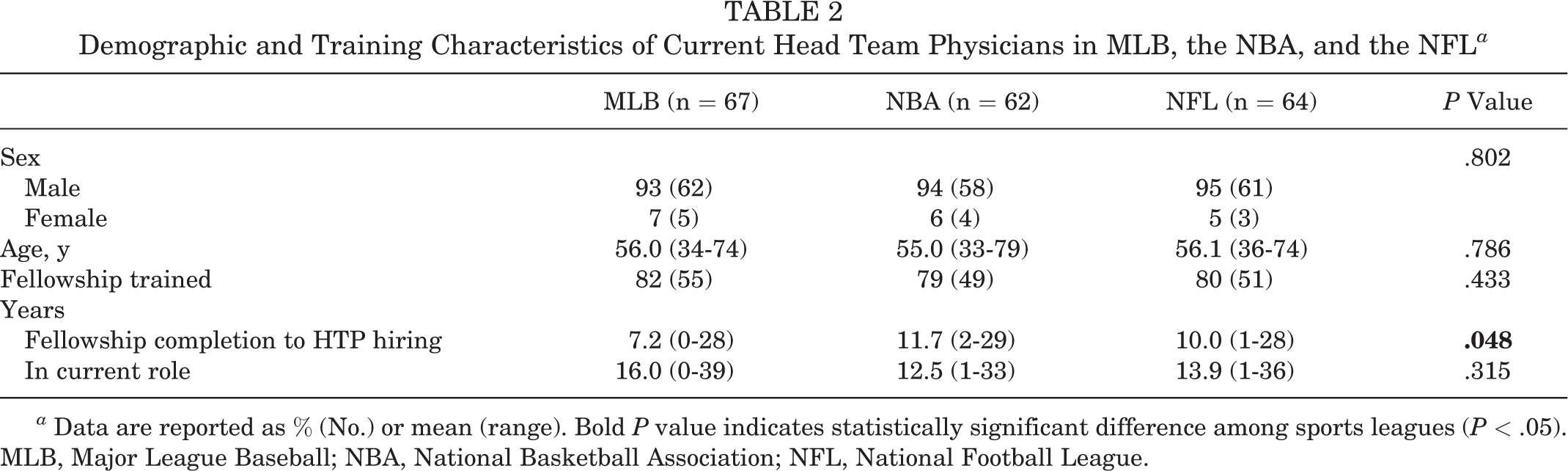
a Data are reported as % (No.) or mean (range). Bold P value indicates statistically significant difference among sports leagues (P < .05). MLB, Major League Baseball; NBA, National Basketball Association; NFL, National Football League.
To show an expanded view of outcomes of training programs, data from the current study were presented with data from a study by Belk et al 1 about orthopaedic sports medicine fellowship directors. The residency program that trained the largest number of current HTPs and orthopaedic sports medicine fellowship directors is the Hospital for Special Surgery, followed by the Harvard Combined Orthopaedic Residency Program (Figure 1). A substantial number of HTPs and fellowship directors received their fellowship training from the Hospital for Special Surgery, the American Sports Medicine Institute, the Kerlan-Jobe Orthopaedic Clinic, the Steadman Clinic, and the University of Pittsburgh (Figures 2 and 3). While a good number of HTPs were fellowship trained at the Cleveland Clinic Foundation, no current orthopaedic sports medicine fellowship directors were trained in this program; it is unknown whether this discrepancy is related to an intentional focus of this fellowship program or some other reason.

Number of current head team physicians (HTPs) from specific orthopaedic (blue) and primary care (yellow) residency programs. When available from Belk et al, 1 data are also shown for current orthopaedic sports medicine fellowship directors (red) who graduated from these residency programs. UCLA, University of California at Los Angeles.

Number of current head team physicians (HTPs) from specific orthopaedic (blue) and primary care (yellow) fellowship programs. When available from Belk et al, 1 data also shown for current orthopaedic sports medicine fellowship directors (red) who graduated from these fellowship programs.
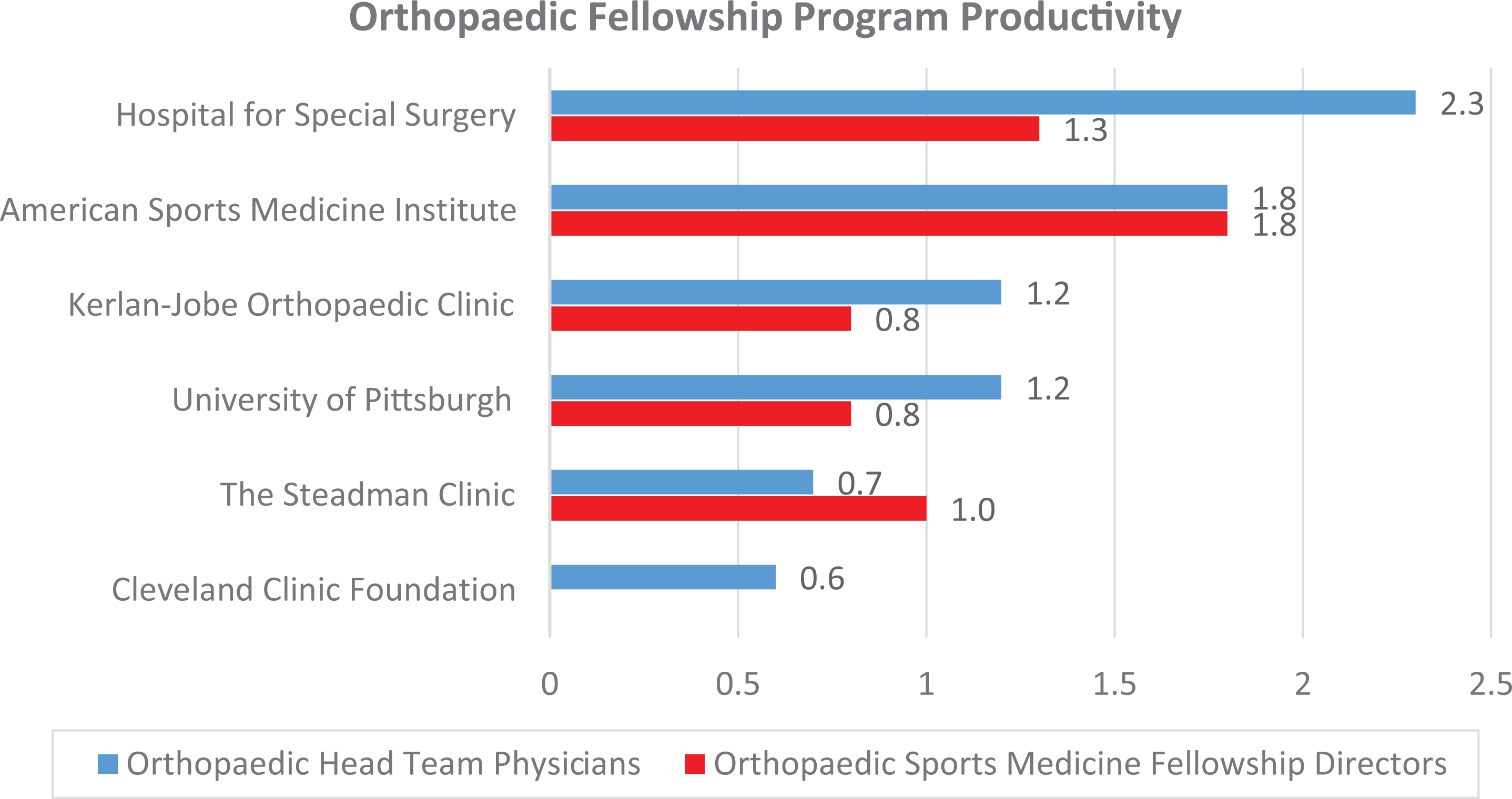
Productivity of orthopaedic sports medicine fellowship programs. Head team physician productivity (blue) was determined as the number of current head team physicians who graduated from the orthopaedic sports medicine fellowship program divided by the total number of fellows trained per year at that program. Similarly, productivity of orthopaedic sports medicine fellowship directors (red) was determined as the number of current orthopaedic sports medicine fellowship directors who graduated from the fellowship program divided by the total number of fellows trained per year at that program. Head team physician data are from current study, whereas fellowship director data are from Belk et al. 1
Discussion
Results from the study supported some of our hypotheses. As expected, men accounted for the majority of HTPs at 94%, with only 6% being women. Five residency programs accounted for 30% of current orthopaedic HTPs, while residency training background for primary care HTPs was less concentrated. The hypothesis that a small number of fellowship programs were prevalent among the background of this cohort was partially supported. Six fellowship programs accounted for approximately 62% of orthopaedic HTPs, while fellowship training background was also less concentrated for primary care HTPs (6 fellowship programs accounting for approximately 22% of primary care HTPs). The hypothesis that most HTPs were fellowship trained was supported, as 81% of HTPs had completed a fellowship. However, a statistically significant difference (P < .001) was found between orthopaedic HTPs and primary care HTPs: nearly all orthopaedic HTPs were fellowship trained, as compared with approximately two-thirds of primary care HTPs.
This cross-sectional analysis identified trends among current HTPs to serve as a resource for those aspiring to one day assume that role. While this study cannot definitively measure what makes one competitive for the role of HTP, it does shine light on characteristics commonly shared among those who have been able to achieve that position. Certain residency and fellowship programs produce higher volumes of physicians who one day achieve the role of HTP. This higher production could be due to several factors. First, some programs simply have more residency or fellowship positions available every year, thus making it more likely that they will produce a future HTP. We attempted to account for this discrepancy by calculating the number of HTPs trained per number of annual fellows (“productivity”) of the most represented fellowship programs. Another possible explanation is that some residency and fellowship programs provide greater networking opportunities, whether that be through increased brand recognition, alumni networking, attending physician and institutional connections, geographical proximity to professional sports teams, or medical coverage of teams. For example, a resident or fellow who trains at an institution that provides care for a professional sports team could have an advantage over other HTP applicants based on prior exposure to and familiarity with that team and league. The productivity of programs in training HTPs may be one factor considered by some medical students applying for residency and a larger factor for residents applying for sports medicine fellowship.
The mean age of the HTPs in our study was 55.4 years; interestingly, this is the same age as in a previous study of sports medicine fellowship directors. 1 Also, when we analyzed trends in time from fellowship training completion to first year in current team role and time spent in current team role, the average HTPs attained the role about 10 years after graduating from their most recent fellowships and held the position for about 14 years. There was a profoundly wide range representing each of these values. The age range spanned >40 years; time from fellowship training completion to first year in current team role was from 0 to 29 years; and time spent in current team role spanned 0 to 39 years. These ranges could be due to, among other factors, the variability in HTP position openings and prior physician relationships with team management and staff.
Limitations
There are limitations to this cross-sectional analysis. Despite extensive efforts to verify each data point, all data were collected via internet-based sources. This inevitably makes it possible that misreported or incorrect information could have been added to our data set. Some residencies and fellowships may be slightly overrepresented in our data set because of the cases in which we could not determine the seniority among team physicians, thus leading us to include all of those in question. Additionally, some physicians in our data set completed >1 fellowship, thus allowing them to simultaneously represent >1 program. Another limitation to our study is that age, year of residency completion, year of fellowship completion, or year started in current team role were not found for a few physicians.
Conclusion
Almost all orthopaedic HTPs were fellowship trained, whereas two-thirds of primary care HTPs had completed a fellowship. Of the 94 orthopaedic HTPs in MLB, the NBA, and the NFL, 62% were trained at 6 specific fellowship programs. Residency training and primary care fellowship training were less concentrated. Men accounted for a majority (94%) of HTPs, while age, number of years from completion of fellowship to hiring as HTP, and number of years spent in current role as HTP varied widely among current HTPs.
Footnotes
Final revision submitted August 15, 2022; accepted August 23, 2022.
The authors have declared that there are no conflicts of interest in the authorship and publication of this contribution. AOSSM checks author disclosures against the Open Payments Database (OPD). AOSSM has not conducted an independent investigation on the OPD and disclaims any liability or responsibility relating thereto.
Ethical approval was not sought for the present study.