



Abstract
Background:
Patellar dislocation is attracting considerable research interest.
Purpose:
To assess studies on patellar dislocation using a scientometric method to better understand the current status of research and explore future study directions.
Study Design:
Scoping review.
Methods:
The Web of Science Core Collection database was selected to retrieve publications on patellar dislocation. Articles and reviews written in English with patellar dislocation as the main topic were included. Conference abstracts, notes, letters, expert opinions, and animal studies were excluded. A total of 4632 articles were identified in our initial search. In addition, Excel 2019, CiteSpace 6.1.R1, and VOSviewer 1.6.9 were used to analyze the h-index, the most highly cited publication, publication essentials, and research themes.
Results:
A total of 1485 articles were included in our analysis, with 36,608 citations and an h-index of 93. Overall, 1494 institutions and 195 journals were identified from these studies. The United States (n = 531) was the most productive country. The institution and journal with the largest number of articles were the Hospital for Special Surgery (n = 59) and Knee Surgery, Sports Traumatology, Arthroscopy (n = 212), respectively. The article “Scoring of Patellofemoral Disorders” by Kujala et al in 1993 was the most highly cited reference. The most commonly found terms used were patellar dislocation, patellar instability, medial patellofemoral ligament, knee, recurrent patellar dislocation, and soft tissue restraints. Four topics were identified after clustering analysis of key terms: risk factors, medial patellofemoral ligament reconstruction, patellar dislocation in skeletally immature patients, and lateral retinacular release.
Conclusion:
This scientometric review of articles on patellar dislocation summarized the current status of research (countries, institutions, and authors) and identified potential research directions.
As a common knee injury, patellar dislocation has a mean annual incidence of 5.8 in 100,000 people and is more prevalent in women. 21 Patellar dislocation not only has a high recurrence rate 51 but also readily causes articular cartilage damage, osteochondral fractures, and patellofemoral arthritis, which can ultimately lead to motor dysfunction and pain. 23,29,37 The causative factors of recurrent patellar dislocation are usually divided into 2 categories: soft tissue structural abnormalities and bony structural abnormalities. Soft tissue structural abnormalities include contracture of the lateral retinaculum, laxity of the medial retinaculum, and injury or rupture of the medial patellofemoral ligament (MPFL); bony structural abnormalities include trochlear dysplasia, tibial external rotation, increased femoral anteversion, lateralization of the tibial tuberosity, and patella alta. 16,26,32,53,64 Nonoperative treatment has long been considered the standard of care, 4,6 whereas operation is now recommended for recurrent patellar dislocations, for osteochondral fractures with free bodies, and for those whose nonoperative interventions have failed. 63
Scientometric analysis is a tool for mapping identified publication records and enabling the study of mathematical patterns in the literature, and it is a method for assessing and predicting research trends in specific fields. 74 Scientometric methods are widely used in medicine—that is, collecting big data from literature databases, exploring the relationships between cited and co-cited literature, visualizing the results (creating maps of knowledge domains), and discovering research rules. 75 The final discovered rules are used to generalize the current status and to guide future research. Currently, there is a lack of scientometric analysis on patellar dislocation.
The purpose of this study was to comprehensively analyze the literature related to patellar dislocation from a scientometric perspective and to summarize the current state of research. We hypothesized that the present study would help researchers have better knowledge of patellar dislocation and that it would provide references and ideas for future researchers.
Methods
Data Sources and Extraction
The Web of Science Core Collection database was searched to retrieve all existing patellar dislocation research articles up to March 28, 2022. A Boolean logic search method was used, and search terms included “patellar dislocation*,” “patella dislocation*,” “patella*,” “dislocate*,” “instability,” and “luxation*.” The inclusion criteria were studies in which the main research focused on patellar dislocation, research articles and reviews, and articles written in English. The exclusion criteria were conference abstracts, notes, letters, and expert opinions, as well as animal studies. There were no restrictions on the date, journal, or country of origin of the literature. Two researchers (H.W. and Z.Y.) independently screened the literature to determine eligibility. Any conflicts were resolved with discussion among the review team. The following parameters from all included studies were extracted and organized in Excel 2019: country, institutions, author, year of publication, journal name, research type, 2020 journal impact factor (IF), and terms used.
Analytical Methods and Tools
VOSviewer 1.6.9 was used to analyze the aforementioned information and create a social network diagram, using the size of the nodes and the thickness of the lines to indicate importance. 50 The nodes represent the number or frequency, while the lines among nodes indicate associations. In addition, we used CiteSpace 6.1.R1, which reflects the dynamics of the scientific literature and analyzes trends in research areas by detecting bursts of co-occurring items, such as authors, key terms, and co-cited references. As a scientometric feature, a burst refers to a period with frequent citations. Co-cited is defined as references cited together in other works. 72
The data analyzed were standardized to reduce bias. The h-index—the largest number (h) such that at least h publications have been cited at least h times each—reflects the impact of the study. 65
Results
General Information
The Web of Science core database identified 4632 publications. The titles, abstracts, and full text were progressively screened according to inclusion and exclusion criteria. A total of 1485 studies were ultimately included, with 36,608 citations and an h-index of 93 (Figure 1). The research types were retrospective study (n = 1213), prospective study (n = 126), case-control (n = 22), review (n = 64), and meta-analysis (n = 60). In addition, a significant upward trend in the number of articles was observed, starting at 22 in 2005 and reaching 150 in 2021. The most highly cited article, “Scoring of Patellofemoral Disorders,” published by Kujala et al 31 in 1993, was about the evaluation of patellofemoral joint disease.
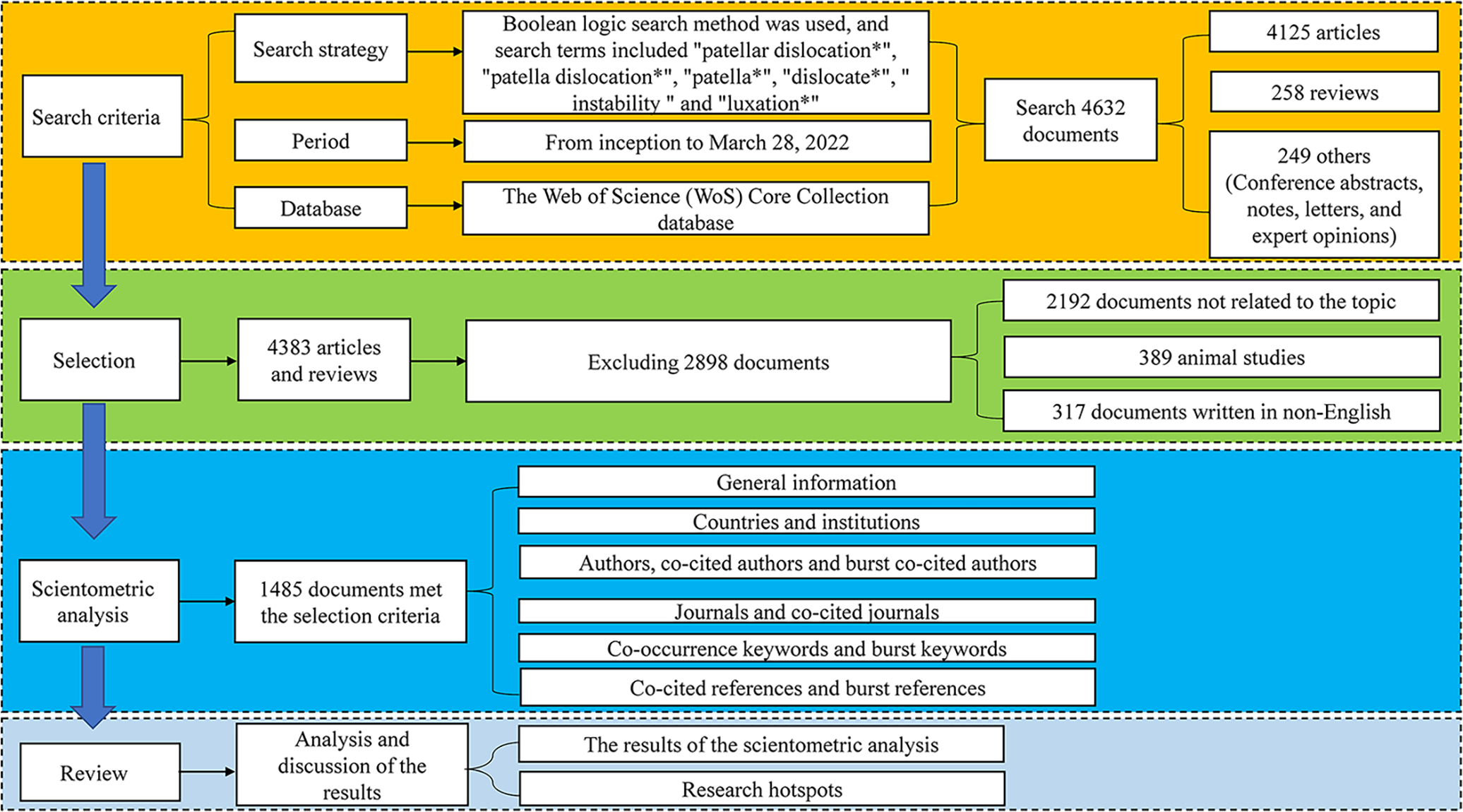
Flowchart of article selection and research framework.
Countries and Institutions
The studies originated from 68 countries and were released in 1494 institutions. Table 1 summarizes the top 10 countries and institutions. Regarding the number of articles published in this field, the United States ranked first with 36% of the total number (531/1485), followed by Germany (9.4%) and the United Kingdom (9.4%). In terms of citations, the United States topped the list (13,737), accounting for 38%; Germany ranked second with 4098 (11%). The top 10 organizations released 268 publications. Of these, the Hospital for Special Surgery published 59 articles in this area, followed by Hebei Medical University (n = 35) and the University of Minnesota (n = 32). Meanwhile, there were 6 US institutions in the top 10 (Hospital for Special Surgery, University of Minnesota, Mayo Clinic and Mayo Foundation, The Ohio State University, Rush University, and Johns Hopkins University), which showed that institutions in the United States occupied a dominant position in this field. Figure 2 presents collaborations among countries with the minimum threshold of 5 articles. As compared with other countries, the United States had the largest number of articles and the strongest collaboration network. The same parameters are used in Figure 3 to show the cooperation among the institutions. Hospital for Special Surgery had close ties with 25 institutions, ranking first in collaborations, followed by the University of Minnesota (24 institutions) and Harvard Medical School (13 institutions).
Top 10 Countries and Institutions Publishing Studies on Patellar Dislocation


Cooperation among countries in patellar dislocation.

Network visualization for institutions.
Authors and Co-cited Authors
A total of 4486 authors have published articles in this field, 79% appeared only once, and the top 10 contributed 203 studies (Table 2). Fei Wang had the largest number of articles, with works focused on the surgical treatment of patellar dislocation. A network map of authors with >5 publications is shown in Figure 4. Bursts of co-cited authors were analyzed with CiteSpace, and a threshold of the top 50 works in a 1-year slice was established. Strong citation bursts, lasting ≥10 years, were found in 92 co-cited authors (see Supplemental Figure S1, available separately).
Top 10 Authors Publishing Studies on Patellar Dislocation

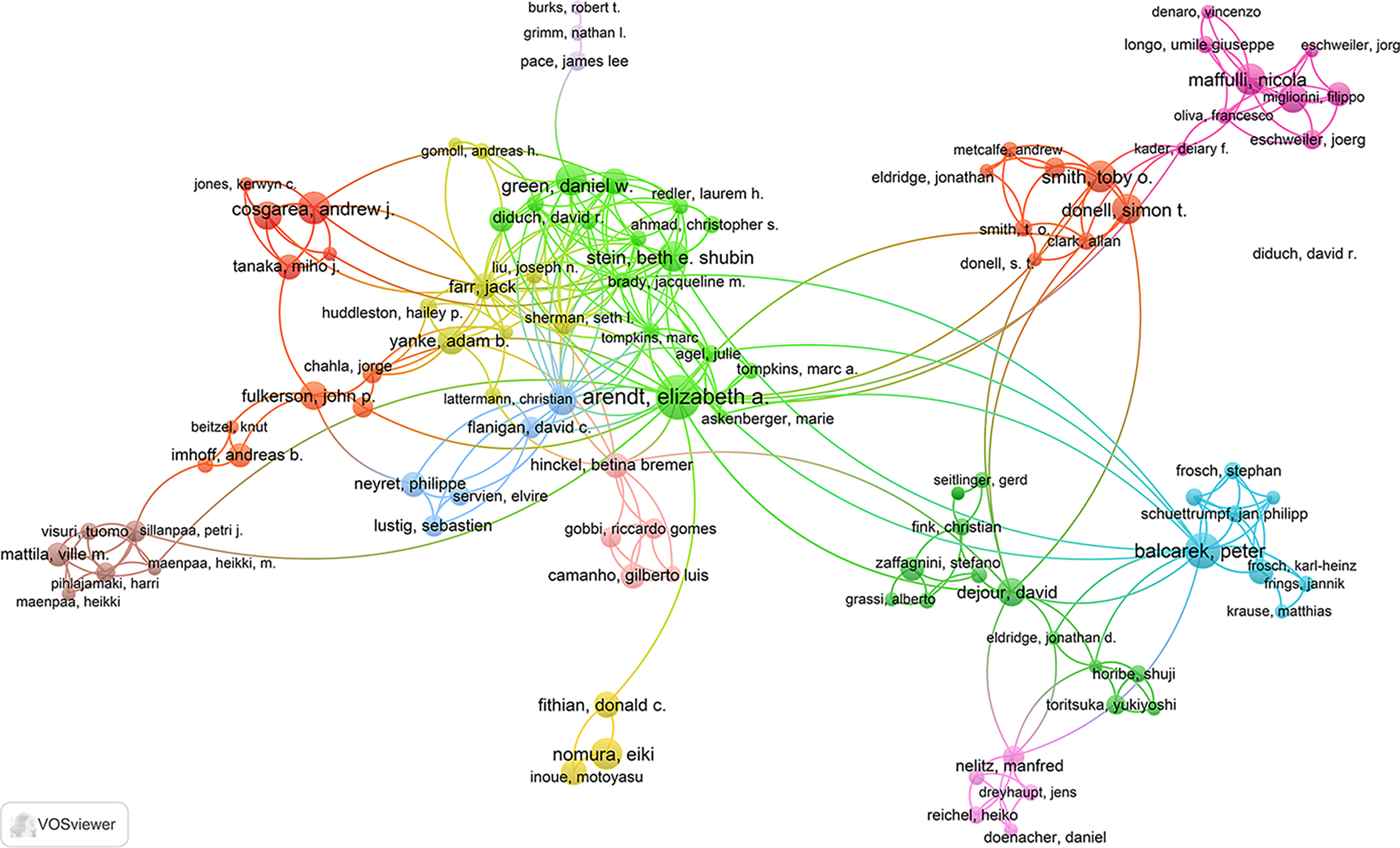
Network map of cooperation among authors publishing studies on patellar dislocation.
Journals and Co-cited Journals
All articles on patellar dislocation were published in 195 journals, with 12 having >30 publications. Details of the journal information are shown in Table 3. Knee Surgery, Sports Traumatology, Arthroscopy (2020 IF = 4.342) published the most, reaching 212 articles, whereas the American Journal of Sports Medicine (2020 IF = 6.203) had the next most at 146 articles. Of the top 10 co-cited journals (ie, journals frequently cited together), the American Journal of Sports Medicine was at the top of the list with 8769 citations, with Knee Surgery, Sports Traumatology, Arthroscopy ranked second, with 5277 citations (Table 4). Figure 5 shows the dual-map overlay of journals. The tags represent the topics covered by the journal. The left side of the map denotes citing journals and the right side denotes co-cited journals. Results indicated that most articles were published in the field of neurology, sports, and ophthalmology, which cited journals in the areas of sports, rehabilitation, and sport.
Top 10 Journals Publishing Studies on Patellar Dislocation a

a IF, impact factor; JCR, Journal Citation Reports; NA, not applicable.
Top 10 Co-cited Journals Publishing Studies on Patellar Dislocation a
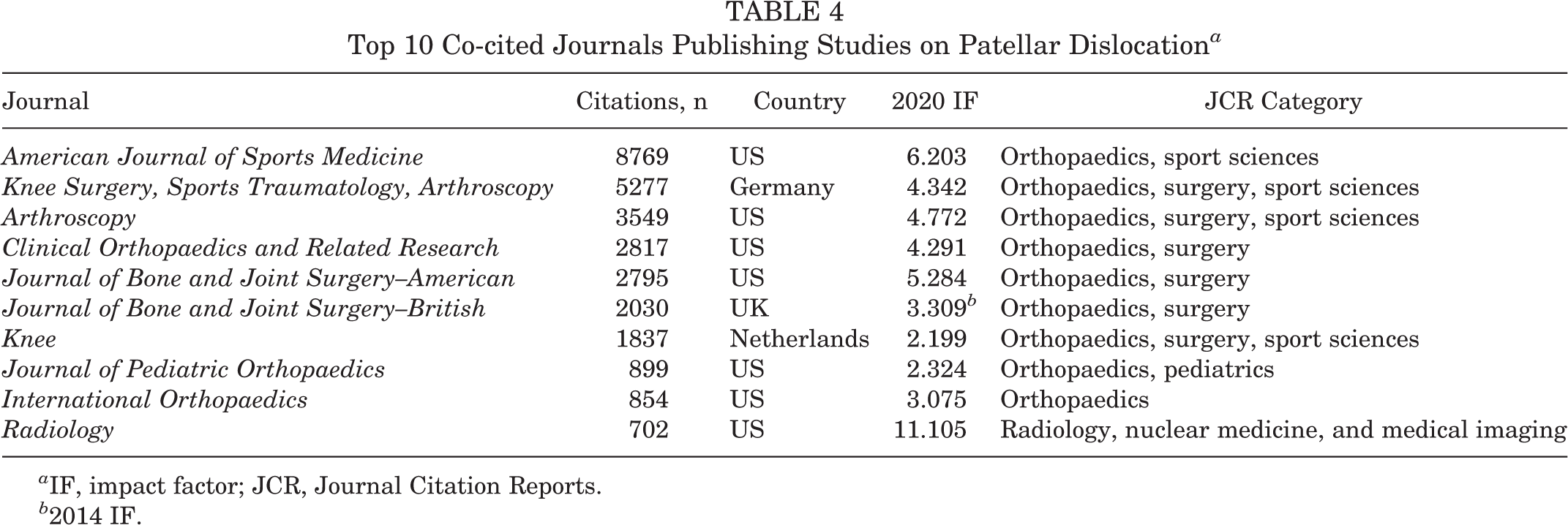
a IF, impact factor; JCR, Journal Citation Reports.
b 2014 IF.

The dual-map overlay of journals related to patellar dislocation. The main path (in pink) indicated that most articles were published in the field of neurology, sports, and ophthalmology, which cited journals in the areas of sports, rehabilitation, and sport.
Analysis of Key Terms
Overall, 2005 key terms with a frequency of 13,334 occurrences were analyzed. Table 5 presents the top 20 terms. Figure 6 shows the cluster analysis of the terms with frequencies >25, and the terms or phrases were divided into 4 clusters. Cluster 1 was the largest cluster and contained 38 terms, including patellar dislocation, patellar instability, risk factors, patella alta, trochlear dysplasia, TT-TG distance, and patellofemoral ligament. Cluster 2 contained 25 terms, mainly related to recurrent patellar instability, MPFL, repair, surgical techniques, reconstruction, autografts, semitendinosus tendon, and clinical outcomes. Cluster 3 had 16 terms, related to children, adolescents, congenital patellar dislocation, management, operative treatment, and rehabilitation. In cluster 4, the terms with a high occurrence were subluxation, lateral retinacular release, arthroscopy, stability, and extensor mechanism. Additionally, using CiteSpace to monitor the changing dynamics of research in the field, strong citation bursts lasting at ≥3 years were identified in 51 key terms (Supplemental Figure S2). The early focus was on congenital dislocation, subluxation, lateral release, nonoperative treatment, extensor mechanism, natural history, distal realignment, and disorder. Recent studies have focused on clinical outcomes, risk factors, patella alta, MPFL reconstruction, adolescent, reliability, and tibial tubercle osteotomy.
Top 20 Terms Used in Studies on Patellar Dislocation
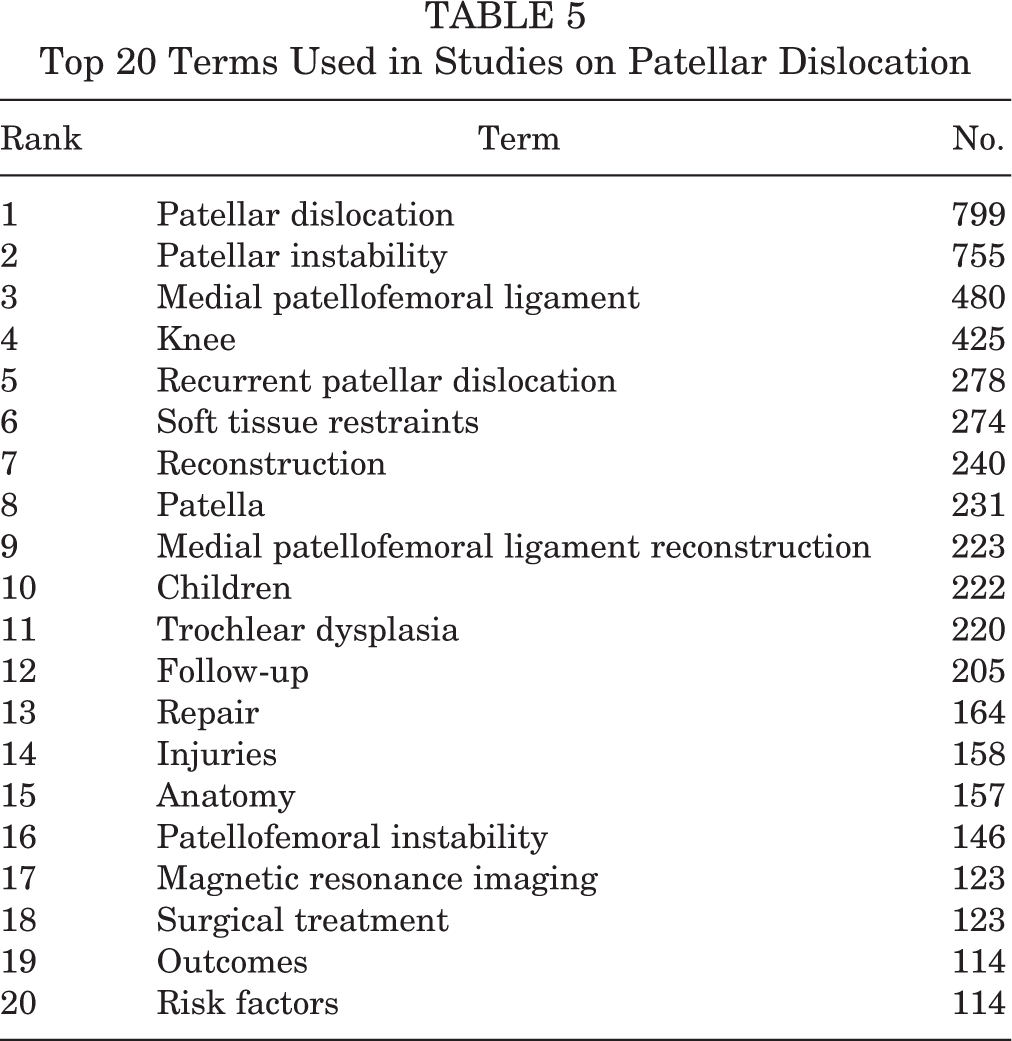
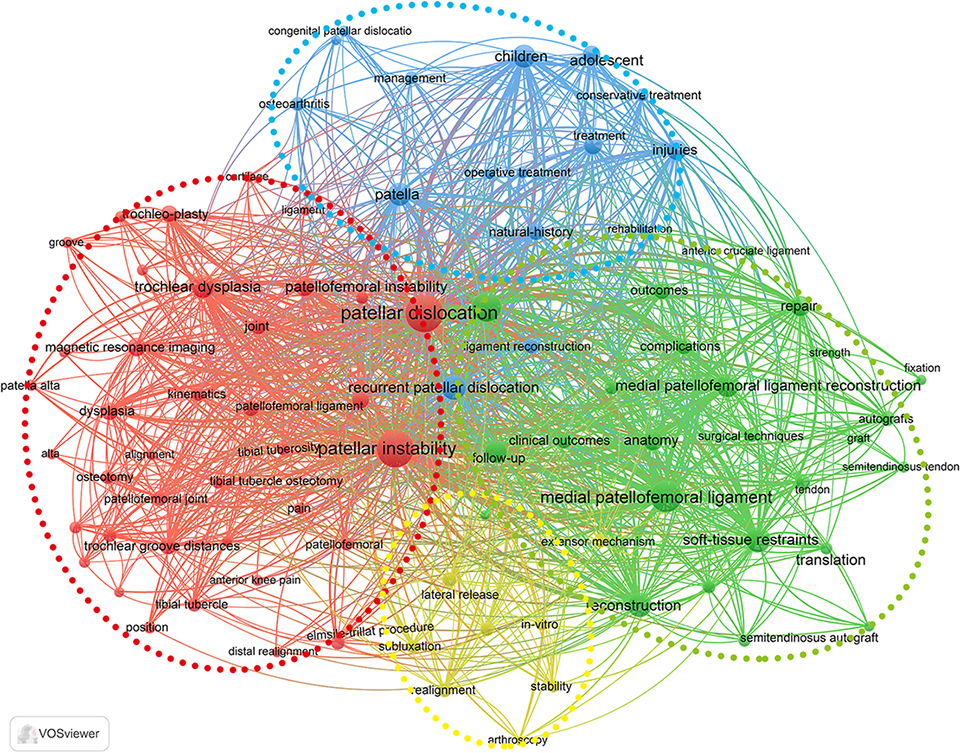
Network graph of terms used in studies on patellar dislocation. Terms were classified into 4 clusters: 1 (red), 2 (green), 3 (blue), and 4 (yellow).
Co-cited References
Table 6 summarizes the top 10 co-cited references according to the total number of citations. 1,12,15,18,21,28,29,31,55,59 The most co-cited literature on the anatomic and radiological factors of patellofemoral instability was published in Knee Surgery, Sports Traumatology, Arthroscopy. 16 To detect citation bursts, we set the same parameters as the previous analysis method and found 88 co-cited references with citation bursts of ≥5 years (Supplemental Figure S3).
Top 10 Co-cited References in Studies on Patellar Dislocation a

aCo-cited is defined as references cited together by researchers.
Discussion
The highlights of this study were a summary of the current state of research on patellar dislocation using scientometric analysis methods (VOSviewer and CiteSpace) and an overview of heated topics. In addition, we mapped intercountry, interinstitutional, and interauthor connections (Figures 2 –4) to help find potential collaborations, and we detected bursts of key terms that might help researchers find subresearch areas (see Supplemental Material for details).
Analysis of Research Groups and Geographical Distributions
Among all countries, the United States placed great importance on collaboration, working with 24 countries, such as the United Kingdom, Germany, France, Italy, China, and Australia, which was one of the reasons why most articles were published in the United States. At the same time, when it comes to publishing in this field, developed countries dominate, with very few developing countries. The potential reasons for the low article output in developing countries may be insufficient funding, political instability, and a lack of enthusiasm and inclination for research in the field. Network cluster analysis indicated adequate cooperation among institutions. In terms of the number and centrality of publications, institutions with a high level of scientific research are mainly focused on higher education research institutions, which are important bases for advancing scientific development. Of the 4486 authors identified, the majority appeared only once (79%), which most likely means that the senior author was assisted by students and orthopaedic surgeons in training wishing to work on a study. In addition, there was active collaboration among lead authors (mostly limited to the same research working group), and collaboration among teams was more frequent among developed countries. In the future, collaboration among high-productivity teams would better facilitate cross-cutting research development; meanwhile, developing countries should enhance cooperation and interaction with developed countries to learn advanced research methodologies and diverse technologies.
Analysis of Published Sources
Knee Surgery, Sports Traumatology, Arthroscopy was the most popular journal. The reasons why Knee Surgery, Sports Traumatology, Arthroscopy attracts important articles are manifold, primarily related to its status as one of the most well-known and relatively early journals in the field of orthopaedics. Over half of the top 10 journals were from the United States for a variety of reasons. First, the United States is widely perceived as the most developed country and the leader in various disciplines, so journals from the United States are more influential and more attractive to authors. Second, American authors are more likely to publish in American journals and usually prefer to cite American articles.
In addition, the IF widely shows the significance of a journal in a given field and has served as a measure of the quality and ranking of journals. Journals with higher IF tend to mean better-quality articles and wide citation rates. The abundance of articles on patellar dislocation published in journals with high IF reflects the importance and priority of such articles and indicates a considerable quality of relevant research. Among the top 10 co-cited journals, the specialized journals in the field of orthopaedics had 9, such as the American Journal of Sports Medicine, Arthroscopy, and Knee Surgery, Sports Traumatology, Arthroscopy. These journals are all highly influential and widely recognized in the field of orthopaedics. Simultaneously, 5 journals appeared in the top 10 journals and the co-cited journals, so they could be regarded as the core journals because they focus not only on the number of articles but also on the quality of articles.
Our findings are consistent with Bradford law, 68 which states that most individuals tend to acquire citations from a few major journals in their respective areas. Once researchers stray from the core journals, their citation rates and implications will diminish, which can lead to a large number of citations from a few key journals.
Analysis of Key Terms
More than 65% of key terms were presented only once, which may be related to the diversity of expression of many terms. In the scientometric analysis, 4 clusters were obtained, which revealed the main interests of a field in some way.
Cluster 1 was mainly related to the topic of risk factors for patellar dislocation. Studies have shown that previous patellar dislocation is one of the biggest risk factors for patellar dislocation, with a recurrence rate of up to 71%. 10,35 In addition, many susceptibility factors have been reported: patella alta, abnormal patella morphology, trochlear dysplasia, anatomic variation of the MPFL, increased Q angle with lateralized tibial tuberosity, genu valgum, hypoplasia of the vastus medialis obliquus, ligament hyperlaxity, elevated tibial tubercle–trochlear groove distance, tibial external rotation, subtalar joint pronation, and increased femoral anteversion. ‡ As the pathophysiology of patellar dislocation continues to be explored in depth, the reconstruction of damaged soft tissue structures and the correction of anatomic risk factors have been long-standing popular topics. A large body of literature reported surgical modalities for different risk factors, such as MPFL reconstruction for soft tissue injuries, 19 trochleoplasty, 69 and tibial tubercle osteotomy 13 to improve bony structural abnormalities. However, bony surgery has some disadvantages, such as the increased incidence of patellofemoral osteoarthritis with trochleoplasty and the fractures associated with tibial tubercle osteotomy. 5,70 Ren et al 54 also found that although trochleoplasty improves patellofemoral instability in patients with trochlear dysplasia, isolated trochleoplasty has a high rate of persistent instability and low prognostic scores. Kim et al 30 concluded that MPFL reconstruction with or without tibial tubercle osteotomy was similar in terms of clinical prognosis for patellar instability in patients with a tibial tubercle–trochlear groove distance of 15 to 25 mm. In contrast, some studies have suggested that MPFL reconstruction alone may not be sufficient for patients with concomitant anatomic risk factors and should be combined with bony operations. 42,43 Currently, a key area of research is the necessity of MPFL reconstruction with osseous surgery to treat patellar dislocation with risk factors.
Cluster 2 focused on the MPFL reconstruction. Imbalance of the soft tissue balance predisposes to recurrent patellar dislocation. 15 MPFL, as the primary passive soft tissue–restraining structure, provides about 60% of the medial restraining force, whereas the medial patellomeniscal ligament, medial retinaculum, and medial patellotibial ligament in 20° of knee flexion provide 13%, 3%, and 3%, respectively. 18 In a 20-year study, Uimonen et al 66 found a rapid development of MPFL reconstruction within the context of a basically stable rate of patellar dislocation surgery. The development of MPFL reconstruction can be traced to 1992, when Ellera Gomes 19 published the world’s first English-language report on MPFL reconstruction using an artificial polyester ligament. Subsequently, diverse MPFL reconstruction techniques have gradually emerged, such as the use of free semitendinosus, gracilis, quadriceps, adductor tendons, or a vastus medialis retinaculum autograft. 14,41,58 In addition, various fixation methods are available, including bone tunnels, 11 interference screws, 34 or anchors for graft fixation of the patella. 62 In terms of clinical outcomes, patients with patellar dislocation can successfully return to their preinjury levels of activity after MPFL reconstruction. 39,73
Cluster 3 described patellar dislocation in patients with skeletal immaturity. Patellar dislocation in children is a complex problem with a high prevalence, up to 43 per 100,000 in children <16 years old, and is particularly common in girls; hence, this type of patellar dislocation needs to be taken seriously. 46,48 Clinically, orthopaedic surgeons need to be alerted to the fact that patellar instability in adolescence can lead to chronic disability and osteoarthritis. 60 Therefore, the focus on patellar dislocation in children is promising. Treatment options are similar to those for adult patients. Acute dislocations are usually treated nonoperatively, and Vavken et al 67 concluded that nonsurgical treatment of a first acute patellar dislocation can result in healing of the MPFL and other medial structures. Surgical treatment is used in the presence of osteochondral injury and recurrent patellar dislocation, but the management of patellofemoral dislocation in children and adolescents is usually challenging because of open growth plates. 44 However, whether procedures such as lateral release, medial reefing, and the Roux-Goldthwait procedure are adequate for daily life needs to be further verified. 7,9,44 After scientometric analysis, we found a potential clinical focus that appropriate nonsurgical treatment strategies may allow postponing surgery until after growth is complete.
Cluster 4 was mainly about lateral retinacular release (LRR). Malposition of the patella and inadequate traction can lead to lateral patellar subluxation, with treatment by nonsurgical methods and LRR surgery. 24,49 In addition, arthroscopic LRR used to be one of the most frequently performed procedures in orthopaedic surgery, owing to the advantages of short operating time, small incisions, minimal trauma, and quick recovery. 27,52 Yet, the technique can lead to complications such as anterior knee pain, constant instability, and hematoma. 57,61 Nowadays, LRR is no longer recommended as an isolated operation, given the many complications mentioned here, yet it is widely used in combination with different surgical procedures. 25,71 Nevertheless, the role of LRR in patellofemoral instability is not entirely clarified. 20,22 Migliorini et al 40 concluded that lateral release had no positive role regarding the outcome of MPFL reconstruction. Malatray et al 38 reached a similar conclusion. However, Gallagher et al 25 recently found that LRR was biomechanically effective in reducing the patellofemoral contact pressures after an overtensioned MPFL reconstruction. Hence, combining LRR with MPFL reconstruction remains controversial. It is indeed a clinical problem that needs to be addressed, and we validated this hotspot through a scientometric method.
Limitations
The results of this scientometric analysis must be interpreted within the context of its limitations. First of all, since only studies in English were included, our results may not apply to studies presented in other languages. Second, since no database system would include all journals that have published on patellar dislocation, data sources remained limited, although a thorough search was performed. Third, although we standardized different expressions of the same term as fully as possible, biases may persist, such as authors with the same name and multiple affiliations of the same institution. Last but not least, since this study served as a scientometric analysis, it focused on analyzing the status of the field of patellar dislocation in terms of countries, institutions, authors, key terms, and their relationships, without assessing the level of evidence of the included literature.
Conclusion
To our knowledge, this is the first comprehensive published scientometric analysis in patellar dislocation. The study not only summarized the current state of research (countries, institutions, and authors) but also identified valuable potential research directions. More important, this study will allow young orthopaedic surgeons to lay the groundwork for more in-depth research.
Supplemental material for this article is available at https://journals.sagepub.com/doi/full/10.1177/23259671221137051#supplementary-materials
Supplemental Material
Supplemental Material, sj-pdf-1-ojs-10.1177_23259671221137051 - A Scientometric Analysis of Studies on Patellar Dislocation
Supplemental Material, sj-pdf-1-ojs-10.1177_23259671221137051 for A Scientometric Analysis of Studies on Patellar Dislocation by Hong Wang, Zhi Yi, Hongwei Zhan, Yuanjun Teng, Shifeng Zhang, Meng Wu, Bin Geng and Yayi Xia in Orthopaedic Journal of Sports Medicine
Footnotes
Notes
Final revision submitted August 26, 2022; accepted August 30, 2022.
One or more of the authors has declared the following potential conflict of interest or source of funding: Funding was received from the National Natural Science Foundation of China (81874017, 81960403, and 82060405), the Lanzhou Science and Technology Plan Program (20JR5RA320), and the Cuiying Scientific and Technological Innovation Program of Lanzhou University Second Hospital (CY2017-ZD02, CY2021-MS-A07). AOSSM checks author disclosures against the Open Payments Database (OPD). AOSSM has not conducted an independent investigation on the OPD and disclaims any liability or responsibility relating thereto.
References
Supplementary Material
Please find the following supplemental material available below.
For Open Access articles published under a Creative Commons License, all supplemental material carries the same license as the article it is associated with.
For non-Open Access articles published, all supplemental material carries a non-exclusive license, and permission requests for re-use of supplemental material or any part of supplemental material shall be sent directly to the copyright owner as specified in the copyright notice associated with the article.
