




Abstract
Objectives:
Osteochondral allograft transplantation (OCA) for cartilage defects provides excellent long-term clinical outcomes. Articular step-off between the donor and recipient has been shown to significantly alter contact pressures, potentially contributing to worse long-term survival. The trochlea in particular is at risk for graft mismatch due to the complexity and variability of trochlear anatomy. Currently, commercial allograft donor selection is primarily based on simple anatomical parameters such as trochlear length, trochlear width, and tibial width. However, there is limited guidance in literature on factors which best predict an adequate match, as defined by ≤1.0 mm articular step-off. We hypothesize that more complex anatomic parameters which better describe trochlear morphology, including sulcus angle, sagittal angle, and radius of curvature, may help optimize donor selection to reduce articular step off for trochlear osteochondral allograft transplantation.
Methods:
Ten deidentified, cadaveric trochlear specimens were utilized for this study (JRF Ortho, Denver, CO). Computed tomography (CT) images of the specimens were obtained, and three-dimensional (3D) point cloud models of the trochleae were then created and exported using a medical segmentation software program (Mimics, Materialise Inc., Leuven, Belgium). Circular defect models were created virtually in each point-cloud model of the recipient trochlea at both supero-lateral (18 mm and 22.5 mm) and central (18 mm, 22.5 mm, 30 mm) locations (
Results:
Ideal graft matches were identified in all superolateral trochlear defects, while central defects had a decreasing frequency of ideal matches with increasing defect size (18 mm: 53.4%, 22.5 mm: 35.21%, 30 mm: 14.8%) (
For 18 mm superolateral defects, medial facet width was the only factor with univariate significance. However, on multivariate analysis considering all factors, no significant predictors were identified. For 22.5 mm superolateral trochlear defects, medial facet width (β=.006, p<0.001) was a significant multivariate predictor of articular step-off. For 22.5 mm superolateral defects, trochlear length (β=.002, p=0.003) was also a significant multivariate predictor.
Conclusions:
Central trochlear defects of increasing size become more difficult to find ideal and acceptable graft matches for based on articular step-off. Tibial width did not correlate with articular step-off in the setting of a computer-simulated model of osteochondral allograft for central or superolateral trochlear defects. Minimizing mismatch in anatomic factors such as sulcus angle, sagittal angle, lateral condyle radius of curvature, and medial facet width may contribute to a more optimal graft. Limitations of this computer-simulated study include the inability to account for surgeon technique in ultimate graft matching outcome.
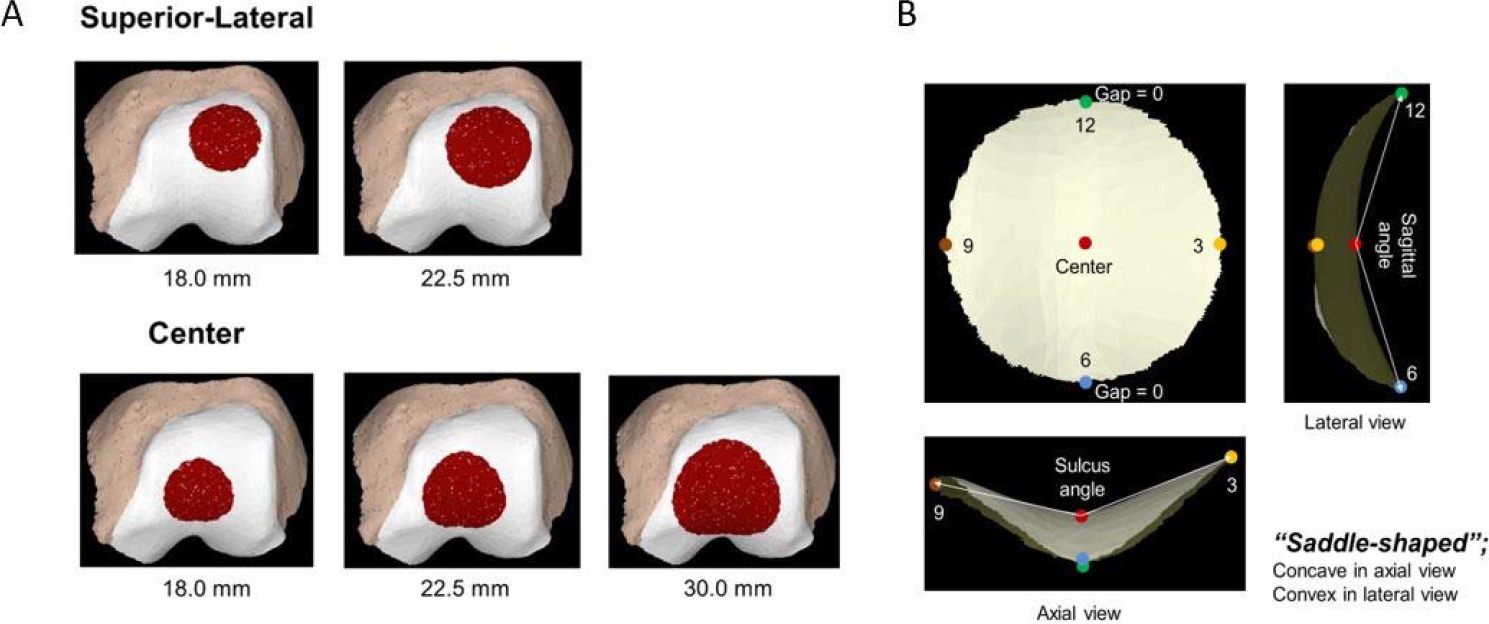
Schematic representations of (A) simulated defect location and sizes at the trochlea and (B) anatomic points of the central defect, including measurement of sagittal and sulcus angle.
Parameters of Graft Mismatch by Defect Location and Size

Univariate Correlations between Anatomic and Demographic Factors with Articular Step-Off


Comparison of anatomic measurements between ideal (0.5 mm step-off) and non-ideal (>0.5mm step-off) grafts for central trochlear defects, including (A) sulcus angle, (B) sagittal angle, (C) lateral radius-of curvalureh{D} medial facet width, and (E) trochlear length. Bracket and asterisk indicates significanl difference between ideal and non-ideal grafts (p<.05).