




Abstract
Objectives:
Although age-related chronic conditions are major drivers of morbidity and healthcare costs, most have proven difficult to prevent or treat. Fundamental aging processes may be root cause contributors to all these disorders, and among these mechanisms is cellular senescence. These cells can release pro-inflammatory cytokines/chemokines and other factors, otherwise known as the senescence-associated secretory phenotype (SASP). Specifically, senescent CD3+ T-Cells have been linked to conditions such as frailty, arthritis, and bone loss. Recently, several senolytics have been proven effective at eliminating senescent cell burden in vitro and in preliminary clinical trials. The senolytic fisetin selectively targets and eliminates senescent cells without affecting healthy cells. This clinical study further supports the body of evidence illustrating an increase in systemic senescent cell burden, SASP biomarkers, and mRNA transcripts in peripheral blood mononuclear cells (PBMCs) from blood with age as well as differences between genders. Importantly, we also found that fisetin reduces a variety of systemic senescence indices when compared to baseline. This body of work presents quantifiable measurements in a large group of participants that could be leveraged to create a composite score of healthy aging, as well as demonstrates the beneficial effects of fisetin in a small subgroup.
Methods:
Study participants were accrued between December 2019 and August 2021 (n=225, n=443 visits) at the Steadman Clinic in Vail, Colorado (IRB#2019-58). Subjects had an average age of 61.6±15.0 between 20 and 100, 48% female and 52% male (
Results:
In 225 patients across 367 clinic visits, highly senescent (or “bright”) T-Cells did not significantly change with age; however, bright highly senescent PBMCs were found to significantly increase by 0.04% per year of age (p=0.0454) (
Conclusions:
With the expanding body of research in the field of aging, the complexity of senescence and senolytics has become ever more apparent. Preliminary data suggests that no individual markers of senescent cells appear to be fully sensitive and specific and that senescence and SASP expression vary drastically between cell types. This is supportive of the lack of significant correlations with age and changes in senescent T-Cell populations in patients taking fisetin – it is possible that assaying T-Cells as an entire population is not sufficiently sensitive to track the effects of senolytics or relation to age. Thus, we believe specific T-Cell subsets (CD4, CD8) may be more reflective of the healthspan and warrant further investigation. This study illustrated the correlation between age and senescent PBMCs as well as increasing circulating SASP factors with increases in senescent PBMC burden. Furthermore, fisetin was shown to significantly reduce these hallmarks of aging with no adverse side-effects. Our findings support the potential that fisetin could alleviate multiple age-related morbidities common in elderly patients. Follow-up analysis is needed to determine how the benefits of fisetin adapt over time. Randomized, controlled trials are needed to determine optimum senolytic regimens dependent on patient’s gender, specific cells’ senescent burden, SASP expression, and health condition. Aging is associated with severe musculoskeletal decline including OA and OP for which there are few treatment options. Several recent reports suggest that targeting senescent cells may be a viable therapeutic modality. However, with the wide variety of senescent cell populations and effects via SASP, it is paramount that we understand which outputs of senescence in which cell populations are most determinative of a negative outcome, as well as being able to track senolytics effects on specific outcomes. This study begins to pool results required to answer these bigdata questions. Ultimately, we believe these (among other) factors can be leveraged into a composite score for biological age as well as an early-detection clinical diagnostic tool to more specifically diagnose/monitor age-related diseases and serve as a novel platform to track senolytic efficacy and/improve autologous orthobiologic therapies.
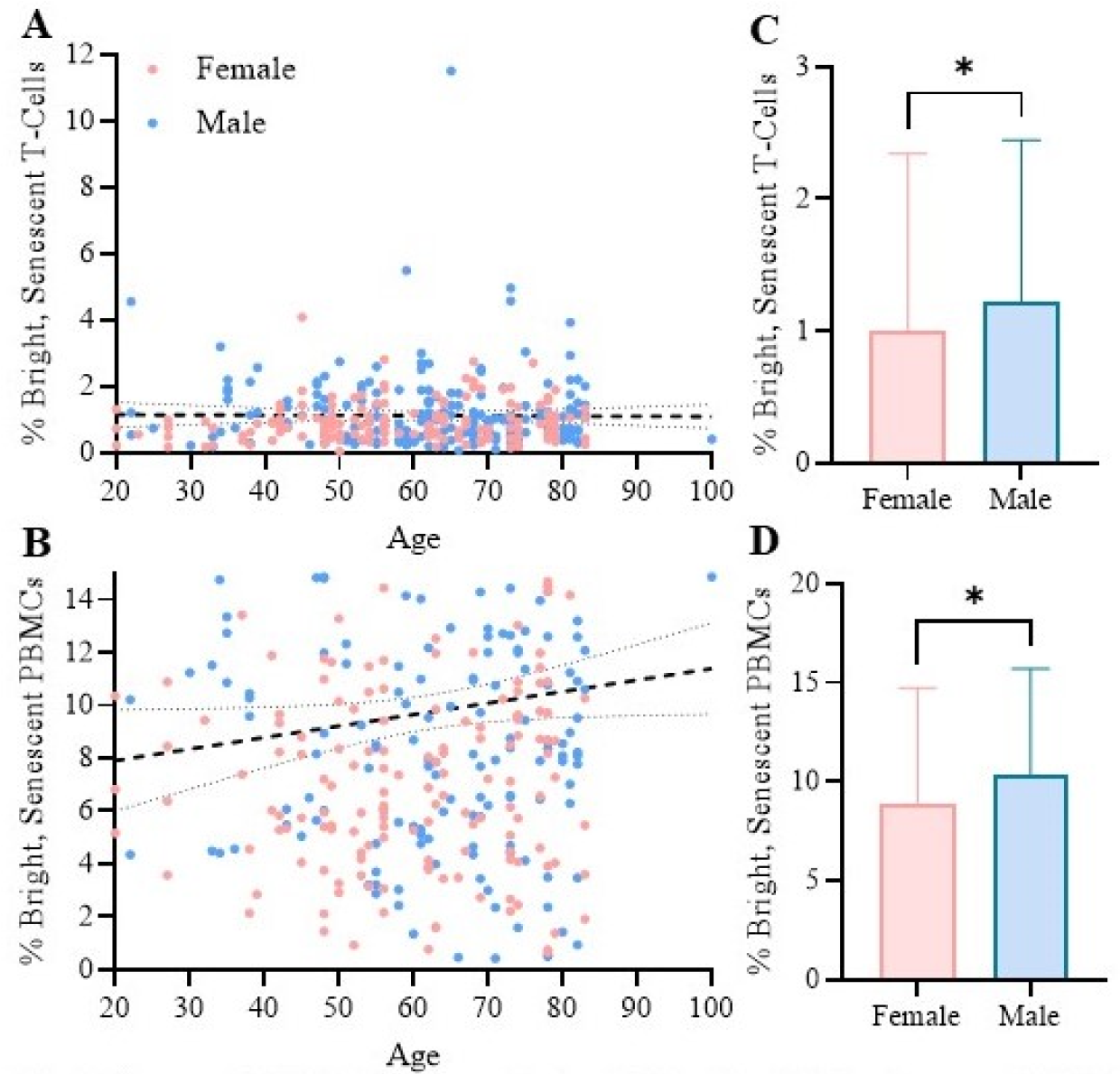


Study Demographics by Gender, Age, and Fisetin.