




Abstract
Background:
Bat swing and grip type may contribute to hook of hamate fractures in baseball players.
Purpose:
To compare the effects of swing type and batting grip on the pressure and rate of pressure development over the hook of hamate in collegiate baseball players.
Study Design:
Descriptive laboratory study. Level of evidence, 3.
Methods:
This was an experimental quasi-randomized study of bat grip and swing differences in National Collegiate Athletic Association Division I baseball players (N = 14; age, 19.6 ± 1.1 years [mean ± SD]). All participants performed swings under 6 combinations: 3 grip types (all fingers on the bat shaft [AO], one finger off the bat shaft [OF], and choked up [CU]) and 2 swing types (full swing and check swing). Peak pressure and rate of pressure generation over the area of the hamate were assessed using a pressure sensor fitted to the palm of the bare hand over the area of the hamate. Wrist angular velocities and excursions of radial ulnar deviation were obtained using 3-dimensional motion analysis.
Results:
The OF–check swing combination produced the highest peak pressure over the hamate (3.72 ± 2.64 kg/cm2) versus the AO–full swing (1.36 ± 0.73 kg/cm2), OF–full swing (1.68 ± 1.17 kg/cm2), and CU–full swing (1.18 ± 0.96 kg/cm2; P < .05 for all). There was a significant effect of condition on rate of pressure development across the 6 conditions (P = .023). Maximal wrist angular velocities were 44% lower in all check swing conditions than corresponding full swing conditions (P < .0001). The time to achieve the maximal wrist angular velocity was longest with the AO–full swing and shortest with the CU–check swing (100.1% vs 7.9% of swing cycle; P = .014).
Conclusion:
The OF–check swing condition produced the highest total pressure reading on the hook of hamate. Check swing conditions also had the steepest rate of pressure development as compared with the full swing conditions.
Clinical Relevance:
Batters who frequently check their swings and use an OF or AO grip may benefit from bat modifications or grip adjustment to reduce stresses over the hamate. Athletic trainers and team physicians should be aware of these factors to counsel players in the context of previous or ongoing hand injury.
In the general population, the incidence of hook of hamate fractures is 2% to 4% of all carpal fractures. 5 Hook of hamate fractures have been reported in athletes who participate in golf, racquet sports, and baseball, which is related to the use of a club, racquet, or bat during play. 4,6 Baseball players can sustain acute fractures and chronic stress injuries that may be related to the position of the bat handle against the area of the hamate during swings. Repetitive swinging is a proposed mechanism of this injury. Almost all hamate injuries occur in the leading, nondominant (lower) hand during the terminal phase of batting motion. 1 Rettig 10 proposed a mechanism of injury based on the physical position of the bat to the hook of hamate. Moreover, the unique anatomy of the hook of hamate may contribute to injury.
The body of the hamate is located dorsally and on the ulnar aspect of the carpus. The hook projects radially and volarly into the base of the hypothenar eminence. The hook of hamate is the site of attachment for the transverse carpal ligament, pisohamate ligament, flexor digiti minimi, and opponens digiti minimi. It also forms the ulnar border of the Guyon canal, with the ulnar nerve passing around the ulnar and distal sides of the hook. Patients with injury to the hook of hamate may present with deep, poorly defined ulnar-sided wrist pain, which may be worse with a tight grip. 2 High, focused mechanical stresses placed on the area over the hamate may cause bony injury, especially if the force is applied quickly, as can occur with a bat swing.
Different swings and styles of bat grip enable the player to change bat speed and how the energy is transferred from the bat to the ball at contact in varied game situations; alternate grips may allow for the player to respond more quickly to pitches, and various swing motions can affect the distance that the ball travels. Type of swing and style of batting grip may place different pressure patterns over the palmar surface and underlying hamate. The pressure differences and rate of pressure development during the swing of a bat when varied grip techniques are used could subject the hamate to varying risk for fracture. Depending on the placement of the hand on the bat with certain grips, the knob of the bat may be differentially compressed over the hook of hamate. At present, the effect of various swings and batting grips on the amount and rate of pressure transfer to the hook of hamate is not known. Therefore, the primary purpose of this study was to investigate the effects of swing type and batting grip on pressure values and rate of pressure development over the hook of hamate in collegiate baseball players. Our hypotheses were as follows: (1) bat swing-grip conditions would affect pressure readings on the hook of hamate and (2) the rate of pressure development over the hamate would be different among the bat grip conditions. Establishment of the association of swing and bat grip to hamate pressures and rate of pressure development would inform players, coaches, and care teams of the potential risks and mechanisms underlying this injury.
Methods
Study Design
This was an experimental quasi-randomized pilot study of bat grip-swing differences in collegiate baseball players. This study was reviewed and approved by our institutional review board, and all procedures on the participants were performed in accordance with the Helsinki Declaration of 1975, as revised in 1983.
Participants
Players composed a convenience sample recruited from the National Collegiate Athletic Association Division I collegiate baseball team at the University of Florida (N = 14). All participants met the following inclusion criteria: male collegiate baseball player aged 18 to 30 years with no injuries or medical conditions within the preceding 6 months that prevented participation in baseball. Participants were excluded if they had a previous hook of hamate injury, had a current injury or medical condition preventing them from competing in baseball, or were unable to understand the study procedure during the informed consent process. All participants provided informed consent before participation.
Participants completed a brief assessment of injury history and characteristics, which included age, height, and weight. Height and weight were measured using a standard medical-grade scale. Participants reported the years of experience that they played baseball, seasons of participation, and positions of play. Participants indicated any previous injuries sustained during baseball play over the last 5 years. Participants’ preferred grip was not recorded.
Testing Procedures
All testing was conducted indoors at the University of Florida’s Sports Performance Center. Each player performed a single testing session during which a series of baseball swings was conducted under different experimental bat grip conditions. For all bat swings, grip pressure over the area of the hamate and overall motion analysis of the body during bat swing were captured. The pressures over the ulnar aspect of the palm (henceforth, “area of the hamate”) were measured in 6 experimental conditions of 2 swing types and 3 batting grips.
Experimental Bat Grip Conditions
There were 3 experimental bat grip conditions in this study. In the “all on” condition (AO), all of the participant’s fingers were directly above the knob of the bat during the grip. In the “one off” condition (OF), the small finger of the participant’s bottom hand was over the knob of the bat. Finally, in the “choked up” condition (CU), the bat was held with the participant’s bottom hand 3.75 cm above the knob (Figure 1). There were 2 experimental swing types: full swing and check swing. The check swing differs from the full swing in that the batter started to swing but stopped midway through. Thus, 6 grip-swing combinations were performed. To reduce the effect of testing order on the study outcomes, each participant was provided an opaque envelope by the study coordinator, which revealed the assignment for the bat grip and swing order. The testing order was randomly generated by a computer algorithm.
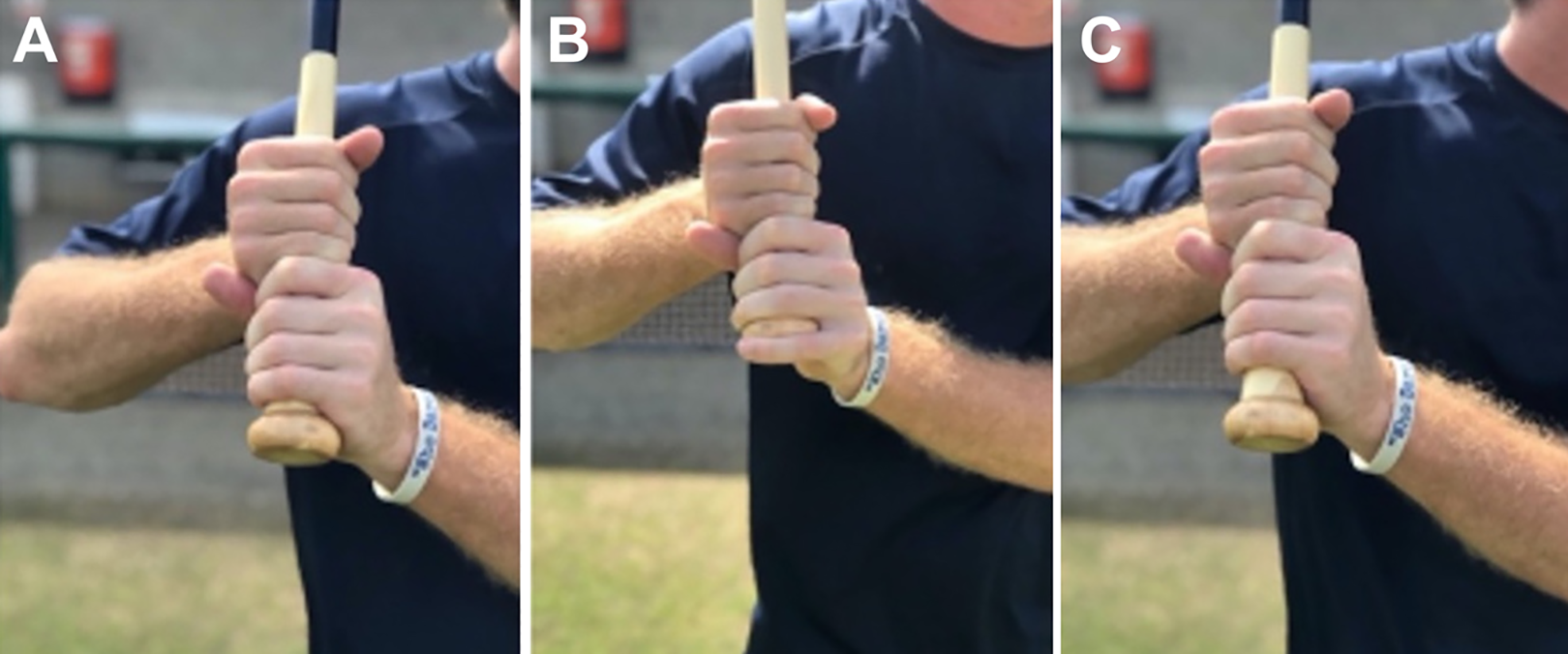
Experimental bat grip conditions. (A) All fingers on the bat shaft (all on). (B) One finger off the bat shaft (one off). (C) Choked up.
Estimation of Pressure Over the Area of the Hamate
Before data capture, participants warmed up on a treadmill for 5 minutes. To capture the pressures generated, a small commercial sensor was fitted over the ulnar aspect of the palm in the approximate location of the hamate bone. This was done using palpation and a line projected between the pisiform and the second metacarpal head. The FingerTPS Advanced Hand and Finger Pressure Sensor System (Pressure Profile Systems Inc) tracked real-time tactile pressure changes on the fingers or palm of the hand and transmitted the data to Chameleon Visualization Software (Pressure Profile Systems Inc) via a secure Bluetooth SSL connection (Figure 2). We acknowledge that gloves are often worn during batting, but given technical issues with glove use over the sensor (moisture on the skin and signal artifact on the output), the participants did not wear gloves for testing.
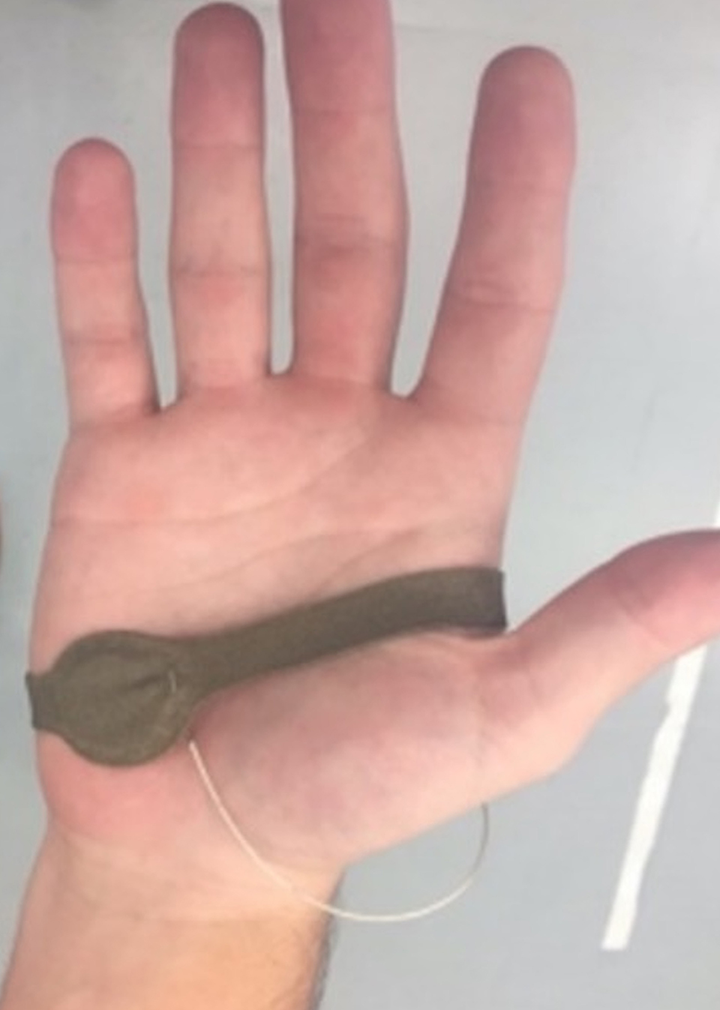
Experimental application of the FingerTPS Advanced Hand and Finger Pressure Sensor System to the hand.
The sensor was wafer thin (0.35 mm) and round with a scan rate of 40 Hz and an accuracy of force resolution <0.2% of the full scale. The response time of the sensor was <1 millisecond. The linearity error was <2.0% and hysteresis <4.0% per the manufacturer. The area of the sensor was 3.14 cm2, and the force applied over the sensor area was expressed as kg/cm 2 . The sensor did not interfere with normal bat gripping. The FingerTPS system was tested for accuracy of measurement using a series of known weights, and the correlation coefficient between actual and detected values was 0.998. 2
Rate of Pressure Development Over the Hamate
The time to achieve peak force was determined using waveform analysis from output produced by the FingerTPS system. Each time-dependent pressure waveform from every trial was hand digitized to determine the time stamps for the start of the bat swing with lowest pressure reading and the time at which peak force was captured. The time between these time stamps was recorded in seconds. The rate of pressure values was determined by dividing the peak pressure attained by the time to achieve it (kg/cm2/s).
Motion Analyses of Bat Swing
Standard motion capture protocols were used, as reported and validated in the baseball biomechanics literature. 8 Participants were provided standardized instructions on simulating game-effort swings during testing for all conditions. Motion was evaluated using a high-speed camera optical motion analysis system (Motion Analysis Corp). Before any testing, the motion capture system was calibrated per the manufacturer’s recommendations with a dynamic wand calibration to within 0.5-mm of error. Twelve cameras were mounted on tripods on the floor (1-2 m high) and around the ceiling (at 6.5 m) in ring formations around the participant to prevent data loss during the bat swing motion. The x-axis was oriented toward the direction of a catcher, the y-axis toward the right, and the z-axis vertically upward. Retroreflective markers were applied bilaterally to anatomic landmarks and body segments, including the acromioclavicular joints, lateral epicondyles, distal radioulnar joints, anterior superior iliac spines, greater trochanters, midthighs, lateral epicondyles of the knee, tibial tuberosities, lateral malleoli, heels, and hallux. Single markers were placed on the distal third metacarpal of the nondominant (lower) hand only and sacrum. Additional markers were placed on both ends of the bat.
Figure 3 provides a close-up view of the upper body computer model and corresponding photograph of the bat swing position. Data were captured at 200 Hz, and marker data were processed with a low-pass filter with a coefficient of 19. Kinematics were derived from the marker data using standard rigid body mechanics equations implemented within commercially available software (MATLAB R2011b; MathWorks).

(A) Motion capture model used to test the bat swing motion; close-up of upper body. (B) Video frame of matched swing and time point in the swing.
A thrower tossed a baseball to the participant from the side in a “soft toss” technique. Participants practiced several swings until the thrower and hitter felt comfortable with ball placement and timing. Participants then performed the experimental swings. Kinematic variables at the wrist were determined to be of greatest interest for this study relating to hand pressures. The bat swing time frame was described by several events, from initial foot contact by the lead foot during the swing (0%) to contact with the ball (100%) and during follow-through (>100%). The bat swing time frame was normalized into time percentage of the swing by 2 events: lead footstep on the ground (0%) and bat contact with the ball (100%). Thus, the time percentage of the swing during follow-through is defined as >100%. Wrist maximal angular velocity (wrist ulnar deviation) was defined as the maximal angular velocity of the radius along the ulnar deviation direction during the bat swing (deg/s). The time to achieve the maximal wrist angular velocity was determined as the time percentage at which peak velocity was attained in the swing. The neutral position of the wrist was calculated by the position in which the markers on the forearm, wrist, and hand were detected as collinear by the MATLAB software program. The overall wrist excursion was calculated as the total arc of radial-ulnar transverse motion (in degrees) relative to neutral position during the swing. The resolution of the system for wrist position based on marker data was 0.3 mm, and the resolution of wrist deviation motion was 1.26°.
Statistical Analyses
Statistics were conducted in SPSS Version 26.0 (IBM). Descriptive statistics were calculated on all study variables and characteristics (means and standard deviations for continuous variables, frequencies and percentages for categorical variables). Normality of the data was tested using Kolmogorov-Smirnov statistics. Hamate pressures and wrist angular velocity were skewed, and the data were log10-transformed to establish a normal distribution. One-way analyses of variance were used to test for differences in outcomes among the study conditions. Dependent variables included peak hamate pressures, time to achieve peak pressure, rate of pressure development, and wrist biomechanical parameters. The independent variable was bat swing experimental condition. Tukey post hoc tests were used to determine where differences existed. The α level was established at 0.05 for all statistical tests. Cohen d effect sizes of the bat swing condition were generated with the AO–full swing as the reference, where values were classified as small (0.20), medium (0.50), and large (≥0.80). 7
Results
Participant Characteristics
Characteristics of the players are summarized in Table 1. There were 12 right-handed batters and 2 left-handed batters. Two right-handed batters were switch hitters who batted from the dominant side. A total of 28.6% of participants reported a prior baseball-related injury. Nearly all participants play baseball year-round. The study sample represented the variety of field positions and a standard batting order.
Participant Characteristics

a Injuries (1 each): concussion, surgery to right shoulder (labrum), surgery for elbow fracture, low back (L5) stress reaction.
Peak Pressure Values Over the Area of the Hamate
Figure 4 provides the peak pressure values over the hamate for all 6 swing conditions. For the raw and log10-transformed data, differences were found among the 6 experimental conditions (P = .001). Post hoc testing revealed significant differences between OF–check swing and AO–full swing, OF–full swing, and CU–full swing. Effect sizes were considered large for the AO–check swing and OF–check swing (d = 1.14 and 1.36, respectively) versus the AO–full swing reference. Small effects were found for OF–full swing, CU–full swing, and CU–check swing (d = 0.24-0.44).

Mean pressure over the area of the hamate during the 6 experimental conditions of the bat swing. Data from 2 players were not included owing to moisture complications with the sensor. Error bars indicate standard deviation, and data in parentheses indicate 95% CI. *Significant difference vs AO–full swing, OF–full swing, and CU–full swing (P < .05 for all).
Rate of Pressure Development Over the Area of the Hamate
Table 2 provides the time for the swing (0%-100% events of the swing), the time to attain peak pressure over the hamate, and the rate of pressure development. There were no significant differences in the times to complete the bat swing conditions (P = .162). There was a significant difference in rate of pressure development across the 6 conditions (P = .023) but not time to attain that peak pressure (P = .145). Tukey post hoc tests did not identify differences among conditions for the rate of pressure development, however. The effect sizes were small to medium for time to attain peak pressure (d = 0.0-0.58) and rate of pressure development (d = 0.26-0.59).
Swing Time, Time to Peak Pressure, and Rate of Pressure Development During the Experimental Bat Swing Conditions a

a Values are mean ± SD (95% CI). Bold P value indicates statistically significant difference among all 3 conditions (P < .05).
Wrist Kinematics
Significant differences existed among the 6 bat grip conditions in the 3 key wrist motion variables (Table 3). Maximal wrist angular velocities were lower in all check swing conditions as compared with full swing conditions (P < .0001). The time to achieve the maximal wrist angular velocity was longest in the AO–full swing condition and shortest in the CU–check swing condition. Finally, the wrist excursion in the transverse plane during the bat swing varied depending on grip and swing type, with the check swings generally producing less excursion than full swings. The effect sizes for all conditions relative to the reference AO–full swing condition ranged from small to large (d = 0.15-2.14).
Key Wrist Kinematics and Timing During the Experimental Bat Swing Conditions a

a Values are mean ± SD (95% CI). Bold P values indicates statistically significant difference among all 3 conditions (P < .05).
b Significantly different vs all on–full swing.
c Significantly different vs one off–full swing.
d Relative to ball contact time of 100%.
e Significantly different vs choked up–full swing.
f Significantly different vs choked up–check swing.
Discussion
The aim of the study was to investigate the effects of swing type and batting grip on pressure values and rate of pressure development over the area of the hamate in baseball players. Our novel findings indicate that various bat swing-grip conditions generated different pressures and rates of pressure development over the hamate. The OF–check swing generated the highest pressure over the hamate during the bat swing, with other conditions producing 23% to 71% of that pressure. The rates of pressure development were highest with the AO– and OF–check swing conditions. Variations occurred in wrist kinematics among the 6 conditions, revealing that the check swings were characterized by lower maximal wrist velocities than full swings. Our results support our initial hypotheses in that swing and grip affect pressure over the area of the hook of hamate. Potential explanations for these findings are explained in turn.
Intuitively, the type of swing should contribute to variations in pressures over the hamate by nature of the time required to generate and complete the swing motion. Our data indicate that there were small variations in bat swing times (nonstatistically different), where the check swings were 5 to 11 milliseconds longer than the full swings. During the check swings, braking forces to decelerate the bat are likely initiated earlier than during a full swing, when deceleration occurs around ball contact and after. The AO– and OF–check swing conditions produced the 2 highest rates of pressure development versus the remaining grip-swing combinations. An interpretation of these data is that sudden and earlier deceleration of the bat before ball contact may cause rapid and longer periods of compression of the bat knob against the hook of hamate of a dorsiflexed wrist. Previous literature 3,11 proposed the association of forceful check swings to hook of hamate fractures in baseball athletes. This study is the first to our knowledge to produce evidence in support of this theory.
Batting grip may modify pressures over the area of the hamate. The OF–check swing produced the highest pressure readings among the swing conditions. This finding may be caused by alterations in the contact area between the bat and the palmar surface. In the AO and CU conditions, the padded cylindrical handle, with a relatively larger contact area than the bat knob, makes contact with the hamate. When the small finger is lifted off the bat, the hands are positioned lower, and the knob (which has a small surface area) is contacting the area over the hook of hamate. Therefore, pressure is focused on a small area over the area of the hamate with this type of grip. It is not known what specific pattern of pressure exposures or rate of pressure is clinically related to hamate failure and fracture in this sport motion, but stress fracture could arise from repeated microtrauma, a blunt trauma from an aggressive swing, or a combination of exposures. Here, we can only surmise that the combination of grip and swing type coupled with exposure time of focused pressure during a bat swing could be a mechanism underlying hook of hamate fracture.
The viscoelastic behavior of bone is complex. Previous research 9 has demonstrated that the viscoelastic response of bone is nonlinear and depends greatly on the time history of strain applied in compressive loads. This nonlinear pattern has caused difficulty in predicting the response of bone to various degrees of strain. It becomes more unclear when force applied varies in direction, perosseous soft tissues are considered, and patient factors are considered. In hamate fractures, the force applied can be proportionally large owing to the relatively small hypothenar surface area overlying the hamate. The distinctive osteology of the hook of hamate likely also plays a role in the unique response to various pressures in terms of possible injury.
Limitations
This study produced novel evidence of pressures on the hamate area of the hand during various bat swing conditions. A few limitations to this study deserve comment. First, we tested bat swings using a standard, unmodified bat. Baseball players commonly modify their personal bats, usually with extra taping, which could affect the amount of pressure transferred over the hamate during a swing. Additionally, there are brand name bats designed to eliminate knob impingement on the hamate. Modifications we noted here included flattening of the batting surface, which contacts the nondominant leading hand palm, and tapered elevated knob on the opposite side, which allows for the same wrist control afforded with a standard knob-handled bat. These bat designs have not been scientifically evaluated to our knowledge. Future researchers interested in replicating and improving our study design could add conditions assessing bats with these player and company modifications. Second, we encountered complications in a couple of participants whose palm moisture interfered with the data capture from the FingerTPS Advanced Hand and Finger Pressure Sensor System, which contributed to data loss. Future protocol adjustments with respect to time between swings may reduce accumulation of moisture on the sensors during testing. Finally, we recognize that elevated pressures alone over the hamate area are not necessarily the primary reason for fracture, as hamate fractures are likely the result of the interplay of multiple variables (eg, repeated trauma and fatigue, wrist and hand motions, and batting response to actual high-speed pitches). Moreover, players may have a preferred bat swing and grip among the combinations tested here. Therefore, at this time, the pressures over the hamate in this study were experimentally produced, and additional study of preferred versus nonpreferred bat grip and swing could clarify whether these results can be replicated regardless of preference. Further study of other contributory factors would improve understanding of the mechanics most likely to produce hamate fracture.
Conclusion
Novel, clinically relevant findings from this study indicate that bat grip and swing combinations produce different pressure over the hook of hamate among collegiate baseball players. Check swings produce the highest peak pressures across all conditions. Check swings in the OF condition were associated with significantly higher peak pressures and rates of pressure development over the hamate. Batters who frequently use check swings with an OF or AO grip may benefit from bat modifications, glove padding, grip adjustment, or more judicious use of the technique. Athletic trainers and team physicians should be aware of these factors to counsel players in the setting of previous or ongoing injury.
Footnotes
Final revision submitted August 2, 2021; accepted August 24, 2021.
One or more of the authors has declared the following potential conflict of interest or source of funding: J.L.Z. has received grant support from Encore Medical. K.W.F. has received education payments from Arthrex and CGG Medical, consulting fees from Flexion Therapeutics, and nonconsulting fees from Arthrex and Arthrosurface. AOSSM checks author disclosures against the Open Payments Database (OPD). AOSSM has not conducted an independent investigation on the OPD and disclaims any liability or responsibility relating thereto.
Ethical approval for this study was obtained from the University of Florida (IRB201702457).