




Abstract
Background:
Previously studied risk factors for sports-related concussion in soccer players include sex, age, and player position. However, prior studies were limited in number, they reported conflicting results, and most did not assess initial concussion severity.
Purpose/Hypothesis:
The purpose of this study was to conduct an in-depth analysis of soccer players across key demographic groups (sex, age, position) for both concussion incidence and severity. It was hypothesized that concussion incidence and severity would be higher among male players, players aged ≥17 years, and goalkeepers.
Study Design:
Cohort study; Level of evidence, 3.
Methods:
The authors analyzed baseline and postinjury ImPACT (Immediate Post-Concussion Assessment and Cognitive Testing) scores for athletes aged 12 to 22 years between July 2009 and June 2019. Players were assigned to an age group based on when they had their most recent baseline test. Concussion incidence and concussion severity index were compared using t tests and multivariate logistic regression.
Results:
For 1189 individuals who reported soccer as their primary sport, 1032 contributed 1754 baseline ImPACT tests (some individuals had multiple baseline tests), whereas 445 individuals were suspected of sustaining a concussion and then referred for a postinjury 1 test. Of these players, 254 (24.6%) had both a baseline and a postinjury test and were analyzed for concussion severity. Linear regression showed that forwards had a lower incidence of ImPACT-proxied concussions than goalkeepers had (P = .008). Female players had a significantly higher incidence of ImPACT concussions compared with male players (mean, 0.07 [female] vs 0.04 [male] concussions per person-year; P = .05). Players in the ≥17-year age group had a higher incidence of ImPACT concussions than players in the 15- to 16-year age group (P = .04), although the 15- to 16-year age group had more severe concussions than the ≥17-year age group (mean severity index, 2.91 [age 15-16 years] vs 1.73 [age ≥17 years]; P = .001).
Conclusion:
Female soccer players experienced a higher incidence of concussion than did male players, and goalkeepers experienced a greater incidence of ImPACT concussions than did forwards. Players of both sexes and all positions in the 15- to 16-year age group showed increased initial concussion severity compared with the ≥17-year age group, despite a lower comparative incidence of ImPACT concussions. Further study is needed to understand whether sex and player position affect concussion severity.
With 7.94 million high school athletes (3.40 million female participants) registered in the 2018-2019 season across 19,500 schools, the necessity for safety evaluations and head injury research for youth in sports remains a priority of parents and coaches in the United States. 18,27 The majority of the current research on head injuries in sports has been focused on American football, and although football continues to be the leading sport for high school male participation, soccer was observed as the sport with the largest gain in new participants from the previous year. 18 In addition to having an increasing number of participants, soccer is one of the leading sports in terms of concussion incidence, 8 which warrants specific research into how different groups, particularly sex, age, and position, are affected.
Consensus is lacking regarding head injury prevalence by sex in soccer 2 : Some analyses 6 –9,12,15,22,25,28 have reported that female players had a higher concussion incidence rate than male players had, whereas other studies 11,28 have reported no significant differences between sexes. Research 8,9,12,15,22,25 looking at sex-based differences across other sports primarily has found that female players had a greater concussion incidence rate than male players had. Soccer studies that evaluated age and head injury have reported that high school athletes took longer to recover after a concussion compared with collegiate athletes 9,19,24 yet collegiate athletes had a greater occurrence of concussions compared with high school athletes. 12,17,25 The research evaluating soccer head injuries by position is more limited in terms of quantity of studies, and a variety of results have been reported regarding the highest concussion incidence: One study reported that defenders had the greatest risk, 2 another reported forwards, 26 and 2 other studies reported goalkeepers. 9,10
The purpose of this study was to conduct an in-depth analysis of soccer players across these 3 key demographic groups (sex, age, position) for both concussion incidence and severity. Our objectives were to improve the understanding of injury risk and potentially contribute to future prevention against head injury in soccer. The authors hypothesized that concussion incidence and severity would be higher among male players, players aged ≥17 years, and goalkeepers.
Methods
This study received approval from our institutional review board. The study was deemed exempt from informed consent because the data were deidentified and previously collected for clinical use.
Data Collection
A total of 25,815 baseline and postinjury ImPACT 14 (Immediate Post-Concussion Assessment and Cognitive Testing) tests (ImPACT Applications Inc) were conducted between July 1, 2009, and June 30, 2019, and 2434 of these tests reported soccer as the primary sport. The baseline and postinjury ImPACT tests among the soccer players were collected between February 2010 and May 2019, a period of 9 years and 3 months. Data were primarily collected for medical care, and the concussion centers had agreements with ImPACT Applications Inc that allowed the data to be repurposed for research.
Although this was a retrospective study, the criteria for athletes who received ImPACT testing were determined prospectively. Eligible participants aged 12 to 22 years were part of athletic organizations following standardized care, which included preseason baseline testing, same-day head injury assessment by physicians and athletic trainers at sites of injury, and postinjury ImPACT testing for athletes with symptoms consistent with suspected concussions. Follow-up postinjury ImPACT tests were conducted at different intervals depending on symptom severity and student availability. Physicians were employed by high schools and had backgrounds in family medicine and/or physical medicine and rehabilitation. Athletic trainers performed initial postinjury assessments if physicians were not available.
Concussion was defined as blunt trauma to the head followed by either the sudden alteration of mental status or the appearance of multiple pathological symptoms, including headaches, nausea, vomiting, dizziness, and vision problems. All athletes with symptoms consistent with a suspected concussion underwent ImPACT testing. An athlete’s performance on the ImPACT test was used to calculate a severity index, a measurement of the intensity of an athlete’s concussion symptoms.
Patient Information and Medical History
Patient information and medical history were self-reported during ImPACT testing. Patient data included age, sex, and sport played. For incidence calculations, players were assigned to an age group based on their age when they had their most recent baseline test. In most cases, this was less than a year before injury. Sensitivity analysis was performed by removing the observations for players more than a year from baseline; because this did not significantly alter results, the original analysis is reported. Sports were categorized into contact/collision, limited contact, and noncontact sports based on the amount of physical contact and number of collisions between players. 18 Medical history data included diagnosed attention-deficit/hyperactivity disorder (ADHD), diagnosed learning disability, autism, dyslexia, depression, anxiety, chronic headaches, chronic migraines, previous concussion history, and altitude.
ImPACT Testing
As previously described, ImPACT-proxied concussions are defined as significant deviations from baseline tests in at least 2 of the 5 subscores (Verbal Memory, Visual Memory, Processing Speed, Reaction Time, and Symptom Score). Significant deviation is defined as a raw subscore differential greater than the 80% confidence intervals (CIs) of controls, as established by ImPACT guidelines. 14
Concussion Incidence
A head injury is considered to be a suspected concussion when an athlete receives a postinjury ImPACT test. A suspected concussion is an ImPACT concussion when the postinjury ImPACT test has significant deviations from baseline. Incidences of both suspected concussions and concussions as proxied via the ImPACT test were calculated with person-years at risk. ImPACT tests are considered stable and relevant for 2 years, allowing comparison with postinjury tests; therefore, participants exceeding that period of time between baseline tests were considered lost to follow-up. 3,4,21 Per the US Centers for Disease Control and Prevention, participants lost to follow-up were assigned 1 person-year. 5
Severity Index
A severity index was calculated to assess concussion severity, as previously described. 13 For severity calculations, players were assigned the age of the first postinjury test. Changes in composite scores (▵Score) from baseline to postinjury 1 test were calculated (Equation 1). If ▵Score did not exceed the statistically significant difference (S diff), it was assumed that there was no change from baseline (Equation 2). To estimate the severity of each head injury, we summed the number of S diff values above baseline for each composite score to create a severity index (Equation 3).


Statistical Analysis
We used t tests to compare means between continuous variables and rates with 2 categories. Person-years at risk was the time a participant had a valid baseline test but not a postinjury test indicating concussion. Weighted by person-years at risk for concussion incidence but unweighted for severity analysis, simple linear regression was used to compare continuous dependent variables with categorical subsets. Multivariate logistic regression was used to calculate the odds ratios (ORs) of suspected concussions, ImPACT-proxied concussions, and severity among both suspected concussions and ImPACT concussions while controlling for demographic variables. For logistic regression, severity was dichotomized into severity ≤8 and >8. All statistical analyses were performed using SAS (Version 9.4 for Windows; SAS Institute Inc); for all analyses, α = .05.
Results
Patients
For ImPACT tests reporting soccer as the primary sport, 1032 individuals contributed 1754 baseline ImPACT tests (some individuals had multiple baseline tests), whereas 445 individuals were suspected of sustaining a concussion and then referred for a postinjury 1 test. A total of 254 (57.1%) individuals with a postinjury ImPACT test had a corresponding previous baseline test and were included in the analysis. Although baseline ImPACT tests were available, some participants did not have a baseline assessment before injury and thus were excluded from analysis.
Of the 1032 individuals with a baseline ImPACT test, 463 (44.86%) were men and 569 (55.14%) were women. There were 316 (30.62%) players aged 12 to 14 years, 479 (46.41%) aged 15 to 16 years, and 237 (22.97%) aged ≥17 years. Player position was available for 795 (77.03%) individuals: 88 (8.53%) were goalkeepers, 270 (26.16%) were defenders, 265 (25.68%) were midfielders, and 172 (16.67%) were forwards. In addition, 44 (4.26%) were diagnosed with ADHD, 29 (2.81%) had a diagnosed learning disability, 2 (0.19%) had autism, 28 (2.71%) had dyslexia, 128 (12.4%) were receiving headache treatment, 95 (9.21%) were receiving migraine treatment, and 284 (27.52%) had at least 1 previous concussion.
Concussion Incidence
All 1032 players with a baseline test were analyzed for concussion incidence. When weighted by the number of person-years in the dataset, the incidence rate was 0.2095 suspected concussions per person-year. The total number of ImPACT concussions was 86. After total concussions were weighted by the number of person-years in the dataset, the resulting incidence rate was 0.0472 ImPACT concussions per person-year.
Concussion Severity
When ImPACT concussion severity was analyzed, only the 254 players with both a baseline and postinjury test were analyzed for sex and age comparisons. All 86 players who sustained an ImPACT-proxied concussion were analyzed for concussion severity. Of the 254 players sustaining a documented suspected concussion with a concomitant baseline, 215 (84.65%) had a corresponding player position and were analyzed when comparing severity across player positions. Of the 86 players with an ImPACT concussion, 75 (87.21%) had a corresponding position and were analyzed for association between severity and position.
Sex
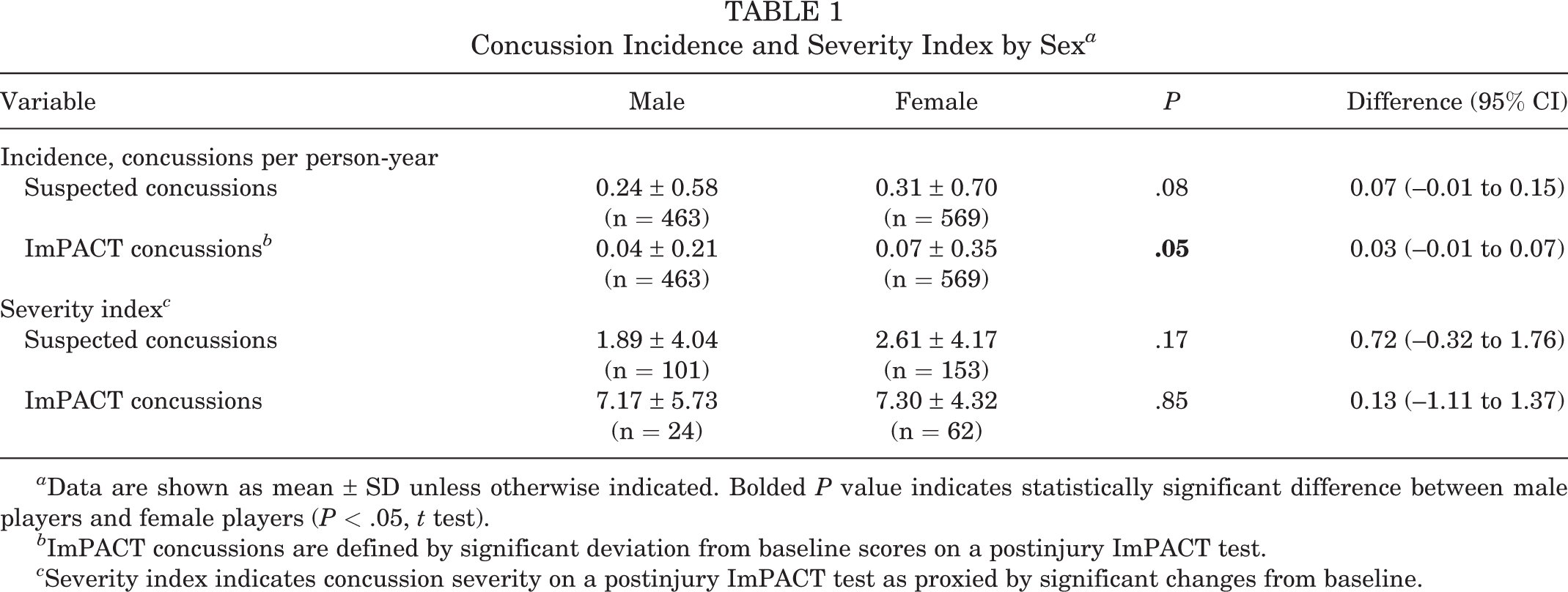
When the number of ImPACT concussions each player had was weighted by the number of person-years that the player contributed to the study, a statistically significant difference was seen between sexes in incidence of ImPACT concussions, with female players having a greater incidence than male players (mean incidence, 0.07 ± 0.35 [females] vs 0.04 ± 0.21 [males] concussions per person-year; P = .05). No significant differences were seen between sexes in the incidence of suspected concussions or the severity index (Table 1).
Concussion Incidence and Severity Index by Sex a
a Data are shown as mean ± SD unless otherwise indicated. Bolded P value indicates statistically significant difference between male players and female players (P < .05, t test).
b ImPACT concussions are defined by significant deviation from baseline scores on a postinjury ImPACT test.
c Severity index indicates concussion severity on a postinjury ImPACT test as proxied by significant changes from baseline.
Age
Overall, the results showed mixed correlations between age and the number of ImPACT concussions, suspected concussions, and severity index (Table 2). After weighting the number of ImPACT concussions by the number of person-years of each group, we noted a statistically significant difference in incidence of ImPACT concussions between the age groups ≥17 years and 15 to 16 years (coefficient = 0.034; P = .040). The numbers of suspected concussions were also compared across the different age groups, and the differences were not statistically significant. However, the older age groups had a greater mean incidence of suspected concussions. We noted a statistically significant difference in mean severity index between the age groups 15 to 16 years and ≥17 years (coefficient = –1.293; P = .001) (Table 2).
Incidence of Concussion and Severity Index by Age Group a

a Data are shown as mean ± SD unless otherwise indicated. Bolded P values indicate statistically significant difference between age groups as indicated (P < .05). Beta coefficients significantly different than zero indicate associations between age group and the dependent variable of interest. The age category of 15-16 years was chosen as the reference.
b Calculated using weighted simple linear regression for concussion incidence and simple linear regression for severity index.
c Age 12-14 vs 15-16 years.
d Age ≥17 vs 15-16 years.
Position
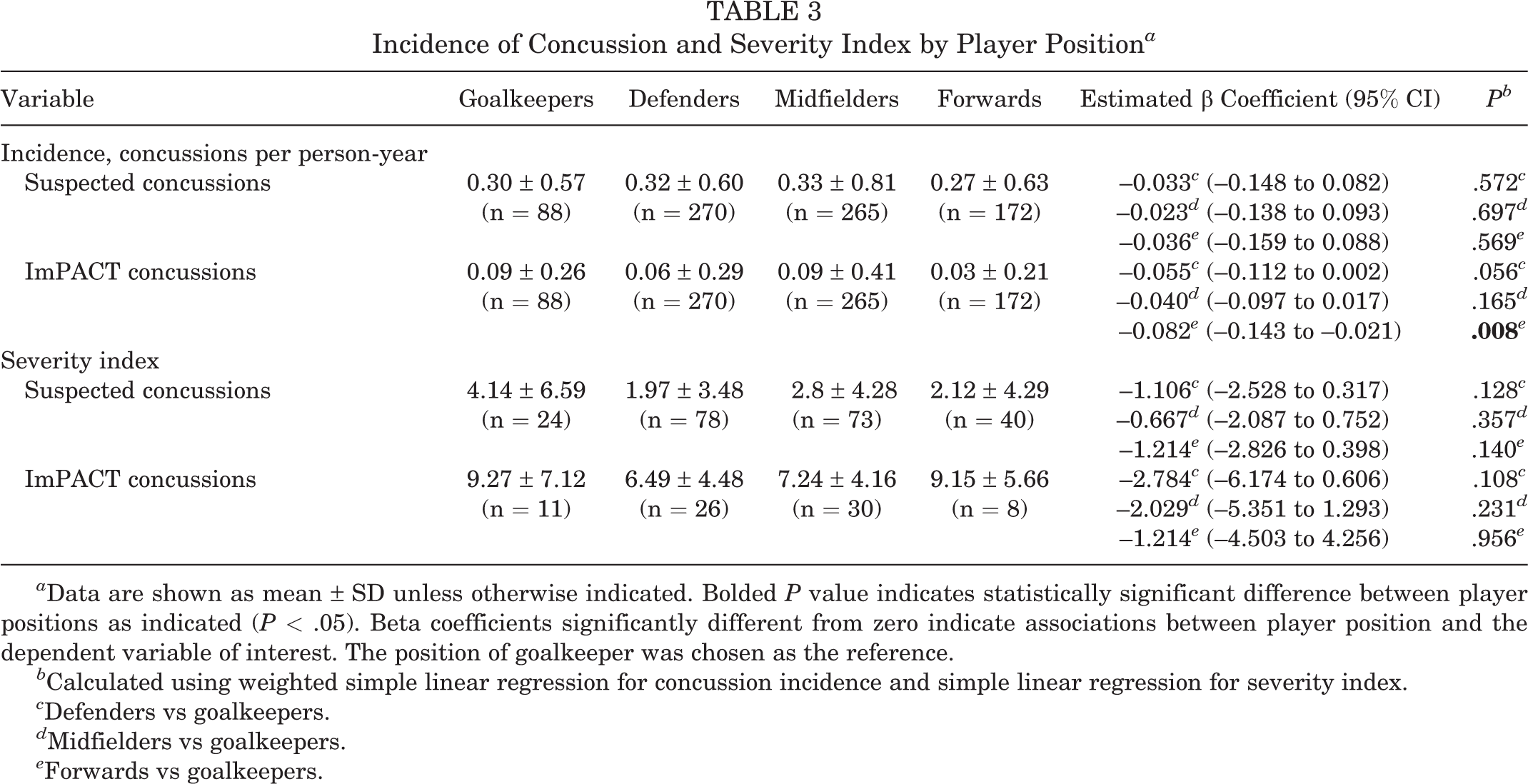
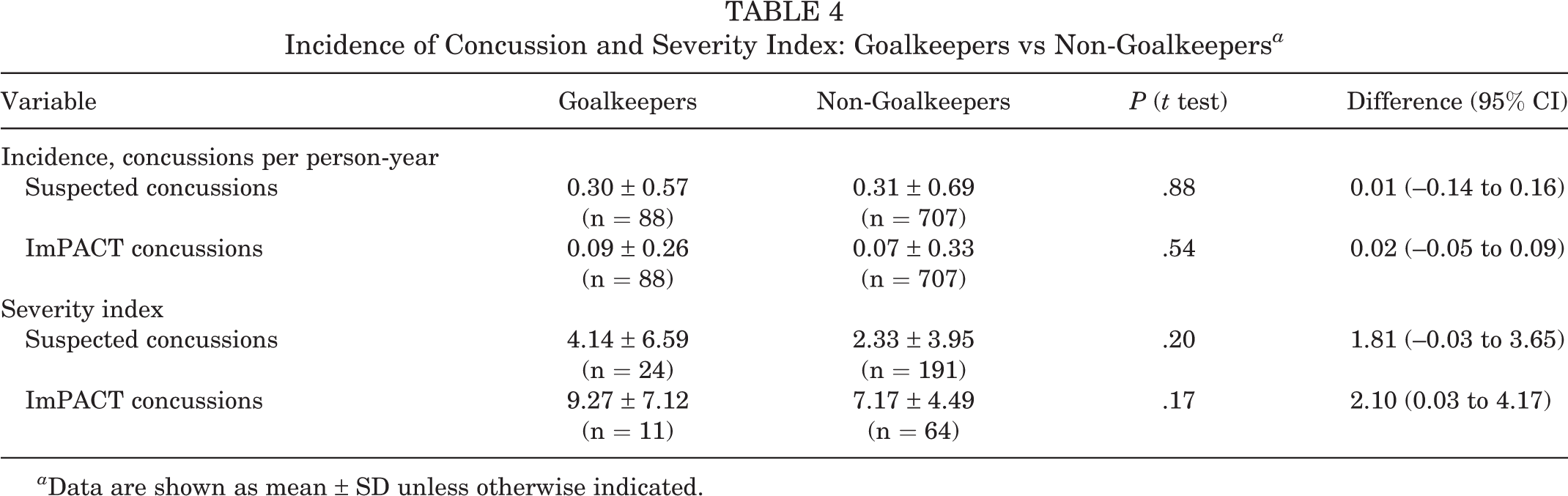
Linear regression analysis showed almost no statistically significant differences in the incidence of ImPACT concussions and suspected concussions across the 4 positions, with the exception that forwards had a lower incidence of ImPACT concussions compared with goalkeepers (mean, 0.03 ± 0.21 vs 0.09 ± 0.26 concussions per person-year, respectively; P = .008). The data showed that forwards had the lowest incidence of ImPACT concussions (mean, 0.03 concussions per person-year) as well as suspected concussions (mean, 0.27 concussions per person-year) (Table 3). When goalkeepers and non-goalkeepers were compared, no significant differences were seen in ImPACT or suspected concussions between the 2 groups (Table 4).
Incidence of Concussion and Severity Index by Player Position a
a Data are shown as mean ± SD unless otherwise indicated. Bolded P value indicates statistically significant difference between player positions as indicated (P < .05). Beta coefficients significantly different from zero indicate associations between player position and the dependent variable of interest. The position of goalkeeper was chosen as the reference.
b Calculated using weighted simple linear regression for concussion incidence and simple linear regression for severity index.
c Defenders vs goalkeepers.
d Midfielders vs goalkeepers.
e Forwards vs goalkeepers.
Incidence of Concussion and Severity Index: Goalkeepers vs Non-Goalkeepers a
a Data are shown as mean ± SD unless otherwise indicated.
When analyzing concussion severity using severity index, we found no statistically significant differences across the 4 positions (Table 3). Goalkeepers had the highest mean severity index (4.14), whereas defenders had the lowest (1.97). As well, we found no statistically significant differences between goalkeepers and non-goalkeepers in terms of mean severity index (Table 4).
Multivariate Logistic Regression Analysis
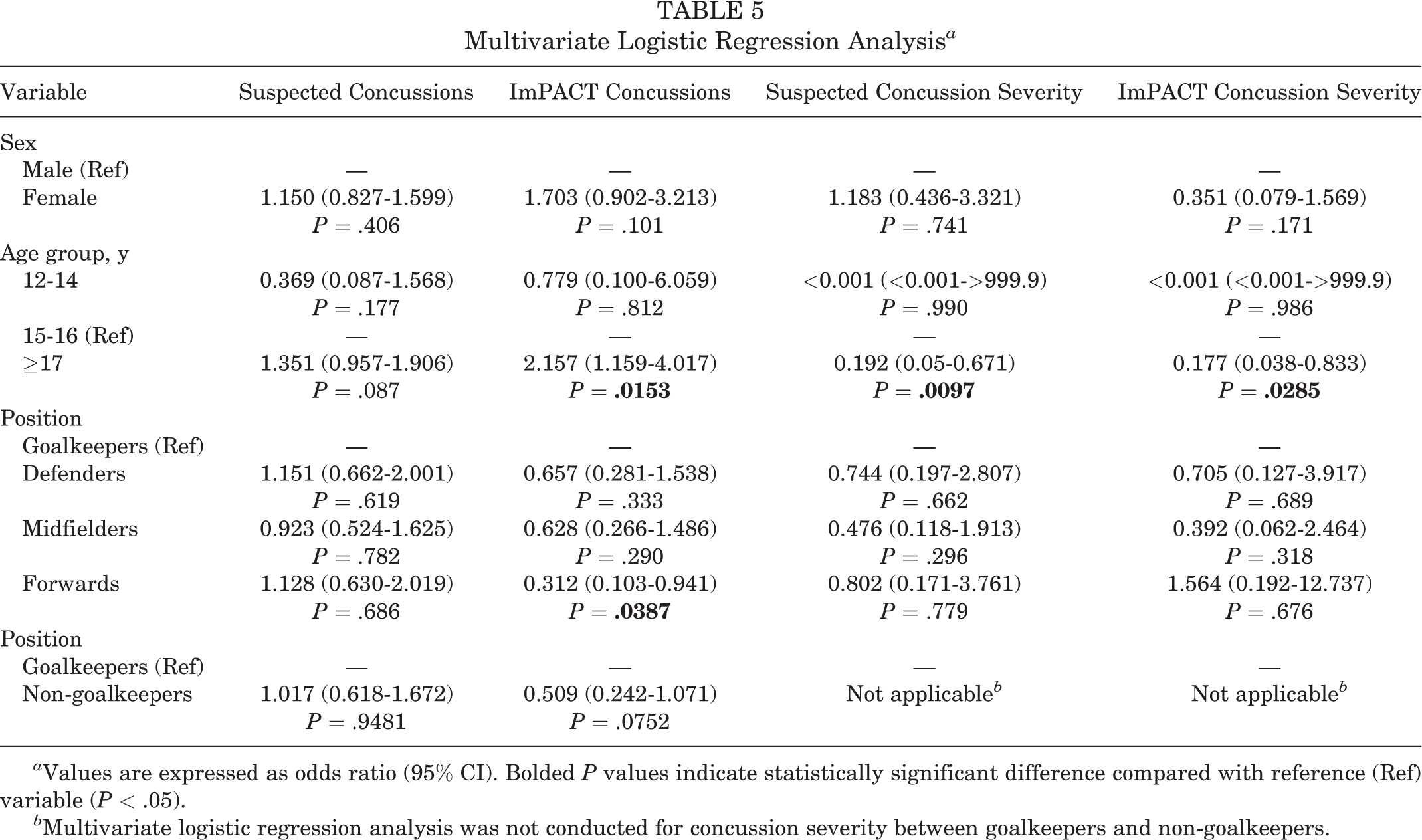
The results of the multivariate logistic regression analysis are presented in Table 5. With male sex as the reference, multivariate analysis did not reveal any significant sex-based difference in suspected concussions (P = .406), ImPACT concussions (P = .101), suspected concussion severity (P = .741), or ImPACT concussion severity (P = .171).
We found no significant differences among player age groups in terms of incidence of suspected concussions and severity index when controlling for sex, position, learning disability diagnosis, ADHD diagnosis, chronic headaches, chronic migraines, dyslexia diagnosis, autism diagnosis, previous concussion history, and altitude. Using age 15 to 16 years as the reference, we noted a significant difference compared with players aged ≥17 years in terms of ImPACT concussions (OR, 2.157 [95% CI, 1.159-4.017]; P = .0153) suspected concussion severity (OR, 0.192 [95% CI, 0.05-0.671]; P = .0097), and ImPACT concussion severity (OR, 0.177 [95% CI, 0.038-0.833]; P = .0285). The lack of ImPACT concussions among the players aged 12 to 14 years limited the ability to draw conclusions about concussion severity for that age group versus players aged 15 to 16 years, but it did not affect the comparison of players aged 15 to 16 years versus ≥17 years.
We found no significant differences among player positions in terms of incidence of suspected concussions and severity index when controlling for sex, age, learning disability diagnosis, ADHD diagnosis, chronic headaches, chronic migraines, dyslexia diagnosis, autism diagnosis, previous concussion history, and altitude. Using goalkeepers as the reference, we noted a significant difference compared with forwards in terms of ImPACT concussions (OR, 0.312 [95% CI, 0.103-0.941]; P = .039). No significant differences were found between goalkeepers and non-goalkeepers with regard to suspected or ImPACT concussions.
Multivariate Logistic Regression Analysis a
a Values are expressed as odds ratio (95% CI). Bolded P values indicate statistically significant difference compared with reference (Ref) variable (P < .05).
b Multivariate logistic regression analysis was not conducted for concussion severity between goalkeepers and non-goalkeepers.
Discussion
The major findings of our study were that female players (vs male players) and players aged ≥17 years (vs those aged 15-16 years) experienced a higher incidence of ImPACT concussions (mean, 0.07 ± 0.35 vs 0.04 ± 0.21 concussions per person-year for male players [P = .05] and 0.07 ± 0.35 vs 0.04 ± 0.27 concussions per person-year for players aged 15-16 years [P = .040]). Multivariate analysis confirmed only the age-related increase (OR, 2.157 [95% CI, 1.159-4.017]; P = .0153). Additionally, goalkeepers had a greater incidence of ImPACT concussions compared with forwards, which was confirmed via multivariate analysis (OR, 0.312 [95% CI, 0.103-0.941], P = .0387). Players in the 15- to 16-year age group showed increased suspected concussion severity compared with the ≥17-year age group (coefficient = –1.293; P = .001), although this was not confirmed via multivariate analysis. However, we found that sex and player position did not significantly affect initial concussion severity, and further study is required to understand whether there is an association.
Although soccer is a leading cause of sports-related concussion, few studies on concussion in soccer have been performed. 2,6,7,10,16,17,22,26,30 The studies that have been done primarily have been focused on sex and age differences. Few studies 2,10,26 have looked at differences among positions, and those that did looked primarily at concussion incidence and not concussion severity. In our analysis of sex-based differences, our univariate results aligned with those of previous research performed on concussion incidence among soccer players based on sex. 6,17,28 However, our multivariate results did not confirm these results. Literature 8,9,12,25 on concussion and sports in general has concluded that women experience a higher incidence of concussion. One possible reason that female players experience a higher incidence of concussion is because they are more inclined to report a head impact and their subsequent symptoms. 15 This may lead to a higher incidence of suspected concussions and, in turn, ImPACT concussions. A variety of hypotheses are available indicating why female soccer players experience a higher incidence of concussion. First, male players have been reported to have stronger and bigger neck and torso muscles, which may enable them to better endure collisions, resulting in a lower incidence of concussion. 10,23 Migraines serve as another potential predictor for higher incidence of concussion, and studies have shown that female players experience a higher incidence of this condition. 8 Our severity finding coincides with other literature that has found no significant sex-based differences on postinjury ImPACT Test performance. 11,30
The effect of age on concussion risk is also highly relevant, as soccer governing bodies across the country continue to explore how rules and playstyle modifications can best be implemented at different ages to reduce the risk of concussion. 28 One benefit of our study is that we looked at specific age groups, whereas other work on concussions in soccer has compared high school versus collegiate athletes. 6,8,11,12,17 Our dataset included players aged 12 to 22 years, enabling us to examine athletes of different levels, including middle school, high school, and college. We found that older soccer players experienced a greater concussion incidence, which has been noted in previous literature. 9,12,17,25 A study 29 on players aged 10 to 19 years found that players in the 15- to 19-year age group sustained a greater incidence of concussion than did the other age groups. In addition, research 9,19,24 has indicated that high school athletes perform worse after concussion and have longer recovery times compared with collegiate athletes. Similarly, using the severity index, we found an increase in concussion severity for the 15- to 16-year age group as compared with the other age groups.
One explanation that supports why older soccer players experience a higher incidence of concussion is that older athletes play soccer at a more competitive level, leading to more frequent head impacts. 12 Also, older players are more likely to have sustained a concussion in their earlier years of playing, which puts them at a greater risk of a subsequent concussion. 22 Our finding that players in the 15- to 16-year age group experienced more severe concussions than did those in the ≥17-year age group could be partially explained by smaller and weaker neck and torso muscles in younger players. 10,23 This increases the chance of a more harmful collision, resulting in a more severe concussion. Despite this, the difference in competition level between the 15- to 16- and 12- to 14-year age groups likely outweighs the biological differences between the 2. Specifically, players in the 15- to 16-year age group play high school soccer, which is much more physical compared with younger levels. As a result, the potential for a more severe concussion is much greater.
Our analysis based on position showed no association between initial concussion severity and player position. However, our finding that goalkeepers experienced a higher incidence of concussion than did forwards is consistent with some of the previous literature. 9,10 Although goalkeepers do not engage in heading the ball, a heavily studied concussion mechanism in soccer, this does not mean they have a lower incidence of concussion. 1 In fact, research has shown that head-to-ball impact is not a leading cause of concussions in soccer. However, goalkeepers, as the last line of defense, are the most inclined to be involved in high-acceleration, unintentional collisions (with players as well as with the ground or the goalpost). 16 Considering these results, we can conclude that goalkeepers are at an increased risk of sustaining a concussion while playing soccer compared with forwards. Despite this, the athlete’s position does not have to be considered when trying to limit the severity of concussions. Boden et al 2 found that defenders were at the greatest risk of sustaining a concussion, and Weber et al 26 found forwards to be at the greatest risk. It is important to note, however, that some of these studies had smaller sample sizes and/or only looked at collegiate athletes. Boden et al had 29 participants with concussions, Delaney et al 10 studied 201 participants with 62.7% concussed during the season, Lamond et al 16 reported on 23 participants with concussions, and Weber et al had a total of 381 participants with 34 concussed participants. The contrast between our results and those of some of the other literature on the topic suggests that the incidence of concussion among soccer players based on position may warrant further research.
Our study had limitations. There was no way to definitively determine whether the reported concussions were from playing soccer. Although all athletes listed soccer as their primary sport and were likely injured while playing soccer, some athletes may have participated in multiple sports and possibly may have been injured in another sport. Another limitation was that the data collection did not include body mass index and test environment, which can be potential moderators of neurocognition. After looking at the dates of concussion of the players in the study, we found that the majority of concussions were sustained during the high school soccer season. Some players in the study may have played on a club soccer team year-round, which would be a plausible explanation for why participants in the study sustained concussions outside of their high school seasons.
Despite the large sample size associated with the overall study, the prevalence of severe ImPACT concussion among the 12- to 14-year age group was low. This was likely due to a lower level of dangerous physical contact in the age group, but it does limit our ability to draw conclusions about differences in that age group. Additionally, ImPACT may only be available at schools with increased resources, which may have biased the study population. Sole use of ImPACT without other tests may have decreased sensitivity for detection of clinical concussion. 20 ImPACT protocol dictates that initial postinjury testing should be done within 48 hours of injury, but many athletes did not report the date of initial injury. Last, unaccounted variation in level of participation, athlete skill level, and other environmental factors may have affected results.
Conclusion
Female soccer players experienced a higher incidence of concussion than did male players, and goalkeepers experienced a greater incidence of ImPACT concussions than did forwards. Players of both sexes and all positions in the 15- to 16-year age group showed increased initial concussion severity compared with those in the ≥17-year age group, despite a lower comparative incidence of ImPACT concussions. Further study is needed to understand whether sex and player position affect concussion severity. It is important to analyze the root causes of concussions that occur among soccer players because that knowledge, in addition to the differences in severity and incidence among different demographic groups explored in this study, will help parents, physicians, coaches, and athletic trainers identify who is at risk and how athletes receive concussions—critical information in concussion prevention.
Footnotes
Final revision submitted June 29, 2021; accepted August 4, 2021.
The authors have declared that there are no conflicts of interest in the authorship and publication of this contribution. AOSSM checks author disclosures against the Open Payments Database (OPD). AOSSM has not conducted an independent investigation on the OPD and disclaims any liability or responsibility relating thereto.
Ethical approval for this study was obtained from Mount Sinai School of Medicine (IF2563222, 87 IF2315880).